Macro EconomicsUnit 111 min read
Macroeconomics: Scope, Objectives & Key Concepts
Unit 1 of Macro Economics introduces the big picture of national economies—what macroeconomics studies, its core goals (growth, stability, employment), and how it differs from microeconomics, with real-world examples from Nepal’s economy and global giants like Google and Ncell.
TAKEAWAYS:
- Macroeconomics studies aggregate economic variables (GDP, inflation, unemployment) while microeconomics focuses on individual agents (households, firms).
- Its three key objectives are economic growth, price stability, and full employment—Nepal’s 15th Five-Year Plan explicitly targets these.
- The circular flow of income shows how households, firms, government, and foreign sectors interact (visualized below).
- Policy tools (fiscal/monetary) are used to correct macroeconomic imbalances, like Nepal’s recent currency devaluation to boost exports.
- Real-world applications: Google’s ad revenue model relies on aggregate demand (advertising spending), while Ncell’s tariff hikes reflect inflationary pressures.
- Exam focus: Define scope, compare micro/macro, and link theory to Nepal’s plans (e.g., "middle-income country by 2050" requires growth + stability).
1. What is Macroeconomics?
Macroeconomics is the study of economy-wide phenomena, including:
- National income and output (GDP, GNP).
- Price levels and inflation (e.g., Nepal’s 7.5% inflation in 2023).
- Unemployment and employment trends (Nepal’s 12.4% unemployment rate in 2023).
- Economic growth and development (Nepal’s GDP growth: 4.6% in FY 2022/23).
- Government policies (fiscal/monetary tools to stabilize the economy).
Key Difference: Micro vs. Macro
| Aspect | Microeconomics | Macroeconomics |
|---|---|---|
| Focus | Individual agents (firms, households) | Aggregate economy (national/global) |
| Example | Daraz’s pricing strategy | Nepal’s GDP growth rate |
| Tools | Supply/demand analysis | Fiscal/monetary policy, AD/AS model |
| Policy Goal | Efficiency in markets | Stability, growth, full employment |
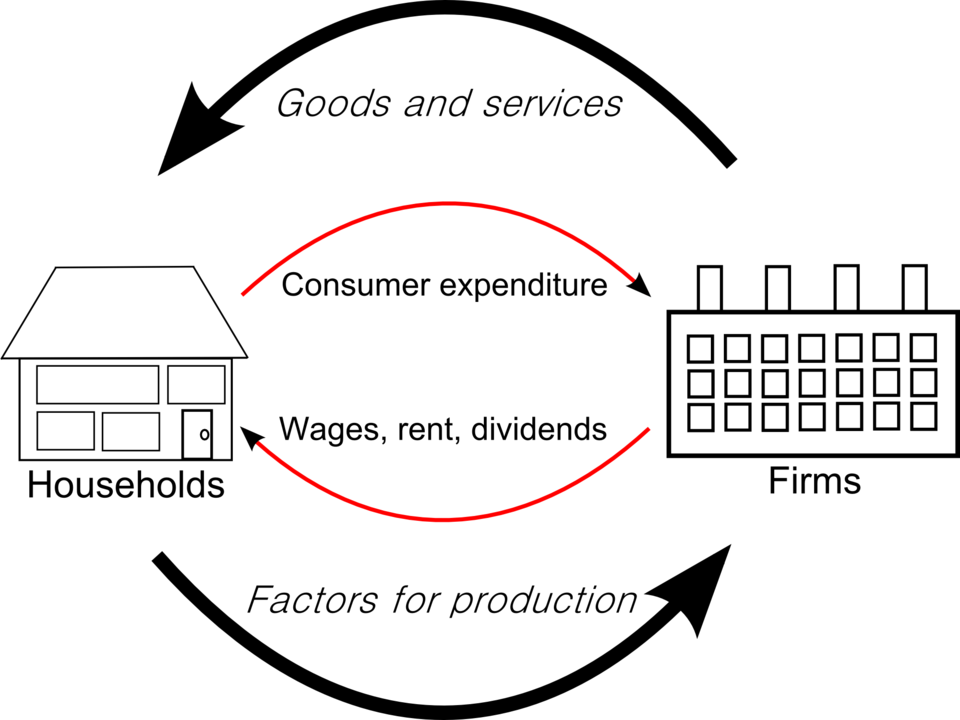 (Image: Irconomics, CC BY-SA 3.0, via Wikimedia Commons)
A labelled diagram showing the interactions between households, firms, government, and foreign sectors in Nepal’s economy, with arrows for factor payments, goods/services, taxes, and imports/exports.
(Image: Irconomics, CC BY-SA 3.0, via Wikimedia Commons)
A labelled diagram showing the interactions between households, firms, government, and foreign sectors in Nepal’s economy, with arrows for factor payments, goods/services, taxes, and imports/exports.
2. Scope of Macroeconomics
Macroeconomics examines five core areas:
- National Income Accounting
- Measures total economic output (GDP, GNP).
- Example: Nepal’s GDP in FY 2022/23 was $38.5 billion (World Bank).
- Economic Growth and Development
- Growth = increase in GDP; Development = improvements in living standards (HDI, poverty reduction).
- Example: Nepal’s HDI improved from 0.554 (2000) to 0.602 (2022).
- Inflation and Price Stability
- Causes: Demand-pull (high consumer spending) or cost-push (rising production costs).
- Example: Nepal’s inflation hit 10.3% in 2022 due to fuel price hikes.
- Unemployment and Employment
- Types: Frictional (job search), structural (skill mismatch), cyclical (recession-driven).
- Example: Nepal’s youth unemployment (ages 15–24) is 20.6% (2023).
- International Trade and Balance of Payments
- Nepal’s trade deficit widened to $10.2 billion in 2022 due to high imports.
FIGURE: Nepal’s GDP Growth (2010–2023)
3. Objectives of Macroeconomics
Macroeconomics aims to achieve three primary goals:
- Economic Growth
- Sustained increase in real GDP (Nepal’s target: 7% annual growth by 2030).
- Tools: Investment in infrastructure (e.g., $1.5 billion Melamchi Water Project).
- Price Stability (Low Inflation)
- Nepal’s central bank (Nepal Rastra Bank) targets 5–7% inflation.
- Example: In 2022, NRB raised repo rates to 7.5% to curb inflation.
- Full Employment
- Achieving NAIRU (Non-Accelerating Inflation Rate of Unemployment), typically 5–6%.
- Example: Nepal’s Employment Fund provides training for 50,000 youth annually.
FIGURE: Nepal’s Inflation Rate (2010–2023)
4. The Circular Flow of Income
This model explains how four sectors interact in an economy:
- Households (consumers).
- Firms (producers).
- Government (taxes and spending).
- Foreign Sector (exports/imports).
MERMAID DIAGRAM:
Real-World Example:
- eSewa’s role: When you pay utility bills via eSewa, you’re part of the household → government flow (taxes/fees).
- Daraz’s role: When Daraz imports goods, it affects the firms → foreign sector flow (imports).
5. Macroeconomic Policies
Governments use two main tools to achieve macroeconomic goals:
| Policy | Tools | Example in Nepal |
|---|---|---|
| Fiscal Policy | Taxes, government spending | Budget 2023/24: Increased education spending by 20%. |
| Monetary Policy | Interest rates, money supply | NRB raised repo rate to 7.5% in 2022 to control inflation. |
FIGURE: Nepal’s Government Revenue vs. Expenditure (2020–2023)
## In the Real World
Google’s Ad Revenue Model
- Concept: Aggregate demand for advertising.
- How it works: Google’s ad revenue (e.g., $209 billion in 2022) depends on macroeconomic factors like consumer spending, business investment, and economic growth. If Nepal’s GDP grows, more businesses advertise on Google, boosting its revenue.
Ncell’s Tariff Hikes
- Concept: Cost-push inflation.
- How it works: When fuel prices rise (e.g., due to global oil shocks), Ncell’s production costs increase. To maintain profits, Ncell raises tariffs, passing the cost to consumers—an example of inflationary pressure in the economy.
Pathao’s Ride Pricing
- Concept: Supply and demand in the gig economy.
- How it works: During Dashain/Tihar, Pathao’s surge pricing reflects increased demand (macroeconomic event) and limited supply (driver availability). This is a micro-level example of how aggregate behavior affects prices.
Nepal Rastra Bank’s Forex Reserves
- Concept: Balance of payments and exchange rates.
- How it works: When Nepal’s forex reserves drop (e.g., $10.5 billion in 2023), the NRB may devalue the rupee to boost exports (like tourism or hydropower). This is a monetary policy tool to correct trade imbalances.
6. Worked Example: Nepal’s 15th Five-Year Plan (2019–2024)
Scenario: Nepal aims to become a middle-income country by 2050 (GDP per capita: $1,000–$4,000). Macroeconomic Goals:
- GDP Growth: Target 7% annually (current: ~4.6%).
- Inflation: Keep below 7% (current: 7.5%).
- Unemployment: Reduce to <10% (current: 12.4%).
Policy Actions:
- Fiscal: Increase infrastructure spending (e.g., $5 billion for roads and energy).
- Monetary: Lower interest rates to encourage borrowing (e.g., repo rate cut to 6% in 2023).
- Trade: Promote exports (e.g., hydropower and textiles).
FIGURE: Nepal’s GDP per Capita (2010–2023)
## Exam Tip
Define Scope Clearly
- Memorize the five components of macroeconomics’ scope (national income, growth, inflation, unemployment, international trade).
- Example answer:
"Macroeconomics studies aggregate economic variables such as GDP, inflation, unemployment, and international trade to analyze the overall performance of an economy like Nepal’s."
Compare Micro vs. Macro
- Use the table format in exams to distinguish between the two.
- Example question: "How does Daraz’s pricing strategy differ from Nepal’s inflation policy?"
Micro: Daraz adjusts prices based on supply and demand for individual products. Macro: Nepal’s inflation policy targets aggregate price levels via monetary/fiscal tools.
Link Theory to Nepal’s Plans
- Examiners love case-based questions on Nepal’s Five-Year Plans.
- Example:
"How does Nepal’s target of 7% GDP growth align with macroeconomic objectives?" Answer: Growth is a primary objective of macroeconomics. Nepal’s plan uses fiscal expansion (infrastructure spending) and monetary easing (lower interest rates) to achieve this, while also aiming for price stability (inflation <7%) and employment generation.
Draw Diagrams
- Circular flow of income and GDP components (C+I+G+X-M) are high-scoring.
- Example: If asked about leakages and injections, draw:
- Use Real Data
- Cite Nepal’s GDP, inflation, or unemployment rates from recent sources (World Bank, NRB).
- Example:
"Nepal’s unemployment rate of 12.4% (2023) highlights the need for structural policies like vocational training, as targeted in the 15th Five-Year Plan."
A photo of the Nepal Rastra Bank headquarters in Kathmandu, labelled with its role in monetary policy (interest rates, forex reserves, inflation control).
Based on the TU BBA syllabus for Macro Economics (ECO204), unit 1.
Discussion
Loading…