Cost Management AccountingUnit 99 min read
Labour Costing & Wage Systems: Piece Rate, Time Rate, Halsey Plan
Unit 9 of Cost Management Accounting explores how to calculate labour costs under different wage systems (piece rate, time rate, Halsey plan), their applications in Nepali manufacturing, and how to compute wages with real-world examples like a Kathmandu garment factory or a brick kiln.
Labour Costing Fundamentals
What is Labour Cost?
Labour cost is the total remuneration paid to employees for their services, including:
- Basic wages (time rate or piece rate)
- Allowances (overtime, bonus, incentives)
- Benefits (provident fund, medical, housing)
- Employer’s contribution (PF, gratuity, insurance)
Why it matters? Labour is often the second-largest cost after materials in manufacturing (e.g., 30-40% of total cost in garment factories). Proper costing ensures profitability and fair wages.
Labour Costing vs. Labour Cost Control
| Labour Costing | Labour Cost Control |
|---|---|
| Records actual wages paid (e.g., Rs 500/hour × 8 hours = Rs 4,000). | Monitors efficiency (e.g., "Why did labour take 10 hours instead of 8?"). |
| Focuses on cost allocation to products. | Focuses on reducing waste (idle time, defects). |
| Example: Assigning wages to a batch of bricks. | Example: Training workers to reduce breakage. |
Wage Systems: How Companies Pay Workers
Three main systems are used in Nepal’s manufacturing (e.g., brick kilns, garment factories, carpentry):
1. Time Rate System
Definition: Workers are paid based on time worked, not output. Formula:
Wages = Hourly Rate × Hours Worked
Example: A carpenter in Kathmandu earns Rs 450/hour and works 8 hours/day. Daily wage = Rs 450 × 8 = Rs 3,600.
Advantages & Disadvantages
| Pros | Cons |
|---|---|
| Simple to administer. | No incentive to work faster. |
| Encourages job security. | Higher costs if workers are inefficient. |
| Suitable for unskilled labour (e.g., bricklayers). | Disputes over overtime. |
When to Use?
- Jobs where output is hard to measure (e.g., security guards, cleaners).
- Repetitive tasks where speed doesn’t matter (e.g., assembly line inspectors).
2. Piece Rate System
Definition: Workers are paid per unit produced (e.g., Rs 10 per brick, Rs 50 per shirt). Formula:
Wages = Piece Rate × Number of Units Produced
Example: A brick kiln worker earns Rs 5 per brick. If they make 500 bricks/day: Daily wage = Rs 5 × 500 = Rs 2,500.
Types of Piece Rates
| Type | Description | Example |
|---|---|---|
| Straight Piece Rate | Fixed rate per unit. | Rs 10 per shirt sewn. |
| Differential Piece Rate | Higher rate for high-quality work. | Rs 8 (standard), Rs 12 (defect-free). |
| Progressive Piece Rate | Rate increases with output. | Rs 5 (first 100 units), Rs 7 (next 200). |
Advantages & Disadvantages
| Pros | Cons |
|---|---|
| Encourages productivity. | Quality may suffer (workers rush). |
| Lower labour cost if efficient. | Disputes over defective units. |
| Used in garment, brick, and handicraft industries. | Not suitable for complex jobs. |
3. Halsey Plan (Premium Bonus System)
Definition: A hybrid system combining time rate + bonus for efficiency. Formula:
Bonus = (Time Saved × Time Rate) × 50%
Total Wages = (Actual Time × Time Rate) + Bonus
Example:
- Standard time for a job: 12 hours.
- Time rate: Rs 40/hour.
- Actual time taken by Mr. A: 10 hours.
Step 1: Calculate time saved = 12 – 10 = 2 hours. Step 2: Bonus = (2 × Rs 40) × 50% = Rs 40. Step 3: Base wages = 10 × Rs 40 = Rs 400. Total wages = Rs 400 + Rs 40 = Rs 440.
Comparison Table
| System | Best For | Wage Calculation | Motivation Level |
|---|---|---|---|
| Time Rate | Unskilled, repetitive work | Fixed per hour | Low |
| Piece Rate | Skilled, measurable output | Per unit produced | High |
| Halsey Plan | Semi-skilled, efficiency-driven | Base + 50% bonus for savings | Medium-High |
Real-World Applications in Nepal
1. Garment Factories (e.g., Himalayan Textile Mills, Kathmandu)
- System Used: Piece Rate (Rs 50–100 per shirt).
- Why? Workers are paid per shirt sewn, increasing output.
- Challenge: Quality control (some workers rush, causing defects).
2. Brick Kilns (e.g., Bhaktapur Brick Industry)
- System Used: Piece Rate (Rs 3–5 per brick).
- Why? Workers are paid per brick made, reducing idle time.
- Challenge: Seasonal demand (rainy season slows production).
3. Carpenters & Furniture Makers (e.g., Patan Woodcraft)
- System Used: Halsey Plan (base wage + bonus for finishing early).
- Why? Encourages efficiency without sacrificing quality.
Worked Example: Labour Costing in a Kathmandu Retail Shop
Scenario: A small Kathmandu retail shop employs 5 workers to pack and label orders. The shop uses a mixed wage system:
- 2 workers on time rate (Rs 350/hour, 8 hours/day).
- 3 workers on piece rate (Rs 15 per order packed).
Data for a day:
- Time-rate workers: Worked 7 hours/day (due to slow orders).
- Piece-rate workers: Packed 200 orders/day.
Calculations:
1. Time Rate Workers
Wages = Hourly Rate × Hours Worked
= Rs 350 × 7 hours
= **Rs 2,450 per worker**
Total for 2 workers = Rs 2,450 × 2 = **Rs 4,900**
2. Piece Rate Workers
Wages = Piece Rate × Number of Orders
= Rs 15 × 200 orders
= **Rs 3,000 per worker**
Total for 3 workers = Rs 3,000 × 3 = **Rs 9,000**
Total Labour Cost for the Day
Time Rate + Piece Rate = Rs 4,900 + Rs 9,000 = **Rs 13,900**
Allocation to Products
If the shop sells:
- 100 orders of Rs 500 each (high-margin).
- 100 orders of Rs 200 each (low-margin).
Labour cost per order:
Total labour cost = Rs 13,900
Total orders = 200
Labour cost per order = Rs 13,900 ÷ 200 = **Rs 69.50**
Profit Impact:
- High-margin orders: Rs 500 – Rs 69.50 = Rs 430.50 profit.
- Low-margin orders: Rs 200 – Rs 69.50 = Rs 130.50 profit.
Insight: The shop should prioritise high-margin orders to maximise profit, even if labour costs are fixed per order.
Labour Cost Variances (Exam Focus)
Companies compare actual wages vs. standard wages to find variances:
- Labour Rate Variance (Difference in hourly rate).
- Labour Efficiency Variance (Difference in time taken).
Formula:
Labour Rate Variance = (Actual Rate – Standard Rate) × Actual Hours
Labour Efficiency Variance = Standard Rate × (Actual Hours – Standard Hours)
Example:
- Standard: 10 hours at Rs 40/hour = Rs 400.
- Actual: 12 hours at Rs 35/hour = Rs 420.
Labour Rate Variance = (Rs 35 – Rs 40) × 12 = **-Rs 60 (favourable)**
Labour Efficiency Variance = Rs 40 × (12 – 10) = **+Rs 80 (unfavourable)**
Net Variance = -Rs 60 + Rs 80 = **+Rs 20 (unfavourable)**
Interpretation:
- Rate variance is favourable (paid less per hour).
- Efficiency variance is unfavourable (took more time).
- Net result: Rs 20 more than standard.
Exam Tip: How to Score Full Marks
- Understand the wage system formulas – Memorise time rate, piece rate, and Halsey plan calculations.
- Practice numericals – Always show step-by-step working (e.g., time saved, bonus calculation).
- Compare systems – Examiners love tables comparing time rate vs. piece rate vs. Halsey.
- Real-world application – Relate to Nepali industries (garment, brick, carpentry).
- Variance analysis – If asked about efficiency, calculate both rate and efficiency variances.
- Avoid common mistakes:
- Forgetting to convert hours to decimal (e.g., 1.5 hours = 1.5, not 1 hour 30 mins).
- Misapplying Halsey’s 50% bonus rule (it’s only 50% of time saved).
- Ignoring overtime in time rate calculations.
Summary Flowchart: Labour Costing Process
flowchart TD
    A["Start"] --> B["Identify Wage System<br/>(Time/Piece/Halsey)"]
    B --> C{"Time Rate?"}
    C -->|"Yes"| D["Calculate: Hours × Rate"]
    C -->|"No"| E{"Piece Rate?"}
    E -->|"Yes"| F["Calculate: Units × Rate"]
    E -->|"No"| G["Halsey Plan<br/>1. Find Time Saved<br/>2. Calculate Bonus (50% of saved time × rate)<br/>3. Add to base wages"]
    D --> H["Allocate to Products"]
    F --> H
    G --> H
    H --> I["Check Variances<br/>(Rate & Efficiency)"]
    I --> J["Adjust Future Planning"]
Key Formulas to Remember
| Concept | Formula |
|---|---|
| Time Rate Wages | Wages = Hourly Rate × Hours Worked |
| Piece Rate Wages | Wages = Piece Rate × Units Produced |
| Halsey Bonus | Bonus = (Time Saved × Rate) × 50% |
| Labour Rate Variance | (AR – SR) × AH |
| Labour Efficiency Variance | SR × (AH – SH) |
Final Checklist Before Exam
✅ Can you calculate wages under all three systems? ✅ Do you know when to use each system (e.g., piece rate for bricks)? ✅ Can you compare advantages/disadvantages in a table? ✅ Can you solve a variance problem? ✅ Can you relate to a Nepali business (e.g., garment factory, brick kiln)?
 Labourers stacking bricks in a traditional kiln (piece rate system). (Image: Frameofashik, CC BY-SA 4.0, via Wikimedia Commons)
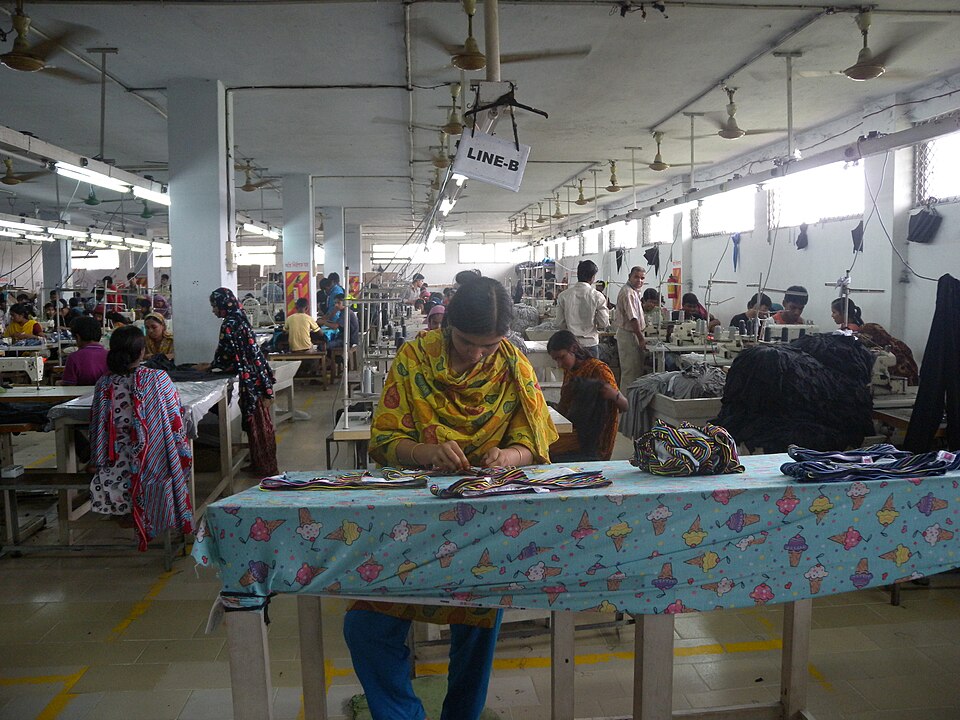 Workers on piece rate earning per shirt sewn. (Image: Tareq Salahuddin from Dhaka, Bangladesh, CC BY 2.0, via Wikimedia Commons)
Based on the TU BBA syllabus for Cost Management Accounting (ACC202), unit 9.
Discussion
Loading…