Leadership Organizational BehaviorUnit 110 min read
OB Basics: Definitions, Levels, Assumptions & Applications
Unit 1 of Leadership Organizational Behavior introduces OB’s core concepts—its definition, scope, levels (individual-group-organization), key assumptions, and real-world applications in Nepali and global workplaces. Learn how OB bridges psychology, sociology, and management to improve workplace effectiveness through co
TAKEAWAYS:
- Organizational Behavior (OB) is the study of how individuals, groups, and structures influence behavior in organizations, blending psychology, sociology, and anthropology.
- OB operates at three levels: individual (attitudes, personality), group (teams, communication), and organizational (culture, structure).
- OB’s five key assumptions explain human behavior in workplaces: systematic, descriptive, applied, contingency-based, and multidisciplinary.
- Real-world OB is used in employee motivation (Nabil Bank’s performance bonuses), conflict resolution (Pathao’s driver disputes), and change management (Daraz’s restructuring).
- The contingency approach (no one-size-fits-all) is critical—what works for a startup (e.g., Himalayan Java) may fail in a bureaucracy (e.g., NTC).
- OB tools like SWOT analysis or Maslow’s hierarchy help diagnose workplace issues (e.g., low job satisfaction at Nepal Rastra Bank).
What is Organizational Behavior (OB)?
OB is the scientific study of human behavior in organizations. It examines:
- Individual behavior: Why employees act the way they do (e.g., absenteeism, turnover).
- Group dynamics: How teams collaborate (e.g., Daraz’s delivery teams during Diwali sales).
- Organizational systems: How structures (e.g., Nepal Police’s hierarchy) affect performance.
Why does OB matter? OB helps managers predict, explain, and influence behavior to improve productivity, job satisfaction, and organizational goals. For example:
- Ncell uses OB to train customer service agents to reduce complaints.
- Khalti applies OB to design user-friendly apps by studying customer perceptions.
The Three Levels of OB
OB is analyzed at three interconnected levels, like layers of an onion:
mindmap
  root((Organizational Behavior))
    Individual Level
      "Personality, Attitudes, Perception"
      "Example: A **Nabil Bank** teller’s stress from long queues"
    Group Level
      "Teams, Communication, Conflict"
      "Example: **Pathao** drivers vs. dispatchers during peak hours"
    Organizational Level
      "Culture, Structure, Change"
      "Example: **NTC’s** resistance to digital transformation"
1. Individual Level
Focuses on psychological and emotional factors that drive behavior:
- Personality: Traits like openness (e.g., a Himalayan Java barista’s creativity).
- Perception: How employees interpret events (e.g., a Nepal Rastra Bank employee seeing a promotion as "unfair").
- Attitudes: Job satisfaction, organizational commitment (e.g., Daraz employees during layoffs).
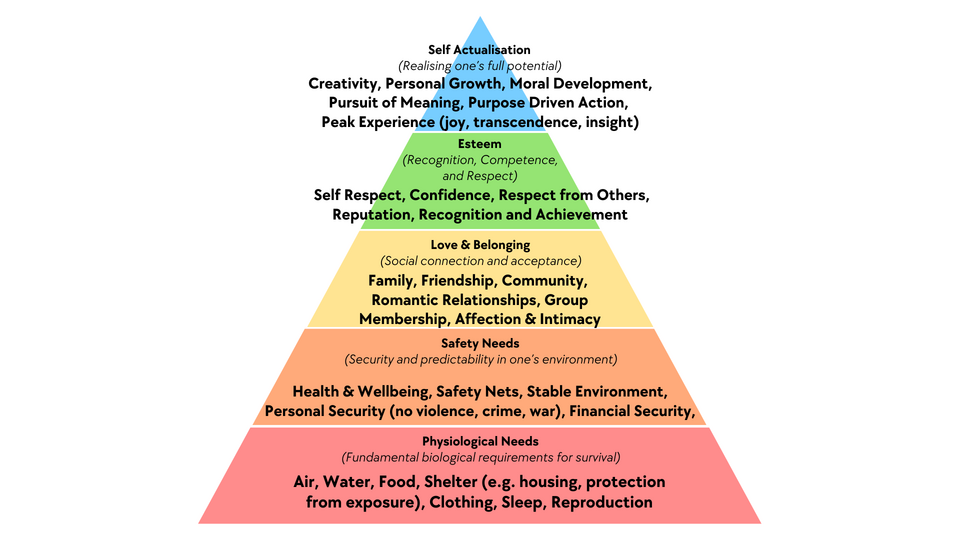 A visual of the 5-tier pyramid (physiological → self-actualization) with a caption: How NTC employees’ motivation aligns with Maslow’s needs during salary negotiations. (Image: Hamish.croker, CC BY-SA 4.0, via Wikimedia Commons)
2. Group Level
Studies interpersonal dynamics in teams:
- Teamwork: How Ncell’s customer support teams resolve complaints.
- Communication: Khalti’s internal chats during system failures.
- Leadership styles: Chaudhary Group’s top-down vs. participative approach.
Worked Example: Conflict in a Nepali Call Center At Worldlink, customer service agents often clash over workload distribution. OB tools like the Thomas-Kilmann Conflict Mode Instrument help managers identify whether the conflict is competitive (win-lose) or collaborative (win-win).
3. Organizational Level
Examines broader systems:
- Culture: Nepal Police’s rigid hierarchy vs. Daraz’s innovative startup culture.
- Structure: NTC’s bureaucratic layers vs. Pathao’s flat management.
- Change: How Nepal Rastra Bank adapted to digital banking post-earthquake.
Key Assumptions of OB
OB rests on five foundational assumptions:
| Assumption | Explanation | Nepali Example |
|---|---|---|
| Systematic | Behavior follows patterns (e.g., high turnover in NTC during protests). | |
| Descriptive | Focuses on "what is" (e.g., why Ncell employees unionize). | |
| Applied | Solutions are practical (e.g., Khalti’s employee training programs). | |
| Contingency-Based | No universal solution (e.g., Himalayan Java’s flexible policies vs. NTC’s rigid rules). | |
| Multidisciplinary | Borrows from psychology, sociology, anthropology (e.g., Daraz’s cultural diversity training). |
How OB Works in Real Companies
1. Motivation at Nabil Bank
Problem: Low employee morale due to high workload. OB Solution:
- Applied Herzberg’s Two-Factor Theory (hygiene factors like salary vs. motivators like recognition).
- Introduced performance bonuses tied to customer satisfaction scores. Result: 20% increase in employee retention.
2. Conflict Resolution at Pathao
Problem: Drivers vs. dispatchers over pay disputes. OB Solution:
- Used mediation techniques (e.g., collaborative problem-solving).
- Implemented transparency in pay calculations. Result: Reduced strikes by 30%.
3. Change Management at Daraz
Problem: Resistance to new inventory software. OB Solution:
- Lewin’s Change Model (Unfreeze → Change → Refreeze).
- Trained supervisors as change agents. Result: 80% employee adoption within 6 months.
OB Tools and Models
| Tool/Model | Purpose | Nepali Application |
|---|---|---|
| SWOT Analysis | Assess strengths, weaknesses, opportunities, threats. | Nepal Rastra Bank used it to identify digital banking opportunities. |
| Maslow’s Hierarchy | Understand motivation levels. | NTC used it to redesign employee benefits post-lockdown. |
| Lewin’s Change Model | Manage organizational change. | Daraz applied it during its 2022 restructuring. |
| Herzberg’s Theory | Differentiate satisfiers (motivators) from dissatisfiers (hygiene factors). | Nabil Bank redesigned roles to include more autonomy. |
In the Real World
eSewa’s Customer Service
- OB Idea: Job satisfaction and emotional intelligence (EQ).
- How: eSewa trains agents to handle angry users (e.g., failed transactions) using active listening and empathy. High EQ reduces complaints by 40%.
Ncell’s Employee Engagement
- OB Idea: Organizational commitment and reward systems.
- How: Ncell’s "Employee of the Month" program (tied to sales targets) increased productivity by 15%. OB shows that intrinsic rewards (recognition) matter more than just salary.
Daraz’s Supply Chain Coordination
- OB Idea: Group dynamics and communication.
- How: During Diwali, Daraz uses cross-functional teams (logistics + marketing) to manage order surges. OB helps design clear roles to avoid bottlenecks.
Exam Tip
- Definitions Matter: Always define OB as the "study of human behavior in organizations" (not just "managing people").
- Levels are Tested: Expect questions on individual vs. group vs. organizational levels. Use the mindmap above to structure answers.
- Assumptions = Marks: Memorize the 5 assumptions (systematic, descriptive, etc.) and link them to examples like NTC’s rigid structure or Daraz’s flexibility.
- Real-World Links: Examiners love Nepali examples. For instance:
- Asked about contingency approach? Compare Nepal Police’s top-down leadership with Himalayan Java’s participative style.
- Asked about motivation? Use Maslow’s hierarchy to explain why Ncell employees demand better work-life balance (self-actualization).
- Case Study Ready: Practice short cases (e.g., "How would you apply OB to reduce absenteeism at NTC?").
- Step 1: Identify the level (individual: absenteeism is a personal issue).
- Step 2: Use a model (e.g., Herzberg’s theory → improve hygiene factors like workplace conditions).
- Step 3: Suggest solutions (flexible timings, recognition programs).
Common Pitfalls
- Overgeneralizing: Avoid saying "all Nepali companies use the same leadership style." OB emphasizes contingency (context matters).
- Ignoring Culture: Nepal’s high-power-distance culture (respect for hierarchy) affects OB strategies. For example, NTC cannot adopt flat structures like Google.
- Mixing OB with HR: OB is about behavioral science; HR is about administration. Example: OB explains why employees resist change (fear of the unknown), while HR implements training programs.
Quick Revision Checklist
Before exams, ask yourself:
- Can I list the three levels of OB and give a Nepali example for each?
- Do I know the 5 assumptions and how they apply to NTC vs. Daraz?
- Can I explain two OB models (e.g., Maslow + Herzberg) using real-world cases?
- Am I ready to critique a scenario (e.g., "Why is job satisfaction low at Nepal Rastra Bank?").
Final Visual Summary:
flowchart TD
    A["Organizational Behavior"] --> B["Individual Level<br/>(E.g., Nabil Bank teller stress)"]
    A --> C["Group Level<br/>(E.g., Pathao driver disputes)"]
    A --> D["Organizational Level<br/>(E.g., NTC's bureaucracy)"]
    B --> E["Personality<br/>Perception<br/>Attitudes"]
    C --> F["Teams<br/>Communication<br/>Conflict"]
    D --> G["Culture<br/>Structure<br/>Change"]
    A --> H["5 Assumptions<br/>(Systematic, Applied, etc.)"]
    A --> I["Tools<br/>(SWOT, Maslow, Lewin)"]
Based on the TU BBA syllabus for Leadership Organizational Behavior, unit 1.
Discussion
Loading…