Leadership Organizational BehaviorUnit 1214 min read
Levels & Dimensions of OB: Individual, Group, Org, Culture
Unit 12 of Leadership Organizational Behavior explains the four levels of analysis (individual, group, organizational, societal) and three key dimensions (time, space, context) in OB, with real-world applications in Nepali companies like Nabil Bank and Daraz, plus exam-focused comparisons and case studies.
TAKEAWAYS:
- OB operates at four nested levels: individual → group → organization → societal, each requiring different tools (e.g., motivation theories vs. organizational culture).
- The three dimensions (time, space, context) shape how OB concepts apply—past vs. future focus, physical vs. virtual teams, and local vs. global norms.
- Nepali examples show how these levels/dimensions work: Nabil Bank’s employee engagement (individual/group) vs. its merger strategy (organizational/societal).
- Exam hotspots: Compare levels (e.g., "How does Maslow’s hierarchy at the individual level differ from organizational culture at the group level?").
- Real-world tie: Pathao’s ride-matching algorithm (group level) vs. its expansion into India (societal level).
- Case study focus: Analyze how Himalayan Java uses OB levels to manage remote workers (space dimension) and local coffee farmers (context dimension).
1. The Four Levels of Organizational Behavior
Organizational Behavior (OB) is studied at four interconnected levels, each requiring distinct theories and tools. Think of it like a Russian doll: each level influences and is influenced by the others.
Level 1: Individual Level
Definition: Focuses on personality, attitudes, perception, learning, and motivation of employees. Key Theories:
- Maslow’s Hierarchy of Needs (motivation)
- Big Five Personality Traits (OCEAN model)
- Attribution Theory (how people explain behavior)
How It Works: At this level, OB asks: Why does an employee at Nabil Bank stay late to finish a loan approval? The answer might involve intrinsic motivation (autonomy) or extrinsic rewards (bonuses). A real-world trace:
- Nepali Bank Teller (Individual): Uses self-efficacy (belief in their ability) to handle angry customers.
- Group Impact: Their positive attitude improves team morale (next level).
- Organizational Impact: High job satisfaction → lower turnover → bank’s reputation improves (societal level).
Visual: Individual Level Theories
mindmap
root((Individual Level OB))
Personality
Big Five: O["Openness"], C["Conscientiousness"], E["Extraversion"], A["Agreeableness"], N["Neuroticism"]
Motivation
Maslow: P["Physiological"] --> S["Safety"] --> L["Love"] --> E["Esteem"] --> S["Self-Actualization"]
Perception
Selective Perception: H["Halo Effect"] --> H["Horns Effect"]
Learning
Operant Conditioning: R["Reinforcement"] --> P["Punishment"]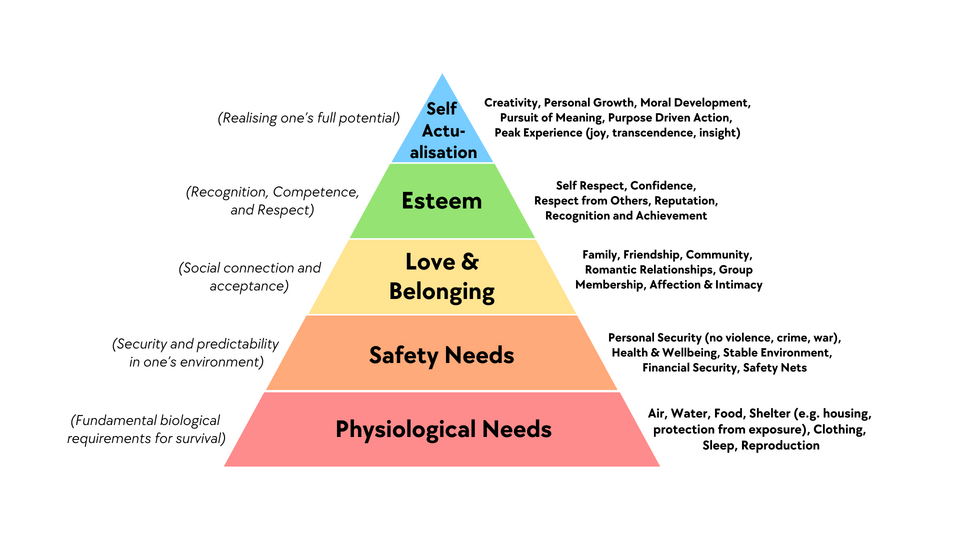 Hierarchy of needs with Nepali examples: a banker’s salary (safety) vs. stock options (self-actualization) (Image: Hamish.croker, CC BY-SA 4.0, via Wikimedia Commons)
Level 2: Group Level
Definition: Examines teams, communication, leadership styles, and conflict resolution within workgroups. Key Theories:
- Tuckman’s Stages of Group Development (Forming → Storming → Norming → Performing)
- Social Identity Theory (how group membership shapes behavior)
- Path-Goal Theory (how leaders motivate teams)
How It Works: At Daraz’s customer support team, a group of 5 agents handles complaints. OB at this level studies:
- Groupthink: Do they avoid dissent to "keep the peace"?
- Norms: Is it okay to take breaks together, or is punctuality strictly enforced?
- Leadership Style: Does the team leader use transformational leadership (inspiring) or transactional leadership (rule-based)?
Worked Example: Pathao’s Ride-Matching Algorithm (Group Level) Pathao’s algorithm doesn’t just match riders and drivers—it’s an OB experiment in real-time group dynamics:
- Individual: A driver’s perception of fairness (e.g., "Why did I get this low fare?") affects their willingness to accept rides.
- Group: The team of dispatchers uses social facilitation (working together under pressure) to resolve conflicts (e.g., rider complaints).
- Organizational: Pathao’s culture of "move fast" (norm) encourages quick decisions, even if it means occasional errors.
Visual: Tuckman’s Stages with a Nepali Example
flowchart LR
  A["Forming\n(Daraz new hires)"] -->|"Conflict over roles"| B["Storming\n(Who answers customer calls?)"]
  B -->|"Team leader sets rules"| C["Norming\n(‘We use Slack for urgent issues’)"]
  C -->|"High performance"| D["Performing\n(Handles 100+ complaints/day)"]
Level 3: Organizational Level
Definition: Studies culture, structure, power, politics, and change management across the entire organization. Key Theories:
- Schein’s Three Levels of Culture (artifacts → values → assumptions)
- Mintzberg’s Organizational Configurations (adhocracy vs. bureaucracy)
- Organizational Change Models (Lewin’s Unfreeze-Change-Refreeze)
How It Works: When NTC (Nepal Telecom) merges with Ncell, OB at this level asks:
- Culture Clash: NTC’s bureaucratic structure (strict rules) vs. Ncell’s innovative startup culture.
- Power Dynamics: Who holds decision-making authority in the new entity?
- Resistance to Change: Will long-term NTC employees resist new digital tools?
Case Study: Nabil Bank’s Merger with Global IME
| Dimension | Nabil Bank (Pre-Merger) | Global IME | Post-Merger OB Challenge |
|---|---|---|---|
| Culture | Family-like, relationship-based | Data-driven, performance-focused | Blending "aunty-ji" culture with KPIs |
| Structure | Decentralized (branch autonomy) | Centralized (headquarters control) | Standardizing processes without stifling innovation |
| Leadership Style | Transformational (charismatic) | Transactional (rule-based) | Training leaders to balance both styles |
Visual: Schein’s Three Levels of Culture (Nepali Example)
mindmap
  root((Nabil Bank Culture))
    Artifacts["Visible: Dress code, ‘Namaste’ greetings, branch decor"]
    Values["Invisible: ‘Customer is like family’"]
    Assumptions["Unconscious: ‘Trust > efficiency’"]
Level 4: Societal Level
Definition: Examines OB in the broader context of society, including ethics, diversity, and global trends. Key Theories:
- Hofstede’s Cultural Dimensions (power distance, individualism vs. collectivism)
- Stakeholder Theory (how organizations balance interests of employees, customers, government)
- Sustainability and CSR (corporate social responsibility)
How It Works: When Himalayan Java sources coffee from small farmers, OB at the societal level considers:
- Collectivism: Farmers’ livelihoods depend on the company’s success (high interdependence).
- Power Distance: Is the relationship between Himalayan Java and farmers egalitarian or hierarchical?
- Ethics: Does the company pay fair trade prices (moral obligation) or market rates (profit-driven)?
Real-World Example: Daraz’s Expansion into India Daraz (Alibaba-owned) entered India by:
- Adapting to Local Culture: Hired local leaders (high power distance in India vs. Nepal).
- Stakeholder Management: Balanced investor demands (Alibaba’s growth targets) with Indian seller concerns (low fees).
- Ethical Dilemma: Used surge pricing during festivals (controversial in a collectivist society).
Visual: Hofstede’s Dimensions (Nepal vs. India)
| Dimension | Nepal (Score) | India (Score) | OB Implication |
|---|---|---|---|
| Power Distance | 74 (High) | 77 (Higher) | Employees expect clear hierarchies; less challenge to bosses |
| Individualism | 16 (Low) | 48 (Moderate) | Group harmony > personal achievement in Nepal |
| Uncertainty Avoidance | 80 (High) | 40 (Low) | Nepali orgs prefer rules; Indian orgs tolerate ambiguity |
2. The Three Dimensions of OB
Beyond levels, OB is shaped by three dimensions: time, space, and context. These dimensions act like lenses that change how we apply OB theories.
Dimension 1: Time (Past vs. Future Focus)
| Time Focus | OB Application | Nepali Example |
|---|---|---|
| Past | Learning from history (e.g., why a merger failed) | NTC’s past resistance to digital transformation |
| Present | Daily interactions, team dynamics | Daraz’s real-time customer complaint resolution |
| Future | Strategic planning, succession planning | Nabil Bank training future leaders |
Visual: Time Dimension in OB
flowchart LR
  A["Past\n(Learning from failures)"] --> B["Present\n(Managing teams)"] --> C["Future\n(Succession planning)"]
  A -->|"Feedback loops"| B
  B -->|"Goals"| C
Dimension 2: Space (Physical vs. Virtual)
| Space Type | OB Challenge | Nepali Example |
|---|---|---|
| Physical | Office politics, proximity bias | Nabil Bank’s "old boys’ club" in Kathmandu HQ |
| Virtual | Trust-building, digital communication | Himalayan Java’s remote farmer training via WhatsApp |
| Hybrid | Balancing in-person and remote work | Pathao’s dispatchers working from home post-pandemic |
Dimension 3: Context (Local vs. Global)
| Context | OB Theory | Nepali Example |
|---|---|---|
| Local | High power distance, collectivism | NTC’s slow decision-making due to consensus culture |
| Global | Low uncertainty avoidance, individualism | Daraz’s fast-paced, meritocratic culture |
| Cross-Cultural | Hofstede’s dimensions | Nabil Bank’s Indian subsidiary adapting to lower power distance |
Case Study: Toyota’s OB in Nepal vs. Japan
- Japan (Context): High uncertainty avoidance → strict quality control processes.
- Nepal (Context): Lower individualism → team-based problem-solving in factories.
- Challenge: Toyota must standardize global processes while adapting to local norms (e.g., more group discussions in Nepal plants).
In the Real World
Nabil Bank’s Loan Approval Process
- Individual Level: A loan officer’s self-efficacy (confidence in their judgment) affects approval speed.
- Group Level: The team’s norm is "no loan > Rs. 5M without manager approval."
- Organizational Level: Nabil’s culture of "relationship banking" means officers know customers personally.
- Societal Level: Government regulations (e.g., financial inclusion policies) shape loan eligibility.
Pathao’s Ride-Matching Algorithm
- Individual: Drivers use attribution theory to explain low fares ("Traffic made me late!").
- Group: Dispatchers negotiate with drivers to balance supply/demand.
- Organizational: Pathao’s algorithm (OB at scale) rewards drivers with high acceptance rates.
- Societal: Criticism over surge pricing during festivals (ethical dilemma).
Himalayan Java’s Farmer Partnerships
- Individual: Farmers’ locus of control (belief in their ability to improve yields).
- Group: Collective bargaining for better prices.
- Organizational: Himalayan Java’s CSR programs (e.g., schools for farmers’ kids).
- Societal: Fair trade certification aligns with global ethical trends.
Exam Tip
This unit is highly conceptual but low on calculations. Exams test your ability to:
Distinguish levels: For example, "Explain how Maslow’s hierarchy (individual) differs from Schein’s culture levels (organizational)."
- Answer Structure:
- Individual (Maslow): Focuses on personal needs (e.g., a banker’s salary for safety needs).
- Organizational (Schein): Focuses on shared assumptions (e.g., "Customers are family" at Nabil Bank).
- Link: Both influence job satisfaction, but at different scales.
- Answer Structure:
Apply dimensions: "How would you analyze a conflict in a virtual team at Daraz?"
- Answer:
- Space Dimension: Virtual teams lack non-verbal cues → miscommunication (e.g., a driver thinks a dispatcher is rude via chat).
- Time Dimension: Async communication (emails) delays conflict resolution.
- Context Dimension: Nepali culture’s high context communication (indirect messages) clashes with Daraz’s low-context (direct) global norms.
- Answer:
Case Study Questions: Expect Nepali companies (e.g., NTC, Nabil, Daraz) or global firms with Nepali operations (e.g., Toyota, Himalayan Java).
- Example Question: "Analyze how Pathao’s OB strategies differ across its Nepal and India markets using Hofstede’s dimensions."
- Answer Framework:
- Power Distance: Higher in India → more centralized decision-making.
- Individualism: Higher in India → drivers may prioritize personal earnings over team goals.
- Uncertainty Avoidance: Lower in India → faster adaptation to algorithm changes.
Comparison Tables: Always ready a 2x2 or 3x3 table for:
- Levels (individual vs. group vs. org vs. societal).
- Dimensions (time/space/context).
- Theories (e.g., Maslow vs. Herzberg for motivation).
Pro Tip: Use real examples in answers. Instead of:
"Leadership styles affect team performance."
Write:
"At Daraz, a transformational leader in the customer support team inspired agents to handle 30% more complaints by framing their work as ‘building Nepal’s e-commerce trust,’ whereas a transactional leader at NTC might only reward agents for meeting call-volume targets."
Final Visual: OB Levels in a Nepali Company (Nabil Bank)
graph TD
  A["Individual\n(Loan Officer: Motivation, Personality)"] --> B["Group\n(Branch Team: Conflict, Norms)"]
  B --> C["Organizational\n(Nabil Bank: Culture, Structure)"]
  C --> D["Societal\n(Government Policies, CSR)"]
  A -->|"Influenced by"| D
  B -->|"Shaped by"| D
  C -->|"Driven by"| D
Based on the TU BBA syllabus for Leadership Organizational Behavior, unit 12.
Discussion
Loading…