Fundamentals Of MarketingUnit 314 min read
Consumer Behavior & Buying Process: Models, Influences & Decision-Making
Unit 3 of Fundamentals Of Marketing covers the psychological, social, and cultural factors shaping consumer decisions, the 5-step buying process, business vs. consumer buying behavior, and real-world applications in Nepal (eSewa, Daraz) and global brands (Google, Unilever).
TAKEAWAYS:
- Consumer behavior is influenced by 4P factors (psychological, personal, social, cultural) and 5-step decision-making (problem recognition → information search → evaluation → purchase → post-purchase).
- Business buyers follow a modified rebuy/new task/straight rebuy process with 8 key roles (initiator, influencer, decider, buyer, gatekeeper, user, controller).
- eSewa’s success hinges on understanding convenience-seeking behavior (low involvement, habitual purchase) for bill payments.
- Daraz’s dynamic pricing exploits reference pricing (comparing to competitors) and scarcity cues (limited stock alerts).
- Global consumer movements (e.g., #BoycottNepal) show how social responsibility and ethical concerns now drive purchasing.
- Post-purchase dissonance (e.g., buyer’s remorse after buying a smartphone) is managed via warranties, returns, and brand trust (e.g., Ncell’s "Easy Installment" plans).
1. What is Consumer Behavior?
Consumer behavior studies how individuals, groups, or organizations select, buy, use, and dispose of goods/services to satisfy needs. It blends psychology, sociology, and economics to explain why people buy what they buy.
Why Study Consumer Behavior?
- Predict demand: Brands like Himalayan Java target coffee lovers by analyzing lifestyle trends (e.g., "work-from-home" culture).
- Design marketing strategies: Nabil Bank’s "Smart Loan" ads target financial security-seeking customers.
- Reduce returns: Daraz’s "7-day return policy" addresses post-purchase anxiety (common in online shopping).
flowchart TD
    A["Problem Recognition\n(Need arises)"]
    B["Information Search\n(Internal/External)"]
    C["Evaluation of Alternatives\n(Criteria: Price, Brand, Quality)"]
    D["Purchase Decision\n(Buyer’s Remorse?)"]
    E["Post-Purchase Evaluation\n(Satisfaction/Dissonance)"]
    A --> B --> C --> D --> E
    E -->|"Feedback"| A
2. Factors Influencing Consumer Behavior
Consumer choices are shaped by 4 broad categories:
| Category | Key Factors | Example in Nepal |
|---|---|---|
| Psychological | Motivation, perception, learning, beliefs, attitudes | Khalti’s "Tap to Pay" leverages habitual behavior (speed > security concerns). |
| Personal | Age, occupation, lifestyle, personality | Nepal Telecom’s "Ncell Recharge" targets students (budget plans) and professionals (data packs). |
| Social | Family, reference groups, culture, social class | Chaudhary Group’s "Bhatbhateni" uses family traditions to sell rice. |
| Cultural | Values, subcultures, social norms | Nepal’s "Dashain" season sees a surge in prasad (offerings) and festive wear. |
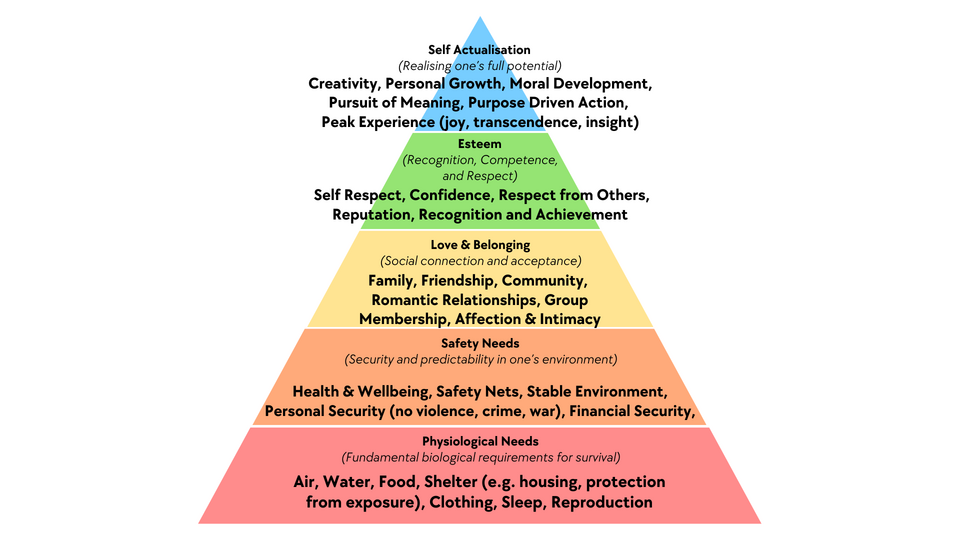 How needs drive purchases (Image: Hamish.croker, CC BY-SA 4.0, via Wikimedia Commons)
mindmap
  root((Maslow's Hierarchy))
    Physiological
    Safety
    Love/Belonging
    Esteem
    Self-Actualization
Real-World Tie-In:
- Pathao’s "Pathao Mart" uses social influence (peer recommendations) to sell groceries. Riders see what others buy and follow trends.
- NTC’s "Smart Card" targets safety-conscious commuters (avoiding cash theft).
3. The Consumer Buying Decision Process
A 5-step model explains how consumers make purchase decisions:
Problem Recognition
- Trigger: Need or want (e.g., phone battery dies → need a charger).
- Example: After seeing Nepal’s power cuts, consumers buy UPS/inverters.
Information Search
- Internal: Past experience (e.g., "I liked Brand X last time").
- External: Ads, reviews, word-of-mouth (e.g., checking Daraz reviews before buying a laptop).
- IMAGE: information search sources table
Source Example in Nepal Personal Friend recommends Himalayan Java coffee. Commercial Ncell’s TV ads for new tariff plans. Public Facebook groups discussing phone deals. Experiential Trying Khalti’s QR payments at a shop. Evaluation of Alternatives
- Consumers use evaluative criteria (price, brand, features) to compare options.
- Example: Buying a refrigerator → Compare LG (reliability), Samsung (design), local brands (price).
Purchase Decision
- Attitude of others and unexpected situational factors (e.g., discounts) may influence the final choice.
- Example: Black Friday sales at Hamrobazaar push consumers to buy electronics they didn’t originally plan for.
Post-Purchase Evaluation
- Satisfaction → Repeat purchase.
- Dissonance (doubt) → Returns or complaints (e.g., Daraz’s 7-day return policy).
- IMAGE: post-purchase outcomes flowchart
flowchart TD
  A["Post-Purchase Evaluation"] --> B["Satisfied"]
  A --> C["Dissatisfied"]
  B --> D["Repeat Purchase\n(Loyalty)"]
  C --> E["Returns/Complaints\n(Churn)"]
  C --> F["Negative WOM\n(Boycott)"]
Worked Example: Buying a Smartphone in Nepal
- Problem: Old phone breaks → need a new one.
- Search: Check Ncell’s website, Daraz reviews, ask friends.
- Evaluate:
- Price: Rs. 30,000–50,000 range.
- Brand: Samsung (trusted), Xiaomi (budget), Apple (premium).
- Features: Camera, battery life, 5G support.
- Purchase: Buy Samsung Galaxy A54 on eSewa installments.
- Post-Purchase:
- If satisfied → repeat purchase (loyalty).
- If dissatisfied → return to Daraz or complain on Facebook.
4. Business Buyer Behavior vs. Consumer Behavior
Business buyers (organizations) and consumers differ in process, participants, and criteria.
| Aspect | Consumer Buying | Business Buying |
|---|---|---|
| Purpose | Personal use | Organizational goals |
| Decision Process | 5-step (individual) | Modified Rebuy/New Task/Straight Rebuy |
| Participants | Single buyer | 8 roles (initiator, influencer, etc.) |
| Criteria | Price, brand, convenience | Quality, delivery, supplier reputation |
| Purchase Volume | Small, frequent | Large, infrequent |
| Example in Nepal | Buying Himalayan Java coffee | NTC buying fiber-optic cables |
Business Buyer Decision Process
- Problem Recognition (e.g., NTC needs new routers).
- General Need Description (specs: speed, durability).
- Product Specification (technical details).
- Supplier Search (RFQs to Nepal Telecom, Ncell).
- Proposal Solicitation (bids from Huawei, Cisco).
- Supplier Selection (based on cost, reliability).
- Order Routine (contract signing).
- Performance Review (post-installation checks).
graph TD
    A["Initiator\n(Identifies need)"]
    B["Influencer\n(Provides info)"]
    C["Decider\n(Makes final choice)"]
    D["Buyer\n(Handles purchase)"]
    E["Gatekeeper\n(Controls info)"]
    F["User\n(End-user)"]
    G["Controller\n(Budget approval)"]
    H["Observer\n(Monitors process)"]
    A --> B --> C --> D --> E --> F
    G --> C
    H --> D
Real-World Example: Nabil Bank’s Loan Process
- Initiator: Customer needs a loan.
- Influencer: Bank’s loan officer explains terms.
- Decider: Bank’s credit committee approves/rejects.
- Buyer: Bank’s operations team processes the loan.
- Gatekeeper: Compliance officer checks KYC documents.
5. Global Consumer Movements & Protection
Consumers today are more informed and rights-aware due to:
- Social media (e.g., #BoycottNepal campaigns).
- Government laws (e.g., Consumer Protection Act, 2075 in Nepal).
- NGOs (e.g., Consumer Protection Forum Nepal).
Key Consumer Movements
| Movement | Example | Impact on Marketing |
|---|---|---|
| Ethical Consumption | Buying fair-trade coffee (Himalayan Java) | Brands highlight sustainability. |
| Boycotts | #BoycottChineseProducts (post-2020) | Forces brands to localize supply chains. |
| Green Marketing | Nepal’s "Go Green" campaigns | Companies adopt eco-friendly packaging. |
Case Study: Daraz’s Response to Consumer Complaints
- Issue: Fake products, delayed deliveries.
- Action: Introduced verified sellers, trackable shipments, and 24-hour customer support.
- Result: Increased trust and repeat purchases.
6. Special Cases in Consumer Behavior
A. High-Involvement vs. Low-Involvement Purchases
| Type | Example | Marketing Strategy |
|---|---|---|
| High-Involvement | Buying a car (Honda, Toyota) | Detailed ads, test drives, long sales cycles. |
| Low-Involvement | Buying toothpaste (Closeup) | Impulse displays, discounts, habit reinforcement. |
Example in Nepal:
- eSewa’s bill payments → Low-involvement (habitual, quick).
- Buying a house → High-involvement (extensive research, loans).
B. Cultural Influences on Buying
- Religion: Dashain/Tihar → Demand for prasad, sweets, new clothes.
- Caste: Hindu families prefer gold jewelry (auspicious).
- Regional Preferences:
- Terai: Prefer rice, wheat.
- Hills/Mountains: Prefer millet, potatoes.
(Note: Replace with a real map of Nepal showing product preferences by region.)
In the Real World
eSewa’s Success
- Idea Used: Low-involvement, habitual purchasing.
- How: Simplified QR payments for bills (electricity, phone) by leveraging convenience-seeking behavior. Most users don’t compare alternatives—they just tap and pay.
Daraz’s Dynamic Pricing
- Idea Used: Reference pricing + scarcity cues.
- How:
- Shows "Compare to MRP" to highlight discounts.
- Uses "Only 3 left in stock!" to trigger fear of missing out (FOMO).
Ncell’s "Easy Installment" Plans
- Idea Used: Post-purchase dissonance reduction.
- How: Offers 0% interest EMIs for phones to ease financial anxiety (common in Nepal’s high-inflation economy).
Exam Tip
How to Score Full Marks
Define Clearly
- Start every answer with a precise definition (e.g., "Consumer behavior refers to...").
- Example: For "factors influencing consumer behavior", list all 4 categories (psychological, personal, social, cultural) with sub-factors.
Use Diagrams
- Mermaid flowcharts for processes (e.g., buying decision process).
- Tables for comparisons (e.g., consumer vs. business buying).
Link to Nepal
- Always give local examples (eSewa, Daraz, Ncell, Chaudhary Group).
- Example: For "post-purchase dissonance", discuss Daraz’s return policy or Ncell’s warranty.
Critical Analysis
- For questions like "Critically examine new product development", discuss:
- Steps (Idea generation → Screening → Testing → Launch).
- Challenges in Nepal (high failure rate, piracy, low consumer trust).
- Success story: Himalayan Java’s market research before launching instant coffee.
- For questions like "Critically examine new product development", discuss:
Avoid Generic Answers
- ❌ "Marketing is important."
- ✅ "Nepal’s rural consumers prefer small packets (due to affordability), while urban millennials buy premium brands (e.g., Puma, Adidas). This segmentation helps Bata Nepal tailor ads."
Common Mistakes to Avoid
- Ignoring the 5-step buying process: Always map answers to problem recognition → purchase → post-purchase.
- Mixing consumer and business buying: Clearly label roles (initiator, decider) for business buyers.
- No real-world examples: Every point must tie to Nepal/global brands (eSewa, Daraz, Ncell, Unilever).
Sample Exam Answer (6 Marks)
Question: "Describe the various steps involved in the consumer buying decision process with a suitable example."
Model Answer (6 Marks) The consumer buying decision process consists of five sequential steps:
Problem Recognition
- Occurs when a consumer identifies a need or want (e.g., low phone battery).
- Example: A student in Pokhara notices their Ncell battery drains fast during exams.
Information Search
- Consumers seek internal (past experience) or external (ads, reviews) info.
- Example: The student checks:
- Internal: "Last time, I used a Samsung charger."
- External: Daraz reviews for Anker vs. Xiaomi chargers.
Evaluation of Alternatives
- Criteria: Price (Rs. 500–1500), brand reputation, fast charging.
- Example: The student compares:
- Anker (premium, Rs. 1200).
- Xiaomi (budget, Rs. 600).
Purchase Decision
- Final choice influenced by attitudes of others (friends’ opinions) and situational factors (e.g., Black Friday sale).
- Example: The student buys the Xiaomi charger via eSewa due to a 20% discount.
Post-Purchase Evaluation
- Satisfaction → Repeat purchase (e.g., buys Xiaomi power bank next).
- Dissonance → Returns or complaints (e.g., charger malfunctions → Daraz return).
- Example: If the charger works well, the student recommends it to friends (positive WOM).
Visual Aid:
flowchart TD
    A["Problem: Low Battery"] --> B["Search: Daraz vs. Local Shop"]
    B --> C["Evaluate: Price vs. Quality"]
    C --> D["Buy Xiaomi (Discount)"]
    D --> E["Satisfied?\nYes: Repeat\nNo: Return"]
Why This Answer Scores Full Marks: ✅ All 5 steps covered with clear definitions. ✅ Local example (Ncell, Daraz, eSewa). ✅ Diagram for visual reinforcement. ✅ Critical detail (post-purchase outcomes).
Based on the TU BBA syllabus for Fundamentals Of Marketing (MKT201), unit 3.
Discussion
Loading…