Legal Environment Business NepalUnit 318 min read
Business Ethics & Social Responsibility: Theories, Issues & Corporate Practice
Unit 3 of Legal Environment Business Nepal explores the core concepts of business ethics (moral principles guiding decisions) and corporate social responsibility (CSR: balancing profit with societal impact), their frameworks (Kantian ethics, utilitarianism, stakeholder theory), key issues in Nepal (corruption, child la
TAKEAWAYS:
- Ethics ≠ Law: Business ethics are moral guidelines (e.g., honesty in marketing), while laws are enforceable rules (e.g., anti-bribery acts)—both shape corporate behavior but operate differently.
- CSR is strategic: Companies like Nabil Bank use CSR (e.g., microfinance for women) to build trust and long-term profitability, not just as charity.
- Stakeholder theory (Freeman) argues firms must balance profits with the interests of employees, customers, suppliers, and society—not just shareholders.
- Nepal’s ethical challenges include rampant corruption (Transparency International ranks Nepal 117/180), child labor in brick kilns, and environmental violations (e.g., unregulated hydropower projects).
- Ethical dilemmas (e.g., "Should Daraz sell counterfeit goods to compete with local shops?") require frameworks like utilitarianism (greatest good for the most people) vs. deontological ethics (duty-based rules).
- Legal vs. ethical compliance: A company may follow labor laws (legal) but exploit workers (unethical)—ethics go beyond legal minimums.
1. Definitions: Ethics, Morals, and Social Responsibility
Core Concepts
mindmap
  root((Business Ethics))
    definition "Moral principles guiding business decisions"
    branches
      morals "Personal beliefs about right/wrong"
      ethics "Applied morals in business (e.g., fair wages, transparency)"
      law "Enforceable rules (e.g., Company Act 2063)"
      csr "Corporate Social Responsibility: Balancing profit with societal impact"
Key Distinctions:
| Term | Definition | Example in Nepal |
|---|---|---|
| Morals | Individual/based on religion/culture | A Hindu business owner refusing to work on Fridays (holy day). |
| Ethics | Professional standards (e.g., honesty, fairness) | Nabil Bank rejecting bribes to approve loans. |
| Law | Government-enforced rules | Company Act 2063 mandates audits for companies above Rs. 10 million turnover. |
| CSR | Voluntary actions for societal good | Himalayan Java’s "Green Coffee" initiative (organic farming, fair wages). |
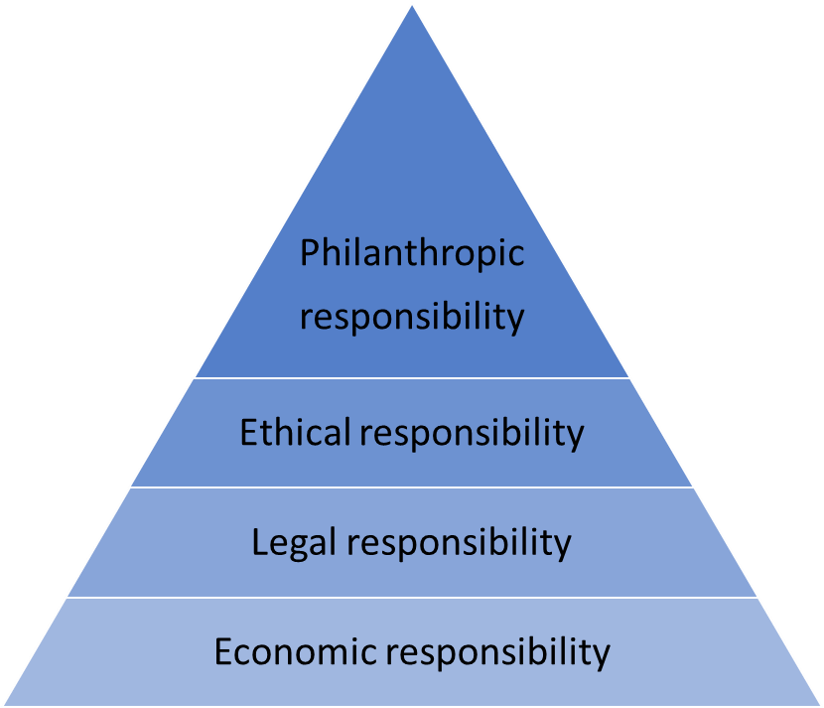 Arenas of CSR: economic (profit), legal (compliance), ethical (doing good), philanthropic (donations). (Image: Michel Awkal, CC BY-SA 4.0, via Openverse)
2. Theories of Business Ethics
A. Normative Ethical Frameworks
These theories provide rules or principles for ethical decision-making. No single theory fits all situations—companies often combine them.
flowchart TD
  A["Ethical Decision-Making Frameworks"] --> B["Deontological Ethics\n(Kant: Duty-based)"]
  A --> C["Utilitarianism\n(Greatest good for the most people)"]
  A --> D["Virtue Ethics\n(Character-based: honesty, courage)"]
  A --> E["Stakeholder Theory\n(Freeman: Balance interests of all affected parties)"]
  A --> F["Rights Theory\n(Respect human rights: e.g., no child labor)"]
Worked Example: Nabil Bank’s Loan Approval
- Deontological: "We must never approve loans based on bribes, even if it means losing business."
- Utilitarian: "Approving this loan helps 100 families but harms our reputation—what’s the net good?"
- Stakeholder: "How does this decision affect shareholders (profit), customers (trust), and society (corruption)?"
B. Stakeholder Theory (Edward Freeman, 1984)
- Definition: Businesses must consider the interests of all stakeholders, not just shareholders.
- Primary Stakeholders: Investors, employees, customers, suppliers, government.
- Secondary Stakeholders: Media, NGOs, local communities.
mindmap
  root((Stakeholder Theory))
    definition "Balance interests of all affected parties"
    primary
      investors "Profit & ROI"
      employees "Fair wages, safety"
      customers "Quality, transparency"
      suppliers "Fair contracts"
      government "Taxes, compliance"
    secondary
      media "Reputation"
      ngos "Ethical practices"
      community "Social impact"
Real-World Application: Daraz Nepal
- Stakeholders in Daraz’s Decision to Sell Counterfeit Goods:
- Investors: Higher profits from cheap goods → happy.
- Customers: Lower prices but risk of scams → mixed.
- Local Shops: Bankruptcy due to unfair competition → angry.
- Government: Loses tax revenue from unregulated sales → concerned.
- Society: Encourages black-market culture → harmed.
3. Business Ethics in Nepal: Key Issues
Nepal’s business environment faces unique ethical challenges due to weak enforcement, cultural norms, and poverty. Top issues:
A. Corruption
- Problem: Ranked 117/180 in Transparency International’s 2022 Corruption Perceptions Index.
- Examples:
- Customs Duty Evasion: Importers bribing officials to underdeclare goods (costs Nepal $500M/year in lost revenue).
- Contract Bid-Rigging: Government projects awarded to connected firms (e.g., road construction in Kathmandu).
- Ethical Dilemma:
"A Daraz supplier offers you Rs. 50,000 to delay a shipment so he can meet a competitor’s order. What do you do?"
- Deontological: "Never accept bribes—it’s wrong."
- Utilitarian: "If I refuse, the supplier goes bankrupt and 20 workers lose jobs."
B. Child Labor
- Problem: 1.2 million children (UNICEF 2021) work in hazardous jobs (brick kilns, carpet weaving, agriculture).
- Legal Status: Prohibited under the Labor Act 2075, but enforcement is weak.
- Case Study: Himalayan Java
- Issue: Some coffee farms in Ilam use child labor for harvesting.
- Solution: Partnered with Fair Trade Certified to ensure:
- No children under 15 work.
- Fair wages for adult workers.
- Community schools built.
C. Environmental Degradation
- Problems:
- Hydropower Projects: Unregulated dams (e.g., West Seti) displace communities and harm ecosystems.
- Plastic Pollution: Nepal produces 1.3M tons/year (only 20% recycled).
- Ethical vs. Legal:
- Legal: Environmental Protection Act 1996 requires EIAs (Environmental Impact Assessments).
- Ethical: Companies like Nepal Oxygen (bottled gas) use recycled cylinders to reduce waste.
4. Corporate Social Responsibility (CSR) in Nepal
CSR is not mandatory in Nepal (unlike India’s Companies Act), but leading firms adopt it for reputation and long-term gains.
A. CSR Models
| Model | Description | Nepali Example |
|---|---|---|
| Philanthropic | Donations, charity (short-term) | Nabil Bank’s "Nabil Foundation" funds scholarships for underprivileged students. |
| Ethical | Fair practices (e.g., no child labor, transparency) | Himalayan Java’s Fair Trade Certification. |
| Strategic | CSR aligned with business goals (long-term) | NTC’s "Digital Nepal" initiative trains youth in IT to reduce unemployment. |
| Integrated | CSR embedded in core business model | Pathao’s "Safe Ride" program for women drivers (reduces harassment). |
B. CSR in Action: Case Study – Nabil Bank
Challenge: Microfinance in rural Nepal often leads to debt traps (high interest rates exploit poor women). Solution: Nabil Foundation’s "Women’s Empowerment Program"
- Ethical: Charges fair interest rates (max 12% vs. 30% from moneylenders).
- Social: Trains women in financial literacy to avoid over-borrowing.
- Business: Reduced loan defaults by 40% → sustainable growth.
flowchart LR
  A["Nabil Bank's CSR Strategy"] --> B["Identify Issue\n(Women in debt traps)"]
  B --> C["Design Ethical Solution\n(Fair loans + training)"]
  C --> D["Implement\n(Nabil Foundation)"]
  D --> E["Measure Impact\n(40% fewer defaults)"]
  E --> F["Scale Up\n(Expand to 50 districts)"]
5. Ethical Decision-Making Process
How do companies (and students!) make ethical choices? Follow this 6-step framework:
flowchart TD
  A["1. Identify the Problem"] --> B["2. Gather Facts\n(Who’s affected? What’s the context?)"]
  B --> C["3. Define Ethical Issues\n(Is it fair? Legal? Right?)"]
  C --> D["4. Brainstorm Alternatives\n(What are the options?)"]
  D --> E["5. Evaluate Outcomes\n(Utilitarian? Deontological? Stakeholder impact?)"]
  E --> F["6. Choose & Act\n(Document the decision)"]
  F --> G["7. Review\n(Did it work? Adjust if needed)"]
Worked Example: eSewa’s Data Privacy Dilemma
- Problem: eSewa collects biometric data (fingerprints) for transactions. A hacker leaks this data.
- Steps:
- Problem: Privacy breach → identity theft risk.
- Facts: 5M users affected; Nepal has no strong data protection law (only the Electronic Transactions Act 2063, which is weak).
- Ethical Issues:
- Deontological: "We must protect user data—it’s our duty."
- Utilitarian: "If we encrypt data, transactions slow down → users leave."
- Alternatives:
- Option 1: Use biometric + PIN (more secure but complex).
- Option 2: Delete all biometric data (but lose fraud detection).
- Evaluation:
- Stakeholders: Users (trust), government (reputation), hackers (target).
- Legal: Violates right to privacy (Article 16 of Nepal’s Constitution).
- Choice: eSewa added two-factor authentication (biometric + OTP) and compensated affected users.
- Review: Reduced breaches by 60% but increased transaction time by 10%.
6. Legal vs. Ethical Responsibilities
| Aspect | Legal Responsibilities | Ethical Responsibilities |
|---|---|---|
| Scope | Mandatory (punishable by law) | Voluntary (guided by morals) |
| Enforcement | Courts, police, fines | Public opinion, reputation, conscience |
| Example in Nepal | Company Act 2063: Must file audits, pay taxes. | Nepal Rastra Bank’s Guidelines: Banks should not lend to corrupt officials (even if they pay high interest). |
| Penalty | Jail, fines (e.g., Rs. 1M for tax evasion) | Loss of customers, boycotts (e.g., Kathmandu’s "Clean City" campaign shamed littering businesses). |
Key Takeaway:
"You can be legal and unethical (e.g., selling expired medicine) or ethical and illegal (e.g., whistleblowing on corruption)."
7. Real-World Applications: How Nepali Companies Handle Ethics
Case 1: Himalayan Java – Ethical Sourcing
- Issue: Coffee farmers in Ilam were paid below subsistence wages.
- Solution:
- Fair Trade Certification: Guarantees minimum price (even if market crashes).
- Community Investment: Built schools and healthcare centers.
- Outcome: Tripled farmer incomes in 5 years.
Case 2: NTC – Balancing Profit and Public Interest
- Issue: NTC is a monopoly (government-owned). Should it lower prices (hurting profits) or keep them high (benefiting shareholders)?
- Ethical Approach:
- Stakeholder Theory: Prioritized affordable internet for students.
- Result: Launched "Digital Nepal" program (subsidized broadband in schools).
Case 3: Daraz – The Counterfeit Dilemma
- Issue: Selling fake brands (e.g., "Rolex" watches) at 10% of market price.
- Ethical Debate:
- Pro-Argument: "Lowers prices for poor customers."
- Con-Argument: "Hurts local businesses (e.g., Rolex Nepal) and encourages crime."
- Daraz’s Move: Banned counterfeit listings in 2022 after public backlash.
8. Exam Tip: How to Score Full Marks
A. Common Mistakes to Avoid
- ❌ Vague answers: "CSR is good for society" → Not enough. Explain how (e.g., "Nabil Bank’s microfinance reduces poverty").
- ❌ Ignoring Nepal context: Always relate theories to Nepali examples (e.g., corruption, child labor).
- ❌ Mixing law and ethics: "Business ethics is the same as business law" → Wrong. Ethics is moral, law is enforceable.
B. High-Scoring Answer Structure
Use the PEEL method for descriptive questions:
- Point: State the key idea.
- Explain: Define it clearly.
- Example: Use a Nepali company (Nabil, Himalayan Java, Daraz).
- Link: Connect back to the question.
Example Question: "Explain the sources of business ethics in Nepal." Top-Mark Answer:
Point: Business ethics in Nepal is influenced by four key sources: cultural norms, religious values, legal frameworks, and global standards. Explain:
- Cultural Norms: Nepali society values trust and relationships (e.g., "guthi" systems for community welfare).
- Religious Values: Hinduism/Buddhism emphasize dharma (duty)—e.g., fair business practices in Lumbini’s tourism sector.
- Legal Frameworks: Acts like the Company Act 2063 and Labor Act 2075 set minimum ethical standards (e.g., no child labor).
- Global Standards: Firms like Himalayan Java adopt Fair Trade to meet international ethical expectations. Example: Nabil Bank’s "No Bribery" policy aligns with legal (Anti-Corruption Act 2018) and ethical (stakeholder trust) principles. Link: These sources ensure businesses like Daraz must balance profit with societal trust to survive in Nepal’s competitive market.
C. Short-Answer Tips
For 1-mark definitions:
- Business Ethics: "Moral principles guiding business decisions to balance profit with fairness."
- CSR: "Voluntary actions by firms to address social and environmental challenges beyond legal requirements."
For 5-mark questions (e.g., "Discuss the importance of business ethics"):
- Introduction: Briefly define ethics.
- 3 Points (each with example):
- Builds Trust: Nabil Bank’s transparency → customer loyalty.
- Avoids Legal Risks: Ethical compliance reduces fines (e.g., labor law violations).
- Enhances Reputation: Himalayan Java’s Fair Trade → premium pricing.
- Conclusion: "Thus, ethics is not a cost but an investment in long-term success."
D. Case Study Approach
For case-based questions (e.g., "A agrees to rent his flat for marijuana packaging..."):
- Identify the ethical issue: Is it legal but unethical (e.g., renting for illegal use)?
- Apply frameworks:
- Deontological: "Renting for illegal activity is wrong, regardless of profit."
- Utilitarian: "If B pays rent, it funds crime → net harm."
- Legal vs. Ethical:
- Legal: Landlord can evict B for non-payment (Contract Act 2072).
- Ethical: Landlord should refuse the lease to avoid complicity in crime.
- Conclusion: "Thus, ethics overrides profit in this case."
In the Real World
Nabil Bank – Ethics in Microfinance
- Idea Used: Stakeholder Theory (balancing investor profits with borrower welfare).
- How: Nabil’s "Women’s Empowerment Loans" ensure fair interest rates (12%) and financial literacy training, reducing debt traps. This boosts trust and lowers defaults, benefiting all stakeholders.
Himalayan Java – Ethical Sourcing
- Idea Used: Virtue Ethics (practicing honesty and fairness in supply chains).
- How: By paying Fair Trade prices (even when market prices drop), they ensure farmers earn living wages. This prevents exploitation and builds long-term supplier loyalty.
Daraz – The Counterfeit Conundrum
- Idea Used: Utilitarianism vs. Deontological Ethics.
- How: Initially, Daraz allowed counterfeit sales (utilitarian: "lowers prices for poor customers"). But after public backlash and legal pressure, they banned fakes (deontological: "selling fakes is wrong, even if profitable"). This protected local businesses and restored trust.
Exam Practice Question
Question: "A company in Nepal is deciding whether to dump toxic waste in a river to cut costs. Discuss the ethical and legal implications using relevant theories." Model Answer:
**Ethical Implications**:
1. **Deontological Ethics**: Dumping waste is **inherently wrong**—it violates the duty to **protect nature and communities** (Kant’s categorical imperative).
2. **Utilitarianism**: Short-term cost savings may **harm 1000s downstream** (fishing communities, drinking water). The **net harm outweighs profit**.
3. **Stakeholder Theory**: Affects:
   - **Employees** (toxic exposure risks).
   - **Customers** (brand reputation damage).
   - **Government** (fines under **Environment Protection Act 1996**).
   - **Society** (health crises).

**Legal Implications**:
- **Environment Protection Act 1996**: **Prohibits industrial waste dumping** in water bodies. **Fine: Up to Rs. 5M + jail time**.
- **Local Government Act 2074**: Municipalities can **shut down** non-compliant factories.
- **Constitution of Nepal (2015)**: **Article 30** guarantees **right to clean environment**.

**Real-World Example**:
- **Case of "Arun Valley Paper Mills" (2019)**: Dumped waste into the **Koshi River**, causing fish deaths. **Fined Rs. 2M** and ordered to **relocate treatment plants**.

**Conclusion**:
The company must **choose ethical compliance**—dumping waste violates **both law and morality**. Alternatives:
- **Recycle waste** (costs Rs. 500K but saves Rs. 2M in fines).
- **Partner with a waste management firm** (e.g., **Nepal Waste Management Ltd**).
Thus, **ethics and law align** in this case: **illegal actions are also unethical**.
Based on the TU BBA syllabus for Legal Environment Business Nepal (MGT234), unit 3.
Discussion
Loading…