Sociology for Business ManagementUnit 912 min read
Power, Authority & Corporate Governance: Types, Theories & Business Impact
Unit 9 of Sociology for Business Management explores the distinctions between power and authority, Max Weber’s three types of authority, corporate governance frameworks (e.g., NEPSE’s compliance rules), and how these concepts shape organizational behavior in Nepali businesses like Nabil Bank or Daraz. Includes real-wor
TAKEAWAYS:
- Power vs. Authority: Power is the ability to influence (coercive or persuasive), while authority is legitimate power recognized by subordinates (e.g., a CEO’s orders vs. a union leader’s strike threats).
- Weber’s Three Authorities: Traditional (hereditary, e.g., royal families), Charismatic (personal appeal, e.g., Elon Musk), and Rational-Legal (rule-based, e.g., corporate bylaws).
- Corporate Governance: A system to balance stakeholder interests (shareholders, employees, regulators) via boards, audits, and transparency—critical for NEPSE-listed firms like Himalayan Java.
- Power in Organizations: French and Raven’s 5 bases of power explain how leaders (or even mid-level managers) gain compliance in Nepali workplaces.
- Ethics and Governance: Poor governance leads to scandals (e.g., Ncell’s past controversies), while strong governance attracts investors (e.g., Nabil Bank’s AAA rating).
- Exam Focus: Case studies (e.g., Tara Palmer Tomkinson’s media power) and SWOT analyses of governance structures are high-yield questions.
1. Power: The Invisible Force in Business
Definition: Power is the capacity to influence others’ behavior, even against their will. It exists in all organizations—from a Daraz delivery agent’s ability to prioritize orders to a bank manager’s authority to approve loans.
How Power Works in Business
Power can be exercised through:
- Coercive power: Threats or punishments (e.g., NTC terminating a contractor for delays).
- Reward power: Incentives (e.g., Pathao offering bonuses to top drivers).
- Legitimate power: Position-based (e.g., a factory foreman’s orders).
- Expert power: Knowledge or skills (e.g., a Kathmandu University professor advising a startup).
- Referent power: Charisma or admiration (e.g., a celebrity endorsing a product like Himalayan Java).
mindmap
  root((Power in Business))
    Coercive["NTC: Fines for traffic violations"]
    Reward["Pathao: Driver bonuses"]
    Legitimate["Nabil Bank: Branch manager's approvals"]
    Expert["Himalayan Java: Quality control team"]
    Referent["Daraz: Influencer partnerships"]
Worked Example: Power in Kathmandu Traffic
- Coercive: Police stop vehicles for overloading (physical force).
- Reward: Auto-rickshaw unions offer discounts to compliant drivers.
- Expert: Traffic engineers redesign routes (knowledge-based influence).
- Referent: A popular YouTuber’s video on "safe driving" changes public behavior.
2. Authority: Legitimate Power with Rules
Definition: Authority is power that is perceived as legitimate by those who obey it. Unlike raw power, authority is institutionalized—people accept it because it’s tied to roles, laws, or traditions.
Max Weber’s Three Types of Authority
| Type | Source | Example in Nepal | Merits | Drawbacks |
|---|---|---|---|---|
| Traditional | Custom, heredity, or ritual | Royal families, traditional guilds (e.g., Newari artisans) | Stability, cultural continuity | Resistance to change, inefficiency |
| Charismatic | Personal charm or extraordinary traits | Elon Musk (Tesla), Nepali political leaders | Inspires innovation, rapid change | Unstable, depends on leader’s presence |
| Rational-Legal | Laws, rules, or procedures | Corporate boards, NEPSE regulations | Predictability, meritocracy | Bureaucracy, slow decision-making |
Real-World Tie-In: Nabil Bank’s Authority Structure
- Rational-Legal: Board of Directors approves loans based on credit policies.
- Charismatic: The bank’s founder’s legacy still influences culture.
- Traditional: Some rural branches follow hereditary loan officer roles.
3. Corporate Governance: The Rules of the Game
Definition: Corporate governance is the system of rules, practices, and processes to direct and control a company, ensuring accountability to stakeholders (shareholders, employees, customers, society).
Key Components of Corporate Governance
flowchart TD
  A["Corporate Governance"] --> B["Board of Directors"]
  A --> C["Shareholder Rights"]
  A --> D["Transparency & Disclosure"]
  A --> E["Risk Management"]
  A --> F["Ethics & Compliance"]
  B --> B1["Independent Directors"]
  B --> B2["CEO Accountability"]
  D --> D1["NEPSE Filings"]
  D --> D2["Annual Reports"]
  F --> F1["Anti-Corruption Policies"]
  F --> F2["ESG Standards"]
Why It Matters for Nepali Businesses
- NEPSE-listed companies (e.g., Chaudhary Group) must follow SEBI-Nepal guidelines.
- Banks (Nabil, Global IME) face RBI/Nepal Rastra Bank oversight.
- Startups (Pathao, Daraz) adopt governance to attract investors.
Case Study: Himalayan Java’s Governance
- Board Diversity: Includes farmers, exporters, and financial experts.
- Transparency: Publishes fair-trade practices and carbon-footprint data.
- Stakeholder Engagement: Consults tea-pickers on wage policies.
4. Power and Authority in Action: French and Raven’s Bases
French and Raven expanded Weber’s ideas with 5 bases of power, applicable to Nepali workplaces:
| Base | Definition | Example in Nepal | Effectiveness |
|---|---|---|---|
| Legitimate | Authority from position | A Daraz zone manager assigning tasks | High (expected compliance) |
| Reward | Ability to give incentives | Ncell offering data bonuses to loyal users | Medium (depends on reward value) |
| Coercive | Ability to punish | NTC cutting off internet for unpaid bills | Short-term, creates resentment |
| Expert | Knowledge or skills | A Kathmandu University professor advising a startup | High (voluntary respect) |
| Referent | Charisma or admiration | A celebrity endorsing a product (e.g., Sushil Koirala for Himalayan Java) | Long-term brand loyalty |
Worked Example: Power in a Nepali Call Center (e.g., Ncell Customer Service)
- Legitimate: Team lead assigns shifts.
- Reward: Top performers get bonuses.
- Expert: Senior agents train new hires.
- Referent: A popular agent’s advice is followed by peers.
- Coercive: Poor performance leads to warnings.
5. Corporate Governance Frameworks in Nepal
Nepal follows global best practices adapted to local contexts:
| Framework | Key Features | Nepali Application |
|---|---|---|
| Cadbury Code (UK-inspired) | Independent boards, audit committees | Adopted by Nabil Bank and Global IME |
| OECD Principles | Stakeholder rights, transparency | NEPSE’s listing rules |
| Basel III (for Banks) | Capital requirements, risk management | Nepal Rastra Bank’s directives for banks |
| ESG (Environmental, Social, Governance) | Sustainability reporting | Himalayan Java’s fair-trade certifications |
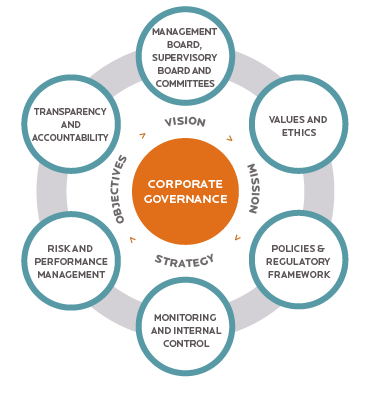 Comparison table with Nepali examples (Image: Asmi-corporatereporting.com, 2017, CC BY-SA 4.0, via Wikimedia Commons)
Real-World Example: NEPSE’s Governance Rules
- Mandatory Audits: All listed companies (e.g., Chaudhary Group) must submit financial statements.
- Independent Directors: At least 1/3 of the board must be independent.
- Shareholder Meetings: Quarterly reports and voting rights.
6. Power Dynamics in Nepali Organizations
Hierarchy vs. Informal Networks
graph LR
  A["Formal Hierarchy"] --> B["CEO"]
  B --> C["Managers"]
  C --> D["Employees"]
  E["Informal Networks"] --> F["Workplace Cliques"]
  F --> G["Gossip Chains"]
  G --> H["Unwritten Rules"]
  H -->|"Example"| I["Who you know > what you know"]
Case Study: Daraz Nepal’s Power Structure
- Formal: Regional managers report to HQ (Kathmandu).
- Informal: Delivery agents form groups to share routes and tips.
- Conflict: Formal rules may clash with informal loyalty (e.g., favoring friends for orders).
7. Ethics and Governance: When Power Goes Wrong
Scandals in Nepali Businesses
| Company | Issue | Governance Failure |
|---|---|---|
| Ncell | Past corruption allegations | Lack of independent board oversight |
| Global IME | Loan defaults | Weak risk management |
| Nepal Airlines | Safety concerns | Poor regulatory compliance |
How to Avoid Scandals
- Whistleblower Policies: Encourage reporting (e.g., Nabil Bank’s hotline).
- Transparency: Publish CSR reports (e.g., Himalayan Java’s sustainability data).
- Independent Audits: Regular third-party checks (e.g., NEPSE’s audits).
In the Real World
Khalti’s Power and Authority
- Expert Power: Khalti’s team uses fintech knowledge to design secure payment systems.
- Legitimate Power: Regulated by Nepal Rastra Bank (NRB), ensuring compliance.
- Referent Power: Users trust Khalti due to its convenience and celebrity endorsements (e.g., actors promoting Khalti for bill payments).
Daraz’s Corporate Governance
- Stakeholder Balance: Daraz Nepal must satisfy sellers, buyers, and Alibaba (parent company).
- Transparency: Publicly lists seller ratings and dispute resolutions.
- Risk Management: Uses AI to detect fake reviews (a governance tool).
Nabil Bank’s Loan Approvals
- Power Bases in Action:
- Expert: Loan officers assess credit scores.
- Legitimate: Board approves large loans.
- Reward: Low-interest rates for loyal customers.
- Governance: Follows Basel III norms to prevent defaults.
- Power Bases in Action:
Exam Tip
How to Score Full Marks
Case Study Analysis (20+ marks)
- Structure: Use the SOAR method (Strengths, Opportunities, Aspects, Results).
- Example: For Tara Palmer Tomkinson’s case:
- Power: Media influence (referent power).
- Authority: Limited (no formal role, but public trust).
- Governance: Lack of transparency in her business ventures.
Differentiate Power vs. Authority
- Power: Can be coercive (e.g., a union leader calling a strike).
- Authority: Legitimate (e.g., a judge’s ruling).
Corporate Governance Scopes
- List 5 key areas: Board structure, transparency, risk management, ethics, stakeholder rights.
Diagrams and Tables
- Mermaid flowcharts for governance processes.
- Comparison tables for Weber’s authority types or French and Raven’s power bases.
Real-World Links
- Always tie answers to Nepali examples (Nabil Bank, Daraz, NEPSE).
- Use headlines (e.g., "Ncell’s past controversies highlight weak governance").
Sample Answer Starter for Case Studies:
"The case of [X] illustrates [power/authority/governance concept]. For instance, [X’s action] demonstrates [base of power/type of authority], as seen when [specific example]. This aligns with [theory] because [explanation]. The governance implications are [impact], which can be mitigated by [solution]."
Final Visual Summary
mindmap
  root((Unit 9: Power, Authority & Governance))
    Power["French & Raven: 5 Bases"]
    Authority["Weber: Traditional/Charismatic/Rational-Legal"]
    Governance["NEPSE/Banks/ESG"]
    Ethics["Scandals & Compliance"]
    Nepal["Ncell, Daraz, Nabil Bank Cases"]
Based on the TU BBA syllabus for Sociology for Business Management (SOC203), unit 9.
Discussion
Loading…