Sociology for Business ManagementUnit 69 min read
Sociology of Work, Labour, and Entrepreneurship: Theories, Markets, and Business
Unit 6 of Sociology for Business Management explores the intersection of work, labor markets, and entrepreneurship through sociological lenses, analyzing theories, labor dynamics, and the role of social structures in shaping modern workplaces and business opportunities.
TAKEAWAYS:
- Work is a social institution shaped by cultural norms, economic systems, and power structures, not just individual effort.
- The labor market is influenced by social stratification, technology, and institutional policies (e.g., minimum wage laws, unionization).
- Entrepreneurship is both an economic activity and a social process, driven by cultural values, social capital, and risk-taking norms.
- Conflict, functionalist, and symbolic interactionist perspectives offer distinct explanations for workplace dynamics and labor disputes.
- Globalization and digitalization (e.g., e-commerce, gig work) have transformed labor markets, creating both opportunities and inequalities.
- Case studies (e.g., Daraz’s logistics, Ncell’s outsourcing) show how sociological factors impact business success or failure.
Core Concepts: Definitions and Frameworks
1. Sociology of Work: Beyond the Job Description
Work is not just a task but a social activity embedded in cultural, economic, and political contexts. Sociologists study:
- Division of labor: How tasks are allocated (e.g., skilled vs. unskilled, formal vs. informal).
- Workplace culture: Norms, values, and power hierarchies (e.g., nepotism in Nepali businesses, remote work in global firms).
- Alienation: Marx’s concept of workers feeling disconnected from their labor (e.g., assembly-line workers vs. artisans).
mindmap
  root((Sociology of Work))
    Concepts
      Division of Labor
        Formal (e.g., factories)
        Informal (e.g., street vendors)
      Workplace Culture
        Hierarchies
        Informal Networks
      Alienation
        Marxist View
        Modern Gig Economy
    Theories
      Marx: Class Conflict
      Weber: Bureaucracy
      Durkheim: Social Solidarity
    Real-World Examples
      Daraz Logistics
      Ncell Call Centers
2. Labor Market: More Than Supply and Demand
The labor market is a social system where:
- Structural factors (e.g., caste, gender, education) limit opportunities.
- Institutions (e.g., unions, government policies) shape wages and conditions.
- Technology (e.g., AI, automation) disrupts traditional jobs (e.g., auto-rickshaw drivers vs. ride-hailing apps like Pathao).
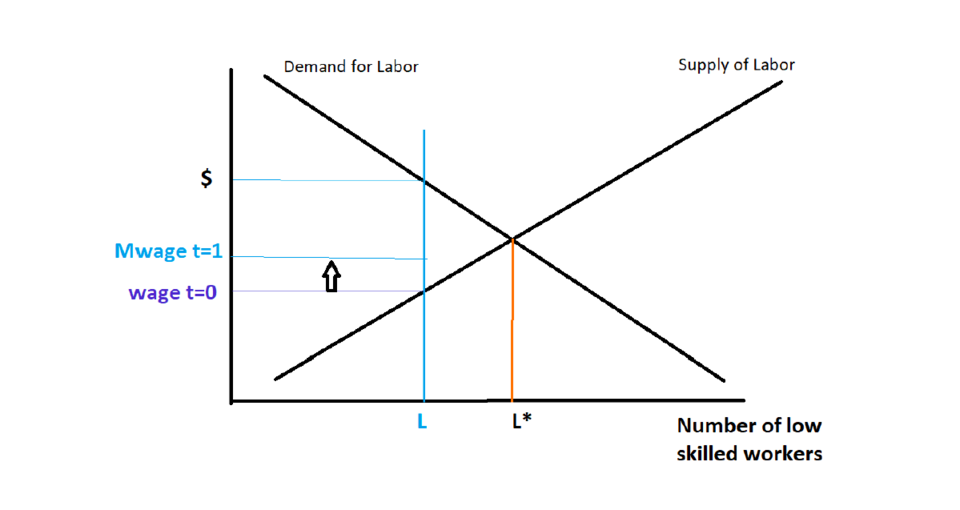 A graph showing how social factors (e.g., discrimination, skills gap) distort the equilibrium wage. (Image: JHKomlos, CC BY-SA 4.0, via Wikimedia Commons)
| Factor | Impact on Labor Market | Example in Nepal |
|---|---|---|
| Education | Determines employability | High unemployment among arts graduates |
| Gender | Wage gaps, occupational segregation | Women in low-paid informal sectors |
| Technology | Job displacement vs. new roles | Daraz replacing traditional retailers |
| Government Policy | Minimum wage, labor laws | NTC’s telecom job regulations |
Theoretical Perspectives on Work and Labor
1. Conflict Perspective (Marxist View)
- Key Idea: Work is a site of class struggle between employers and workers.
- Application:
- Exploitation: Workers are paid less than the value they produce (e.g., garment factory workers in Kathmandu).
- Resistance: Strikes, unions (e.g., NTF’s protests for better wages).
- Criticism: Overlooks cooperation and shared goals in workplaces.
2. Functionalist Perspective (Durkheim/Weber)
- Key Idea: Work integrates society and maintains order.
- Durkheim: Mechanical solidarity (traditional societies) vs. organic solidarity (modern, interdependent jobs).
- Weber: Bureaucracy rationalizes work (e.g., Ncell’s HR policies).
- Example: Nepali banks’ hierarchical structures ensure stability but limit innovation.
3. Symbolic Interactionism
- Key Idea: Work is shaped by daily interactions and meanings.
- Example: A Daraz delivery agent’s identity is tied to their bike and customer relations.
- Workplace rituals: Morning tea breaks, office gossip (e.g., in Himalayan Java).
## In the Real World
Daraz’s Logistics Network
- Idea: Division of labor and informal economy
- How: Daraz relies on informal workers (e.g., local delivery agents) who lack benefits but provide flexibility. Sociologically, this reflects flexible capitalism (precarious work) and digital platform governance.
Ncell’s Customer Service Outsourcing
- Idea: Global labor market and social stratification
- How: Ncell outsources call-center jobs to lower-cost regions (e.g., India, Philippines). This shows how technology and globalization create transnational labor hierarchies, often exploiting cheaper labor.
Khalti’s Gig Economy
- Idea: Symbolic interactionism and work identity
- How: Khalti’s payment app enables freelancers (e.g., tutors, drivers). Their work is fluid and identity-based—users see themselves as "digital entrepreneurs," not traditional employees.
## Worked Example: NTC’s Telecom Job Market
Scenario: NTC hires engineers but faces high turnover. Why? Analysis:
- Conflict Perspective: Low wages vs. high qualifications → frustration.
- Functionalist View: Poor workplace culture (e.g., nepotism) weakens solidarity.
- Symbolic Interaction: Engineers’ identity clashes with bureaucratic rigidity. Solution: NTC could adopt flexible work policies (e.g., remote options) and transparency in promotions to align with modern labor expectations.
Entrepreneurship: A Sociological Lens
1. Definition
Entrepreneurship is not just starting a business but a social process influenced by:
- Cultural values (e.g., Nepali preference for family businesses).
- Social capital (networks, trust—e.g., Chaudhary Group’s connections).
- Risk tolerance (e.g., youth vs. older entrepreneurs).
2. Sociology of Entrepreneurship
| Factor | Impact | Nepali Example |
|---|---|---|
| Family Businesses | Social support but limited innovation | Himalayan Java’s legacy coffee trade |
| Gender | Women face financing barriers | Fewer female entrepreneurs in tech |
| Urban vs. Rural | Access to capital and markets | Kathmandu’s startup hub vs. rural cooperatives |
3. Challenges in Nepal
- Informal economy: 80% of Nepali workers lack social security (e.g., Pathao drivers).
- Cultural barriers: Stigma against "failure" deters risk-taking.
- Policy gaps: Lack of startup incubators (vs. India’s "Startup India").
## Case Study: Pathao’s Gig Work Revolution
Background: Pathao, Nepal’s ride-hailing app, employs 100,000+ drivers as independent contractors. Sociological Analysis:
- Flexible Capitalism: Drivers set their own hours but lack benefits.
- Digital Surveillance: Pathao tracks performance via ratings (symbolic interaction—identity tied to app scores).
- Urban Informality: Drivers operate outside formal labor laws (conflict with unions).
Outcome: Pathao’s model reflects global gig economy trends but raises ethical questions about worker exploitation vs. economic freedom.
Exam Tip
- Theory Application: Always link concepts to real Nepali examples (e.g., Daraz for division of labor, Ncell for bureaucracy).
- Case Studies: Expect short-answer questions on companies like Khalti or Pathao—analyze them using 2-3 theories.
- Definitions: Memorize key terms:
- Labor market: Social system matching workers to jobs.
- Entrepreneurship: Socially embedded economic activity.
- Diagrams: Draw mindmaps for theories (Marx vs. Weber) or flowcharts for labor processes (e.g., hiring at Nabil Bank).
- Critical Analysis: For questions like "How does conflict theory explain work?", contrast it with functionalist views using Nepali data (e.g., wage gaps).
Key Takeaways for Exam Success
- Work is social: Use Durkheim’s solidarity or Marx’s class struggle to explain workplace issues.
- Labor markets are unequal: Cite gender, caste, or education as barriers (e.g., in NTC hiring).
- Entrepreneurship needs networks: Highlight family businesses or digital platforms (e.g., Khalti).
- Visuals win marks: Sketch organizational trees (e.g., Chaudhary Group) or labor market graphs.
- Link to Nepal: Every answer should tie to Daraz, Ncell, Pathao, or banks to show real-world relevance.
Final Challenge: "How would a functionalist vs. conflict theorist explain the success of Himalayan Java?"
- Functionalist: Strong social cohesion (family values) and tradition sustain the business.
- Conflict: The Chaudhary family’s power exploits workers while maintaining control.
Based on the TU BBA syllabus for Sociology for Business Management (SOC203), unit 6.
Discussion
Loading…