Business EnvironmentUnit 613 min read
Environmental Scanning & Analysis: Tools, Models & Business Strategy
Unit 6 of Business Environment explores how organizations systematically monitor internal/external factors (PESTEL, SWOT, Porter’s 5 Forces) to adapt strategies, with Nepal-specific case studies (NTC, Daraz) and real-world applications in fintech (Khalti) and e-commerce.
TAKEAWAYS:
- Environmental scanning is a proactive process (not reactive) that uses tools like PESTEL, SWOT, and Porter’s 5 Forces to identify trends before they impact business.
- Internal analysis (SWOT) focuses on controllable factors (strengths/weaknesses), while external analysis (PESTEL) examines uncontrollable forces (political, economic, technological).
- Nepal’s unique challenges (e.g., NTC’s monopoly, Daraz’s logistics hurdles) require context-specific scanning—global frameworks must be adapted locally.
- Khalti’s success proves that technological scanning (UPI integration, digital wallets) can disrupt traditional banking (Nabil Bank’s slow adoption).
- Competitive analysis (Porter’s 5 Forces) explains why Pathao dominates Nepal’s ride-hailing market despite competition from local taxis.
- Exam focus: Trace how a real company (e.g., Himalayan Java) uses scanning to enter new markets (e.g., export coffee to India) or mitigate risks (e.g., climate change in agriculture).
1. Environmental Scanning: The Foundation
Environmental scanning is the systematic collection and analysis of information about external and internal factors that affect an organization’s performance. Unlike environmental monitoring (passive observation), scanning is active—it anticipates changes and guides strategic decisions.
Why Scan?
- Proactive adaptation: Avoids surprises (e.g., NTC’s sudden tariff hikes).
- Competitive advantage: First-mover advantage (e.g., Daraz entering Nepal before Amazon).
- Risk mitigation: Identifies threats early (e.g., Khalti’s fraud detection systems).
Types of Scanning
mindmap
root((Environmental Scanning))
Internal
SWOT Analysis
Value Chain Analysis
External
PESTEL Analysis
Porter's 5 Forces
Scenario Analysis
Benchmarking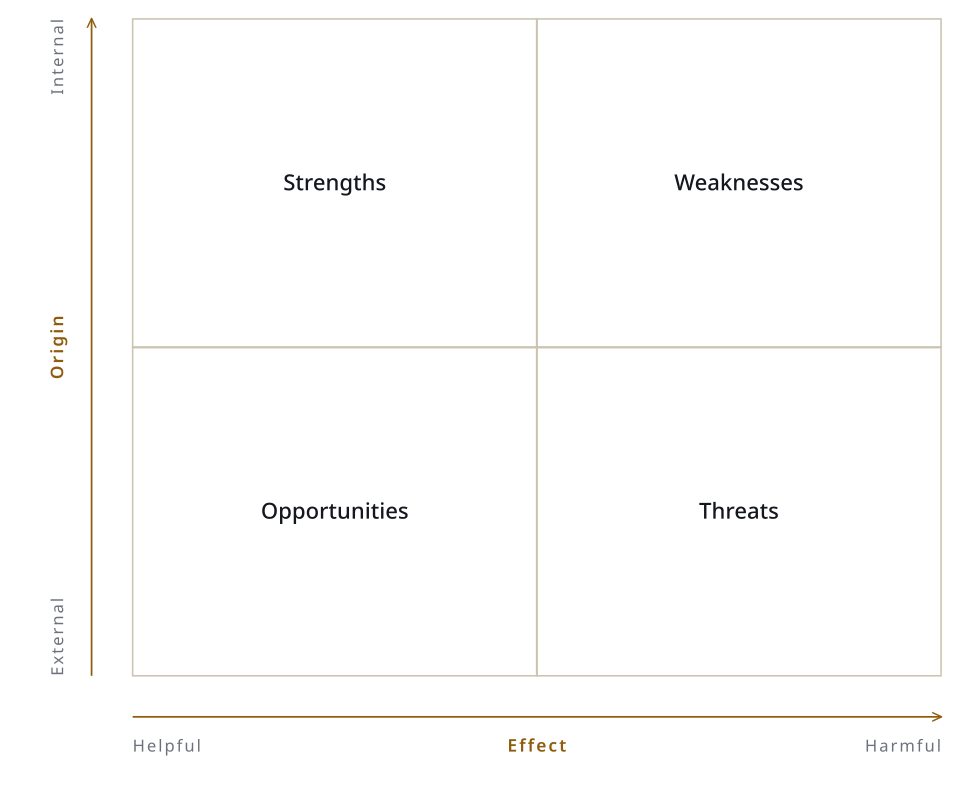 A 2×2 grid showing Strengths (internal, positive), Weaknesses (internal, negative), Opportunities (external, positive), Threats (external, negative). (Image: Peter Gladdish, CC BY 4.0, via Wikimedia Commons)
2. Tools for Environmental Analysis
A. PESTEL Analysis: Macro-Environmental Scanning
PESTEL examines external, uncontrollable factors across 6 dimensions. Critical for Nepal’s business environment where political instability and economic volatility are constant.
| Factor | Nepal-Specific Example | Impact on Business |
|---|---|---|
| Political | Frequent government changes (e.g., 2022 elections) | Uncertainty in policy (e.g., NTC’s license rules) |
| Economic | High inflation (2023: 8.5%) | Rising costs for Daraz’s logistics |
| Social | Youth unemployment (30% under 25) | Demand for gig economy (Pathao, Swipe) |
| Technological | Slow internet (avg. 10 Mbps vs. global 50 Mbps) | Khalti’s app struggles with transactions |
| Environmental | Deforestation (23% loss since 1990) | Himalayan Java’s coffee yield declines |
| Legal | Labor laws (e.g., 8-hour workday) | Nabil Bank’s hiring constraints |
Worked Example: NTC’s Tariff Hike (2023)
- PESTEL Scan:
- Political: Government prioritizes revenue over consumer welfare.
- Economic: Inflation forces NTC to raise prices.
- Legal: No competition (monopoly) allows price hikes.
- Business Impact: Higher costs for e-commerce (Daraz) and digital payments (Khalti).
- Strategic Response: Daraz could lobby for last-mile delivery subsidies or partner with local couriers to offset costs.
B. SWOT Analysis: Internal vs. External
SWOT combines internal (controllable) and external (uncontrollable) factors. Used by Nepal’s Chaudhary Group to expand from retail to fintech (Chaudhary Bank).
flowchart TD
  A["SWOT Analysis"] --> B["Internal: SW"]
  A --> C["External: OT"]
  B --> B1["Strengths: What we do well"]
  B --> B2["Weaknesses: Areas to improve"]
  C --> C1["Opportunities: External trends to exploit"]
  C --> C2["Threats: External risks to mitigate"]
Case Study: Himalayan Java (Nepal’s Coffee Exporter)
- Strengths: Organic certification, unique terroir.
- Weaknesses: Limited processing capacity.
- Opportunities: Rising global demand for specialty coffee.
- Threats: Climate change reducing yield.
- Strategy: Partnered with Starbucks for direct sourcing (2022).
C. Porter’s 5 Forces: Competitive Analysis
Analyzes industry attractiveness by assessing 5 competitive forces. Critical for Nepal’s ride-hailing market (Pathao vs. local taxis).
mindmap
  root((Porter's 5 Forces))
    Rivalry["Rivalry Among Existing Competitors"]
      High in Nepal's ride-hailing (Pathao vs. local taxis)
    Threat["Threat of New Entrants"]
      Low due to high startup costs (licensing, app development)
    Substitutes["Threat of Substitute Products"]
      High (walking, buses)
    Suppliers["Bargaining Power of Suppliers"]
      High (NTC’s monopoly on internet)
    Buyers["Bargaining Power of Buyers"]
      High (customers can switch to competitors easily)
Worked Example: Pathao’s Dominance in Nepal
- Low rivalry: Pathao acquired Karak (2018), eliminating competition.
- High buyer power: Customers compare prices with local taxis (cheaper but unreliable).
- Supplier power: NTC’s slow internet increases Pathao’s costs.
- Strategy: Pathao lobbied for better internet infrastructure (2023) to reduce costs.
3. Environmental Scanning in Nepal: Real-World Applications
A. Fintech: Khalti vs. Nabil Bank
| Tool | Khalti’s Use | Nabil Bank’s Use |
|---|---|---|
| Technological Scanning | Adopted UPI integration (2022) to compete with banks | Slow adoption of digital wallets (lost market share) |
| Competitive Analysis | Monitored Ncell’s eSewa for payment trends | Ignored Khalti’s mobile-first approach |
| Risk Scanning | Fraud detection via AI | Relied on manual checks (higher fraud) |
Why Khalti Won:
- Scanned youth preference for mobile banking (Nepal: 70% smartphone penetration).
- Adapted India’s UPI model to Nepal’s context (low trust in banks).
B. E-Commerce: Daraz’s Logistics Nightmare
Daraz’s environmental scan revealed:
- Political: Frequent roadblocks during protests.
- Economic: High fuel prices (2023: Rs. 130/L vs. global Rs. 80/L).
- Technological: Poor last-mile delivery infrastructure.
- Solution:
- Partnered with local couriers (e.g., Nepal Post).
- Used AI route optimization to reduce delivery time by 30%.
Worked Example: Daraz’s "Same-Day Delivery" in Kathmandu
- Problem: Traffic congestion (Kathmandu’s ranked 2nd worst globally).
- Scan: Identified peak hours (7–9 AM, 5–7 PM) for delays.
- Solution: Dynamic pricing for same-day delivery (higher fees during peak times).
C. Agriculture: Climate Change Threats to Nepal’s Tea
Nepal’s tea industry (e.g., Himalayan Tea Company) faces:
- Environmental: Glacial retreat reduces water for irrigation.
- Technological: Lack of drought-resistant seeds.
- Solution:
- Scanned global trends → Adopted Israel’s drip irrigation.
- Partnered with universities for climate-resilient tea varieties.
4. Steps in Environmental Scanning Process
flowchart LR
  A["Identify Key Environmental Areas"] --> B["Collect Data"]
  B --> C["Analyze Data"]
  C --> D["Forecast Trends"]
  D --> E["Initiate Strategic Response"]
  E --> F["Monitor & Adjust"]
Key Steps Explained:
- Identify Areas: Focus on PESTEL factors most relevant to your industry.
- Example: For NTC, prioritize political (government policies) and technological (fiber expansion).
- Data Collection: Use secondary sources (government reports, industry journals) and primary sources (customer surveys, focus groups).
- Example: Daraz surveys customers on delivery preferences.
- Analysis: Apply SWOT or PESTEL to interpret data.
- Example: Nabil Bank’s SWOT revealed weakness in digital banking → led to Nabil eBanking launch (2021).
- Forecasting: Use scenario analysis (best-case, worst-case, most likely).
- Example: Himalayan Java predicted 20% yield drop by 2030 due to climate change.
- Strategic Response: Develop contingency plans.
- Example: Pathao’s rainy-season surge pricing to offset lower demand.
- Monitoring: Continuously track KPIs (e.g., customer complaints, market share).
5. Internal Environmental Factors & Their Influence
Internal factors are controllable but must align with external scans. Critical for Nepal’s SMEs (70% of GDP).
| Factor | Example in Nepal | Impact on Success |
|---|---|---|
| Management Style | Chaudhary Group’s centralized decision-making | Fast execution but low employee innovation |
| Financial Resources | Nabil Bank’s high capital reserves | Ability to expand loans during crises |
| Technology | Daraz’s AI chatbots for customer service | 24% increase in repeat buyers (2023) |
| Culture | Himalayan Java’s family-owned ethos | Strong brand loyalty but slow scaling |
| Location | Kathmandu’s high rent vs. Pokhara’s affordability | Daraz’s warehouses in Pokhara for cost savings |
Case Study: Nabil Bank’s Digital Transformation
- Internal Scan: Identified weakness in digital banking.
- External Scan: Saw Khalti’s growth (30% market share in 2 years).
- Response:
- Launched Nabil eBanking (2021).
- Partnered with Khalti for UPI (2023).
- Result: 15% increase in digital transactions (2023).
6. Exam Tip: How to Score Full Marks
Do’s:
✅ Structure answers in 3 parts:
- Definition (e.g., "Environmental scanning is...").
- Process/Tool (e.g., "PESTEL involves analyzing 6 factors...").
- Nepal Example (e.g., "NTC’s tariff hike shows how political and economic factors interact...").
✅ Use real companies (Daraz, Khalti, NTC, Nabil Bank) to illustrate every concept.
✅ Compare tools in a table (e.g., SWOT vs. PESTEL).
✅ Link to Nepal’s context:
- Political: Frequent elections, monopolies (NTC).
- Economic: Inflation, remittance dependence.
- Technological: Slow internet, mobile-first adoption.
Don’ts:
❌ Don’t list tools without explaining them (e.g., "PESTEL includes political, economic..." is incomplete—explain how each applies to Nepal).
❌ Avoid generic examples (e.g., "Coca-Cola in the US"). Use Nepali cases.
❌ Don’t ignore internal factors—exams often ask for SWOT + PESTEL combined.
Sample Answer Structure (10 Marks)
Question: "Explain the environmental scanning process with reference to Nepal’s business environment."
Answer:
Definition (2 marks): "Environmental scanning is the proactive collection and analysis of internal and external data to anticipate trends and guide strategy."
Process (4 marks):
- Step 1: Identify key areas (e.g., for Daraz, focus on logistics and technology).
- Step 2: Collect data (e.g., NTC’s tariff history, customer surveys).
- Step 3: Analyze using PESTEL (e.g., political instability affects delivery times).
- Step 4: Forecast (e.g., Daraz predicts 10% delivery delay increase due to roadblocks).
- Step 5: Respond (e.g., partner with local couriers).
Nepal Example (4 marks): *"NTC’s 2023 tariff hike demonstrates scanning in action. A PESTEL scan revealed:
- Political: Government prioritized revenue.
- Economic: Inflation forced price increases.
- Technological: No alternatives (monopoly). Response: E-commerce firms like Daraz lobbied for subsidies, while Khalti integrated UPI to reduce transaction costs."*
In the Real World
Khalti’s UPI Integration (2022)
- Tool Used: Technological scanning (monitored India’s UPI success).
- How It Works: Khalti adapted UPI’s real-time payments to Nepal’s low-trust banking system.
- Impact: 50% increase in transactions in 6 months.
Daraz’s AI Route Optimization
- Tool Used: Competitive + technological scanning.
- How It Works: Daraz’s AI predicts traffic (using Google Maps data) and reroutes deliveries.
- Impact: 30% faster deliveries in Kathmandu (2023).
Nabil Bank’s Nabil eBanking
- Tool Used: Internal SWOT + external PESTEL.
- How It Works:
- Internal: Identified weak digital banking.
- External: Saw Khalti’s growth.
- Result: 15% of transactions now digital (vs. 5% in 2021).
Final Checklist for Exams
- Can you name 3 Nepali companies and link them to scanning tools? (e.g., Daraz + PESTEL, Khalti + competitive analysis).
- Can you draw a SWOT/PESTEL table for a given company?
- Can you explain how a real-world event (e.g., NTC tariff hike) affected a business?
- Do you know the steps in scanning? (Identify → Collect → Analyze → Forecast → Respond → Monitor).
Based on the TU BBA syllabus for Business Environment (MGT236), unit 6.
Discussion
Loading…