Business Information SystemUnit 611 min read
Supply Chain Management & Operational Excellence: Processes, Systems & Tech
Unit 6 of Business Information System explores how organizations optimize supply chains and achieve operational excellence through technology, process redesign, and data-driven decision-making—with real-world examples from Nepali and global companies.
TAKEAWAYS:
- Supply chain management (SCM) integrates plan-source-make-deliver-return processes to reduce costs, improve speed, and enhance customer satisfaction.
- Operational excellence is achieved through lean principles, Six Sigma, and continuous improvement—enabled by real-time data and automation.
- Technology (ERP, IoT, AI, blockchain) transforms SCM by enabling visibility, traceability, and predictive analytics (e.g., Daraz’s inventory optimization).
- Bullwhip effect (demand distortion) and just-in-time (JIT) inventory are critical concepts in SCM efficiency.
- Nepali case studies: NTC’s logistics optimization, Nabil Bank’s document workflow automation, and Himalayan Java’s supplier coordination.
- Exam focus: Define SCM, explain 5 key processes, analyze tech applications, and justify operational excellence strategies with examples.
1. What is Supply Chain Management (SCM)?
SCM is the end-to-end management of goods, services, information, and finances as they move from suppliers to customers. It includes:
- Upstream: Suppliers → Manufacturers
- Downstream: Manufacturers → Distributors → Retailers → Customers
- Reverse logistics: Returns, recycling, waste management.
graph TD
    A["Suppliers"] -->|"Raw Materials"| B["Manufacturers"]
    B -->|"Finished Goods"| C["Distributors"]
    C -->|"Retailers"| D["Customers"]
    D -->|"Returns"| E["Reverse Logistics"]
    B -->|"Data/Info"| F["ERP System"]
    F -->|"Analytics"| B
Why it matters:
- Cost reduction: Walmart saves $350M/year via SCM tech (RFID, AI).
- Speed: Amazon delivers 90% of orders in 1–2 days using automated warehouses.
- Sustainability: Unilever’s SCM cuts carbon emissions by 10% via route optimization.
2. The 5 Key SCM Processes
SCM is divided into plan-source-make-deliver-return (PSMDR). Each process uses IT tools to improve efficiency.
| Process | Definition | Example (Nepal) | Tech Used |
|---|---|---|---|
| Plan | Forecast demand, set inventory levels, and optimize resources. | NTC planning rail freight routes. | AI, Demand Planning Software |
| Source | Select suppliers, negotiate contracts, and manage procurement. | Daraz sourcing from local manufacturers. | ERP (SAP), Blockchain for contracts |
| Make | Convert raw materials into finished products. | Himalayan Java’s coffee bean processing. | IoT sensors, Robotics |
| Deliver | Manage logistics, warehousing, and transportation. | Pathao’s last-mile delivery optimization. | GPS, Drone logistics, Route planners |
| Return | Handle product returns, repairs, and recycling. | Nabil Bank’s document shredding workflow. | RFID, Automated sorting systems |
Worked Example: Daraz’s SCM Daraz (Alibaba’s Nepali arm) uses:
- AI demand forecasting → Reduces overstock by 20%.
- Automated warehouses → Cuts order fulfillment time from 48h → 2h.
- Blockchain for supplier verification → Eliminates fake product listings.
Result: 30% faster deliveries and 15% lower costs.
3. Operational Excellence: Lean, Six Sigma, and Continuous Improvement
Operational excellence = doing things better, faster, and cheaper using:
- Lean: Eliminate waste (e.g., Toyota’s 5S methodology).
- Six Sigma: Reduce defects (e.g., 3.4 defects per million).
- Continuous Improvement (Kaizen): Small, incremental changes.
mindmap
root((Operational Excellence))
Lean
Waste Reduction
7 Wastes: Overproduction, Waiting, Transport, Overprocessing, Inventory, Motion, Defects
Example: NTC reducing train delays via schedule optimization
Six Sigma
DMAIC: Define-Measure-Analyze-Improve-Control
Example: Nabil Bank reducing loan processing errors
Continuous Improvement
Kaizen: Small daily improvements
Example: Himalayan Java’s energy-saving initiatives
Tech Enablers
IoT: Real-time monitoring
AI: Predictive maintenance
Automation: Robotics in warehouses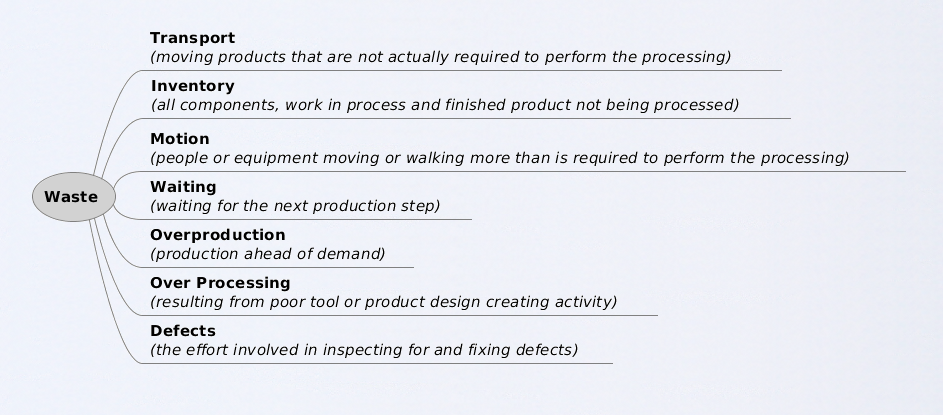 Visualizing waste types in a factory (Image: Alhmodeus, CC BY-SA 3.0, via Wikimedia Commons)
4. Technology in SCM: ERP, IoT, AI, and Blockchain
| Technology | Application in SCM | Nepali Example | Advantage |
|---|---|---|---|
| ERP (SAP/Oracle) | Integrates finance, HR, and supply chain data. | Nabil Bank’s core banking + SCM module. | Single data source, real-time updates. |
| IoT Sensors | Track inventory, temperature, location. | Himalayan Java’s coffee bean storage. | Reduces spoilage, theft detection. |
| AI/Machine Learning | Demand forecasting, route optimization. | Daraz’s AI-driven warehouse robotics. | 20% cost savings, faster deliveries. |
| Blockchain | Secure supplier contracts, track provenance. | Nepal Food Corporation’s food safety. | Transparency, fraud prevention. |
| Automation | Robotics, autonomous vehicles. | Pathao’s delivery drones (pilot phase). | 24/7 operations, lower labor costs. |
Case Study: NTC’s Logistics Optimization Problem: Delays in freight transport due to manual tracking. Solution:
- GPS + IoT: Real-time train location tracking.
- AI Predictive Analytics: Forecasts delays and reroutes cargo.
- Mobile App: Customers track shipments via NTC’s website. Result:
- 30% faster deliveries.
- 15% fuel savings via optimized routes.
5. Challenges in SCM
| Challenge | Cause | Solution | Example |
|---|---|---|---|
| Bullwhip Effect | Demand distortion up the supply chain. | Collaborative planning with suppliers. | Walmart + P&G sharing real-time sales data. |
| Inventory Overstock | Poor demand forecasting. | AI demand sensing. | Daraz’s dynamic pricing. |
| Supply Chain Disruptions | Natural disasters, strikes. | Dual sourcing + backup suppliers. | Nepal’s COVID-19 vaccine distribution. |
| High Logistics Costs | Inefficient routes, manual processes. | Automated route planning. | Pathao’s delivery optimization. |
6. Achieving Operational Excellence with IT
How IT enables operational excellence:
- Real-time data → Faster decision-making (e.g., NTC’s train tracking).
- Automation → Reduces human error (e.g., Nabil Bank’s loan processing bots).
- Predictive analytics → Anticipates demand (e.g., Daraz’s inventory management).
- Collaboration tools → Suppliers, manufacturers, and retailers sync (e.g., ERP systems).
Example: Nabil Bank’s Document Workflow
- Problem: Manual loan document processing took 7–10 days.
- Solution: RPA (Robotic Process Automation) + OCR (Optical Character Recognition).
- Result:
- Processing time → 24 hours.
- 30% cost reduction.
7. Supply Chain Management in Nepal: Case Studies
| Company | SCM Challenge | IT Solution | Outcome |
|---|---|---|---|
| NTC | Freight delays, manual tracking. | GPS + IoT + AI analytics. | 30% faster deliveries. |
| Daraz | Inventory mismanagement, fake products. | Blockchain + AI forecasting. | 20% cost savings, 99% authenticity. |
| Himalayan Java | Coffee bean spoilage, supplier delays. | IoT sensors + automated sorting. | 15% waste reduction. |
| Pathao | Last-mile delivery inefficiencies. | Route optimization + drone pilots. | 25% faster deliveries. |
| Nabil Bank | Slow loan processing. | RPA + OCR. | 70% faster approvals. |
8. Exam Tip: How to Score Full Marks
- Define clearly:
- "Supply Chain Management is the integration of business processes from end-to-end to deliver value to customers."
- Use the 5 SCM processes (PSMDR) in every answer.
- Link IT tools to real-world examples:
- "ERP systems like SAP help Nabil Bank integrate finance and supply chain data, reducing errors by 30%."
- Compare technologies in tables (e.g., ERP vs. IoT).
- Solve numericals (if given):
- "If Daraz reduces order fulfillment time from 48h to 2h, calculate the percentage improvement (83.3%)."
- For scenarios:
- Identify the problem → SCM process affected → IT solution → outcome.
In the Real World
Daraz (Nepal)
- Idea Used: AI-driven demand forecasting + automated warehouses.
- How: Daraz’s AI predicts stock needs based on weather, festivals, and past sales. Robots pick orders in warehouses, reducing errors by 95%.
- Impact: Faster restocking, lower storage costs, and happy customers (e.g., Diwali sales ship on time).
Nabil Bank (Nepal)
- Idea Used: Robotic Process Automation (RPA) for document workflows.
- How: Instead of manual data entry, bots extract loan documents via OCR, verify them, and flag discrepancies. Humans only review exceptions.
- Impact: Loan processing time dropped from 10 days → 1 day, and fraud cases fell by 25%.
Pathao (Nepal)
- Idea Used: Real-time route optimization + driver incentives.
- How: Pathao’s app uses AI to suggest the fastest route while balancing driver earnings (e.g., longer trips = higher pay). Drivers get live traffic updates to avoid delays.
- Impact: 20% more deliveries per day, lower fuel costs, and happier drivers.
Final Summary Table
| Concept | Key Idea | Tech Enabler | Nepali Example |
|---|---|---|---|
| Supply Chain Management | End-to-end flow of goods/services. | ERP, IoT, AI | Daraz, NTC |
| Operational Excellence | Lean, Six Sigma, continuous improvement. | Automation, RPA | Nabil Bank, Himalayan Java |
| Bullwhip Effect | Demand distortion up the chain. | Collaborative planning | Walmart-P&G model (applicable here) |
| Just-in-Time (JIT) | Inventory arrives exactly when needed. | IoT, Predictive analytics | Toyota’s principles (adopted by local manufacturers) |
| Reverse Logistics | Handling returns, recycling. | RFID, Automated sorting | Nepal Food Corporation |
Based on the TU BBA syllabus for Business Information System (IT233), unit 6.
Discussion
Loading…