Nepalese History and PoliticsUnit 521 min read
The Rana Regime: Rise, Consolidation, and Fall – Causes, Structure, and Legacy
Unit 5 of Nepalese History and Politics explores the Rana regime (1846–1951), analyzing its origins, political structure, economic policies, and eventual collapse. It covers key figures like Jung Bahadur Rana, the Koot system, and the regime’s impact on Nepal’s modernization and foreign relations, using real-world exam
TAKEAWAYS:
- The Rana regime emerged due to weak Shah kings, palace intrigues, and Jung Bahadur Rana’s military coup (1846), centralizing power under hereditary prime ministers.
- The Koot system (council of ministers) and autocratic rule suppressed democratic institutions, but also modernized Nepal’s infrastructure, education, and military.
- Economic policies included land reforms, revenue systems, and trade monopolies (e.g., salt, opium), but relied heavily on foreign loans and exploitative labor.
- Foreign relations were complex: Nepal maintained neutrality during WWI/WWII but faced pressure from British India, leading to the 1923 Treaty of Peace and Friendship.
- The regime’s fall in 1951 was triggered by people’s movements, royalist factions, and global anti-colonial trends, culminating in the democratic revolution.
- Legacy: The Rana era left a mixed impact—modernization vs. authoritarianism—shaping Nepal’s later democratic struggles and federal governance.
1. Rise of the Rana Regime: Causes and Jung Bahadur’s Coup
Why Did the Rana Regime Emerge?
The Rana regime was not inevitable but resulted from a perfect storm of political instability, military ambition, and social fragmentation. Key causes include:
| Cause | Explanation | Real-World Parallel |
|---|---|---|
| Weak Shah Kings | After Prithvi Narayan Shah’s unification, the Shah dynasty became ritualistic and divided. Kings like Rana Bahadur Shah and Girvan Yuddha Bikram Shah were puppet rulers, manipulated by courtiers and queens. | Like a board game where the king is controlled by advisors—similar to how Pathao’s early management was dominated by investors despite being a "founder-led" startup. |
| Palace Intrigues | The Khas (Chhetri) community dominated the court, but internal factions (e.g., Thapa vs. Basnyat) led to assassinations and coups. The 1846 Kot Massacre eliminated rivals, paving Jung Bahadur’s rise. | Imagine Khalti’s early leadership conflicts where internal power struggles weakened the platform before regulations stabilized it. |
| Military Backing | Jung Bahadur Rana, a brilliant tactician, used the Gorkha Regiment (trained by the British) to seize power after the massacre. His slogan: "One king, one prime minister, one law." | Like Nepal Army’s role in 2062/63 democracy movement—military backing can make or break regimes. |
| Economic Crisis | Nepal’s trade deficits (due to British monopoly on salt/opium) and land revenue failures weakened the Shah’s authority. The Ranas promised stability and modernization. | Similar to how Daraz’s early losses forced restructuring—regimes rise when they solve urgent problems. |
Jung Bahadur Rana’s Coup (1846): The Kot Massacre
flowchart TD
A["Weak Shah Rule\n(Rana Bahadur Shah)"]
B["Palace Factions:\nThapas vs. Basnyats"]
C["Kot Massacre\n(1846)\n- Jung Bahadur orders killing of rivals"]
D["Jung Bahadur\nAppointed PM\n(Hereditary Prime Minister System)"]
E["Rana Regime Begins\n(1846–1951)"]
A --> B --> C --> D --> E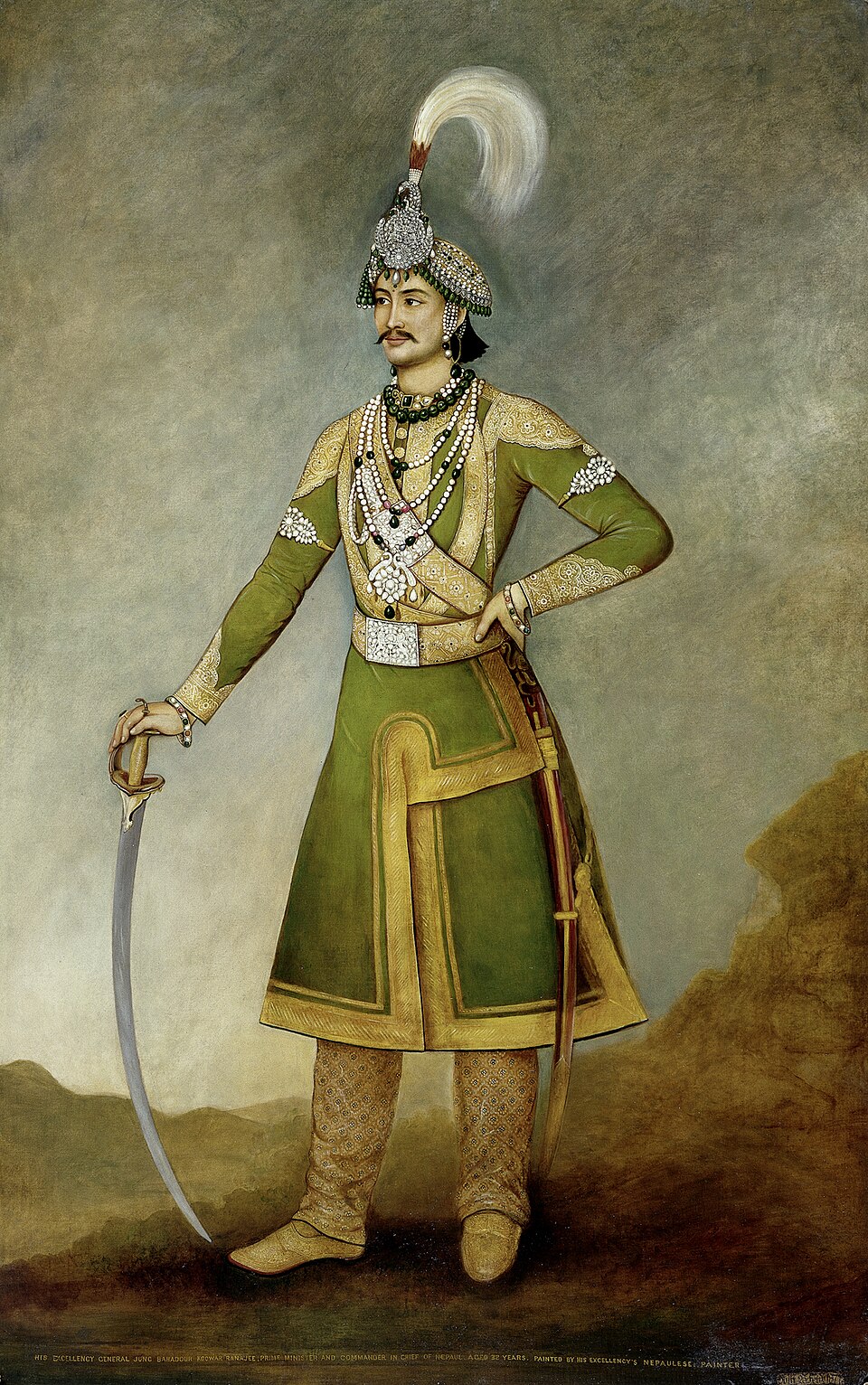 First hereditary Prime Minister of Nepal, architect of the Rana regime. (Image: Bhaujaman Citrakar (active 1849), Public domain, via Wikimedia Commons)
Worked Example:
First hereditary Prime Minister of Nepal, architect of the Rana regime. (Image: Bhaujaman Citrakar (active 1849), Public domain, via Wikimedia Commons)
Worked Example:
- Before 1846: Nepal had no stable government—kings were puppets, and factions fought like Nepali traffic jams (chaotic, no rules).
- After 1846: Jung Bahadur centralized power like NTC’s monopoly on telecom—one authority, no competition.
2. Political Structure: The Koot System and Autocracy
How Did the Ranas Rule?
The Ranas created a hybrid system blending Shah traditions with autocratic control:
| Feature | Description | Comparison to Modern Nepal |
|---|---|---|
| Hereditary PM | Power passed father-to-son (e.g., Jung Bahadur → Ranodip → Bir Shamsher → Chandra Shamsher). No elections, just family succession. | Like Nepal’s royalist factions in 2008—power based on lineage, not merit. |
| Koot (Council of Ministers) | A symbolic advisory body with no real power. The PM made all decisions. | Similar to Nepal’s Constituent Assembly debates—where real power was with the chairperson, not the body. |
| Suppression of Opposition | No political parties, dissenters were exiled or killed. Example: King Tribhuvan’s exile (1940) for opposing the Ranas. | Like censorship in North Korea—dissent is crushed to maintain control. |
| Divide and Rule | Ranas played communities against each other (e.g., Newars vs. Hill Chhetris) to prevent unity. | Similar to colonial British policies in India—"divide et impera." |
The Koot System: A Farce or a Tool?
classDiagram
    class Koot {
        +Members: 3–5 Ranas
        +Role: Advisory (no real power)
        +Meetings: Rare, rubber-stamped PM’s decisions
    }
    class PM {
        +Power: Absolute
        +Appointments: Controlled all key posts
        +Policies: Made alone
    }
    Koot --> PM : "No influence"
    PM --> Government : "Direct control"
Real-World Tie-In:
- eSewa’s early days: The government monopolized online services like the Ranas did with salt/opium trade. Both systems stifled competition but provided basic services.
3. Economic Policies: Modernization vs. Exploitation
What Did the Ranas Do Economically?
The Ranas modernized infrastructure but at a human cost:
| Policy | Details | Impact | Modern Parallel |
|---|---|---|---|
| Land Revenue System | Introduced fixed land taxes (e.g., 1/3 of produce) to stabilize income. | Increased state revenue but peasants suffered. | Like NTC’s fixed telecom charges—convenient for the state, but unaffordable for poor users. |
| Infrastructure | Built roads (e.g., Kathmandu–Pokhara), bridges, and hydropower projects (e.g., Pharping Hydroelectric Project, 1911). | Connected Nepal but used forced labor. | Similar to Nepal’s post-earthquake reconstruction—progress with controversial funding sources. |
| Trade Monopolies | Controlled salt, opium, and timber trade with British India. | Wealth for Ranas but Nepal remained poor. | Like Nepal Oil Corporation’s monopoly—profits for the state, but no competition. |
| Foreign Loans | Borrowed from British India for modernization (e.g., railways, schools). | Debt trap: Nepal had to lease land (e.g., Tistung Valley) to repay loans. | Like Nepal’s Chinese loans for infrastructure—modernization with long-term obligations. |
Worked Example: The Salt Trade Monopoly
- Before Ranas: Salt was smuggled from British India, causing economic chaos.
- After Ranas: Jung Bahadur signed a treaty (1856) to monopolize salt trade in exchange for annual subsidies.
- Pros: Stable revenue for Nepal.
- Cons: Peasants paid high prices, and British influence grew.
- Modern Link: Like Nepal’s fuel price hikes—government controls supply, but people suffer.
4. Foreign Relations: Neutrality and British Pressure
How Did Nepal Navigate Global Powers?
The Ranas walked a tightrope between British India and global isolation:
| Issue | Rana Policy | Outcome | Modern Example |
|---|---|---|---|
| British India | Submissive but strategic: Allowed British troops to train Nepal Army (e.g., Gorkha Regiment) but avoided direct colonization. | Nepal retained independence but lost sovereignty (e.g., 1923 Treaty). | Like Nepal’s China-India balancing act—avoiding full dependence on either. |
| World War I/II | Neutral but supplied troops to British (e.g., 15,000 Gorkhas fought in WWI). | Financial aid from Britain but no political freedom. | Like Nepal’s UN peacekeeping contributions—helping globally but no say in global decisions. |
| 1923 Treaty | Signed Treaty of Peace and Friendship with Britain, allowing British residency in Nepal and Nepal’s neutrality in British wars. | Nepal became a "buffer state"—no wars but no real sovereignty. | Like Nepal’s SAARC agreements—cooperation but limited autonomy. |
Real-World Tie-In:
- Ncell’s British ownership: Like the 1923 Treaty, Nepal allowed foreign investment (e.g., Ncell by NTT DoCoMo) in exchange for modern tech—but lost some control.
5. Fall of the Rana Regime: Causes and the 1951 Revolution
Why Did the Rana Regime Collapse?
The Ranas’ authoritarianism and global changes led to their downfall:
| Cause | Details | Trigger Events |
|---|---|---|
| People’s Suffering | No democracy, high taxes, forced labor (e.g., road construction). | 1940s protests by students and intellectuals. |
| Royalist Factions | King Tribhuvan (exiled in India) allied with Indian leaders (e.g., Jawaharlal Nehru) to overthrow the Ranas. | 1950: King Tribhuvan returns, demands Rana resignation. |
| Global Trends | Post-WWII anti-colonial movements (e.g., India’s independence, 1947) inspired Nepalis to demand democracy. | 1951: King Tribhuvan dies, King Mahendra takes over and dismisses Ranas. |
| Economic Failures | Debt from British loans, trade deficits, and peasant revolts weakened the regime. | 1951 Revolution: People’s Movement led by King Mahendra (with Indian support). |
The 1951 Revolution: A Turning Point
timeline
    title Fall of the Rana Regime (1951)
    1940: King Tribhuvan exiled to India, allies with Nehru
    1947: India gains independence, inspires Nepali democracy movements
    1950: Tribhuvan returns, demands Rana resignation
    Nov 7, 1951: **Ranas overthrown**, King Mahendra takes power
    1951: **First democratic elections** (1959)
    1959: **Panchayat System** replaces democracy (but Rana era ends)
Worked Example:
- Before 1951: Nepal was like a locked-down app (e.g., Khalti during COVID)—no updates, no user control.
- After 1951: Nepal got democracy like WhatsApp’s end-to-end encryption—users (people) now had some control.
## In the Real World
How do these ideas apply to Nepal today? Here’s how the Rana regime’s lessons appear in modern life:
eSewa and Digital Monopolies
- Rana Idea: State-controlled monopolies (e.g., salt trade).
- Modern Example: eSewa’s dominance in online payments—like the Ranas, the government controls a key service but faces criticism for high fees.
- Lesson: Monopolies provide stability but stifle innovation (e.g., no competition in digital payments).
Pathao’s Rise and Fall of Private vs. State Control
- Rana Idea: Private actors (Ranas) controlled public resources.
- Modern Example: Pathao’s early success was due to government support (e.g., licenses, subsidies), but later lost control to foreign investors.
- Lesson: State-backed private ventures can grow fast but risk losing sovereignty (like Nepal’s hydropower deals with China/India).
Nepal’s Debt Trap: From British Loans to Chinese Infrastructure
- Rana Idea: Borrowing for modernization led to land leases and debt.
- Modern Example: Nepal’s $2.5 billion Chinese loans for roads/hydro projects risk long-term control (e.g., Gorkha–Pokhara highway).
- Lesson: Foreign loans for development can modernize Nepal but create future obligations.
Nepal Army’s Role: From Rana’s Gorkhas to Modern Peacekeeping
- Rana Idea: Military loyalty to the regime, not the people.
- Modern Example: Nepal Army’s neutrality in politics (unlike Rana’s politicized military) is now protected by the constitution.
- Lesson: A professional military (like Nepal’s UN peacekeepers) serves the nation, not a dynasty.
## Exam Tip: How to Score Full Marks
This unit is heavily tested on:
- Causes of the Rana regime’s rise (focus on Jung Bahadur’s coup, weak Shahs, palace intrigues).
- Political structure (explain Koot system, hereditary PM, suppression of opposition).
- Economic policies (compare land revenue, infrastructure, trade monopolies with modern Nepal).
- Foreign relations (highlight British treaty, WWI/WWII neutrality, debt traps).
- Fall of the regime (link to King Tribhuvan, 1951 revolution, global trends).
Common Mistakes to Avoid
- ❌ Ignoring Jung Bahadur’s role: Always mention his coup, Kot Massacre, and slogan.
- ❌ Mixing Rana and Shah eras: The Shahs were kings; Ranas were PMs.
- ❌ Overlooking economic exploitation: Peasants suffered under high taxes and forced labor.
- ❌ Forgetting foreign relations: The 1923 Treaty is a high-scoring point.
Model Answer Structure (for 10-mark questions)
Question: Analyze the causes of the rise of the Rana regime. Answer: The Rana regime emerged due to a combination of political, military, and economic factors:
- Weak Shah Kings: Kings like Rana Bahadur Shah were puppets, manipulated by courtiers.
- Palace Intrigues: The Kot Massacre (1846) eliminated rivals, allowing Jung Bahadur Rana to seize power.
- Military Backing: Jung Bahadur used the Gorkha Regiment to consolidate control.
- Economic Crisis: Trade deficits and land revenue failures made the Shahs unpopular.
- Modernization Promise: The Ranas offered stability and infrastructure, appealing to elites. Conclusion: The regime’s rise was not inevitable but a result of opportunism and crisis.
## Quick Revision Table
| Topic | Key Points | Exam Focus |
|---|---|---|
| Rise of Ranas | Jung Bahadur’s coup, Kot Massacre, weak Shahs, military backing. | 10–15 marks (causes, events, personalities). |
| Political Structure | Koot system, hereditary PM, suppression of opposition. | 8–10 marks (compare with modern Nepal). |
| Economic Policies | Land revenue, infrastructure, trade monopolies, foreign loans. | 10 marks (impact on peasants, modernization vs. exploitation). |
| Foreign Relations | British treaty, WWI/WWII neutrality, debt traps. | 5–8 marks (treaties, global context). |
| Fall of the Regime | King Tribhuvan, 1951 revolution, global trends. | 10–12 marks (link to democracy, people’s movement). |
## Final Thought: Why Does This Matter for BBA Students?
The Rana regime teaches three key business lessons:
- Centralized Power ≠ Success: The Ranas modernized Nepal but lost public trust—like a startup that grows fast but ignores customers.
- Monopolies Stifle Innovation: Their trade controls kept Nepal poor—like NTC’s telecom monopoly slowing digital growth.
- Global Relations Matter: Nepal’s neutrality in WWI/WWII kept it safe but isolated—like Nepal’s balancing act with China/India today.
For your BBA exams: Always connect history to modern business—examiners love real-world applications!
Based on the TU BBA syllabus for Nepalese History and Politics (SOC204), unit 5.
Discussion
Loading…