Consumer BehaviourUnit 410 min read
Consumer Learning & Memory: Types, Models & Real-World Applications
Unit 4 of Consumer Behaviour explores how consumers acquire knowledge (learning theories), store information (memory systems), and apply these processes in decision-making, with Nepali case studies like Himalayan Organics and Ncell promotions.
TAKEAWAYS:
- Learning in consumer behaviour follows classical (Pavlov), operant (Skinner), and cognitive (Bandura) theories—each explains how habits form (e.g., Daraz’s "free delivery" rewards).
- Memory has three systems: sensory (fleeting), short-term (7±2 items), and long-term (semantic networks)—Nepali brands like Khalti use repetition to move info from short-term to long-term.
- Elaboration likelihood model (ELM) shows how deep processing (central route) vs. superficial cues (peripheral route) influence memory retention (e.g., Himalayan Organics’ herbal claims vs. NTC’s billboard ads).
- Schema theory explains how consumers categorize products (e.g., "fast food" schema for Jai Bhaiya vs. "organic" schema for Himalayan Organics).
- Forgetting curves (Ebbinghaus) apply to marketing: consumers forget 50% of ad messages in 24 hours unless reinforced (e.g., Ncell’s repeated SMS promotions).
- Neuromarketing uses fMRI scans to measure memory encoding (e.g., Pathao’s app design triggers dopamine for repeat use).
1. Consumer Learning: Theories and Applications
Learning is the process by which consumers acquire knowledge or modify existing knowledge through experience, observation, or reasoning. For marketers, understanding how consumers learn helps design effective advertising, product placements, and loyalty programs.
1.1 Types of Learning Theories
mindmap
  root((Consumer Learning Theories))
    Classical Conditioning["🔗 Pavlov (Stimulus-Response)"]
      example["🍔 Jai Bhaiya’s smell triggers hunger (unconditioned stimulus) → paired with TV ads (conditioned stimulus) → hunger when seeing ads"]
      marketer_use["Use jingles, mascots, or scents (e.g., Himalayan Organics’ herbal fragrance in stores)"]
    Operant Conditioning["🎯 Skinner (Reinforcement)"]
      example["📱 Pathao rewards frequent riders with cashback (positive reinforcement) → repeat usage"]
      types["Positive (reward), Negative (remove penalty), Punishment (discourage), Extinction (ignore)"]
    Cognitive Learning["🧠 Bandura (Observation & Imitation)"]
      example["👗 Seeing influencers wear Himalayan Organics → consumers mimic the purchase"]
      marketer_use["Celebrity endorsements, user-generated content (e.g., Daraz reviews)"]
    Social Learning["👥 Group Influence"]
      example["🚗 Toyota’s ‘safety first’ ads reinforced by word-of-mouth in families"]
**1.2 How Learning Affects Consumer Behaviour
- Habit Formation: Repeated exposure to stimuli (e.g., Ncell’s "Hello Nepal" jingles) reduces decision-making effort.
- Brand Loyalty: Operant conditioning (e.g., Khalti’s cashback) creates repeat purchases.
- Product Trial: Free samples (e.g., Himalayan Organics’ trial kits) reduce perceived risk.
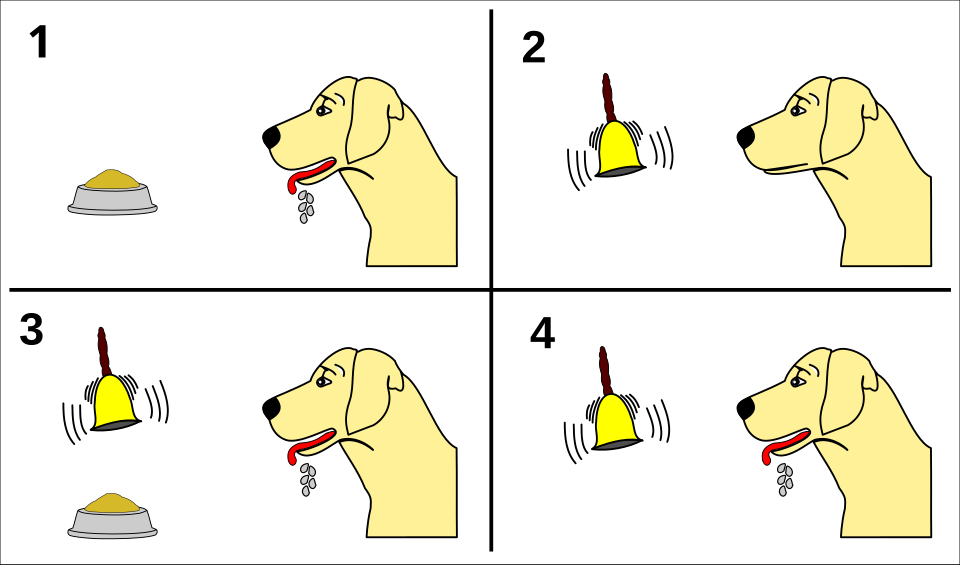 Classical conditioning: How unconditioned (food) and conditioned (bell) stimuli create responses. (Image: Maxxl², CC BY-SA 4.0, via Wikimedia Commons)
2. Memory Systems in Consumer Decision-Making
Memory is the retention of learned information over time. Consumers use memory to recall brands, features, and past experiences when making purchase decisions.
2.1 Types of Memory
| Memory Type | Duration | Capacity | Example in Nepal | Marketing Application |
|---|---|---|---|---|
| Sensory Memory | < 1 second | High (unlimited) | Glimpse of a Daraz ad on a bus | Use bold visuals/sounds (e.g., NTC’s loud ads) |
| Short-Term Memory | 20–30 seconds | 7±2 items | Remembering a Khalti promo code | Keep messages short (e.g., "50% off, code: SAVE50") |
| Long-Term Memory | Permanent | Unlimited | Recall of Himalayan Organics’ benefits | Storytelling ads (e.g., "Herbal since 1998") |
2.2 Memory Encoding: How Information is Stored
flowchart TD
  A["Sensory Input\n(e.g., seeing a Ncell ad)"] --> B["Attention\n(Selective perception)"]
  B --> C["Encoding\n(Meaningful processing)"]
  C --> D["Storage\n(Short-term → Long-term)"]
  D --> E["Retrieval\n(Recalling during purchase)"]
Key Encoding Methods:
- Visual Encoding: Remembering a Himalayan Organics bottle’s green color.
- Acoustic Encoding: Recall of a jingle (e.g., "Chaudhary Group’s ‘Desh ko badalne’").
- Semantic Encoding: Understanding that "organic" means "chemical-free" (Himalayan Organics’ claim).
3. Forgetting and Retention: The Ebbinghaus Curve
Consumers forget information over time unless reinforced. The forgetting curve (Ebbinghaus, 1885) shows that:
- 50% of info is forgotten in 1 hour if not reinforced.
- 70% forgotten in 24 hours without repetition.
Application in Nepal:
- Ncell sends SMS reminders after 1 day of a promo.
- Himalayan Organics runs ads in cycles (e.g., monthly Facebook campaigns).
- Daraz uses retargeting ads for abandoned carts.
graph LR
  A["Time\n(0 hours)"] -->|"50% forgotten"| B["1 hour"]
  B -->|"70% forgotten"| C["24 hours"]
  C -->|"80% forgotten"| D["1 week"]
4. Schema Theory: How Consumers Categorize Products
Schema is a mental framework that organizes knowledge. Consumers use schemas to simplify decision-making.
Example: Fast Food Schema in Nepal
mindmap
  root((Fast Food Schema))
    Jai Bhaiya["🍢 Spicy, cheap, quick"]
    KFC["🍗 Western, fried, premium"]
    Momo["🥟 Tibetan, dumpling, street food"]
    Attributes["Price: Low-Medium", "Taste: Spicy/Sweet", "Setting: Roadside/Restaurant"]
Marketing Implications:
- Himalayan Organics positions itself as the "organic health" schema (vs. "chemical beauty" schema of L’Oréal).
- Nabil Bank uses the "trustworthy institution" schema in ads (e.g., "Since 1982").
5. Neuromarketing: Measuring Memory and Emotion
Neuromarketing uses brain scans (fMRI, EEG) to study how consumers encode and retrieve memories.
Real-World Example: Pathao’s App Design
- Dopamine Trigger: The app’s green "Confirm Ride" button activates pleasure centers when users complete a ride.
- Memory Reinforcement: Repeated use creates a habit loop (cue: need a ride → routine: open Pathao → reward: discount).
In the Real World
Himalayan Organics
- Learning: Uses classical conditioning by pairing their herbal scent with "natural beauty" in ads.
- Memory: Reinforces long-term memory with schema consistency ("organic = healthy skin").
- Forgetting Curve: Runs quarterly loyalty programs to combat forgetting.
Ncell Promotions
- Operant Conditioning: Offers cashback for top-ups (positive reinforcement).
- Short-Term Memory: Uses bold SMS headlines (e.g., "FREE 1GB! Code: HAPPY") to grab attention.
- Neuromarketing: Colors like red (urgency) and green (trust) are psychologically tested.
Daraz’s "Free Delivery" Strategy
- Cognitive Learning: Consumers observe others getting free delivery → imitate.
- Memory: The Daraz logo + free delivery tagline becomes a mental shortcut for "no extra cost."
- Forgetting Curve: Sends abandoned cart emails within 1 hour.
Exam Tip
How to Score Full Marks
Define + Explain + Example
- Bad: "Short-term memory holds 7 items."
- Good:
"Short-term memory (STM) is a limited-capacity system (7±2 items) that temporarily stores information (e.g., a Khalti promo code ‘KHALTI50’) for 20–30 seconds. Marketers use chunking (e.g., ‘SAVE50’ instead of ‘50%OFF’) to improve retention."
Compare with Tables
- Always use 2-column tables for differences (e.g., Classical vs. Operant Conditioning).
Use Nepali Cases
- Link theories to Himalayan Organics, Ncell, or Daraz (examiners love local examples).
Diagrams > Text
- Draw memory systems, learning theories, or schema mindmaps in exams (even rough sketches earn marks).
Forgetting Curve Question Trick
- If asked about retention, always mention repetition/reinforcement (e.g., "Ncell’s SMS reminders combat forgetting").
Worked Example: Himalayan Organics’ Launch
Scenario: Himalayan Organics introduces a new sunscreen. How do learning and memory theories apply?
Step-by-Step Analysis:
Classical Conditioning:
- Unconditioned Stimulus (US): Natural sun protection (herbal ingredients).
- Conditioned Stimulus (CS): Green bottle + "100% Organic" label.
- Result: Seeing the bottle triggers trust (like Pavlov’s dog salivation).
Operant Conditioning:
- Reinforcement: "Buy 2, Get 1 Free" trial offer.
- Outcome: Repeat purchases due to positive reinforcement.
Schema Theory:
- Consumers categorize it under "organic skincare" schema (vs. "chemical sunscreen" schema like Garnier).
Memory Encoding:
- Visual: Green bottle color.
- Semantic: "Herbal = safe for sensitive skin."
- Retention: Monthly Facebook ads reinforce long-term memory.
Forgetting Curve:
- Solution: Quarterly loyalty programs (e.g., "Summer Glow Kit") to re-activate memory.
Exam Answer Structure:
"Himalayan Organics leverages classical conditioning by associating their green bottle with natural sun protection, creating a conditioned response of trust. Operant conditioning is used via ‘Buy 2, Get 1 Free’ trials to encourage repeat purchases. Schema theory positions the product under the ‘organic skincare’ category, differentiating it from chemical brands. To combat the forgetting curve, they employ repetition (monthly ads) and reinforcement (loyalty programs). Neuromarketing principles are applied through sensory cues (herbal scent) that trigger emotional memory encoding."
Common Pitfalls to Avoid
- ❌ Mixing theories: Don’t say "Pavlov’s dogs use operant conditioning."
- ❌ Ignoring Nepali context: Always tie answers to Himalayan Organics, Ncell, or Daraz.
- ❌ Overcomplicating: Examiners prefer clear examples over vague definitions.
- ❌ Forgetting the "why": Always explain how the theory applies to marketing (e.g., "This helps consumers remember the brand").
Based on the TU BBA syllabus for Consumer Behaviour (MKM201), unit 4.
Discussion
Loading…