Investment AnalysisUnit 810 min read
Derivatives & Short-Term Investments: Types, Mechanics & Applications
Unit 8 of Investment Analysis explores derivatives (futures, options, swaps, forwards) and short-term investments (T-bills, commercial paper, CDs), their valuation, risks, and real-world use in hedging, speculation, and liquidity management—with Nepalese and global examples.
TAKEAWAYS:
- Derivatives are financial contracts whose value depends on an underlying asset (e.g., stocks, commodities, interest rates), used for hedging or speculation.
- Short-term investments (e.g., T-bills, commercial paper) offer liquidity and low risk but yield lower returns than long-term assets.
- Futures and forwards are binding agreements; options give the right (not obligation) to buy/sell at a set price.
- Interest rate swaps help companies manage debt costs, while currency swaps mitigate exchange rate risks.
- Nepal’s NEPSE and global platforms (e.g., NSE India) use derivatives for market efficiency and risk transfer.
1. Introduction to Derivatives
Derivatives are financial instruments whose value is derived from an underlying asset (e.g., stocks, bonds, commodities, interest rates, or currencies). They are used for:
- Hedging: Protecting against price fluctuations (e.g., a wheat farmer locking in a future price).
- Speculation: Betting on price movements (e.g., traders profiting from stock index rises).
- Arbitrage: Exploiting price differences across markets.
Types of Derivatives
classDiagram
    class Derivatives {
        <<Abstract>>
        +Value derived from underlying asset
    }
    class Forwards {
        +Customizable terms
        +No exchange-traded
        +Delivery at maturity
    }
    class Futures {
        +Standardized contracts
        +Traded on exchanges
        +Daily settlement (mark-to-market)
    }
    class Options {
        +Right (not obligation)
        +Premium paid upfront
        +Call/Put types
    }
    class Swaps {
        +Exchange of cash flows
        +Interest rate/currency swaps
    }
    Derivatives <|-- Forwards
    Derivatives <|-- Futures
    Derivatives <|-- Options
    Derivatives <|-- Swaps
2. Forwards and Futures: Key Differences
| Feature | Forwards | Futures |
|---|---|---|
| Trading | OTC (over-the-counter) | Exchange-traded (e.g., NSE India) |
| Standardization | Custom terms (quantity, expiry) | Standardized (contract size, expiry) |
| Settlement | Delivery at maturity | Daily mark-to-market (cash settlement) |
| Liquidity | Low (counterparty risk) | High (exchange guarantees) |
| Example | A Nepalese importer locking in USD/INR rate | NEPSE’s futures on Nifty 50 index |
Worked Example: Hedging with Futures (Nepal Context)
- Scenario: A Kathmandu-based exporter expects to receive $50,000 in 3 months but fears INR depreciation.
- Action: The exporter buys USD-INR futures at Rs 150/USD (current spot rate: Rs 148).
- Outcome:
- If INR weakens to Rs 155/USD, the futures contract limits loss to Rs 5/USD × 50,000 = Rs 250,000.
- If INR strengthens (e.g., Rs 145/USD), the exporter gains from the futures position.
3. Options: Calls and Puts
Options grant the right (not obligation) to buy (call) or sell (put) an asset at a fixed price (strike price) by a specific date (expiry).
Option Types
mindmap
  root((Options))
    Call Option
      +Right to **buy** at strike price
      +Used when expecting price **rise**
      +Example: Buying a call on NEPSE index if bullish
    Put Option
      +Right to **sell** at strike price
      +Used when expecting price **fall**
      +Example: Farmers selling put options on wheat futures
    Intrinsic Value
      Call: Max(Spot Price - Strike, 0)
      Put: Max(Strike - Spot Price, 0)
    Time Value
      +Premium = Intrinsic Value + Time Value
      +Decays as expiry nears (theta decay)
Real-World Example: NEPSE’s Index Options
- Product: NEPSE offers call/put options on the NEPSE Index (e.g., strike at 2,500).
- Use Case: An investor buys a call option at Rs 50 premium, expecting the index to rise above 2,500.
- If index hits 2,600, profit = (2,600 - 2,500) × lot size - Rs 50 premium.
- If index falls, loss is limited to the Rs 50 premium.
4. Swaps: Interest Rate and Currency Swaps
Swaps involve exchanging cash flows between parties to manage risk.
Interest Rate Swap
- Example: A bank borrows in fixed rate (10%) but wants floating rate (e.g., 6-month LIBOR + 2%).
- Mechanism:
- Bank pays floating rate to a counterparty (e.g., another bank).
- Receives fixed rate (10%) in return.
- Net effect: Bank effectively borrows at LIBOR + 2% instead of 10%.
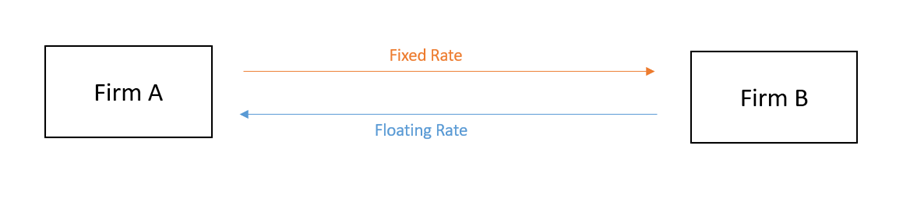 A flowchart showing two parties exchanging fixed and floating payments over time. (Image: Ayvabomford, CC BY-SA 4.0, via Wikimedia Commons)
Currency Swap (Nepalese Context)
- Example: A Nepalese company (receiving USD revenue) wants to hedge against INR depreciation.
- Mechanism:
- Company swaps USD cash flows for INR cash flows with a bank.
- Locks in a fixed exchange rate (e.g., Rs 150/USD) for 3 years.
- Benefit: Avoids volatility if INR weakens beyond Rs 150/USD.
5. Short-Term Investments
Short-term investments (STIs) mature in <1 year and include:
- Treasury Bills (T-bills): Issued by governments (e.g., Nepal Rastra Bank).
- Commercial Paper (CP): Issued by corporations (e.g., NMB Bank).
- Certificates of Deposit (CDs): Bank-issued time deposits.
Comparison Table
| Instrument | Issuer | Maturity | Risk Level | Yield | Nepalese Example |
|---|---|---|---|---|---|
| T-bills | Government | 3/6/12 months | Low | ~8-10% p.a. | NRB’s 91-day T-bills |
| Commercial Paper | Corporates | 7-270 days | Medium | ~9-11% p.a. | NMB Bank’s CP |
| CDs | Banks | 30-364 days | Low-Medium | ~7-9% p.a. | Global IME Bank CDs |
Worked Example: T-Bill Investment (Nepal)
- Scenario: An investor buys a 91-day T-bill at Rs 980 (face value: Rs 1,000).
- Calculation:
- Discount = Rs 1,000 - Rs 980 = Rs 20.
- Annualized Yield = (Rs 20 / Rs 980) × (365/91) × 100 ≈ 8.37% p.a.
- Why Invest?: Safe, liquid, and tax-efficient for short-term parking of funds.
6. Risks in Derivatives and STIs
| Risk Type | Derivatives | Short-Term Investments |
|---|---|---|
| Market Risk | Price volatility of underlying asset | Interest rate fluctuations |
| Credit Risk | Counterparty default (forwards) | Issuer default (CP) |
| Liquidity Risk | Hard to unwind OTC contracts | Early redemption penalties (CDs) |
| Operational Risk | Settlement failures (futures) | Bank runs (unlikely in Nepal) |
| Interest Rate Risk | Swaps tied to rates | T-bills/CDs sensitive to rates |
## In the Real World
NEPSE’s Derivatives Market
- Product: NEPSE offers index futures (Nifty 50 equivalent) and stock futures (e.g., NABIL, NMB).
- Use: Hedge funds and institutional investors use futures to bet on market direction without owning stocks.
Khalti’s Payment Hedging
- Problem: Khalti processes USD payments but faces INR volatility.
- Solution: Uses currency forwards to lock in exchange rates for merchant payouts in INR.
NMB Bank’s Interest Rate Swaps
- Scenario: NMB borrows in fixed rate (12%) but wants to pass floating costs to customers.
- Tool: Enters an interest rate swap to convert fixed debt into floating, reducing funding costs.
Daraz Sellers’ Futures
- Problem: Daraz sellers fear commodity price spikes (e.g., rice, electronics).
- Solution: Some use commodity futures (e.g., MCX in India) to hedge input costs.
NTC’s Short-Term Investments
- Strategy: NTC parks surplus cash in T-bills and CDs for liquidity while earning ~9% p.a.
## Exam Tip
Definitions Matter:
- Memorize key terms: strike price, premium, mark-to-market, OTC vs. exchange-traded.
- Example: "A futures contract is a standardized agreement to buy/sell an asset at a future date for a fixed price, traded on exchanges like NSE India."
Worked Examples Are Critical:
- Exams often ask for hedging scenarios (e.g., "How would a wheat farmer use futures?").
- Template:
- Identify the underlying asset (e.g., wheat, NEPSE index).
- Choose long/short position (buy futures if expecting rise, sell if expecting fall).
- Calculate profit/loss at expiry.
Compare Instruments:
- Tables comparing forwards vs. futures or T-bills vs. CDs are high-yield answers.
- Example question: "Why would an investor prefer commercial paper over T-bills?"
- Answer: Higher yield (~11% vs. ~9%) but slightly higher risk (credit risk).
Real-World Applications:
- Link theory to Nepalese contexts:
- NEPSE derivatives for market efficiency.
- NMB Bank swaps for cost management.
- Khalti’s hedging for payment stability.
- Link theory to Nepalese contexts:
Avoid Common Mistakes:
- ❌ Confusing options (right to buy/sell) with futures (obligation to buy/sell).
- ❌ Ignoring time value in options (premium = intrinsic + time value).
- ❌ Forgetting daily settlement in futures (unlike forwards).
## Practice Questions (Exam-Style)
Define:
- Strike price in options.
- Mark-to-market in futures trading.
Scenario: Ramhari invests Rs 10 million in:
- Option A: 91-day T-bills at 9% p.a.
- Option B: 6-month commercial paper at 10% p.a. Compare the return and risk of both. Which would you recommend for a conservative investor?
Calculation: A trader buys 1 call option on NEPSE index at strike 2,500 for Rs 40 premium. At expiry, the index is at 2,600. Calculate the profit/loss per option.
Application: How can a Nepalese importer use currency forwards to hedge against INR depreciation when paying USD suppliers?
## Summary Table: Key Takeaways
| Concept | Purpose | Nepalese Example | Risk Involved |
|---|---|---|---|
| Futures | Hedge/speculate on price moves | NEPSE index futures | Market risk, liquidity risk |
| Options | Right to buy/sell (limited risk) | NEPSE call/put options | Premium cost, time decay |
| Swaps | Exchange cash flows | NMB Bank’s interest rate swap | Counterparty credit risk |
| T-bills | Short-term safe investment | NRB’s 91-day T-bills | Low (government-backed) |
| Commercial Paper | High-yield STI | NMB Bank’s CP | Medium (corporate issuer) |
Based on the TU BBA syllabus for Investment Analysis (BNK204), unit 8.
Discussion
Loading…