Business StrategyUnit 410 min read
Strategic Formulation: Approaches, Tools & Decision-Making
Unit 4 of Business Strategy explores systematic approaches (top-down, bottom-up, emergent) and tools (SWOT, PESTEL, BCG matrix, Ansoff matrix) for formulating business strategies, with real-world applications in Nepali firms like Nabil Bank and Daraz.
TAKEAWAYS:
- Strategic formulation bridges analysis (Units 2–3) and implementation (Unit 7) using structured approaches and tools.
- The top-down approach (vision-driven) contrasts with bottom-up (operational-driven) and emergent (adaptive) strategies.
- SWOT and PESTEL analyze internal/external factors, while BCG/Ansoff evaluate portfolio and growth options.
- Acceptability screening filters strategic alternatives using financial (NPV, ROI) and non-financial (risk, ethics) criteria.
- Real-world tools: Nabil Bank uses SWOT for loan risk assessment; Daraz applies Ansoff for market expansion.
- Exam focus: Define terms, compare tools, and apply frameworks to case studies (e.g., NTC’s digital transformation).
1. Strategic Formulation: Core Concepts
Strategic formulation is the process of defining long-term objectives and choosing strategies to achieve them. It links strategic analysis (Units 2–3) with implementation (Unit 7). Key steps:
- Define mission/vision (e.g., Nabil Bank’s "financial inclusion").
- Set objectives (SMART: Specific, Measurable, Achievable, Relevant, Time-bound).
- Generate alternatives (e.g., Daraz’s expansion into rural Nepal).
- Evaluate and select strategies using tools like SWOT or BCG.
- Implement and monitor.
2. Approaches to Strategy Formulation
Three primary approaches differ in origin and flexibility:
| Approach | Definition | Pros | Cons | Example (Nepal) |
|---|---|---|---|---|
| Top-Down | Leadership-driven (CEO/board) with clear vision. | Aligns with corporate goals, faster execution. | Risk of ignoring operational realities. | NTC’s "Digital Nepal" initiative. |
| Bottom-Up | Emerges from employee/team ideas (e.g., R&D, sales). | Encourages innovation, employee buy-in. | May lack alignment with top priorities. | Pathao’s driver feedback on routes. |
| Emergent | Adapts to unforeseen opportunities/threats (e.g., COVID-19). | Flexible, responsive to change. | Unpredictable, hard to control. | Khalti’s pivot to QR payments during lockdown. |
MERMAID DIAGRAM:
flowchart TD
    A["Vision/Mission"] --> B["Top-Down Approach"]
    A --> C["Bottom-Up Approach"]
    A --> D["Emergent Approach"]
    B --> E["Clear Objectives"]
    C --> F["Team Inputs"]
    D --> G["Adaptive Strategies"]
    E & F & G --> H["Strategic Alternatives"]
Worked Example: Nabil Bank’s Loan Strategy
- Top-Down: Board sets "20% SME loan growth" (aligned with financial inclusion vision).
- Bottom-Up: Branch managers suggest micro-loan products for farmers.
- Emergent: During floods, bank offers zero-interest relief loans (unplanned but strategic).
3. Key Tools for Strategic Formulation
A. SWOT Analysis
Definition: Evaluates Strengths (internal), Weaknesses (internal), Opportunities (external), and Threats (external). How to Use:
- List factors for a business (e.g., Nepal Telecom).
- Match Strengths → Opportunities (SO) and Weaknesses → Threats (WT) for strategies.
| Internal | External |
|---|---|
| Strengths | Weaknesses |
| - Strong brand (NTC) | - High customer churn |
| - Government ties | - Outdated infrastructure |
| Opportunities | Threats |
| - 5G rollout | - Competition (Ncell) |
| - Rural expansion | - Regulatory changes |
SO Strategy: Leverage government ties to secure 5G spectrum. WT Strategy: Invest in fiber to reduce churn.
B. PESTEL Analysis
Definition: Scans Political, Economic, Social, Technological, Environmental, Legal factors. Example: Daraz in Nepal
| Factor | Impact on Daraz |
|---|---|
| Political | Trade restrictions with India affect imports. |
| Economic | Rising fuel costs increase delivery expenses. |
| Social | Urbanization drives e-commerce demand. |
| Technological | Mobile wallets (Khalti) boost payments. |
| Environmental | Plastic ban forces eco-friendly packaging. |
| Legal | New data privacy laws require GDPR compliance. |
C. Portfolio Analysis (BCG Matrix)
Definition: Classifies business units/products into 4 quadrants based on market growth and market share. Quadrants:
- Stars (High growth, high share): Invest heavily (e.g., Nepal’s fintech apps like eSewa).
- Cash Cows (Low growth, high share): Generate cash (e.g., NTC’s landline services).
- Question Marks (High growth, low share): Decide to invest or divest (e.g., Daraz’s rural delivery).
- Dogs (Low growth, low share): Phase out (e.g., Nepal’s traditional teashops vs. Starbucks).
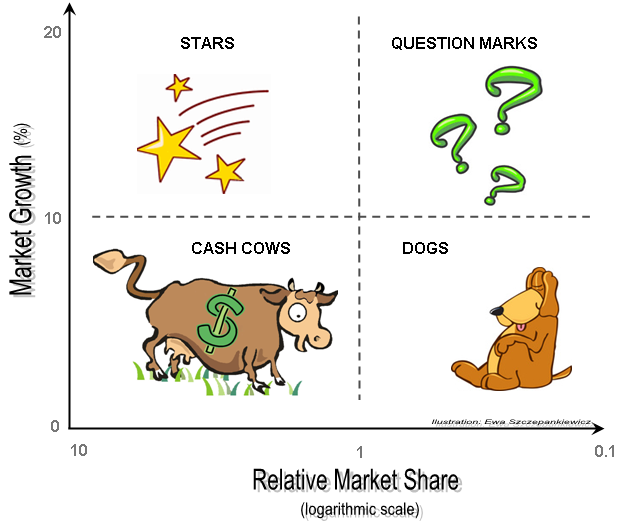 Plot NTC’s services: Mobile (Star), Landline (Cash Cow), Broadband (Question Mark) (Image: CC BY-SA 4.0, via Wikimedia Commons)
D. Ansoff Matrix
Definition: Identifies growth strategies via market/product combinations. Strategies:
| Market | Existing Product | New Product |
|---|---|---|
| Existing | Market Penetration | Product Development |
| New | Market Development | Diversification |
Example: Himalayan Java
- Market Penetration: Discounts for bulk orders (existing market, existing product).
- Market Development: Export to India (new market, existing product).
- Diversification: Launch instant coffee (new product, new market).
4. Strategic Alternatives and Acceptability Screening
After generating options (e.g., Nepal’s NEPSE could expand to crypto trading), screen using:
| Criteria | Methods | Example |
|---|---|---|
| Financial | NPV, ROI, Payback Period | Nabil Bank’s ROI on ATM network expansion. |
| Non-Financial | Risk assessment, ethical alignment, stakeholder impact | NTC’s ethical AI use in customer service. |
| Acceptability | Feasibility, compatibility with culture, legal compliance | Daraz’s cash-on-delivery vs. digital payments. |
Worked Example: NTC’s 5G Strategy
- Alternatives:
- Partner with Huawei (lower cost, higher risk).
- Invest in local infrastructure (higher cost, lower risk).
- Screening:
- Financial: ROI of 15% for Huawei vs. 10% for local build.
- Non-Financial: Political risk (China-Nepal relations) vs. job creation.
- Acceptability: Government approval likely for local build.
Decision: Hybrid model (Huawei for urban areas, local build for rural).
5. Strategic Vision and Leadership
Strategic Vision: A long-term aspirational goal (e.g., Toyota’s "Mobility for All"). Key Traits:
- Inspiring (e.g., "Be the world’s most customer-centric company" – Amazon).
- Clear (avoid jargon; e.g., "Double rural internet access by 2027" – NTC).
- Stretch but achievable (e.g., Chaudhary Group’s "Nepal’s largest FMCG player").
How Leaders Drive Formulation:
- Communicate vision (e.g., Daraz’s "Digital Nepal" messaging).
- Empower teams (e.g., Nabil Bank’s branch-level innovation contests).
- Monitor and adapt (e.g., Pathao’s real-time route adjustments).
MERMAID DIAGRAM:
mindmap
  root((Strategic Vision))
    Inspiring
    Clear
    Stretch
    Aligned with Stakeholders
    Example["Toyota: Mobility for All"]
## In the Real World
Nabil Bank’s Loan Strategy
- Tool Used: SWOT + Ansoff Matrix
- How: Analyzed rural weaknesses (low financial literacy) vs. urban opportunities (high demand). Used market development to launch mobile banking in rural areas, reducing reliance on cash cows like corporate loans.
Daraz’s Expansion in Nepal
- Tool Used: PESTEL + BCG Matrix
- How: Identified social trend (urbanization) and technological (mobile wallets). Classified rural delivery as a Question Mark and invested in last-mile logistics, turning it into a Star.
NTC’s Digital Transformation
- Tool Used: Top-Down Approach + Portfolio Analysis
- How: Board set vision ("Digital Nepal"). Used BCG to divest from declining landlines and invest in 5G, aligning with opportunities (smart cities) and threats (Ncell’s fiber expansion).
## Exam Tip
Do’s:
- Define clearly: For "strategic decision," write:
"A long-term choice that allocates resources to achieve organizational goals, balancing risk and return (e.g., NTC’s 5G investment)."
- Compare tools: Use tables (like SWOT vs. PESTEL) to show differences.
- Apply to cases: For acceptability screening, analyze Nepal’s NEPSE expanding to crypto:
- Financial: High ROI but volatile.
- Non-Financial: Regulatory risk (SEBON’s stance).
- Draw diagrams: Sketch BCG/Ansoff matrices for 2–3 marks.
Don’ts:
- Mix approaches: Don’t say "bottom-up is always better"—explain contexts (e.g., startups use bottom-up; banks use top-down).
- Ignore real-world ties: Examiners love links to Nepali firms. Always name 1–2 examples per concept.
- Overcomplicate: For strategic vision, avoid vague statements. Use SMART criteria.
Sample Answer Starter (5 marks):
"Strategic formulation involves selecting approaches (top-down, bottom-up, emergent) and tools (SWOT, BCG) to align resources with goals. For example, Nabil Bank uses a top-down approach to set financial inclusion targets but adopts bottom-up ideas from branches for micro-loans. The BCG matrix helps prioritize investments: mobile banking (Star) gets funding, while landline services (Cash Cow) generate cash for expansion. Acceptability screening ensures choices like digital wallets meet financial (ROI >12%) and non-financial (Khalti integration) criteria. This systematic process minimizes risk while maximizing growth potential."
Based on the TU BBA syllabus for Business Strategy (MGT208), unit 4.
Discussion
Loading…