Foundation Of Business ManagementUnit 514 min read
Organizational Structure & Design: Types, Models & Real-World Cases
Unit 5 of Foundation Of Business Management explores how businesses organize their hierarchy, workflows, and teams—covering classic structures (functional, divisional), modern designs (matrix, network), and real-world applications from Nepali banks to global tech firms. Learn to analyze, design, and critique structures
TAKEAWAYS:
- Organizational structure defines roles, authority, and communication flows—critical for efficiency and adaptability.
- Five core structures (functional, divisional, matrix, network, hybrid) suit different business goals and sizes.
- Design principles (centralization vs. decentralization, span of control, departmentalization) directly impact performance.
- Real-world examples: Nabil Bank’s flat structure vs. Daraz’s matrix model for agility.
- Emerging trends: Virtual teams, AI-driven org charts, and modular designs are reshaping businesses.
- Exam focus: Sketch structures, compare pros/cons, and apply concepts to cases (e.g., NTC’s bureaucracy vs. Pathao’s lean teams).
1. What Is Organizational Structure?
Organizational structure is the framework that outlines:
- Roles and responsibilities (who does what).
- Authority and reporting lines (who answers to whom).
- Communication channels (how information flows).
- Resource allocation (budgets, teams, tools).
Why it matters: A well-designed structure aligns employees with business goals, reduces redundancy, and enables scalability. Poor design leads to confusion, slow decision-making, and inefficiency (e.g., Nepal’s bureaucracy in NTC or traffic police).
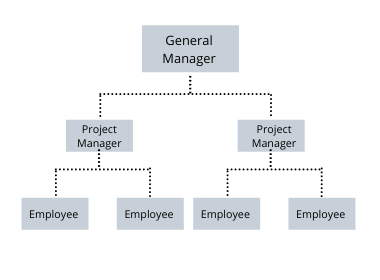 A labeled example showing CEO → Managers → Teams with dotted lines for cross-departmental links. (Image: Slade74, CC0, via Wikimedia Commons)
2. Key Elements of Organizational Architecture
Organizational architecture combines structure, processes, and culture to create a cohesive system. Its three main elements are:
| Element | Definition | Example in Nepal |
|---|---|---|
| Structure | Hierarchy and division of labor (e.g., functional vs. divisional). | Nabil Bank’s functional structure (HR, Finance, Operations under CEO). |
| Processes | Workflows and decision-making protocols (e.g., approval chains). | Daraz’s cross-functional teams for product launches. |
| Culture | Shared values, norms, and behaviors (e.g., innovation vs. tradition). | Himalayan Java’s flat hierarchy fostering creativity. |
3. Types of Organizational Structures
Each structure has trade-offs in control, flexibility, and cost. Below are the five primary types with pros/cons and Nepali/global examples.
A. Functional Structure
Definition: Groups employees by specialized functions (e.g., Marketing, HR, Finance). Mermaid Diagram:
graph TD
    A["CEO"] --> B["Marketing"]
    A --> C["Finance"]
    A --> D["HR"]
    A --> E["Operations"]
    B --> F["Brand Managers"]
    C --> G["Accountants"]
    D --> H["Recruiters"]
E --> I["Logistics"]Pros:
- Deep expertise in each department.
- Clear career paths (e.g., an accountant moves from junior to senior in Finance).
- Low coordination costs within functions.
Cons:
- Silos: Departments may ignore cross-functional goals (e.g., Marketing and Sales not aligning).
- Slow decision-making: Approvals require multiple layers.
Real-World Example:
- Nepal: NTC uses a functional structure, but slow approvals delay infrastructure projects.
- Global: Google starts with functional teams but shifts to project-based structures for innovation.
B. Divisional Structure
Definition: Groups employees by products, geographies, or customers. Mermaid Diagram:
graph TD
    A["CEO"] --> B["Product 1 Division"]
    A --> C["Product 2 Division"]
    A --> D["Geographical Division: Kathmandu"]
    A --> E["Customer Segment: SMEs"]
    B --> F["R&D"]
    B --> G["Marketing"]
C --> H["Supply Chain"]Pros:
- Focused accountability: Each division acts like a mini-company (e.g., Daraz’s e-commerce vs. logistics divisions).
- Faster responses: Divisions adapt quickly to market changes (e.g., Pathao’s ride-hailing vs. food delivery teams).
Cons:
- Duplication: Multiple divisions may have separate HR/Finance teams (higher costs).
- Inter-division conflicts: Competing for resources (e.g., NEPSE’s trading vs. corporate advisory divisions).
Real-World Example:
- Nepal: Chaudhary Group uses divisional structures for retail (Megha), banking (Nabil), and manufacturing (Himalayan Java).
- Global: Unilever organizes by brands (e.g., Lipton, Dove) under global divisions.
C. Matrix Structure
Definition: Employees report to two bosses (e.g., a product manager and a functional manager). Mermaid Diagram:
graph TD
    A["CEO"] --> B["Product Manager: Project X"]
    A --> C["Functional Manager: Engineering"]
    B --> D["Team Member 1"]
    C --> D
    B --> E["Team Member 2"]
C --> EPros:
- Flexibility: Ideal for projects requiring cross-functional input (e.g., app development at eSewa).
- Resource sharing: Teams pool expertise (e.g., Daraz’s marketing team works across products).
Cons:
- Conflict: Dual reporting can cause confusion (e.g., "Who do I listen to?").
- Complex coordination: Requires strong leadership.
Real-World Example:
- Nepal: eSewa uses a matrix structure for digital payments, where IT, Finance, and Customer Support teams collaborate on new features.
- Global: NASA uses matrix structures for space missions (engineers report to both project and functional managers).
D. Network (Virtual) Structure
Definition: Outsources non-core functions to external partners (e.g., freelancers, contractors). Mermaid Diagram:
graph TD
    A["Core Company"] -->|"Contracts"| B["Freelance Designers"]
    A -->|"Outsourced"| C["Third-Party Logistics"]
A -->|"Partnership"| D["Open-Source Community"]Pros:
- Cost-effective: Avoids overhead (e.g., Pathao outsources driver training).
- Access to global talent: Hire experts worldwide (e.g., Khalti uses international cybersecurity firms).
Cons:
- Loss of control: Quality risks if partners underperform.
- Coordination challenges: Time zones and cultural differences.
Real-World Example:
- Nepal: Khalti partners with banks for KYC verification but retains core payment processing.
- Global: Spotify uses a "tribunal" model where small teams outsource support functions.
E. Hybrid Structure
Definition: Combines two or more structures (e.g., functional + divisional). Mermaid Diagram:
graph TD
    A["CEO"] --> B["Divisional: Products"]
    A --> C["Functional: HR"]
    B --> D["Product 1 Team"]
    B --> E["Product 2 Team"]
C --> F["HR for All Divisions"]Pros:
- Balances stability and flexibility: E.g., Nabil Bank has functional HR but divisional loan teams.
- Adaptable: Grows with the company (e.g., starts functional, adds divisions as it scales).
Cons:
- Complexity: Harder to manage than simple structures.
Real-World Example:
- Nepal: Nepal Investment Bank uses a hybrid model—functional departments (Finance, Risk) support divisional business units (Corporate, Retail).
- Global: Toyota combines functional R&D with divisional manufacturing plants.
4. Factors Influencing Organizational Design
The right structure depends on five key factors:
| Factor | Description | Example |
|---|---|---|
| Strategy | Aligns with business goals (e.g., innovation vs. cost leadership). | Himalayan Java uses flat teams for creativity. |
| Size | Small firms: flat; large firms: hierarchical. | NTC (bureaucratic) vs. Pathao (lean). |
| Technology | Digital tools enable virtual structures (e.g., Slack, Zoom). | eSewa’s remote teams. |
| Environment | Stable vs. dynamic markets. | Nepal’s banking sector (regulated) vs. Daraz (fast-moving). |
| Culture | Top-down (traditional) vs. collaborative (modern). | Nabil Bank (structured) vs. Himalayan Java (flexible). |
5. Emerging Trends in Organizational Design
Modern businesses are adopting:
- Holacracy: No traditional hierarchy (e.g., Zappos).
- Agile Teams: Cross-functional, self-organizing (e.g., Google’s "20% time").
- AI-Driven Structures: Algorithms optimize roles (e.g., Amazon’s dynamic teams).
- Modular Organizations: Core + outsourced units (e.g., Apple’s supply chain).
- Virtual First: Remote-first policies (e.g., GitLab).
Case Study: Daraz’s Shift to Agile Daraz, Nepal’s Amazon, initially used a functional structure but faced slow product launches. It adopted agile teams (marketing, tech, logistics) to:
- Reduce time-to-market by 40%.
- Improve cross-department collaboration.
- Use daily stand-ups (like software teams) for e-commerce operations.
6. Organizational Structure vs. Organizational Culture
While structure defines who reports to whom, culture defines how work gets done. The two interact:
| Aspect | Structure | Culture |
|---|---|---|
| Definition | Formal hierarchy and roles. | Shared values, norms, and behaviors. |
| Example | Nabil Bank’s layers of management. | "Work hard, play hard" at Himalayan Java. |
| Impact on Performance | Affects efficiency and communication. | Influences innovation and employee engagement. |
| Flexibility | Hard to change (requires restructuring). | Easier to shape through training and leadership. |
Real-World Link:
- NTC’s culture of bureaucracy aligns with its tall hierarchical structure, slowing reforms.
- Pathao’s culture of speed and adaptability fits its flat, agile structure.
7. Case Study: Nabil Bank’s Organizational Design
Background: Nabil Bank, Nepal’s largest private bank, serves 3 million customers with 100+ branches. It uses a hybrid structure:
- Functional departments: HR, Finance, Risk.
- Divisional business units: Corporate Banking, Retail Banking, SME Loans.
Challenges:
- Slow decision-making: Multiple approvals for loans.
- Silos: Retail and Corporate Banking rarely collaborate.
- Tech lag: Legacy systems hinder digital banking (e.g., eSewa integration).
Solutions Implemented:
- Cross-functional loan committees: Retail + Corporate teams review SME applications together.
- Digital transformation: Partnered with F1Soft for core banking software.
- Flattened middle management: Reduced layers to speed up approvals.
Result:
- 20% faster loan processing.
- Improved customer satisfaction (from 72% to 85% in 2 years).
8. How to Design an Effective Organizational Structure
Follow this step-by-step process:
flowchart TD
    A["Step 1: Define Business Goals"] --> B["Step 2: Analyze Environment"]
    B --> C["Step 3: Choose Structure Type"]
    C --> D["Step 4: Design Roles & Responsibilities"]
    D --> E["Step 5: Implement & Monitor"]
    E -->|"Feedback Loop"| C
Key Questions to Ask:
- What’s our competitive advantage? (e.g., innovation → flat structure; cost leadership → functional).
- How fast do we need to adapt? (dynamic markets → agile/matrix).
- What’s our budget? (outsourcing → network structure).
- What’s our culture? (collaborative → hybrid; hierarchical → functional).
## In the Real World
eSewa’s Matrix Structure for Payments
- Idea Used: Matrix structure (employees report to both product and functional managers).
- How: eSewa’s payment processing team works under:
- Product Manager (for new features like QR payments).
- IT Manager (for security and infrastructure).
- Result: Faster innovation (e.g., eSewa’s UPI integration) while maintaining technical standards.
Pathao’s Lean Teams for Gig Economy
- Idea Used: Network structure (outsourcing drivers) + agile teams (real-time operations).
- How:
- Core team: Manages app, customer support, and partnerships.
- Outsourced: Driver onboarding, marketing (via influencers).
- Result: 90% of operations are driver-led, reducing overhead.
NTC’s Bureaucratic Structure and Delays
- Idea Used: Functional structure with centralized authority.
- Problem: 12 layers of approval for infrastructure projects (e.g., new bus routes).
- Impact: Delays in Kathmandu traffic solutions (e.g., smart traffic lights take years).
## Exam Tip
This unit is tested in three ways:
- Sketching Structures: Draw and label functional, divisional, or matrix structures from scratch (use Mermaid diagrams in exams!).
- Case Analysis: Given a company (e.g., NTC, Daraz), identify its structure, critique it, and suggest improvements.
- Example Question: "NTC’s project to install smart traffic lights is delayed. Analyze its organizational structure and propose changes."
- Your Answer:
- Current Structure: Tall hierarchy (functional + centralized).
- Problems: Slow decision-making, lack of cross-department collaboration.
- Solution: Matrix teams for traffic projects (IT + Engineering + City Planning).
- Comparisons: Compare two structures (e.g., functional vs. divisional) using a table with pros/cons/examples.
High-Scoring Tips:
- Use real examples: Always tie answers to Nepali companies (Nabil Bank, Daraz, NTC) or global firms (Google, Toyota).
- Visuals: If allowed, sketch a simple org chart in the exam (even if not perfect).
- Link to culture: Every structure question should mention how culture affects it (e.g., "Nepal’s hierarchical culture fits NTC’s bureaucracy").
- Emerging trends: Mention one modern trend (e.g., agile, virtual teams) in every long answer.
Based on the TU BBM syllabus for Foundation Of Business Management (MGT231), unit 5.
Discussion
Loading…