Micro Economics for BusinessUnit 114 min read
Microeconomics Basics: Definitions, Scope & Business Applications
Unit 1 of Micro Economics for Business covers the core concepts of microeconomics—its definition, key principles, and real-world applications in business decision-making, with visual tools to clarify abstract ideas.
TAKEAWAYS:
- Microeconomics studies individual decision-making by households, firms, and governments, focusing on how prices are determined and resource allocation.
- It contrasts with macroeconomics by analyzing small-scale units (e.g., a single firm’s pricing strategy) rather than economy-wide trends.
- The scope of microeconomics includes consumer behavior, production theory, market structures, and government interventions—all critical for business strategy.
- Key tools like supply-demand analysis, cost-benefit trade-offs, and elasticity help businesses optimize profits and respond to market changes.
- Real-world examples (e.g., eSewa’s dynamic pricing, Ncell’s tariff adjustments) show how microeconomic principles drive everyday economic decisions.
- Exam focus: Define microeconomics clearly, distinguish it from macroeconomics, and explain its practical applications in business (e.g., pricing, resource allocation).
1. What Is Microeconomics?
Microeconomics is the branch of economics that examines how individuals, households, and businesses make decisions about allocating limited resources (time, money, labor) to satisfy unlimited wants. It focuses on:
- Price determination (e.g., why a Daraz product costs ₹500).
- Consumer choices (e.g., why Pathao riders prefer electric scooters).
- Firm behavior (e.g., how NTC sets electricity tariffs).
- Market structures (e.g., monopoly vs. competition in Nepal’s telecom sector).
Key Definitions
| Term | Definition | Example |
|---|---|---|
| Microeconomics | Study of individual agents (consumers, firms) and their interactions. | A single farmer deciding how much maize to sell at the local market. |
| Macroeconomics | Study of aggregate economy (inflation, GDP, unemployment). | Nepal’s overall inflation rate in 2023 (8.5%). |
| Scarcity | Unlimited wants vs. limited resources. | Limited water supply in Kathmandu vs. high demand for drinking water. |
| Opportunity Cost | Cost of the next best alternative forgone. | Studying for TU exams instead of working at a hotel. |
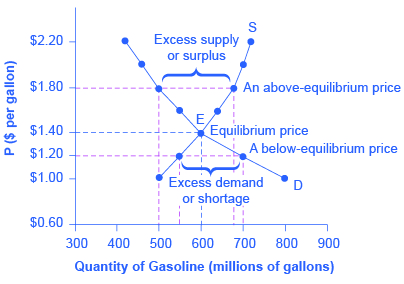 (Image: OpenStax College, CC BY 4.0, via Wikimedia Commons)
Labelled: "Microeconomics in Action: Equilibrium Price (P) and Quantity (Q*) for a Daraz smartphone (₹25,000)."*
Shows:
(Image: OpenStax College, CC BY 4.0, via Wikimedia Commons)
Labelled: "Microeconomics in Action: Equilibrium Price (P) and Quantity (Q*) for a Daraz smartphone (₹25,000)."*
Shows:
- Demand curve (D): Slopes downward (higher price → fewer buyers).
- Supply curve (S): Slopes upward (higher price → more sellers).
- Equilibrium (P, Q)**: Where supply meets demand (₹25,000, 500 units).
- Shift arrows: Dashed lines for increase in demand (e.g., festive season) and decrease in supply (e.g., import restrictions).
2. How Microeconomics Works: Core Principles
Microeconomics relies on three fundamental ideas:
A. The Problem of Scarcity
- Resources (land, labor, capital, entrepreneurship) are limited, but human wants are unlimited.
- Example: Nepal’s hydropower potential (limited) vs. rising electricity demand (unlimited).
B. Rational Decision-Making
- Assumption: Individuals and firms act rationally to maximize utility (consumers) or profit (businesses).
- Example: Khalti’s dynamic pricing adjusts transaction fees based on demand (e.g., higher fees during Dashain).
C. Marginal Analysis
- Decisions are made at the margin (additional unit).
- Marginal Benefit (MB): Extra satisfaction from one more unit.
- Marginal Cost (MC): Extra cost of producing one more unit.
- Rule: If MB > MC, do it! If MB < MC, stop.
- Example: Ncell’s data pricing
- First 1GB: ₹100 (high MB for basic users).
- Next 1GB: ₹50 (lower MB, but still worth it).
- Beyond 5GB: ₹200 (MB drops; many users stop upgrading).
Labelled: "Ncell’s Data Plan: Where to Stop Upgrading?" Shows:
- MB curve: Declines as usage increases (diminishing satisfaction).
- MC curve: Rises after 3GB (higher cost for extra data).
- Optimal point: Where MB = MC (4GB for this user).
3. Scope of Microeconomics: What It Covers
Microeconomics studies five key areas critical for business:
| Area | What It Studies | Business Application | Nepal Example |
|---|---|---|---|
| Consumer Behavior | How people make purchasing decisions. | Helps firms design pricing strategies and advertising campaigns. | Daraz’s discounts during Dashain to boost sales. |
| Production Theory | How firms produce goods/services efficiently. | Guides cost minimization and resource allocation. | NTC’s decision to use solar power in remote areas. |
| Market Structures | Types of markets (perfect competition, monopoly). | Helps businesses choose pricing models and competitive strategies. | Ncell vs. NTC: Oligopoly in telecoms leads to tariff wars. |
| Factor Markets | How wages, rents, and profits are determined. | Influences hiring decisions and wage setting. | Minimum wage laws in Nepal (₹18,000/month) affect small businesses. |
| Government Policy | How taxes, subsidies, and regulations work. | Helps firms lobby for favorable policies or adapt to new laws. | Electricity subsidies for industries in Nepal’s Special Economic Zones. |
4. Microeconomics vs. Macroeconomics: Key Differences
| Feature | Microeconomics | Macroeconomics |
|---|---|---|
| Focus | Individual agents (firms, households). | Entire economy (GDP, inflation, unemployment). |
| Example | Why a single restaurant raises prices. | Why Nepal’s inflation rose to 8.5% in 2023. |
| Tools | Supply-demand, elasticity, game theory. | Aggregate demand-supply, fiscal policy, monetary policy. |
| Policy Goal | Efficiency (optimal resource use). | Stability (low inflation, high growth). |
Labelled: "Micro vs. Macro: What’s the Difference?" Shows:
- Micro: Close-up of a single market (e.g., Kathmandu’s vegetable market).
- Macro: Bird’s-eye view of Nepal’s economy (GDP growth, remittances).
- Overlap: Both use supply-demand, but scales differ.
5. Why Microeconomics Matters for Business
Businesses use microeconomic principles to:
- Set Prices: Use demand elasticity to decide if a price hike will boost revenue.
- Allocate Resources: Decide how much to spend on labor vs. machinery.
- Compete Effectively: Choose between monopoly pricing (e.g., NTC) or competitive pricing (e.g., Daraz).
- Respond to Government Policies: Adjust to taxes (e.g., VAT on online sales) or subsidies (e.g., fuel subsidies).
Real-World Example: eSewa’s Dynamic Pricing
- Problem: eSewa charges transaction fees (0.5%–3%) for digital payments.
- Microeconomic Principle: Price discrimination (charging different users different prices based on willingness to pay).
- How It Works:
- Low-income users: Pay 0.5% (subsidized by higher fees from businesses).
- High-value transactions (e.g., ₹50,000): Charge 3% (higher MB for eSewa).
- Result: Maximizes revenue without losing customers.
Labelled: "eSewa’s Transaction Fees: Higher for Big Spenders" Shows:
- Two demand curves: Low-income (D₁) vs. high-income (D₂).
- Single price (P₁): Would leave deadweight loss (inefficient).
- Price discrimination (P₁ for D₁, P₂ for D₂): Captures more consumer surplus.
6. Common Microeconomic Fallacies
Students often confuse microeconomics with:
- "Microeconomics is just about money."
- Reality: It’s about choices (e.g., time trade-offs, like studying vs. working).
- "All markets are perfectly competitive."
- Reality: Most markets have imperfections (e.g., monopolies like NTC).
- "Government intervention always helps."
- Reality: Can create inefficiencies (e.g., price controls leading to shortages).
7. Exam Tip: How to Score Full Marks
- Define Clearly:
- Start with a precise definition (e.g., "Microeconomics is the study of how individuals and firms allocate scarce resources to satisfy unlimited wants...").
- Use Real Examples:
- Link theory to Nepalese businesses (e.g., Daraz, Ncell, banks).
- Example: "Like NTC adjusts electricity tariffs based on demand, firms use price elasticity to set product prices."
- Draw Diagrams:
- Supply-demand curves, PPC (Production Possibility Curve), or cost curves can earn extra marks.
- Compare and Contrast:
- Always contrast micro vs. macro or perfect competition vs. monopoly where relevant.
- Apply to Business:
- End with a practical implication (e.g., "This shows why Khalti uses dynamic pricing to maximize profits.").
In the Real World
Pathao’s Surge Pricing
- Concept: Price elasticity of demand.
- How it works: During peak hours (e.g., 7–9 PM), Pathao increases fares by 20–50% to match supply with high demand.
- Why it matters: Ensures drivers earn more during busy times, while riders still get rides (unlike taxis that may refuse trips).
Nepal Rastra Bank’s Interest Rate Decisions
- Concept: Cost of borrowing and monetary policy.
- How it works: When inflation rises (e.g., 2022–23), NRB increases repo rates (from 5% to 9%) to discourage borrowing and cool demand.
- Impact: Higher loan rates for businesses (e.g., small shops), reducing spending and stabilizing prices.
Daraz’s "Lightning Deals"
- Concept: Scarcity and artificial demand.
- How it works: Daraz creates limited-time offers (e.g., "Only 100 units left!") to trigger fear of missing out (FOMO), increasing sales.
- Microeconomic logic: Shifts the demand curve rightward temporarily, even if the product isn’t truly scarce.
Worked Example: Should a Local Bakery Raise Bread Prices?
Scenario: A bakery in Kathmandu sells ₹50 loaves of bread. Demand is elastic (customers switch to cheaper brands if prices rise). The bakery’s marginal cost is ₹20 per loaf.
Steps:
Calculate Current Revenue:
- Price (P) = ₹50, Quantity (Q) = 100 loaves/day.
- Revenue (R) = P × Q = ₹5,000.
Test a Price Increase:
- New price (P’) = ₹60.
- Elastic demand: Quantity drops by 30% → Q’ = 70 loaves.
- New revenue (R’) = ₹60 × 70 = ₹4,200.
Compare:
- Old revenue: ₹5,000.
- New revenue: ₹4,200.
- Result: Revenue falls by ₹800 → Do not raise prices.
Microeconomic Insight:
- Since demand is elastic, a price hike reduces total revenue.
- Solution: The bakery should advertise to shift demand rightward or reduce costs (e.g., bulk flour purchases).
Key Formulas to Remember
| Concept | Formula | Example |
|---|---|---|
| Price Elasticity of Demand (PED) | If Qd falls by 20% when P rises by 10%, (elastic). | |
| Total Revenue (TR) | ₹50 × 100 loaves = ₹5,000. | |
| Marginal Cost (MC) | If total cost rises by ₹200 for 10 more loaves, MC = ₹20. |
Common Exam Questions & How to Answer
Question 1: "Explain the scope of microeconomics with examples from Nepal." Answer Structure:
- Definition: "Microeconomics studies individual decision-making..."
- Five scopes (use the table above).
- Nepal examples for each (e.g., NTC’s pricing for production theory).
- Conclusion: "Thus, microeconomics helps businesses and policymakers make informed decisions."
Question 2: "How does the concept of opportunity cost apply to a student preparing for TU exams?" Answer Structure:
- Define opportunity cost: "The value of the next best alternative forgone."
- Student’s choices:
- Option 1: Study for ECO203 (gains knowledge).
- Option 2: Work part-time (earns ₹15,000/month).
- Calculation: If studying leads to a first division (higher future salary), the opportunity cost is ₹15,000 × 6 months = ₹90,000.
- Conclusion: "The student must weigh the long-term benefit of a degree against the short-term income lost."
Final Checklist Before the Exam
✅ Can you define microeconomics in one sentence? ✅ Can you draw a supply-demand graph with equilibrium? ✅ Can you explain how a Nepalese business (e.g., Daraz, Ncell) uses microeconomic principles? ✅ Do you know the difference between micro and macroeconomics? ✅ Can you calculate price elasticity of demand?
Remember: Microeconomics is not just theory—it’s the language of business decisions. Every time you see a price tag, a salary slip, or a government policy, think: "How does this relate to supply, demand, or opportunity cost?"
Based on the TU BBM syllabus for Micro Economics for Business (ECO203), unit 1.
Discussion
Loading…