Macroeconomics for BusinessUnit 316 min read
Circular Flow of Income: Real vs Money Flows, Sectors, Leakages & Injections
Unit 3 of Macroeconomics for Business explains how money and goods circulate between households and firms (real flow) and banks/government (money flow), why leakages (savings, taxes) and injections (investment, government spending) matter, and how equilibrium income is determined in a two-sector economy—with Nepalese e
TAKEAWAYS:
- The circular flow model shows two parallel loops: real flow (goods/services) and money flow (payments), connecting households, firms, government, and foreign sectors.
- Leakages (savings, taxes, imports) reduce spending power, while injections (investment, government spending, exports) add to it—equilibrium occurs when leakages = injections.
- In a two-sector economy (households + firms), equilibrium income , where (consumption depends on disposable income).
- Government and foreign sectors introduce taxes (T), transfers (Tr), exports (X), and imports (M), turning the simple two-sector model into a four-sector model.
- The multiplier effect explains how an initial injection (e.g., Rs 100 million in NTC’s road projects) creates total income change = injection × multiplier (1/(1 − MPC)).
- Real-world applications: eSewa’s payment system relies on money flow between users and merchants; Daraz’s inventory depends on real flows from suppliers to consumers.
1. The Circular Flow of Income: Two-Sector Model
The simplest macroeconomic model shows interactions between households and business firms (two sectors). Here, households provide factors of production (labor, land, capital) to firms, and firms pay factor incomes (wages, rent, profit) to households. Households then spend this income on goods and services, which firms produce and sell back.
Key Components
flowchart TD
    A["Households"] -->|"Labor, Land, Capital"| B["Firms"]
    B -->|"Goods & Services"| A
    A -->|"Consumption (C)"| B
B -->|"Factor Incomes (Wages, Rent, Profit)"| A- Real Flow: Goods/services move from firms → households; factors of production move from households → firms.
- Money Flow: Factor incomes (money) move from firms → households; consumption expenditures move from households → firms.
Why It Matters
- Shows how income generation and spending are interdependent.
- Helps explain equilibrium income (when total spending = total production).
- Nepal Example: When you buy rice from a local shop (real flow), the shopkeeper pays you wages (money flow). The shopkeeper’s revenue comes from your spending, and your income comes from their payment—this is the circular flow in action.
2. Leakages and Injections: Disrupting the Simple Flow
In reality, not all income is spent on consumption. Some is saved (S), paid as taxes (T), or spent on imports (M). These are called leakages because they reduce the circular flow. Conversely, investment (I), government spending (G), and exports (X) are injections that add to the flow.
Four-Sector Circular Flow Model
flowchart TD
    A["Households"] -->|"Savings (S)"| D["Financial Markets"]
    A -->|"Taxes (T)"| E["Government"]
    A -->|"Imports (M)"| F["Foreign Sector"]
    D -->|"Investment (I)"| B["Firms"]
    E -->|"Government Spending (G)"| B
    F -->|"Exports (X)"| B
    B -->|"Goods & Services"| A
B -->|"Factor Incomes"| A- Leakages: (reduce spending).
- Injections: (increase spending).
- Equilibrium Condition: For the economy to be stable, leakages must equal injections:
Real-World Example: eSewa Transactions
When you pay your electricity bill via eSewa:
- Real Flow: NTC provides electricity (good/service) to you.
- Money Flow: You pay NTC via eSewa (leakage: your money leaves your account).
- Injection: NTC’s revenue (from your payment) is used to buy new transformers (investment, ) or pay salaries (government-like spending, ).
If more people pay via eSewa, NTC’s revenue increases (injection), but if people save more (leakage), NTC’s income might drop, affecting its ability to invest in infrastructure.
3. Determining Equilibrium Income in a Two-Sector Economy
In the simplest model (only households and firms), equilibrium income is determined by: where:
- = Consumption (depends on disposable income , but in two-sector, ).
- = Autonomous investment (fixed, e.g., Rs 200 million).
Consumption Function
Consumption is split into:
- Autonomous consumption (): Spending even if income is zero (e.g., basic needs).
- Induced consumption (): Spending that rises with income (marginal propensity to consume, MPC).
Example: If , then:
- At , (autonomous).
- For every Rs 1 increase in income, consumption rises by Rs 0.7.
Equilibrium Condition
At equilibrium, planned spending = actual income: Verification:
- If , then .
- Total spending (equilibrium).
Graphical Representation
Interpretation:
- The 45° line () shows where planned spending equals income.
- The intersection at is equilibrium.
4. Multiplier Effect: How Small Changes Create Big Impacts
The multiplier shows how an initial change in injection (ΔI) or leakage (ΔS) affects total income. The income multiplier is: where:
- MPC (Marginal Propensity to Consume): Fraction of extra income spent.
- MPS (Marginal Propensity to Save): Fraction of extra income saved ().
Example: NTC’s Road Construction
Suppose NTC spends Rs 100 million on a new road (injection, ).
- If MPC = 0.8 (people spend 80% of extra income), then:
- Total income increase = million.
Round-by-Round Breakdown:
| Round | Injection/Re-spending | Total Income Added |
|---|---|---|
| 1 | 100 (initial) | 100 |
| 2 | 80 (0.8 × 100) | 80 |
| 3 | 64 (0.8 × 80) | 64 |
| 4 | 51.2 | 51.2 |
| 5 | 40.96 | 40.96 |
| ... | ... | ... |
| Total | 500 | 500 |
Why It Matters for Nepal:
- If the government increases spending on healthcare or education, the multiplier effect can boost GDP significantly.
- However, if people save more (higher MPS), the multiplier shrinks, reducing the impact.
5. Three-Sector and Four-Sector Models: Adding Government and Foreign Trade
The two-sector model is too simplistic. Real economies include:
- Government sector: Taxes () and spending ().
- Foreign sector: Exports () and imports ().
Three-Sector Model (Households, Firms, Government)
Equilibrium condition: where:
- (consumption depends on disposable income).
- (taxes can be autonomous or proportional).
Example: Given:
- ,
Step 1: Substitute into :
Step 2: Write equilibrium :
Verification:
- Disposable income
- Total spending ✓
Four-Sector Model (Adding Foreign Trade)
Equilibrium condition: where = net exports.
Example: Given:
- (imports depend on income).
- (fixed exports).
Step 1: Rewrite equilibrium:
Interpretation:
- Adding imports reduces equilibrium income because some spending leaks abroad.
- Nepal’s Trade Deficit: If , net exports are negative, further reducing income.
6. Money Flow vs. Real Flow: Key Differences
| Feature | Real Flow | Money Flow |
|---|---|---|
| Nature | Physical goods/services, factors of production | Payments (wages, rent, prices) |
| Direction | Firms → Households (goods), Households → Firms (factors) | Households → Firms (spending), Firms → Households (income) |
| Example | You buy rice from a shop (real flow: rice moves to you). | You pay Rs 100 to the shop (money flow: Rs 100 moves to shopkeeper). |
| Disruption | Famine, supply chain breakdown | Inflation, tax hikes, savings changes |
| Policy Impact | Affects production capacity (e.g., NTC building power plants) | Affects spending power (e.g., government cutting taxes) |
Real-World Example: Pathao’s Operations
- Real Flow: Pathao’s drivers provide rides (service) to passengers; Pathao buys fuel and bikes (goods) from suppliers.
- Money Flow: Passengers pay via Khalti/eSewa (money to Pathao); Pathao pays drivers’ salaries and fuel bills (money to drivers/suppliers).
- If fuel prices rise (real flow disruption), Pathao’s costs increase.
- If passengers stop using Khalti (money flow disruption), Pathao’s revenue drops.
7. Exam Tip: How to Score Full Marks
Draw the Circular Flow Diagram:
- Always sketch the two-sector, three-sector, or four-sector model when asked about flows.
- Label real flows (arrows for goods/factors) and money flows (arrows for payments) clearly.
Equilibrium Income Calculation:
- Start with .
- Substitute and .
- Solve for step-by-step. Show all substitutions to get partial marks.
Multiplier Questions:
- If asked to derive the tax multiplier, start with: The tax multiplier is negative because taxes reduce disposable income:
- Example: If MPC = 0.8, tax multiplier = . A Rs 100 tax hike reduces income by Rs 400.
Real-World Applications:
- Link theories to Nepal’s economy:
- eSewa/Khalti: Money flow between users and merchants.
- NTC/Daraz: Real flow of goods/services; money flow via payments.
- Government spending: Injections (e.g., Rs 100 billion budget) create multiplier effects.
- Link theories to Nepal’s economy:
Common Mistakes to Avoid:
- Forgetting to subtract taxes from income before calculating consumption ().
- Ignoring imports in the four-sector model (they reduce equilibrium income).
- Misplacing signs: Injections (+) increase income; leakages (−) decrease it.
8. Past Exam Questions Solved
Question 1: Derive the tax multiplier.
Solution: The tax multiplier measures how a change in taxes () affects equilibrium income (). Starting from: Substitute : Differentiate both sides w.r.t. : Thus, the tax multiplier is:
Question 2: "An attempt to increase saving would actually lead to decrease in both income and saving." Elucidate with an example.
Solution: This paradox arises because saving is a leakage. If households try to save more:
- Reduced Consumption: Less spending () → firms produce less → income falls ().
- Lower Income: With , disposable income → consumption falls further.
- Saving Also Falls: If income drops more than intended, total saving () may decrease.
Example:
- Suppose MPC = 0.8, initial income .
- Autonomous saving target: .
- But if households save more, , leading to:
- New equilibrium .
- New saving (dissaving!).
- Conclusion: Higher intended saving leads to lower actual income and saving.
9. Summary Table: Key Models and Equilibrium Conditions
| Model | Sectors Involved | Equilibrium Condition | Example |
|---|---|---|---|
| Two-Sector | Households, Firms | Simple economy with no government/foreign trade | |
| Three-Sector | Households, Firms, Government | Nepal’s budget includes Rs 100B spending | |
| Four-Sector | All four | Nepal’s trade deficit affects GDP | |
| With Taxes | Any | Income tax reduces disposable income |
10. Final Visual: Circular Flow with All Sectors
flowchart TD
    A["Households"] -->|"Labor, Land, Capital"| B["Firms"]
    A -->|"Consumption (C)"| B
    B -->|"Goods & Services"| A
    B -->|"Factor Incomes (W, R, P)"| A
    A -->|"Savings (S)"| D["Financial Markets"]
    A -->|"Taxes (T)"| E["Government"]
    A -->|"Imports (M)"| F["Foreign Sector"]
    D -->|"Investment (I)"| B
    E -->|"Government Spending (G)"| B
F -->|"Exports (X)"| BLabels:
- Households: Provide factors, consume goods.
- Firms: Produce goods, pay incomes.
- Financial Markets: Channel savings → investment.
- Government: Taxes and spending.
- Foreign Sector: Exports and imports.
11. In the Real World
eSewa/Khalti Payments:
- Money Flow: When you pay your NTC bill via eSewa, money moves from your account → eSewa → NTC (leakage from your spending power).
- Real Flow: NTC uses this money to maintain power plants (injection into their production capacity).
- Multiplier Effect: If NTC hires more workers (injection), those workers spend their wages (injection → more spending → higher income).
Daraz’s Inventory Management:
- Real Flow: Daraz imports goods from China (imports, ) and sells to Nepali consumers (exports of goods to households).
- Money Flow: Consumers pay via Khalti (money to Daraz); Daraz pays suppliers (money abroad).
- Equilibrium: If is negative (trade deficit), Daraz’s revenue may shrink, affecting its ability to stock inventory.
Nepal Rastra Bank’s Monetary Policy:
- When NRB cuts interest rates, banks lend more (injection ) → firms invest more → income rises.
- If NRB raises reserve requirements, banks lend less (leakage ) → spending falls → income drops.
12. Exam Tip Recap
- Diagrams > Words: Always draw the circular flow model for full marks.
- Step-by-Step Calculations: Show every substitution in equilibrium income problems.
- Real-World Links: Connect theories to eSewa, NTC, Daraz, or NRB for higher marks.
- Multiplier Signs: Remember:
- Spending multiplier: Positive ().
- Tax multiplier: Negative ().
- Leakages vs. Injections: If leakages > injections, economy contracts; if injections > leakages, economy expands.
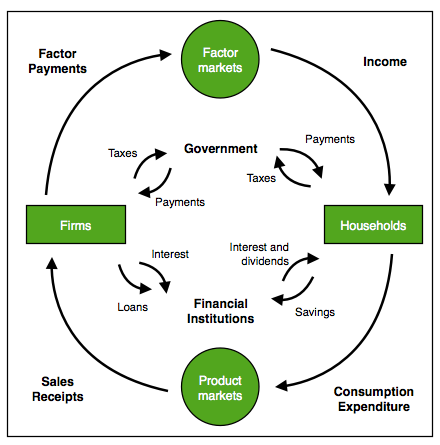 A labeled four-sector circular flow model showing real and money flows. (Image: Le0t, CC BY-SA 3.0, via Wikimedia Commons)
Based on the TU BBM syllabus for Macroeconomics for Business (ECO204), unit 3.
Discussion
Loading…