Basic FinanceUnit 814 min read
Cash Flows & Financial Planning: Statements, Analysis & Forecasting
Unit 8 of Basic Finance explores the Statement of Cash Flows (SCF) framework, its three sections (operating, investing, financing), how to prepare it from trial balance data, and its role in financial planning. Learn to reconcile accrual accounting with cash movements, analyze free cash flows, and apply forecasting tec
Core Concepts: What is the Statement of Cash Flows?
The Statement of Cash Flows (SCF) is a financial statement that reports cash inflows and outflows over a period (usually a year). Unlike the income statement (which uses accrual accounting), the SCF focuses only on actual cash transactions.
Why is it important?
- Shows liquidity (can the company pay its bills?)
- Explains why cash changed from the start to the end of the period
- Helps investors and managers plan future cash needs
Key Definitions
| Term | Definition |
|---|---|
| Cash Equivalents | Short-term, highly liquid investments (e.g., treasury bills, money market funds) that can be converted to cash within 3 months with little risk. |
| Operating Activities | Cash flows from core business operations (e.g., sales, salaries, rent). |
| Investing Activities | Cash flows from buying/selling long-term assets (e.g., machinery, land, investments). |
| Financing Activities | Cash flows from borrowing, repaying debt, or issuing stock (e.g., loans, dividends, share capital). |
| Free Cash Flow (FCF) | Cash left after operating expenses and capital expenditures (CapEx). Formula: FCF = Operating Cash Flow – Capital Expenditures |
The Three Sections of the SCF
The SCF is divided into three main sections, each with specific rules for classification.
1. Operating Activities
Purpose: Measures cash generated from normal business operations. Key Items:
- Cash received from customers (sales)
- Cash paid to suppliers (inventory purchases)
- Cash paid for salaries, rent, utilities
- Cash paid for taxes
- Depreciation/Amortization (added back because it’s a non-cash expense)
How to Calculate?
Indirect Method (Most Common): Start with net income and adjust for non-cash items (e.g., depreciation, bad debts). Formula:
Operating Cash Flow = Net Income + Depreciation/Amortization – Increase in Working CapitalDirect Method (Less Common): Lists actual cash receipts and payments (e.g., "Cash from customers = Rs. 50,000,000").
2. Investing Activities
Purpose: Tracks cash used for long-term assets (investments in the business). Key Items:
- Purchase/Sale of Property, Plant & Equipment (PPE)
- Purchase/Sale of Investments (stocks, bonds, other companies)
- Loans made to other entities
Example: If Kathmandu Retailers Ltd. buys a new delivery truck for Rs. 2,000,000, this is recorded as:
Investing Cash Flow: – Rs. 2,000,000 (Cash Outflow)
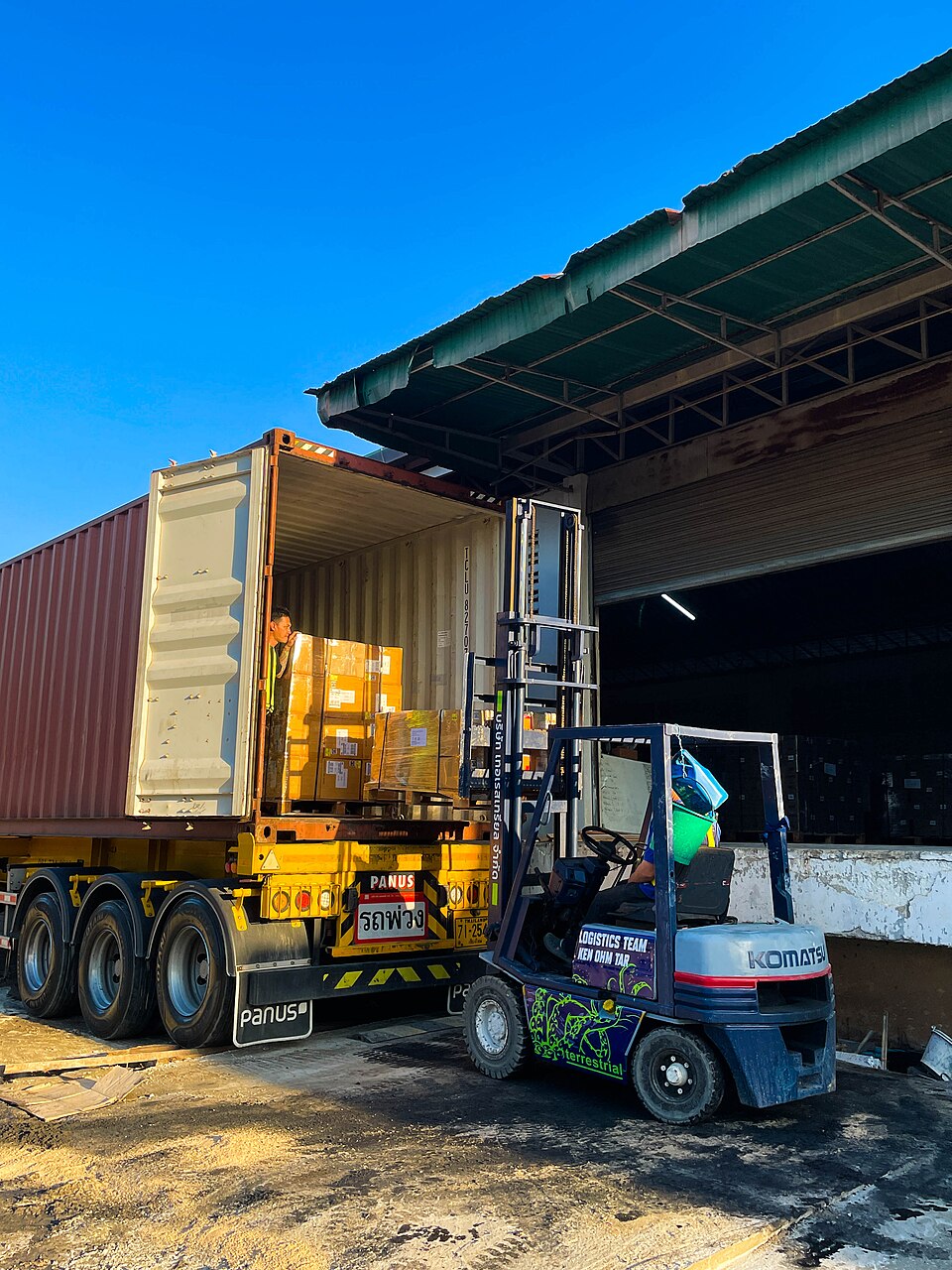 Investing activity: Purchase of equipment by a Daraz warehouse (Image: Goterrestrial, CC BY 4.0, via Wikimedia Commons)
3. Financing Activities
Purpose: Shows cash flows from debt and equity financing. Key Items:
- Borrowing money (loans, bonds)
- Repaying debt (loan principal)
- Issuing stock (selling shares)
- Paying dividends
- Buying back shares (treasury stock)
Example: If Nepal Bank Ltd. takes a Rs. 5,000,000 loan, it records:
Financing Cash Flow: + Rs. 5,000,000 (Cash Inflow)
How to Prepare a Statement of Cash Flows (Step-by-Step)
The SCF is prepared using the indirect method (most common in exams). Here’s the process:
Step 1: Start with Net Income (from Income Statement)
Assume Kathmandu Electronics has:
- Net Income (2023): Rs. 10,000,000
- Depreciation Expense: Rs. 2,000,000
- Increase in Accounts Receivable: Rs. 1,500,000
- Increase in Inventory: Rs. 800,000
- Decrease in Accounts Payable: Rs. 500,000
Step 2: Adjust for Non-Cash Items (Add Back Depreciation)
Net Income = Rs. 10,000,000
+ Depreciation = + Rs. 2,000,000
= Rs. 12,000,000
Step 3: Adjust for Working Capital Changes
Working capital changes affect cash flow. Increases in assets (e.g., receivables, inventory) reduce cash, while increases in liabilities (e.g., payables) increase cash.
| Item | Change | Adjustment (Dr/Cr) |
|---|---|---|
| Accounts Receivable | + Rs. 1,500,000 | – Rs. 1,500,000 |
| Inventory | + Rs. 800,000 | – Rs. 800,000 |
| Accounts Payable | – Rs. 500,000 | + Rs. 500,000 |
Calculation:
Rs. 12,000,000 (Step 2)
– Rs. 1,500,000 (Receivables)
– Rs. 800,000 (Inventory)
+ Rs. 500,000 (Payables)
= **Operating Cash Flow = Rs. 10,200,000**
Step 4: Investing Activities
Assume Kathmandu Electronics bought new machinery for Rs. 3,000,000 and sold old equipment for Rs. 1,000,000.
Investing Cash Flow:
– Rs. 3,000,000 (Purchase of Machinery)
+ Rs. 1,000,000 (Sale of Old Equipment)
= **Net Investing Cash Flow = – Rs. 2,000,000**
Step 5: Financing Activities
Assume the company:
- Took a loan of Rs. 4,000,000
- Paid dividends of Rs. 1,500,000
Financing Cash Flow:
+ Rs. 4,000,000 (Loan)
– Rs. 1,500,000 (Dividends)
= **Net Financing Cash Flow = + Rs. 2,500,000**
Step 6: Calculate Net Change in Cash
Operating Cash Flow = + Rs. 10,200,000
Investing Cash Flow = – Rs. 2,000,000
Financing Cash Flow = + Rs. 2,500,000
**Net Increase in Cash = + Rs. 10,700,000**
Final SCF Table for Kathmandu Electronics (2023)
| Cash Flows from Operating Activities | Rs. (000) |
|---|---|
| Net Income | 10,000 |
| + Depreciation | + 2,000 |
| – Increase in Accounts Receivable | – 1,500 |
| – Increase in Inventory | – 800 |
| + Decrease in Accounts Payable | + 500 |
| Net Operating Cash Flow | 10,200 |
| Cash Flows from Investing Activities | Rs. (000) |
|---|---|
| Purchase of Machinery | – 3,000 |
| Sale of Old Equipment | + 1,000 |
| Net Investing Cash Flow | – 2,000 |
| Cash Flows from Financing Activities | Rs. (000) |
|---|---|
| Loan Proceeds | + 4,000 |
| Dividends Paid | – 1,500 |
| Net Financing Cash Flow | + 2,500 |
| Net Increase in Cash | + 10,700 |
|---|---|
| Beginning Cash Balance (2022) | 5,000 |
| Ending Cash Balance (2023) | 15,700 |
The Accounting Cycle & SCF Connection
The SCF is the last step in the accounting cycle. Here’s how it fits:
Key Insight:
- The Income Statement and Balance Sheet feed into the SCF.
- The SCF explains changes in cash between two balance sheets.
Free Cash Flow (FCF): The Ultimate Liquidity Measure
Free Cash Flow (FCF) tells us how much cash a company can generate after paying for operations and capital expenditures.
Formula:
FCF = Operating Cash Flow – Capital Expenditures (CapEx)
Where:
- Operating Cash Flow = Cash from core business (from SCF)
- CapEx = Cash spent on long-term assets (e.g., new machinery, property)
Example: Ncell’s Free Cash Flow
Assume Ncell reports:
- Operating Cash Flow (2023): Rs. 20,000,000,000
- Capital Expenditures (New Towers, Equipment): Rs. 8,000,000,000
FCF = Rs. 20,000,000,000 – Rs. 8,000,000,000 = **Rs. 12,000,000,000**
What does this mean?
- Ncell has Rs. 12 billion left after operations and investments.
- This cash can be used for:
- Dividends (shareholder returns)
- Debt repayment
- Acquisitions (e.g., buying a smaller telecom firm)
Financial Planning: Using SCF for Future Decisions
The SCF helps businesses plan for future cash needs. Two key techniques:
1. Cash Budgeting
A cash budget predicts future cash inflows and outflows to avoid shortages.
Example: Kathmandu Café’s Monthly Cash Budget
| Month | Cash Inflows (Sales) | Cash Outflows (Expenses) | Net Cash Flow | Beginning Balance | Ending Balance |
|---|---|---|---|---|---|
| Jan | Rs. 5,000,000 | Rs. 4,200,000 | + Rs. 800,000 | Rs. 1,000,000 | Rs. 1,800,000 |
| Feb | Rs. 6,000,000 | Rs. 4,500,000 | + Rs. 1,500,000 | Rs. 1,800,000 | Rs. 3,300,000 |
| Mar | Rs. 4,500,000 | Rs. 5,000,000 | – Rs. 500,000 | Rs. 3,300,000 | Rs. 2,800,000 |
Problem: In March, the café has a cash deficit (– Rs. 500,000). Solution:
- Delay rent payment
- Take a short-term loan
- Increase sales (e.g., promotions)
2. Pro Forma Financial Statements
Pro forma means "as a form of" or forecasted. Companies prepare pro forma SCFs to predict future cash flows.
Example: Daraz Nepal’s Pro Forma SCF (2024)
| Item | 2023 Actual | 2024 Forecast |
|---|---|---|
| Net Income | Rs. 15,000,000,000 | Rs. 18,000,000,000 |
| + Depreciation | + Rs. 3,000,000,000 | + Rs. 3,500,000,000 |
| – Increase in Inventory | – Rs. 2,000,000,000 | – Rs. 2,500,000,000 |
| Operating Cash Flow | Rs. 16,000,000,000 | Rs. 19,000,000,000 |
| – Capital Expenditures | – Rs. 5,000,000,000 | – Rs. 6,000,000,000 |
| Free Cash Flow | Rs. 11,000,000,000 | Rs. 13,000,000,000 |
Why is this useful?
- Helps investors decide whether to buy Daraz shares.
- Helps management plan expansion (e.g., new warehouses).
In the Real World
1. eSewa & Kathalti: Managing Cash Flows for Digital Payments
- Problem: eSewa and Khalti process millions of transactions daily, but liquidity management is critical.
- How SCF Helps:
- Tracks cash inflows (user deposits, transaction fees).
- Ensures sufficient cash reserves to cover withdrawals and refunds.
- Helps plan loan repayments to banks (e.g., NMB, Global IME).
- Real Example:
- During Dashain/Tihar, transaction volumes spike by 300%.
- eSewa must ensure enough cash in its accounts to process all payments without delays.
2. NTC & Ncell: Capital Expenditures & Free Cash Flow
- Problem: Telecom companies like NTC and Ncell spend billions on 5G infrastructure.
- How SCF Helps:
- Calculates FCF to see if they can afford new towers and fiber networks.
- If FCF is negative, they may need to issue bonds or take loans.
- Real Example:
- In 2022, Ncell reported Rs. 12 billion FCF.
- Used Rs. 8 billion for 4G/5G upgrades and Rs. 4 billion for dividends.
3. Daraz & Pathao: Working Capital Management
- Problem: E-commerce (Daraz) and ride-hailing (Pathao) businesses have high working capital needs (inventory, driver payments, logistics).
- How SCF Helps:
- Monitors cash from sales vs. cash paid to suppliers/drivers.
- Helps avoid cash crunches (e.g., Pathao drivers demanding same-day payments).
- Real Example:
- During lockdowns (2020-2021), Daraz’s inventory levels rose, reducing operating cash flow.
- To fix this, Daraz negotiated longer payment terms with suppliers.
Common Mistakes & How to Avoid Them
| Mistake | Why It’s Wrong | How to Fix |
|---|---|---|
| Mixing Operating & Investing Cash Flows | Classifying equipment purchase as operating. | Rule: If it’s a long-term asset, it’s investing. |
| Ignoring Working Capital Changes | Forgetting to adjust for increase in receivables. | Always ask: "Did this affect cash?" |
| Double-Counting Depreciation | Adding depreciation twice (once in SCF, once in notes). | Depreciation is non-cash; add it only once. |
| Confusing Financing with Operating | Recording loan repayments under operating. | Loans = Financing, salaries = Operating. |
Exam Tip: How to Score Full Marks
Understand the Three Sections
- Operating: Core business cash flows.
- Investing: Long-term assets (PPE, investments).
- Financing: Debt and equity.
Memorize the Indirect Method Formula
Operating Cash Flow = Net Income + Depreciation – (ΔWorking Capital)Practice with Real Numbers
- Exams often give income statements + balance sheet changes.
- Always reconcile ending cash balance with the balance sheet.
Watch for Key Terms
- Free Cash Flow (FCF) = Operating CF – CapEx
- Cash Equivalents = Highly liquid short-term investments
- Direct vs. Indirect Method (Indirect is more common in TU exams)
Use the SCF to Answer "Why?"
- If cash increased, was it from sales (operating) or loans (financing)?
- If cash decreased, was it due to investments or dividend payments?
Worked Example: Nabil Bank’s SCF (Simplified)
Given:
- Net Income (2023): Rs. 8,000,000,000
- Depreciation: Rs. 1,200,000,000
- Increase in Loans Given to Customers: Rs. 2,000,000,000
- Purchase of New ATM Machines: Rs. 1,500,000,000
- Dividends Paid: Rs. 500,000,000
- Borrowing from RBI: Rs. 3,000,000,000
Step 1: Operating Cash Flow (Indirect Method)
Net Income = Rs. 8,000,000,000
+ Depreciation = + Rs. 1,200,000,000
– Increase in Loans Given (Working Capital) = – Rs. 2,000,000,000
= **Operating Cash Flow = Rs. 7,200,000,000**
Step 2: Investing Cash Flow
– Purchase of ATM Machines = – Rs. 1,500,000,000
= **Investing Cash Flow = – Rs. 1,500,000,000**
Step 3: Financing Cash Flow
+ Borrowing from RBI = + Rs. 3,000,000,000
– Dividends Paid = – Rs. 500,000,000
= **Financing Cash Flow = + Rs. 2,500,000,000**
Step 4: Net Change in Cash
Operating: + Rs. 7,200,000,000
Investing: – Rs. 1,500,000,000
Financing: + Rs. 2,500,000,000
**Net Increase in Cash = + Rs. 8,200,000,000**
Final SCF Table for Nabil Bank (2023)
| Section | Cash Flow (Rs. in millions) |
|---|---|
| Operating Activities | + 7,200 |
| Investing Activities | – 1,500 |
| Financing Activities | + 2,500 |
| Net Increase in Cash | + 8,200 |
Summary Checklist for Exams
✅ Can you define:
- Statement of Cash Flows?
- Free Cash Flow?
- Operating vs. Investing vs. Financing activities?
✅ Can you prepare an SCF using the indirect method?
- Start with net income.
- Adjust for depreciation and working capital changes.
- Classify investing and financing correctly.
✅ Can you interpret an SCF?
- If operating cash flow is negative, is the business sustainable?
- If financing cash flow is high, is the company over-reliant on debt?
✅ Can you apply SCF to real businesses?
- How does eSewa manage liquidity?
- Why does Ncell need high CapEx?
Final Thought: The Statement of Cash Flows is like a business’s bank statement—it tells the real story of where cash came from and where it went. Master this, and you’ll ace financial analysis in exams and real life! 🚀
Based on the TU BBM syllabus for Basic Finance (FIN211), unit 8.
Discussion
Loading…