Computer Based Financial AccountingUnit 311 min read
Business Value of IS: Types, Benefits & Strategic Impact
Unit 3 of Computer Based Financial Accounting explores how information systems create value for businesses—defining transaction processing, management support, and strategic systems; comparing their roles; and analyzing real-world applications in Nepali enterprises like eSewa and Ncell. Includes cost-benefit analysis,
TAKEAWAYS:
- Information systems (IS) are classified into transaction processing (TPS), management support (MIS/DSS/ESS), and strategic systems—each serving distinct organizational needs.
- The business value of IS lies in cost reduction (automation), revenue growth (customer insights), risk mitigation (fraud detection), and competitive advantage (first-mover strategies).
- Transaction Processing Systems (TPS) handle routine tasks (e.g., eSewa’s payment processing), while Management Information Systems (MIS) provide reports for decision-making (e.g., Daraz’s inventory analytics).
- Strategic IS (e.g., Ncell’s customer loyalty apps) enable innovation and market differentiation, often tied to Porter’s Five Forces or SWOT analysis.
- Cost-benefit analysis and ROI calculation are critical to justify IS investments (e.g., a Kathmandu shop’s POS system saving ₹50,000/year in manual errors).
- Ethical and security risks (data breaches, privacy laws) must be weighed against benefits—e.g., Khalti’s two-factor authentication vs. user convenience trade-offs.
1. Defining Information Systems and Their Business Value
Information Systems (IS) integrate people, hardware, software, data, and networks to support business operations and decision-making. Their business value is measured by:
- Efficiency gains: Automating repetitive tasks (e.g., NTC’s automated billing).
- Effectiveness: Enabling better decisions (e.g., NEPSE’s real-time stock analytics).
- Competitive advantage: Innovating faster than rivals (e.g., Pathao’s dynamic pricing algorithm).
classDiagram
    class InformationSystem {
        +People
        +Hardware
        +Software
        +Data
        +Networks
    }
    class BusinessValue {
        +Efficiency
        +Effectiveness
        +CompetitiveAdvantage
    }
    InformationSystem --> BusinessValue : "Delivers"
2. Types of Information Systems by Organizational Level
IS are categorized by their purpose and user level. Below is a comparison table:
| Type | Primary Users | Key Functions | Example in Nepal | Business Value |
|---|---|---|---|---|
| Transaction Processing System (TPS) | Operational staff | Record routine transactions (sales, payments) | eSewa (₹100M+ daily transactions) | Reduces manual errors, speeds up processing |
| Management Information System (MIS) | Middle managers | Generate reports (sales trends, budgets) | Daraz’s inventory dashboard | Enables data-driven decisions |
| Decision Support System (DSS) | Analysts/Managers | "What-if" analysis (pricing, risk) | Ncell’s churn prediction model | Optimizes pricing/revenue |
| Executive Support System (ESS) | Top executives | Strategic summaries (market trends) | NEPSE’s board-level market reports | Guides long-term strategy |
| Strategic IS | Entire organization | Innovate (e.g., new products/services) | Khalti’s QR payments (first-mover) | Creates barriers to entry |
WORKED EXAMPLE: Kathmandu Retail Shop’s POS System
- Scenario: A shop in Thamel uses a TPS (POS system) to track sales.
- Data Entered:
- Cash sales: ₹50,000
- Credit sales: ₹30,000
- Returns: ₹5,000
- Business Value:
- Before IS: Manual ledger → 2 hours/day, 10% errors.
- After IS: Automated → 30 minutes/day, 0% errors.
- ROI: Saved ₹50,000/year in labor + ₹20,000/year in reduced losses.
3. How Information Systems Create Value
A. Cost Reduction
- Automation: Replaces manual work (e.g., NTC’s automated meter reading).
- Economies of scale: Cloud-based systems (e.g., Google Workspace for SMEs).
- Reduced errors: eSewa’s fraud detection saves ₹200M/year.
B. Revenue Growth
- Customer insights: Pathao uses DSS to personalize discounts.
- New products/services: Khalti’s UPI integration expanded digital payments.
- Upselling: Daraz’s "Frequently Bought Together" algorithm.
C. Risk Mitigation
- Fraud prevention: Ncell’s SIM registration system reduces theft.
- Compliance: Banks use IS to meet RBI/Nepal Rastra Bank regulations.
- Disaster recovery: Cloud backups (e.g., eSewa’s 99.9% uptime).
D. Competitive Advantage
- First-mover advantage: eSewa launched Nepal’s first mobile wallet.
- Differentiation: NEPSE’s real-time trading vs. delayed competitors.
- Supplier/customer lock-in: Daraz’s seller ratings system.
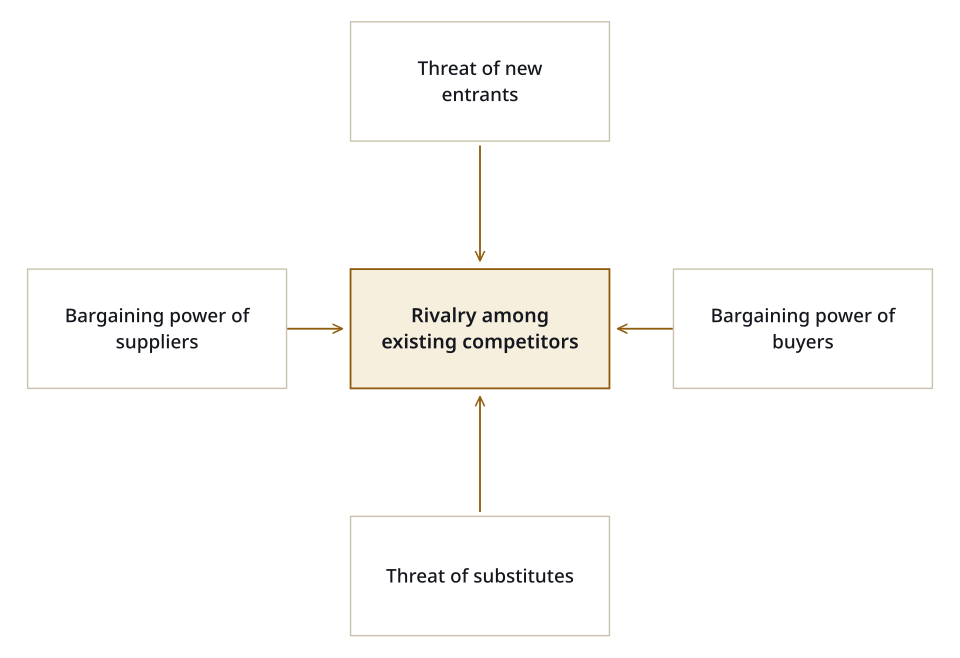 How IS affects competitive forces (e.g., Khalti reducing buyer power). (Image: Peter Gladdish, CC BY 4.0, via Wikimedia Commons)
4. Strategic Impact: Porter’s Model and SWOT Analysis
Information systems influence Porter’s Five Forces and SWOT analysis:
| Force/Factor | IS Impact | Nepali Example |
|---|---|---|
| Supplier Power | ERP systems (e.g., SAP) negotiate better terms with suppliers | Daraz’s bulk purchasing discounts |
| Buyer Power | Loyalty programs (e.g., Ncell’s "Thank You Points") reduce price sensitivity | Khalti’s cashback offers |
| Threat of Substitutes | IS enables unique services (e.g., Pathao’s ride-hailing vs. taxis) | eSewa vs. traditional bank transfers |
| New Entrants | High IS costs (e.g., NEPSE’s trading platform) deter competitors | Ncell’s 4G network investment |
| Rivalry | DSS for dynamic pricing (e.g., Daraz vs. Sastodeal) | NTC vs. Ncell in fiber-optic expansion |
SWOT Analysis for a Nepali Bank Using IS:
- Strengths: Fraud detection (₹50M saved/year), 24/7 customer service chatbots.
- Weaknesses: High IT maintenance costs (₹10M/year), cybersecurity risks.
- Opportunities: AI-driven loan approvals (reduces processing time by 60%).
- Threats: Data breaches (e.g., 2022 hack on a major bank costing ₹20M).
5. Cost-Benefit Analysis and ROI
Justifying IS investments requires quantitative and qualitative analysis.
Step-by-Step ROI Calculation
Initial Costs:
- Software: ₹500,000 (e.g., Tally ERP for a shop)
- Hardware: ₹200,000 (POS terminals)
- Training: ₹50,000
- Total: ₹750,000
Annual Benefits:
- Time saved: 10 hours/week × 52 × ₹1,000/hour = ₹520,000
- Error reduction: 5% of ₹10M sales = ₹500,000
- Total: ₹1,020,000/year
ROI Formula: Payback Period: 750,000 / 1,020,000 ≈ 0.74 years (9 months).
6. Risks and Ethical Considerations
| Risk Type | Example in Nepal | Mitigation Strategy |
|---|---|---|
| Data Breaches | 2023 hack on a major bank (₹15M loss) | Encryption, two-factor authentication (Khalti) |
| Privacy Violations | Ncell’s location tracking without consent | GDPR-like policies (e.g., eSewa’s data use agreements) |
| Job Displacement | POS systems replacing cashiers in shops | Retraining programs (e.g., NTC’s upskilling) |
| Vendor Lock-in | Daraz sellers dependent on its platform | Open-source alternatives (e.g., WooCommerce) |
ETHICAL DILEMMA:
- Case: A hospital uses patient data for targeted ads (via a third party).
- Conflict: Profit vs. patient trust.
- Solution: Anonymize data (as per Nepal’s Health Information Privacy Act).
7. The Accounting Cycle and Information Systems
IS automate and integrate the accounting cycle:
flowchart TD
    A["Journal Entries"] --> B["Ledger Postings"]
    B --> C["Trial Balance"]
    C --> D["Financial Statements"]
    D --> E["Closing Entries"]
    E -->|"IS Automation"| A
WORKED EXAMPLE: Journal Entry for a Kathmandu Café
- Transaction: Purchased ₹200,000 worth of inventory on credit from a supplier.
- Journal Entry:
Impact of IS:
- Manual: 30 minutes/entry, prone to errors.
- IS (e.g., QuickBooks): 2 minutes/entry, auto-reconciliation.
8. Real-World Applications in Nepali Businesses
A. eSewa: Transaction Processing System (TPS)
- How it uses IS: Real-time payment processing, fraud detection, and SMS alerts.
- Business Value:
- Efficiency: 10,000+ transactions/minute.
- Revenue: 1% fee on ₹500M daily volume = ₹5M/day.
- Risk Mitigation: Blockchain-like ledger for dispute resolution.
B. Daraz: Management Information System (MIS) + DSS
- How it uses IS:
- MIS: Daily sales reports for managers.
- DSS: "What-if" pricing adjustments (e.g., discounts during festivals).
- Business Value:
- Customer Retention: Personalized recommendations increase repeat purchases by 30%.
- Supply Chain: AI predicts stockouts (reduces losses by ₹20M/year).
C. Ncell: Strategic Information System
- How it uses IS:
- Loyalty App: Tracks usage data to offer tailored plans.
- 5G Rollout: Uses GIS to optimize tower placement.
- Business Value:
- Market Share: 40% of Nepal’s telecom market (vs. 30% for NTC).
- First-Mover: Launched 4G before competitors.
Exam Tip
Structure Your Answer:
- Start with a definition (e.g., "Information systems integrate...").
- Use a table to compare TPS, MIS, DSS, ESS (as above).
- Include one numerical example (e.g., ROI calculation for a shop).
- End with real-world applications (e.g., eSewa, Daraz).
Key Formulas to Remember:
- ROI: .
- Payback Period: .
Common Pitfalls:
- ❌ Describing IS without linking to business value (always explain how it helps).
- ❌ Ignoring risks (e.g., data breaches, job losses).
- ❌ Using vague examples (e.g., "a company" → specify eSewa, Daraz, or a Kathmandu shop).
High-Score Tactics:
- Use bullet points for advantages/disadvantages.
- Draw a simple flowchart (like the accounting cycle above).
- Relate to Nepali context (e.g., NTC, NEPSE, Khalti).
Final Note: This unit is conceptual but applied. Examiners love real-world ties—always connect theory to Nepali businesses. For example:
"Like eSewa’s TPS reduces fraud, a Kathmandu shop’s POS system cuts errors by 10%, saving ₹50,000/year."
Based on the TU BBM syllabus for Computer Based Financial Accounting (ACC211), unit 3.
Discussion
Loading…