Nepalese Society And PoliticsUnit 114 min read
Nepalese Society: Culture, History & Foundations
Unit 1 of Nepalese Society And Politics explores Nepal’s cultural diversity, historical evolution from ancient kingdoms to modern republic, and the interplay between geography, ethnicity, and social structures that define its unique identity.
TAKEAWAYS:
- Nepal’s cultural mosaic includes 125 ethnic groups, 123 languages, and 8 major religions, shaped by Himalayan geography and millennia of migration.
- The Gorkha conquest (1768) unified Nepal under the Shah dynasty, creating a centralized state that resisted colonialism until the Anglo-Nepalese War (1814–1816).
- Hinduism and Buddhism coexist as state religions, influencing festivals, governance, and social hierarchies (e.g., caste systems vs. Buddhist egalitarianism).
- Geographical isolation (Himalayas, Terai plains) and climate zones (from tropical to Arctic) created distinct regional cultures and economic systems.
- Colonial pressures (British, Chinese) and modernization (Rana oligarchy, democracy movements) reshaped Nepal’s political and social fabric.
- Cultural symbols (e.g., Dhaka topi, Daura Suruwal, Jhyauro) and festivals (Dashain, Tihar, Buddha Jayanti) reflect Nepal’s syncretic identity.
1. Nepal’s Cultural Diversity: Ethnic Groups, Languages, and Religions
Nepal is a microcosm of diversity, with its cultural tapestry woven from 125 ethnic groups, 123 languages, and 8 major religions. This diversity is not just a historical artifact but a living reality that shapes politics, economics, and social interactions today.
1.1 Ethnic Groups and Their Distribution
Nepal’s ethnic groups can be broadly categorized into three major groups:
- Indo-Aryan (e.g., Chhetris, Bahuns, Tharus, Newars)
- Mongoloid (e.g., Gurungs, Magars, Rai, Limbu, Tamangs)
- Tibeto-Burman (e.g., Sherpas, Kiratis, Yolmo)
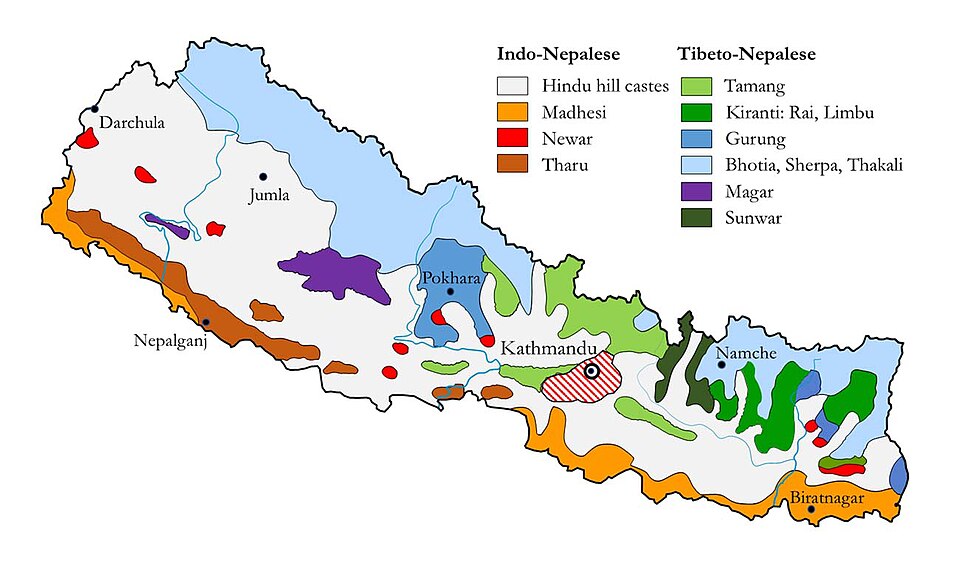 A map showing the geographical distribution of major ethnic groups in Nepal’s hills, mountains, and Terai regions. (Image: mapsland, CC BY-SA 3.0, via Wikimedia Commons)
Key Observations:
- Hill regions: Dominated by Gurungs, Magars, Tamangs, and Newars.
- Terai plains: Home to Tharus, Madhesis, and Muslim communities.
- Mountain regions: Sherpas, Bhotes, and other Himalayan ethnicities.
1.2 Linguistic Diversity
Nepal’s linguistic landscape is equally complex:
- Official language: Nepali (Indo-Aryan).
- Recognized regional languages: Maithili, Bhojpuri, Tharu, Tamang, Newari, Magar, Rai, Limbu, Gurung, and more.
- UNESCO-endangered languages: Over 30 languages are critically endangered.
Why does this matter?
- Political demands: Ethnic groups like Madhesis and Janajatis (indigenous groups) often demand mother-tongue education and political representation.
- Economic disparities: Language barriers affect access to education and jobs (e.g., Newari businesses in Kathmandu vs. Tharu farmers in the Terai).
1.3 Religious Pluralism
Nepal is the only Hindu-majority country with Buddhism as a state religion. Other major religions include:
- Hinduism (81%): Dominant in the hills and Kathmandu Valley.
- Buddhism (9%): Strong in the Himalayas (e.g., Lumbini, Swayambhunath).
- Islam (4.4%): Concentrated in the Terai.
- Kirant (indigenous religions, 3.6%): Practiced by Limbus, Rai, and other groups.
- Christianity (1%): Growing in urban areas.
How religion shapes society:
- Festivals: Dashain (Hindu), Buddha Jayanti (Buddhist), Eid (Muslim), and Christian Christmas are all national holidays.
- Social hierarchies: Hindu caste system vs. Buddhist egalitarianism.
- Political conflicts: Secularism debates (e.g., 2015 Constitution declares Nepal a secular democratic republic but retains Hindu symbols like Pashupatinath).
2. Historical Foundations: From Ancient Kingdoms to Modern Nepal
Nepal’s history is a story of conquest, resistance, and adaptation, from ancient city-states to a modern federal democracy.
2.1 Ancient Nepal: City-States and Early Kingdoms
- Licchavi Dynasty (400–750 CE): Ruled the Kathmandu Valley, promoted Hinduism and Buddhism, and built stupas and temples (e.g., Swayambhunath, Pashupatinath).
- Malla Dynasty (12th–18th century): Known for art, architecture (e.g., Patan Durbar Square), and cultural flourishing.
2.2 The Rise of the Gorkha Kingdom (1768)
- Prithvi Narayan Shah’s conquest: Unified Nepal through strategic alliances and military campaigns.
- Why Gorkha?
- Geographical advantage: Gorkha’s location in the hills made it a natural fortress.
- Military prowess: The Gurkha soldiers became legendary (later recruited by the British).
- Cultural assimilation: Shah allowed conquered groups to retain their languages and customs while integrating them into a centralized state.
Worked Example: The Anglo-Nepalese War (1814–1816)
- Cause: British expansion into India threatened Nepal’s Terai region.
- Outcome: Nepal lost two-thirds of its territory (Sikkim, Garhwal, Kumaon) but retained its independence.
- Legacy: The war cemented Nepal’s identity as a buffer state between British India and Tibet.
2.3 The Rana Oligarchy (1846–1951): Autocracy and Isolation
- Jung Bahadur Rana seized power, establishing a hereditary prime minister system.
- Key policies:
- Isolationism: Nepal avoided colonial rule but lagged in modernization.
- Feudal economy: Land ownership concentrated in the hands of Thakuris (Rana elite).
- Suppression of democracy: Opposition was crushed (e.g., 1951 revolution led by King Tribhuvan).
Comparison Table: Rana Rule vs. Modern Democracy
| Aspect | Rana Oligarchy (1846–1951) | Modern Nepal (Post-1990) |
|---|---|---|
| Government | Autocratic, hereditary prime minister | Federal democratic republic |
| Economy | Feudal, agrarian | Mixed economy with tourism and remittances |
| Military | Loyal to Ranas | Professional, under civilian control |
| Social Structure | Caste-based, rigid hierarchy | Affirmative action for marginalized groups |
| Foreign Relations | Isolated, neutral | Engaged with SAARC, UN, and global partners |
3. Geography and Its Impact on Culture and Society
Nepal’s diverse geography—from the Himalayas to the Terai plains—has shaped its cultural, economic, and political landscape.
3.1 Climate Zones and Their Influence
Nepal has three major climate zones:
- Himalayan (Arctic to Sub-Arctic): Sherpas, high-altitude farming.
- Hill (Temperate): Gurungs, Magars, agriculture (maize, potatoes).
- Terai (Tropical): Tharus, rice cultivation, high population density.
How geography affects culture:
- Himalayan regions: Buddhist influence (e.g., monasteries in Mustang, Dolpo).
- Terai: Muslim and Madhesi dominance, agricultural economy.
- Kathmandu Valley: Newari culture, Hindu-Buddhist syncretism.
3.2 Impact on Economy and Migration
- Terai: Agricultural hub (rice, sugarcane) but prone to floods and political unrest.
- Hills: Tourism and hydropower (e.g., Pokhara, Chitwan).
- Mountains: Limited agriculture, but high-altitude tourism (Everest, Annapurna).
Real-World Example: Migration from Hills to Cities
- Cause: Land scarcity in the hills pushes people to Kathmandu, Pokhara, or abroad (Gulf countries, Malaysia).
- Effect:
- Remittances (25% of Nepal’s GDP) fund local economies.
- Urban overcrowding leads to slums (e.g., Balaju, Thankot) and traffic congestion.
## In the Real World
Nepal’s cultural and historical foundations are visible in everyday life through institutions, businesses, and social movements:
eSewa and Khalti (Digital Payments)
- Idea Used: Ethnic and linguistic inclusivity.
- How?
- eSewa and Khalti apps support Nepali, English, and regional languages (e.g., Maithili, Newari).
- Biometric authentication (fingerprint, face ID) helps illiterate users (common in rural areas).
- Remittance services (e.g., sending money from Gulf countries) rely on cultural trust in digital platforms.
Pathao and Daraz (Ride-Hailing and E-Commerce)
- Idea Used: Geographical adaptation to urban-rural divide.
- How?
- Pathao (ride-hailing) operates in Kathmandu, Pokhara, and Bhaktapur, but fewer drivers in remote areas due to road infrastructure.
- Daraz (Amazon-like platform) faces challenges in last-mile delivery in the hills, where narrow roads and weather delays shipping.
Nepal Rastra Bank (NRB) and Financial Inclusion
- Idea Used: Historical distrust of centralized institutions.
- How?
- After the Rana-era suppression of banks, modern Nepal has microfinance institutions (e.g., Swayam Sahayata Samuha) to include rural and marginalized groups.
- Mobile banking (e.g., Ncell’s eSewa) helps illiterate farmers in the Terai who lack bank accounts.
Homestay Tourism (Rural Development Strategy)
- Idea Used: Cultural preservation through economic incentives.
- How?
- Gurung and Tamang families in the hills offer homestays, preserving traditional architecture and cuisine.
- Example: A Sherpa homestay in Namche Bazaar provides cultural exchange while generating income.
- Challenge: Seasonality (tourism peaks in spring/autumn) and lack of infrastructure in remote areas.
4. Cultural Symbols and Their Political Significance
Nepal’s symbols, festivals, and attire are not just cultural but politically charged.
4.1 National Symbols
| Symbol | Meaning | Political Significance |
|---|---|---|
| National Flag | Two overlapping triangles (Hinduism and Buddhism) | Represents religious harmony. |
| Dhaka Topi | Traditional hat worn by Gurkhas | Symbol of military pride and national identity. |
| Daura-Suruwal | Traditional Nepali attire | Worn by politicians and officials to project authenticity. |
4.2 Festivals as Political Tools
- Dashain and Tihar: Hindu festivals celebrated nationwide, reinforcing national unity.
- Buddha Jayanti: Secularism debates—some groups demand it be a national holiday.
- Loi (Newari festival): Kathmandu Valley’s identity vs. central government policies.
Worked Example: Tihar in Kathmandu vs. Terai
- Kathmandu: Hindu rituals (e.g., Gai Tihar—worshipping cows).
- Terai: Muslim communities celebrate Eid alongside Tihar, showing coexistence.
- Political angle: Madhesi parties often demand equal recognition for Muslim festivals.
## Exam Tip
This unit is heavily tested in short-answer, case-study, and essay questions. Here’s how to maximize marks:
1. Short-Answer Questions (2–5 Marks)
- Focus on definitions and key facts:
- "What are the major ethnic groups of Nepal?" → List 4–5 groups with regions.
- "Why was the Anglo-Nepalese War significant?" → Territorial loss + buffer state status.
- Use bullet points for concise answers.
2. Case-Study Questions (10–15 Marks)
- Example: "Analyze how geography affects Nepal’s economy."
- Structure:
- Introduction: Briefly state the link between geography and economy.
- Body:
- Terai: Agriculture (rice, sugarcane) but flood risks.
- Hills: Tourism (Pokhara, Chitwan) and hydropower.
- Mountains: Limited farming but high-altitude tourism (Everest).
- Conclusion: Migration and remittances as a solution to geographical constraints.
- Structure:
3. Essay Questions (20+ Marks)
- Example: "Discuss the role of culture in shaping Nepal’s political identity."
- Thesis: "Nepal’s cultural diversity—ethnic groups, religions, and geography—has both unified and divided the nation, influencing its political evolution."
- Body:
- Unifying factors:
- Common festivals (Dashain, Tihar).
- Gurkha military tradition.
- Secular constitution (2015) balancing Hindu and Buddhist influences.
- Divisive factors:
- Ethnic federalism demands (Madhesi, Janajati).
- Religious tensions (Hindu majority vs. Buddhist/Muslim minorities).
- Geographical disparities (Terai vs. hills).
- Real-world example: 2015 Constitution protests by Madhesis over state restructuring.
- Unifying factors:
4. Diagram-Based Questions
- If a map or flowchart is given, label it accurately:
- Example: A map of Nepal showing ethnic distribution → Color-code groups (e.g., red for Indo-Aryan, blue for Mongoloid).
- Example: A timeline of Nepal’s political history → Highlight key events (Gorkha unification, Rana rule, 1990 democracy).
5. Common Mistakes to Avoid
- Overgeneralizing: Don’t say "all Nepalis are Hindu"—mention Buddhist, Muslim, and Kirant minorities.
- Ignoring geography: Always relate ethnic groups to regions (e.g., Tharus in Terai, Sherpas in Himalayas).
- Memorizing without analysis: Examiners want cause-effect relationships (e.g., "How did the Rana oligarchy’s isolationism affect modern Nepal?").
Final Advice: Relate everything to real-world examples (e.g., eSewa’s language support, Pathao’s urban-rural divide, NRB’s financial inclusion). This shows depth of understanding and application of concepts—key for full marks!
Based on the TU BBM syllabus for Nepalese Society And Politics (SOC202), unit 1.
Discussion
Loading…