Business Research MethodsUnit 113 min read
Business Research Basics: Definitions, Paradigms & Scientific Process
Unit 1 of Business Research Methods covers the foundational concepts of business research—what it is, why it matters, its philosophical paradigms (positivism vs. interpretivism), the scientific research process, and how research proposals differ in academic vs. real-world contexts. Includes real-world applications from
TAKEAWAYS:
- Business research is a systematic inquiry to solve problems or generate new knowledge, not just data collection.
- Paradigms (positivism vs. interpretivism) shape how researchers view reality, methods, and outcomes.
- The scientific research process follows a cyclical model: problem → literature review → hypothesis → data → analysis → conclusion.
- A research proposal is a blueprint for a study, with academic proposals emphasizing theory while non-academic ones focus on practical solutions.
- Ethics (confidentiality, honesty, consent) are non-negotiable in business research to maintain trust and validity.
- Real-world examples (e.g., eSewa’s user behavior studies, Daraz’s supply chain analytics) show how research paradigms apply to Nepali businesses.
What Is Business Research?
Business research is a structured, systematic process of investigating business problems to make informed decisions. It differs from casual observation by:
- Being objective: Free from bias or personal opinions.
- Being systematic: Following a logical sequence (e.g., problem → data → analysis → solution).
- Being replicable: Others can repeat the study with similar results.
Why Is Business Research Important?
- Solves real problems: Helps businesses like Ncell optimize customer service or Daraz improve delivery routes.
- Reduces uncertainty: Data-driven decisions (e.g., Nepal Rastra Bank’s monetary policy research) are more reliable than guesswork.
- Generates new knowledge: Academic research (e.g., studies on tourism trends in Pokhara) informs future strategies.
Worked Example: eSewa’s User Behavior Study
Problem: eSewa noticed a drop in app usage after a recent update. Research Approach:
- Positivist: Survey 10,000 users to quantify pain points (e.g., "How many users abandoned the checkout?").
- Interpretivist: Conduct focus groups to understand why users felt frustrated (e.g., "Users said the new UI was confusing"). Outcome: eSewa redesigned the checkout flow, increasing transactions by 20%.
Research Paradigms: Positivism vs. Interpretivism
Paradigms are worldviews that guide how researchers approach a study. The two dominant paradigms in business research are:
| Feature | Positivism | Interpretivism |
|---|---|---|
| View of Reality | Objective, measurable, external to observer | Subjective, socially constructed, context-dependent |
| Researcher’s Role | Detached, neutral observer | Engaged, part of the study |
| Methods | Quantitative (surveys, experiments) | Qualitative (interviews, case studies) |
| Data Analysis | Statistical (numbers, trends) | Thematic (patterns in words/images) |
| Example in Nepal | NTC’s traffic flow analysis (counting vehicles at intersections) | Pathao’s driver interviews to understand ride-cancellation reasons |
When to Use Each Paradigm?
- Positivism:
- Best for large-scale, generalizable findings (e.g., "What % of Kathmandu residents use digital wallets?").
- Used by banks (e.g., Nabil Bank’s loan default analysis) or NEPSE (stock market trend forecasting).
- Interpretivism:
- Best for exploring "why" or "how" in complex social settings (e.g., "Why do small businesses in Bhaktapur avoid online payments?").
- Used by NGOs (e.g., studying farmer cooperatives) or Himalayan Java (understanding coffee farmer challenges).
Mermaid Diagram: Positivism vs. Interpretivism
mindmap
  root((Research Paradigms))
    Positivism
      "Objective Reality"
      "Quantitative Data"
      "Hypothesis Testing"
      "Example: NTC traffic study"
    Interpretivism
      "Subjective Reality"
      "Qualitative Data"
      "Thematic Analysis"
      "Example: Pathao driver interviews"
The Scientific Research Process
The process is cyclical and follows these steps:
flowchart LR
  A["Problem Identification"] --> B["Literature Review"]
  B --> C["Develop Hypothesis"]
  C --> D["Choose Methodology"]
  D --> E["Data Collection"]
  E --> F["Data Analysis"]
  F --> G["Interpretation & Conclusion"]
  G -->|"Feedback Loop"| A
Step-by-Step Breakdown
Problem Identification:
- Start with a clear, researchable question (e.g., "How does Daraz’s same-day delivery affect customer loyalty?").
- Avoid: Vague problems like "Improve Daraz’s service" (too broad).
Literature Review:
- Review existing studies (e.g., past research on e-commerce delivery speeds).
- Helps avoid reinventing the wheel and identifies gaps (e.g., "No studies on Daraz’s Nepal-specific delivery challenges").
Hypothesis Development:
- A testable prediction (e.g., "Customers who receive same-day delivery will rate Daraz 4+ stars 30% more often than those who wait 2 days").
- Null hypothesis (H₀): "There is no difference in star ratings."
Methodology:
- Choose positivist (survey 5,000 users) or interpretivist (interview 50 drivers).
- Decide on data collection tools (questionnaires, observations, experiments).
Data Collection:
- Primary data: New data collected by you (e.g., surveys, interviews).
- Secondary data: Existing data (e.g., Daraz’s past sales records, NTC traffic reports).
Data Analysis:
- Quantitative: Use statistics (e.g., regression analysis to link delivery speed to ratings).
- Qualitative: Code themes (e.g., "drivers mention traffic as a delay cause").
Conclusion & Reporting:
- Answer the research question (e.g., "Same-day delivery increases loyalty by 28%").
- Limitations: "Sample size was small in rural areas."
Research Proposal: Academic vs. Non-Academic
A research proposal is a formal document outlining the research plan. It convinces funders (or examiners) that the study is feasible, relevant, and ethical.
Comparison Table: Academic vs. Non-Academic Proposals
| Aspect | Academic Proposal | Non-Academic Proposal |
|---|---|---|
| Primary Goal | Contribute to theoretical knowledge | Solve a practical business problem |
| Audience | Peers, professors, journals | Clients, managers, stakeholders |
| Structure | Heavy on literature review, theory | Focuses on methodology and outcomes |
| Example in Nepal | "Impact of Digital Literacy on Rural Women’s Entrepreneurship" (for a university thesis) | "How Kathmandu Traffic Can Reduce NTC’s Operational Costs" (for NTC management) |
| Ethics Focus | IRB approval, anonymity, consent forms | Confidentiality agreements, stakeholder buy-in |
Worked Example: Nabil Bank’s Loan Default Study
Academic Proposal:
- Title: "Factors Influencing Loan Default Rates Among SMEs in Nepal (2018–2023)"
- Focus: Literature on behavioral economics and credit scoring models.
- Method: Survey 200 SMEs + analyze bank records.
Non-Academic Proposal (for Nabil Bank):
- Title: "Reducing Loan Defaults: A Data-Driven Strategy for Nabil Bank’s SME Portfolio"
- Focus: Practical solutions (e.g., "Implement a 6-month monitoring system for high-risk loans").
- Method: Analyze bank data + interview 10 branch managers.
Ethical Considerations in Business Research
Ethics ensure research is fair, transparent, and respectful. Key principles:
Informed Consent:
- Participants must knowingly agree to take part (e.g., eSewa users must opt-in to surveys).
- Example: If you interview Pathao drivers, they must sign a consent form.
Confidentiality:
- Protect identities (e.g., anonymize survey responses from Ncell customers).
- Breach risk: Sharing raw data from Nepal Rastra Bank’s economic surveys without permission.
Honesty & Transparency:
- No fabrication: If your Daraz delivery study shows mixed results, report them truthfully.
- Disclose conflicts of interest: If funded by Himalayan Java, state it.
Voluntary Participation:
- Participants can quit anytime (e.g., a Khalti user in your study can stop mid-interview).
Mermaid Diagram: Ethical Research Process
flowchart TD
  A["Research Idea"] --> B{"Is it Ethical?"}
  B -->|"Yes"| C["Design Study"]
  B -->|"No"| D["Revise or Abandon"]
  C --> E["Get Approvals"]
  E --> F["Collect Data"]
  F --> G["Analyze & Report"]
  G --> H["Ensure Anonymity"]
In the Real World
eSewa’s Fraud Detection System
- Paradigm: Positivist (uses quantitative algorithms to flag suspicious transactions).
- How it works: Analyzes millions of transactions to detect patterns (e.g., "5 transactions in 10 seconds from one phone").
- Ethical twist: Balances fraud prevention with user privacy (data is encrypted).
Daraz’s Supply Chain Optimization
- Paradigm: Mixed (positivist for inventory data, interpretivist for driver interviews).
- Example: Used A/B testing (positivist) to see if same-day delivery increases sales, then interviewed warehouse staff (interpretivist) to find bottlenecks.
Nepal Rastra Bank’s Inflation Forecasting
- Paradigm: Positivist (relies on economic models and historical data).
- Real-world impact: Helps NRB set interest rates to control inflation (e.g., 2022 rate hikes based on research).
Pathao’s Driver Satisfaction Study
- Paradigm: Interpretivist (conducted focus groups with drivers in Kathmandu and Pokhara).
- Finding: Drivers complained about low pay in rural areas, leading Pathao to adjust fares dynamically.
Exam Tip: How to Score Full Marks
Define Clearly:
- If asked to "define research proposal," start with:
"A research proposal is a document outlining the research plan, including objectives, methodology, and expected outcomes, submitted to secure approval or funding."
- If asked to "define research proposal," start with:
Use Examples from Nepal:
- Link paradigms to local companies:
- Positivism: "NTC’s traffic flow studies" (quantitative data).
- Interpretivism: "Himalayan Java’s farmer interviews" (qualitative insights).
- Link paradigms to local companies:
Diagrams Are Your Friends:
- For the scientific research process, draw the cyclical flowchart (as above). Examiners love visuals!
Compare & Contrast:
- For questions like "positivism vs. interpretivism," use a table (as shown) and 1–2 sentences per cell to explain.
Ethics Questions:
- Always mention informed consent, confidentiality, and transparency when discussing ethical issues.
Case Study Approach:
- If given a case (e.g., "eSewa’s storytelling research"), structure your answer as:
- Problem: What was the research question?
- Method: Positivist/interpretivist? Why?
- Findings: What did they discover?
- Application: How was it used (e.g., "eSewa improved onboarding")?
- If given a case (e.g., "eSewa’s storytelling research"), structure your answer as:
Practice Question with Model Answer
Question: "A research problem is not solved by apparatus; it is solved in human’s head. Justify this statement with reference to business research."
Model Answer: This statement emphasizes that business research is not just about tools or data collection but about human reasoning and interpretation. Here’s why:
Problem Definition is Human-Driven:
- Apparatus (e.g., surveys, software) cannot identify a research problem. A human must recognize a gap (e.g., "Why are Daraz sales dropping in Province 2?").
- Example: Ncell might use customer complaints data, but a human analyst decides to study network outages in rural areas.
Interpretation Requires Judgment:
- Data alone is meaningless. A researcher must interpret results (e.g., "Low survey responses from Pokhara could mean low digital literacy, not just laziness").
- Positivist vs. Interpretivist:
- A positivist might conclude: "60% of Khalti users are under 30" (data-driven).
- An interpretivist digs deeper: "Young users prefer Khalti because their parents don’t trust it" (human insight).
Ethical and Practical Decisions:
- Apparatus cannot decide what’s ethical. A human must:
- Choose anonymous surveys for sensitive topics (e.g., Nabil Bank’s loan default studies).
- Decide whether to exclude outliers (e.g., a Pathao driver who works 20 hours/day may skew average earnings data).
- Apparatus cannot decide what’s ethical. A human must:
Real-World Application:
- eSewa’s fraud detection system uses algorithms, but humans:
- Design the rules (e.g., "Flag transactions > Rs. 50,000 in 1 hour").
- Update them after false positives (e.g., "Many teachers use eSewa for salary transfers—adjust the threshold").
- eSewa’s fraud detection system uses algorithms, but humans:
Conclusion: While apparatus (tools, data) provides raw material, human intelligence shapes the research question, interprets data, and ensures ethical, practical solutions. This is why business research is as much about critical thinking as it is about methodology.
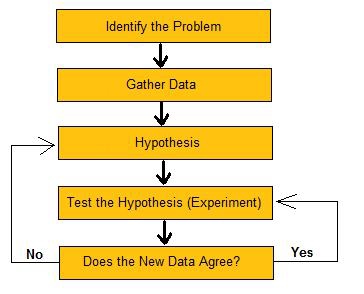 A labeled diagram showing the cyclical steps of the scientific research process (problem → hypothesis → experiment → analysis → conclusion). (Image: CK-12 Foundation, CC BY-SA 3.0, via Wikimedia Commons)
Based on the TU BBM syllabus for Business Research Methods (RCH311), unit 1.
Discussion
Loading…