Financial ManagementUnit 911 min read
Agency Theory & Corporate Governance: Conflicts, Solutions & Nepal’s Context
Unit 9 of Financial Management explores the agency problem between owners (principals) and managers (agents), governance mechanisms to align interests, and real-world applications in Nepali businesses like Ncell and NEPSE, with visual tools like t-accounts for governance costs and a flowchart of the corporate governanc
TAKEAWAYS:
- Agency problem arises when managers (agents) prioritize personal goals over shareholder (principal) wealth maximization, creating conflicts of interest.
- Governance mechanisms (internal: board structure, audits; external: market discipline, laws) mitigate agency costs but incur trade-offs between control and flexibility.
- Nepal’s context: Ncell’s dividend policy (2023) and NEPSE’s delisting rules exemplify how governance shapes investor trust and firm performance.
- Costs of governance: Monitoring expenses (e.g., audits) vs. residual loss (e.g., empire-building) must be balanced—visualized via a cost-benefit t-account.
- Ethical governance: Socially responsible firms (e.g., Green Tara Group) use stakeholder theory to reduce agency conflicts beyond legal compliance.
- Exam focus: Link theory to real cases (e.g., Daraz’s expansion vs. shareholder returns) and calculate agency costs (e.g., per-share monitoring expense).
1. The Agency Problem: Principals vs. Agents
Agency theory studies conflicts when principals (owners/shareholders) hire agents (managers) to act on their behalf. The core issue: agents may pursue self-interest (e.g., perks, empire-building) rather than maximizing principal wealth.
Why Does This Happen?
graph LR
    A["Principal (Shareholder)"] -->|"Hires"| B["Agent (Manager)"]
    B -->|"Acts in"| C["Self-Interest"]
    C -->|"Leads to"| D["Agency Costs"]
    D -->|"Types"| E["Monitoring Costs\n(e.g., audits)"]
    D -->|"Types"| F["Residual Loss\n(e.g., lost profits)"]
    D -->|"Types"| G["Bonding Costs\n(e.g., executive bonuses tied to performance)"]
Real-World Example: Ncell’s Dividend Policy
- Conflict: Ncell’s board (agents) declared a 50% dividend payout (2023) while shareholders pushed for higher returns.
- Agency Cost: Shareholders bore opportunity costs (e.g., reinvestment potential lost) due to conservative payouts.
- Governance Response: Ncell’s independent directors (3/10) now scrutinize dividend decisions to align with shareholder goals.
2. Sources of Agency Conflict
| Principal-Agent Pair | Conflict Example | Nepalese Case |
|---|---|---|
| Shareholders vs. Managers | Managers take risky projects to boost bonuses but harm firm value. | Nepal Investment Bank’s 2021 loan defaults: Managers approved high-risk loans to meet targets. |
| Managers vs. Employees | Managers cut employee benefits to boost profits. | NTC’s 2022 layoffs: Reduced workforce to improve efficiency but sparked protests. |
| Shareholders vs. Creditors | Shareholders demand high dividends, increasing firm risk and creditor losses. | Global IME Bank’s 2019 crisis: Shareholder-driven expansion led to insolvency. |
| Society vs. Firm | Firms pollute to cut costs, harming communities. | Kathmandu’s brick kilns: Use cheap (but polluting) fuel, ignoring social costs. |
3. Governance Mechanisms to Align Interests
Governance mechanisms reduce agency costs by monitoring, bonding, or incentivizing agents.
A. Internal Governance Mechanisms
Board of Directors
- Independent Directors: At least 30% of board members must be independent (SEB Act, 2063).
- Role: Oversee management, approve major decisions.
- Example: NEPSE’s board includes independent directors to prevent insider trading.
Executive Compensation
- Stock Options: Tie bonuses to share price performance (e.g., Ncell’s CEO earns 50% via stock options).
- Risk: Overemphasis on short-term gains (e.g., Daraz’s aggressive expansion vs. profitability).
Auditing and Controls
- Internal Audits: Check financial statements (e.g., Nabil Bank’s 2023 audit flagged irregularities).
- External Audits: Mandatory for listed firms (e.g., NEPSE-listed companies).
B. External Governance Mechanisms
| Mechanism | How It Works | Nepalese Example |
|---|---|---|
| Market for Corporate Control | Poorly managed firms get taken over (e.g., hostile takeovers). | NMB Bank’s 2018 acquisition: Improved governance post-merger. |
| Legal Protections | Laws protect shareholders (e.g., SEB Act 2063, Company Act 2063). | NEPSE’s delisting rules: Force firms to disclose governance failures. |
| Media and Activism | Public scrutiny (e.g., protests, media campaigns). | #SaveKathmanduTraffic: Pressured government to improve urban governance. |
4. Agency Costs: The Hidden Tax on Firms
Agency costs include:
- Monitoring Costs: Expenses to oversee agents (e.g., audit fees, board meetings).
- Bonding Costs: Agents’ expenses to assure principals (e.g., executive bonuses, insurance).
- Residual Loss: Profits lost due to conflicts (e.g., empire-building, shirking).
Worked Example: Calculating Agency Costs for a Nepali Retailer
Scenario: Kathmandu’s "Everest Retail Pvt. Ltd." has:
- Shareholders: 100 owners.
- Annual Profit: ₹50,00,000.
- Manager’s Salary: ₹20,00,000 (₹200k/year).
- Monitoring Costs: ₹5,00,000 (audits, board meetings).
- Residual Loss: Manager invests in non-profitable ventures (e.g., a failed café), costing ₹3,00,000.
Step 1: Calculate Total Agency Costs
| Cost Type          | Amount (₹) | Calculation                          |
|--------------------|-------------|---------------------------------------|
| Monitoring Costs   | 5,00,000    | Audit fees + board meetings          |
| Bonding Costs      | 20,00,000   | Manager’s salary (could be lower)    |
| Residual Loss      | 3,00,000    | Lost profit from café venture        |
| **Total**          | **28,00,000** |                                   |
Step 2: Per-Shareholder Cost
Total Agency Cost / No. of Shareholders = ₹28,00,000 / 100 = **₹28,000 per shareholder per year**.
Interpretation: Each shareholder effectively loses ₹28,000/year due to agency conflicts—equivalent to 5.6% of annual profit per shareholder.
5. Governance in Nepal: Challenges and Solutions
Challenges
- Weak Enforcement: Laws exist (e.g., SEB Act 2063) but lack strict penalties.
- Family Control: Many firms (e.g., Green Tara Group) are family-owned, reducing independent oversight.
- Limited Market Discipline: Few hostile takeovers due to concentrated ownership.
Solutions
| Solution | Implementation in Nepal |
|---|---|
| Stronger Independent Boards | NEPSE’s new rule: Listed firms must have ≥40% independent directors by 2025. |
| Transparency | Mandatory ESG reporting for top 50 firms (pilot in 2024). |
| Shareholder Activism | Investor groups (e.g., Nepal Investment Summit) pushing for governance reforms. |
6. Ethical Governance: Beyond Legal Compliance
Stakeholder Theory: Firms must consider shareholders, employees, society, and environment. Example: Green Tara Group’s Governance
- Social: Donates 5% of profits to education.
- Environmental: Uses renewable energy in factories.
- Ethical: Pays living wages (₹30,000/month) to workers.
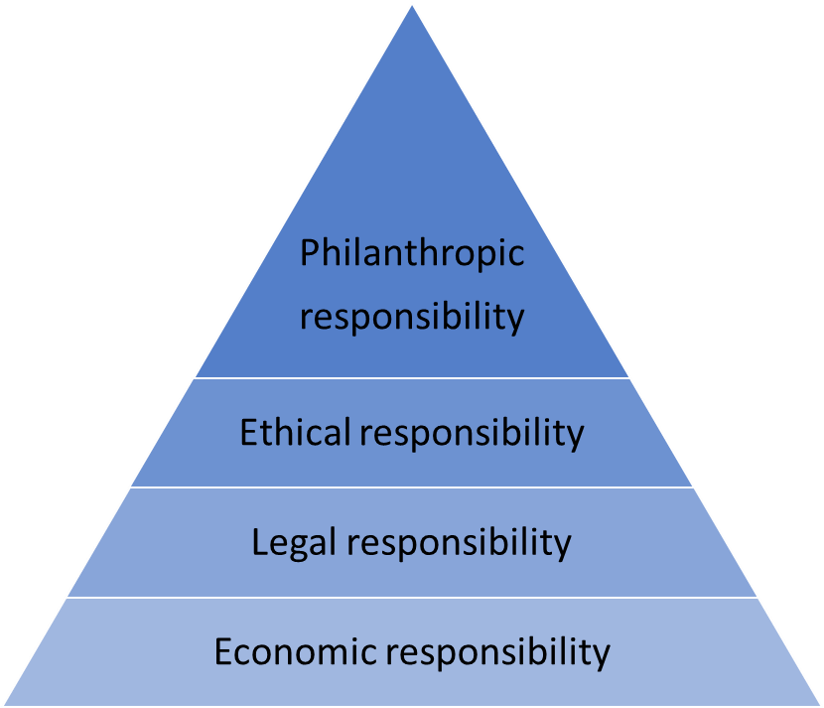 A pyramid showing legal compliance (base), ethical responsibility, philanthropy (top). (Image: Michel Awkal, CC BY-SA 4.0, via Wikimedia Commons)
7. The Corporate Governance Cycle
flowchart TD
    A["Shareholder Wealth Maximization"] --> B["Hire Managers\n(Agency Problem Arises)"]
    B --> C["Governance Mechanisms\n(Internal/External)"]
    C --> D["Monitor & Incentivize"]
    D --> E["Reduce Agency Costs"]
    E --> F["Improve Firm Value"]
    F --> A
    G["External Shocks\n(e.g., Scandal, Law Change)"] --> C
Key Takeaway: Governance is a feedback loop—poor governance leads to crises (e.g., Global IME’s collapse), which triggers reforms.
## In the Real World
Ncell’s Dividend Policy
- Idea Used: Agency conflict between shareholders and managers.
- How: Ncell’s board (agents) declared a 50% dividend payout in 2023, while shareholders demanded higher returns. The independent directors now push for performance-linked bonuses to align interests.
Daraz’s Expansion vs. Shareholder Returns
- Idea Used: Empire-building (agency cost).
- How: Daraz’s rapid expansion (e.g., ₹10B loss in 2022) was driven by managers seeking growth, not shareholder value. Alibaba’s intervention (2023) imposed stricter governance to cut losses.
NEPSE’s Delisting Rules
- Idea Used: Market discipline as governance mechanism.
- How: Firms failing governance standards (e.g., non-disclosure, fraud) get delisted. Example: Nepal Investment Bank faced scrutiny for loan defaults, leading to stricter audits.
## Exam Tip
Link Theory to Cases:
- If asked about agency problems, cite Ncell’s dividends or Global IME’s collapse.
- For governance mechanisms, compare NEPSE’s independent directors vs. family-controlled firms.
Calculate Agency Costs:
- Formula:
Agency Cost = Monitoring + Bonding + Residual Loss. - Example: In the Everest Retail case above, compute per-shareholder cost (₹28,000).
- Formula:
Compare Governance Models:
- Use a table to contrast Nepal (weak enforcement) vs. Singapore (strong market discipline).
Ethical Governance:
- Green Tara Group is a high-scoring example for stakeholder theory. Mention ESG reporting as a trend in Nepal.
Common Pitfalls:
- ❌ Saying "governance only matters for big firms" → NTC and Ncell are counterexamples.
- ❌ Ignoring residual loss in cost calculations → Always include it!
## Practice Questions (Exam-Style)
Short Answer:
- "Explain how Ncell’s independent directors reduce agency costs." (3 marks)
- Answer: Independent directors monitor management, approve major decisions, and align incentives (e.g., performance-linked bonuses), reducing residual loss from empire-building.
Numerical:
- A firm has 50 shareholders, ₹1Cr profit, ₹20L monitoring costs, and ₹10L residual loss. Calculate per-shareholder agency cost.
- Solution:
Total Agency Cost = ₹20L (monitoring) + ₹10L (residual) = ₹30L.
Per-shareholder cost = ₹30L / 50 = **₹60,000**.
Case Study:
- "How did Global IME Bank’s governance failures lead to its 2019 crisis?"
- Answer:
- Weak board: Lacked independent directors.
- Risky loans: Managers approved non-performing loans (₹50B).
- No market discipline: No hostile takeover to replace management.
- Outcome: ₹100B bailout by government.
Based on the TU BBM syllabus for Financial Management (FIN207), unit 9.
Discussion
Loading…