PsychologyUnit 515 min read
Personality & Individual Differences: Theories, Models & Measurement
Unit 5 of Psychology explores the nature of personality, its biological and environmental foundations, the Big Five model, and how psychologists measure personality using objective and projective techniques—with real-world applications in workplace hiring, mental health, and consumer behavior.
TAKEAWAYS:
- Personality is the unique pattern of thoughts, feelings, and behaviors that distinguishes individuals, shaped by both heredity and environment.
- The Big Five model (OCEAN) provides the most widely accepted framework for describing personality traits: Openness, Conscientiousness, Extraversion, Agreeableness, and Neuroticism.
- Measurement tools include objective tests (self-report inventories) and projective tests (unstructured stimuli like inkblots), each with distinct strengths and limitations.
- Individual differences in intelligence (e.g., Gardner’s multiple intelligences) and personality influence learning, career success, and social interactions.
- Real-world applications span from hiring (e.g., Google’s structured interviews) to mental health (e.g., Kathmandu’s suicide prevention programs targeting neuroticism).
- Exam focus: Define key terms (e.g., "personality," "trait"), compare models (e.g., Big Five vs. Freud’s psychodynamic), and analyze measurement methods with examples.
1. What Is Personality?
Personality refers to the unique and relatively stable pattern of thoughts, feelings, and behaviors that define how a person responds to the world. It emerges from the interaction of:
- Heredity (genetic predispositions, e.g., temperament).
- Environment (culture, upbringing, life experiences).
- Situational factors (e.g., stress at work may temporarily alter behavior).
Key Theories of Personality
Personality theories attempt to explain why people differ. The three major perspectives are:
mindmap
  root((Personality Theories))
    Freud["Psychodynamic (Freud)"]
      id["Unconscious drives (pleasure principle)"]
      ego["Reality mediator (balance)"]
      superego["Morality (conscience)"]
      defense["Mechanisms (e.g., repression)"]
    Allport["Trait Theory"]
      cardinal["Dominant traits (e.g., honesty)"]
      central["Common traits (e.g., sociability)"]
      secondary["Situational traits (e.g., shyness at parties)"]
    BigFive["Five-Factor Model (OCEAN)"]
      O["Openness to experience"]
      C["Conscientiousness"]
      E["Extraversion"]
      A["Agreeableness"]
      N["Neuroticism"]
2. The Big Five Model: OCEAN of Personality
The Big Five model (also called the Five-Factor Model) is the most scientifically validated framework for describing personality. It identifies five broad dimensions, each with two poles:
| Trait | High Pole | Low Pole | Example in Nepal |
|---|---|---|---|
| Openness | Creative, curious, loves novelty | Practical, traditional, prefers routine | A Kathmandu University student exploring art vs. an NTC engineer sticking to manuals. |
| Conscientiousness | Organized, disciplined, goal-oriented | Spontaneous, careless, impulsive | A Daraz delivery executive vs. a freelance graphic designer. |
| Extraversion | Sociable, energetic, thrives in groups | Reserved, independent, prefers solitude | A Khalti customer service agent vs. a solo hiker in Annapurna. |
| Agreeableness | Compassionate, trusting, cooperative | Skeptical, competitive, ruthless | A nurse at Patan Hospital vs. a stockbroker at NEPSE. |
| Neuroticism | Anxious, moody, emotionally unstable | Calm, resilient, emotionally stable | A student stressed before TU exams vs. a retired Ncell employee. |
Why It Matters:
- Predicts job performance (e.g., conscientiousness → better at NTC’s project management).
- Explains mental health (high neuroticism → higher risk of depression; low agreeableness → conflict in teams).
- Used in hiring (e.g., Google’s "Project Oxygen" found conscientiousness and extraversion were top traits for managers).
Worked Example: Personality in a Bank Loan Officer A loan officer at Nabil Bank must balance:
- High Conscientiousness (to assess risk meticulously).
- Moderate Extraversion (to build trust with clients).
- Low Neuroticism (to stay calm under pressure). If an officer scores low on agreeableness, they might struggle with customer relations, even if technically skilled.
3. Measuring Personality: Objective vs. Projective Tests
Psychologists use two main types of tools to assess personality:
A. Objective Tests (Self-Report Inventories)
Definition: Structured questionnaires where individuals rate their own traits. Examples:
- Minnesota Multiphasic Personality Inventory (MMPI-2)
- 567 true/false questions to detect psychopathology (e.g., depression, paranoia).
- Used in clinical settings (e.g., mental health clinics in Nepal).
- Big Five Inventory (BFI)
- 44 questions to measure OCEAN traits.
- Used in workplace assessments (e.g., Pathao’s driver screening).
Advantages:
- Reliable (consistent results over time).
- Easy to administer (e.g., online surveys for Khalti’s customer feedback).
- Quantifiable (scores can be compared statistically).
Disadvantages:
- Social desirability bias (people may lie to appear "better").
- Limited depth (misses unconscious motives).
B. Projective Tests (Unstructured Stimuli)
Definition: Ambiguous stimuli (e.g., inkblots) that reveal unconscious thoughts. Examples:
- Rorschach Inkblot Test
- 10 symmetrical inkblots; responses analyzed for themes (e.g., aggression, anxiety).
- Used in forensic psychology (e.g., assessing criminals in Nepal’s courts).
- Thematic Apperception Test (TAT)
- Subjects create stories about ambiguous images (e.g., a child with a violin).
- Reveals motivations and conflicts (e.g., a Daraz employee’s ambition vs. fear of failure).
Advantages:
- Uncovers unconscious motives (e.g., a Khalti user’s hidden fears about digital payments).
- Flexible (no "right" answer).
Disadvantages:
- Subjective scoring (depends on psychologist’s interpretation).
- Low reliability (different psychologists may give different results).
- Cultural bias (e.g., rural Nepalis may interpret inkblots differently than urbanites).
Comparison Table:
| Feature | Objective Tests | Projective Tests |
|---|---|---|
| Structure | Fixed questions/items | Ambiguous stimuli |
| Bias Risk | Social desirability | Psychologist’s bias |
| Use Case | Workplace, research | Clinical, forensic |
| Example in Nepal | TU’s student personality surveys | Mental health assessments at CIATM |
4. Individual Differences: Beyond Personality
While personality shapes behavior, individual differences also arise from:
- Intelligence (e.g., Gardner’s multiple intelligences: linguistic, logical-mathematical, etc.).
- Cognitive styles (e.g., field-dependent vs. field-independent learners).
- Temperament (innate emotional reactivity, e.g., "easy" vs. "difficult" babies).
Intelligence: Theories and Applications
Definition: The ability to learn, understand, and apply knowledge. Traditionally measured by IQ, but modern views emphasize multiple intelligences (Howard Gardner).
Gardner’s 8 Intelligences:
graph TD
  A["Multiple Intelligences"] --> B["Linguistic"]
  A --> C["Logical-Mathematical"]
  A --> D["Spatial"]
  A --> E["Musical"]
  A --> F["Bodily-Kinesthetic"]
  A --> G["Interpersonal"]
  A --> H["Intrapersonal"]
  A --> I["Naturalistic"]
Real-World Example: NEPSE Traders
- Logical-Mathematical Intelligence: Essential for analyzing stock charts and predicting market trends.
- Interpersonal Intelligence: Crucial for networking with brokers and clients.
- Intrapersonal Intelligence: Helps traders manage risk and emotional discipline.
Worked Example: A Daraz Delivery Person
- Bodily-Kinesthetic Intelligence: Navigating Kathmandu’s traffic efficiently.
- Interpersonal Intelligence: Handling customer complaints with empathy.
- Naturalistic Intelligence: Recognizing shortcuts or safe routes based on terrain.
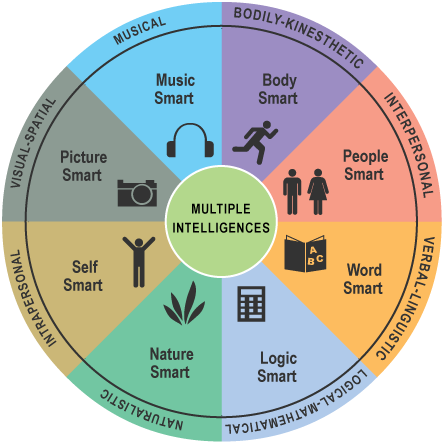 Visual representation of the 8 intelligences with icons. (Image: Howard, CC BY-SA 4.0, via Wikimedia Commons)
5. Applications of Personality Psychology
A. Workplace and Organizational Psychology
- Hiring: Companies like Google use personality tests (e.g., Big Five) to predict job success.
- Example: Extraversion is key for sales roles (e.g., Daraz’s customer service), while conscientiousness matters for data entry.
- Team Building: Understanding personality blends can reduce conflicts (e.g., pairing high-agreeable employees with neurotic ones for support).
- Leadership: Transformational leaders often score high on extraversion and openness.
B. Mental Health and Therapy
- Personality Disorders: High neuroticism + low agreeableness may indicate borderline personality disorder.
- Cognitive Behavioral Therapy (CBT): Targets maladaptive traits (e.g., high neuroticism → anxiety management).
- Nepal Example: CIATM (Central Institute of Psychiatry) uses MMPI-2 to diagnose depression and schizophrenia.
C. Consumer Behavior and Marketing
- Targeted Ads: Facebook/Google use personality data to tailor ads (e.g., extraverts see social event ads; conscientious users see budget-friendly products).
- Nepal Example: Khalti designs its app for high conscientiousness (secure transactions) and low neuroticism (minimal stress in payments).
D. Education
- Learning Styles: Matching teaching methods to personality (e.g., kinesthetic learners benefit from hands-on TU lab work).
- Student Counseling: Identifying at-risk students (e.g., high neuroticism + low openness → academic burnout).
In the Real World
Khalti’s Personality-Driven Design
- Idea Used: Conscientiousness and Neuroticism
- How: Khalti’s app minimizes steps for high-conscientious users (e.g., auto-save transaction details) while offering low-neuroticism features like 24/7 customer support to reduce anxiety about failed payments.
Pathao’s Driver Screening
- Idea Used: Big Five (Conscientiousness + Agreeableness)
- How: Pathao’s hiring process includes personality tests to select drivers who are punctual (conscientious) and patient with passengers (agreeable), reducing conflicts and improving ratings.
NTC’s Project Management
- Idea Used: Extraversion and Openness
- How: NTC’s infrastructure projects require extraverted team leaders for stakeholder communication and open-minded engineers to adapt to rural challenges (e.g., terrain in Far-Western Nepal).
Nepal Police Recruitment
- Idea Used: Projective Tests (TAT)
- How: Candidates undergo TAT to assess unconscious aggression levels—critical for roles like anti-terrorism units where emotional control is key.
YouTube’s Algorithm (Global Example)
- Idea Used: Openness and Extraversion
- How: YouTube’s recommendation engine favors high-openness users (who seek diverse content) with niche videos, while extraverts get more social/interactive content (e.g., live streams).
Exam Tip
How to Score Full Marks
Definitions First
- Always start with precise definitions (e.g., "Personality is the dynamic organization of psychological systems that create a person’s characteristic patterns of behavior").
- Example Answer Starter:
"Personality refers to the unique constellation of psychological traits that differentiate individuals in their thoughts, emotions, and behaviors. It is shaped by both genetic predispositions and environmental influences."
Compare Models with Tables
- For questions like "Explain the Big Five model vs. Freud’s psychodynamic theory," use a side-by-side table (as shown above) to highlight differences.
Use Real-World Examples
- Always tie theory to Nepal. For instance:
"In the context of Nepali workplaces, a high-neuroticism employee at Ncell might struggle with the fast-paced call-center environment, while a low-neuroticism colleague would thrive under pressure."
- Always tie theory to Nepal. For instance:
Measurement Methods: Objective vs. Projective
- For projective tests: Mention one strength and one weakness with an example.
"The Rorschach test reveals unconscious motives (e.g., a Pathao driver’s hidden fear of accidents), but its subjective scoring can lead to inconsistencies between psychologists."
- For projective tests: Mention one strength and one weakness with an example.
Individual Differences in Intelligence
- If asked about Gardner’s theory, list 3 intelligences and give a Nepal-specific example for each.
"A TU student excelling in linguistics (writing essays) but struggling in math (logical-mathematical) demonstrates Gardner’s multiple intelligences theory."
- If asked about Gardner’s theory, list 3 intelligences and give a Nepal-specific example for each.
Avoid Vague Statements
- ❌ "Personality is important." → ✅ "Conscientiousness predicts job performance in structured roles like NTC’s engineering teams, while extraversion enhances leadership in customer-facing jobs like Khalti’s support."
Practice Question with Model Answer
Question: "What is personality? How do you measure personality? Explain projective and objective measures with suitable examples."
Model Answer: Personality is the unique and stable pattern of thoughts, feelings, and behaviors that distinguishes individuals. It arises from the interaction of heredity, environment, and situational factors, shaping how people perceive and respond to the world.
Personality is measured using two primary methods: objective tests (structured, self-report) and projective tests (unstructured, indirect).
Objective Measures
- Definition: Standardized questionnaires where individuals rate their own traits.
- Example: The Big Five Inventory (BFI) assesses OCEAN traits. In Nepal, TU’s student counseling centers use such inventories to match students with suitable majors (e.g., high openness → arts; high conscientiousness → engineering).
- Advantage: Reliable and easy to administer (e.g., online surveys for Khalti’s customer satisfaction).
- Disadvantage: Social desirability bias (e.g., a Daraz manager may overreport agreeableness).
Projective Measures
- Definition: Ambiguous stimuli (e.g., inkblots) that reveal unconscious motives.
- Example: The Rorschach Inkblot Test is used in CIATM’s forensic psychology unit to assess criminals’ unconscious aggression. A blot interpreted as "a knife" might indicate suppressed hostility.
- Advantage: Uncovers hidden motivations (e.g., a Ncell employee’s fear of job loss).
- Disadvantage: Subjective scoring (e.g., two psychologists may disagree on a Khalti user’s inkblot response).
Comparison:
| Aspect | Objective Tests | Projective Tests |
|---|---|---|
| Example | BFI (Big Five Inventory) | Rorschach Inkblot Test |
| Nepal Use | TU admissions counseling | CIATM’s criminal profiling |
| Strength | Quantifiable, reliable | Reveals unconscious motives |
| Weakness | Social desirability bias | Low reliability, cultural bias |
Conclusion: While objective tests provide structured, quantifiable data, projective tests offer depth into unconscious processes. In practice, psychologists often combine both (e.g., using BFI for initial screening and Rorschach for clinical diagnosis).
Based on the TU BBM syllabus for Psychology (PSY201), unit 5.
Discussion
Loading…