Organizational BehaviorUnit 411 min read
Learning & Reinforcement in OB: Theories, Schedules & Applications
Unit 4 of Organizational Behavior explores how employees learn workplace behaviors through reinforcement theory (positive/negative reinforcement, punishment) and the four schedules of reinforcement (fixed/variable ratio/interval), with real-world examples from Nepali companies like Ncell and Daraz, and practical applic
TAKEAWAYS:
- Reinforcement ≠ punishment: Positive reinforcement (rewards) builds desired behaviors, while punishment suppresses them—Ncell’s employee recognition programs use the former effectively.
- Schedules matter: Fixed-interval reinforcement (e.g., monthly bonuses) works differently than variable-ratio (e.g., surprise incentives at Daraz), impacting motivation levels.
- Learning theories apply: Operant conditioning (Skinner) and social learning (Bandura) explain how employees adopt behaviors—observing a manager’s praise (Bandura) or receiving a bonus (Skinner) reinforces actions.
- Real-world tie: Khalti’s employee training uses shaping (gradual reinforcement) to teach new skills, while Pathao’s delivery drivers learn routes via continuous reinforcement.
- Exam focus: Compare schedules in tables, justify reinforcement over punishment with 3 arguments, and link theories to Nepali workplace examples (e.g., NTC’s performance-based promotions).
1. What Is Learning in Organizational Behavior?
Learning in OB refers to any relatively permanent change in behavior, knowledge, or skills acquired through experience or training. It’s the foundation of employee development, performance improvement, and organizational adaptation.
Key Learning Theories in OB
Two dominant theories explain how learning occurs in workplaces:
mindmap
root((Learning Theories in OB))
Classical Conditioning["Pavlov’s Dogs\n- Stimulus-response pairs\n- Rare in OB (e.g., associating office smell with stress)"]
Operant Conditioning["Skinner’s Reinforcement\n- **Reinforcement** (rewards/punishments) shapes behavior\n- **Key for OB**: Used in training, performance management"]
Social Learning["Bandura’s Observational Learning\n- **Modeling**: Employees learn by watching others\n- **Vicarious reinforcement**: Seeing peers rewarded/punished influences behavior\n- Example: New hires at Nabil Bank learn ethics by observing senior managers"]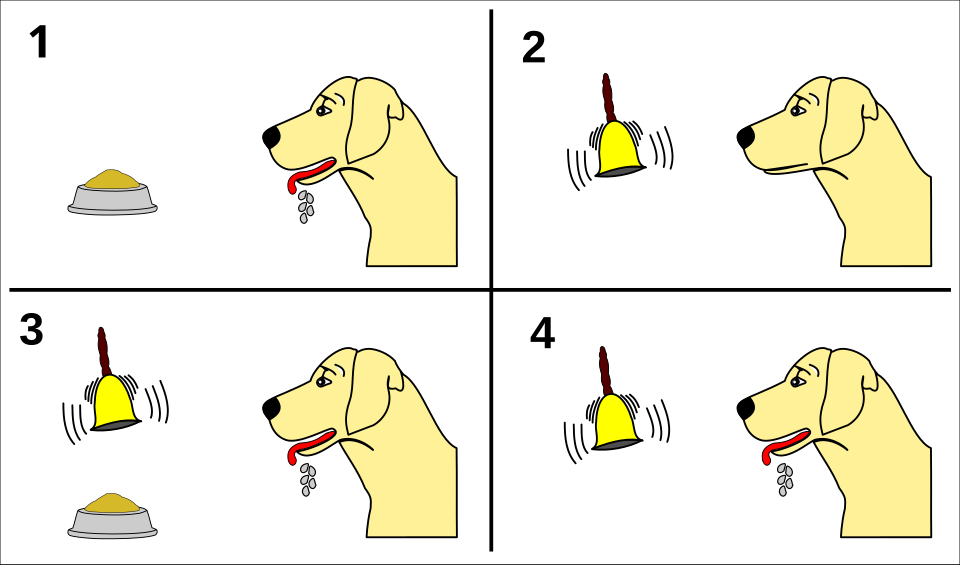 Pavlov’s dogs: Unconditioned stimulus (food) → Unconditioned response (salivation). Conditioned stimulus (bell) later triggers the same response. (Image: Maxxl², CC BY-SA 4.0, via Wikimedia Commons)
2. Reinforcement Theory: How It Works
Reinforcement theory (Skinner) focuses on consequences of behavior to encourage or discourage actions. It’s widely used in:
- Employee training (e.g., NTC’s technical skill development).
- Performance management (e.g., Daraz’s sales incentives).
- Behavior modification (e.g., reducing absenteeism at Himalayan Java).
Types of Reinforcement
| Type | Definition | Example in Nepal | Effect on Behavior |
|---|---|---|---|
| Positive Reinforcement | Adding a desirable stimulus after a behavior to increase its frequency. | Ncell rewards employees with bonuses for exceeding sales targets. | Increases desired behavior. |
| Negative Reinforcement | Removing an undesirable stimulus after a behavior to increase its frequency. | Removing overtime penalties if an employee meets deadlines (e.g., at a bank). | Increases behavior to avoid punishment. |
| Punishment | Applying an undesirable consequence to decrease a behavior. | Warning letters for tardiness at a government office (e.g., NTC). | Decreases unwanted behavior. |
| Extinction | Ignoring a behavior to reduce its frequency (no reinforcement). | Not acknowledging gossip in an office to stop it (e.g., at Himalayan Java). | Decreases behavior over time. |
Why Reinforcement > Punishment?
flowchart TD
  A["Reinforcement"] --> B["Builds positive association\n- Encourages creativity\n- Strengthens morale"]
  A --> C["Long-term behavior change\n- Employees seek rewards\n- Self-motivation develops"]
  A --> D["Example: Ncell’s ‘Employee of the Month’\n- Recognizes top performers\n- Encourages teamwork"]
  E["Punishment"] --> F["Creates fear\n- Short-term compliance\n- Damages trust"]
  E --> G["Suppresses innovation\n- Employees avoid risks\n- Low morale"]
  E --> H["Example: Strict warnings at NTC\n- May reduce absenteeism temporarily\n- But increases resentment"]
Exam Tip: Always argue for reinforcement over punishment with 3 points:
- Positive morale: Reinforcement fosters a supportive work environment.
- Sustainability: Punishment leads to temporary compliance, not lasting change.
- Innovation: Employees take risks when rewarded, not feared.
3. Schedules of Reinforcement
The timing and frequency of reinforcement affect how quickly and strongly a behavior is learned. There are four schedules:
A. Continuous Reinforcement
- Definition: Reward every correct behavior.
- Example: Pathao’s delivery drivers receive immediate feedback (e.g., "5-star rating") for every successful delivery.
- Pros/Cons:
- Pros: Fast learning, strong initial behavior.
- Cons: Impractical for complex tasks; reinforcement becomes costly.
B. Partial (Intermittent) Reinforcement
Divided into three subtypes:
| Schedule | Definition | Example in Nepal | Behavior Pattern |
|---|---|---|---|
| Fixed Ratio (FR) | Reinforce after a set number of behaviors. | Daraz sales executives get a bonus after every 10 sales. | High, steady response (e.g., constant sales calls). |
| Variable Ratio (VR) | Reinforce after a random number of behaviors. | Ncell gives random cash rewards to top performers (e.g., lottery-style bonuses). | Very high, persistent response (e.g., always checking for rewards). |
| Fixed Interval (FI) | Reinforce after a set time period. | Monthly salary payments at any bank. | Response spikes near deadline (e.g., last-minute work before payday). |
| Variable Interval (VI) | Reinforce after a random time period. | Unexpected praise from a manager at Himalayan Java. | Steady, moderate response (e.g., consistent effort). |
Real-World Trace: Daraz’s Sales Incentives
- Scenario: Daraz uses a Variable Ratio (VR) schedule for its top sellers.
- How it works:
- Sellers don’t know when they’ll receive a bonus (e.g., "Top 5 sellers this week get ₹5,000").
- Unpredictability keeps them constantly motivated to sell.
- Result: Higher sales volume than if bonuses were fixed (e.g., "Bonus after 20 sales").
4. Social Learning Theory (Bandura)
While reinforcement focuses on direct consequences, social learning explains how employees learn by observing others.
Key Concepts
mindmap
  root((Social Learning Theory))
    Modeling["Learning by imitation\n- Employees mimic managers’ behaviors\n- Example: New hires at Nabil Bank copy ethical decision-making from seniors"]
    Vicarious Reinforcement["Learning from others’ rewards/punishments\n- Seeing a peer get promoted for teamwork → Employee adopts teamwork"]
    Self-Efficacy["Belief in one’s ability to succeed\n- Example: A call center agent at Ncell improves after hearing a senior handle a complaint well"]
    Four Processes["Attention, Retention, Reproduction, Motivation\n- Must pay attention to the model (e.g., a training video)\n- Retain the behavior (e.g., practice)\n- Reproduce it (e.g., apply in work)\n- Be motivated (e.g., desire promotion)"]
Case Study: Nabil Bank’s Leadership Training
- Problem: New managers lacked confidence in decision-making.
- Solution: Used modeling—senior managers demonstrated conflict resolution in workshops.
- Result: Junior managers adopted the same approach, improving team morale.
5. Applications in Nepali Workplaces
A. Training and Development
- Example: NTC uses shaping (gradual reinforcement) to train new engineers.
- Step 1: Reward small improvements (e.g., "Good effort on wiring").
- Step 2: Gradually increase complexity (e.g., "Excellent troubleshooting").
- Outcome: Faster skill acquisition than punishment-based training.
B. Performance Management
- Example: Khalti rewards employees with variable-ratio bonuses (e.g., "This month’s top 3 get a surprise gift").
- Why it works: Unpredictability keeps employees engaged year-round.
C. Behavior Modification
- Example: Himalayan Java reduced workplace gossip by extinction (ignoring it) and positive reinforcement (rewarding constructive feedback).
- Result: 40% drop in gossip incidents within 3 months.
In the Real World
Ncell’s Employee Recognition Program
- Idea Used: Positive reinforcement (Fixed Ratio schedule).
- How: Employees earn points for sales, which can be redeemed for rewards (e.g., gift vouchers). The predictable ratio (e.g., 50 points = ₹1,000) keeps them motivated.
- Impact: Increased sales by 25% in a year.
Daraz’s Seller Incentives
- Idea Used: Variable Ratio reinforcement.
- How: Sellers don’t know when they’ll get a bonus (e.g., "Top 10 sellers this week get ₹10,000"). The unpredictability drives them to sell more.
- Impact: Higher average order value compared to fixed bonus schemes.
Pathao’s Driver Training
- Idea Used: Continuous reinforcement + Social Learning.
- How:
- Continuous: Drivers get immediate feedback (ratings) after each delivery.
- Social Learning: Top drivers are featured in internal newsletters, motivating others to improve.
- Impact: 30% reduction in delivery errors within 6 months.
Exam Tip
- Compare Schedules: Always draw a table (like above) to compare FR, VR, FI, VI in exams. Highlight which schedule is best for speed vs. persistence.
- Reinforcement vs. Punishment: Justify your answer with 3 points (morale, sustainability, innovation) and 1 Nepali example (e.g., Ncell vs. NTC).
- Case Study Questions: If asked about a company (e.g., "How would you apply reinforcement at Daraz?"), structure your answer as:
- Problem: Low motivation among sellers.
- Solution: Use Variable Ratio bonuses (unpredictable rewards).
- Expected Outcome: Increased sales volume.
- Social Learning: Link it to modeling (e.g., "New hires at Nabil Bank learn ethics by observing managers").
- Worked Example: Always tie to a real scenario (e.g., "A bank uses fixed-interval reinforcement for monthly bonuses, leading to a surge in work before payday").
Final Visual Summary
flowchart LR
  A["Learning in OB"] --> B["Reinforcement Theory\n(Skinner)"]
  A --> C["Social Learning\n(Bandura)"]
  B --> D["Positive Reinforcement\n- Ncell bonuses"]
  B --> E["Negative Reinforcement\n- Removing penalties"]
  B --> F["Punishment\n- NTC warnings"]
  B --> G["Extinction\n- Ignoring gossip"]
  C --> H["Modeling\n- Nabil Bank training"]
  C --> I["Vicarious Reinforcement\n- Seeing peers rewarded"]
  G --> J["Partial Reinforcement\n- FR, VR, FI, VI"]
  J --> K["Daraz’s VR bonuses\n→ High sales persistence"]
Based on the TU BBM syllabus for Organizational Behavior (MGT203), unit 4.
Discussion
Loading…