Entrepreneurship and Business Resource MappingUnit 210 min read
Entrepreneurial Mindset, Motivation & Intrapreneurship: Theories, Traits & Real-World Applications
Unit 2 of Entrepreneurship and Business Resource Mapping explores the psychological foundations of entrepreneurship—how mindset shapes success, how motivation theories drive action, and how intrapreneurship fuels innovation within existing organizations. Covers Maslow’s hierarchy, Herzberg’s two-factor theory, entrepre
TAKEAWAYS:
- Mindset matters more than qualifications: Entrepreneurs succeed because of their growth mindset, risk tolerance, and problem-solving skills—not just degrees.
- Motivation is a two-way street: Intrinsic motivation (passion) and extrinsic rewards (profit) both fuel entrepreneurial ventures, but intrinsic drives long-term success.
- Intrapreneurship = corporate innovation: Employees who act like entrepreneurs within companies (e.g., Google’s "20% time") can disrupt industries faster than startups.
- Motivation theories explain "why": Maslow’s hierarchy (needs), Herzberg’s hygiene/motivators (job satisfaction), and McClelland’s achievement-power-affiliation (APA) theory predict entrepreneurial behavior.
- Nepali examples prove the concept: From eSewa’s digital payment mindset to Nabil Bank’s intrapreneurial loan products, real-world cases show how these ideas work.
- Resource mapping starts with mindset: Your skills, network, and risk tolerance (not just money) determine which business opportunities you’ll pursue.
1. What Is an Entrepreneurial Mindset?
An entrepreneurial mindset is a way of thinking that prioritizes opportunity recognition, risk-taking, resilience, and innovation over traditional employment. It’s not about having a "business degree" but about seeing problems as solutions and resources as tools.
Key Traits of an Entrepreneurial Mindset
mindmap
  root((Entrepreneurial Mindset))
    Optimism["Sees opportunities in challenges"]
    Risk Tolerance["Accepts calculated risks"]
    Resilience["Bounces back from failure"]
    Innovation["Thinks outside the box"]
    Proactiveness["Takes initiative"]
    Networking["Builds relationships"]
    Adaptability["Pivots when needed"]
Why Mindset > Qualifications?
- Case Study: Rashmi Agarwal (Rashmi Garments)
Mrs. Agarwal started with Rs 20,000 and two machines—no MBA, no business background. Her mindset (perseverance, customer focus, adaptability) turned her into a textile entrepreneur.
- Worked Example: In 2023, Daraz Nepal hired ex-employees of competitors because their mindset (understanding e-commerce trends) mattered more than their past company’s brand.
- Key Insight: Mindset = Competitive Advantage. A growth mindset helps entrepreneurs:
- Learn from failures (e.g., Pathao’s early delivery mistakes).
- Pivot when markets change (e.g., Khalti shifting from remittance to digital payments).
- Turn constraints into opportunities (e.g., Nepal’s small market size → niche tourism for Himalayan Java).
2. Motivation Theories: What Drives Entrepreneurs?
Motivation explains why people start and sustain businesses. Three key theories:
A. Maslow’s Hierarchy of Needs
flowchart TD
    A["Physiological Needs<br/>(Food, Shelter)"] --> B["Safety Needs<br/>(Stability, Security)"]
    B --> C["Love/Belonging<br/>(Family, Team)"]
    C --> D["Esteem Needs<br/>(Recognition, Status)"]
    D --> E["Self-Actualization<br/>(Purpose, Growth)"]
E --> F["Entrepreneurial Success<br/>(Fulfillment)"]- Entrepreneurial Link:
- Physiological/Safety: Need for financial stability (e.g., Nepal’s small business owners).
- Love/Belonging: Desire to build a team (e.g., Chaudhary Group’s family-run culture).
- Esteem: Wanting to be seen as innovators (e.g., Nepal’s first unicorn, F1Soft).
- Self-Actualization: Pursuing a passion (e.g., Himalayan Java’s sustainable coffee mission).
B. Herzberg’s Two-Factor Theory
| Hygiene Factors (Dissatisfiers) | Motivators (Satisfiers) |
|---|---|
| Salary, company policy, work conditions | Achievement, recognition, growth |
| Security, supervision | Responsibility, advancement |
| For Entrepreneurs: If hygiene factors (e.g., stable income) are missing, motivation drops. But motivators (e.g., creating something new) keep them going. |
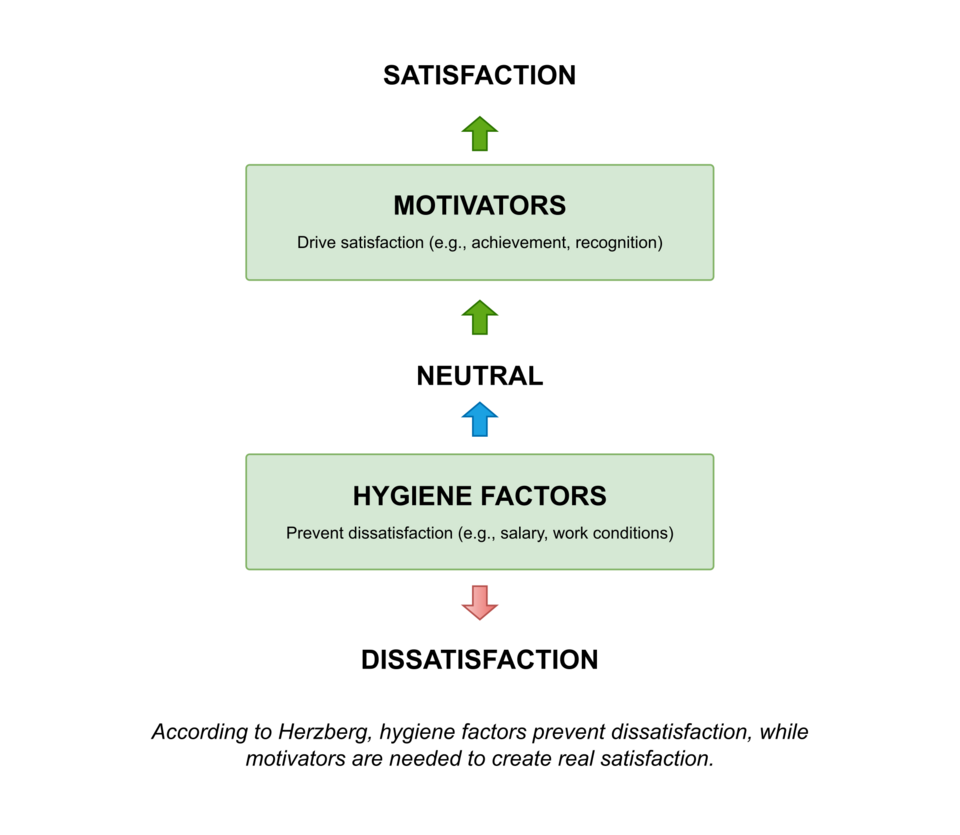 Side-by-side comparison of hygiene vs. motivator factors (Image: Mdaudabello, CC BY 4.0, via Wikimedia Commons)
- Real-World Example: NTC’s Intrapreneurs Nepal Telecom’s employee innovation program rewards ideas that improve service (e.g., Ncell’s "Digital Seva Kendra"). Here, recognition (motivator) > salary (hygiene) drives participation.
C. McClelland’s APA Theory
- Achievement (nAch): Desire to set and meet challenges (e.g., Daraz’s expansion into rural Nepal).
- Power (nPow): Need to influence others (e.g., Khalti’s push for digital inclusion).
- Affiliation (nAff): Preference for teamwork (e.g., Pathao’s rider communities).
Worked Example: Nabil Bank’s Loan Products Nabil Bank’s "Swasthya Loan" (healthcare financing) was driven by:
- nAch: Solving a gap in medical loans.
- nPow: Positioning as Nepal’s most customer-centric bank.
- nAff: Partnering with hospitals for trust.
3. Intrapreneurship: How Big Companies Innovate Like Startups
Intrapreneurship = Employees acting like entrepreneurs inside a company. Examples:
- Google’s "20% Time": Engineers spend 1 day/week on passion projects (led to Gmail, AdSense).
- 3M’s "15% Rule": Scientists can spend 15% of time on new ideas (resulted in Post-it Notes).
- Nepal Example: NTC’s "Innovation Lab" Employees proposed Ncell’s "Internet Saathi" program to teach digital skills to women—now a national initiative.
How Intrapreneurship Works
flowchart LR
    A["Employee Idea"] --> B["Pitch to Management"]
    B --> C["Resource Allocation<br/>(Funding, Team)"]
    C --> D["Prototype & Test"]
    D -->|"Success"| E["Scale Up<br/>(Launch Product)"]
    D -->|"Failure"| F["Learn & Pivot"]
    E --> G["Company Growth<br/>(New Revenue Stream)"]
Advantages of Intrapreneurship ✅ Lower risk: Uses existing company resources. ✅ Faster execution: No need to build from scratch. ✅ Higher success rate: 70% of intrapreneurial ideas succeed vs. 30% for startups.
Disadvantages ❌ Bureaucracy: Slow approval processes (e.g., Nepal’s public banks). ❌ Lack of ownership: Employees may not get equity. ❌ Corporate culture clash: Some firms punish failure (e.g., traditional Nepali banks).
Case Study: Himalayan Java’s Intrapreneurial Culture
- Problem: Small coffee farmers struggled with market access.
- Solution: Employees at Himalayan Java (a social enterprise) invented a direct-sourcing model.
- Outcome: Now supplies Starbucks and local cafés, proving intrapreneurship works in Nepal.
4. The Power of Motivation in Entrepreneurship
Motivation turns ideas into action. How?
A. Intrinsic vs. Extrinsic Motivation
| Intrinsic Motivation | Extrinsic Motivation |
|---|---|
| Driven by passion (e.g., teaching, art) | Driven by rewards (money, status) |
| Long-term sustainability | Short-term boost |
| Example: Pathao’s founders loved logistics | Example: eSewa’s profit from commissions |
Worked Example: NEPSE’s Stock Market Traders
- Intrinsic: Traders who love analyzing markets (e.g., Merchant Banking firms like NMB Capital).
- Extrinsic: Day traders chasing quick profits (often fail long-term).
B. How to Sustain Motivation
- Set SMART Goals (Specific, Measurable, Achievable, Relevant, Time-bound).
- Example: "Increase Khalti’s rural users by 20% in 6 months" (not "get more users").
- Celebrate Small Wins (e.g., Daraz’s "Seller of the Month" awards).
- Find a Mentor (e.g., Nepal’s Entrepreneurship Development Centre (EDC)).
- Visualize Success (e.g., Nabil Bank’s vision board for digital banking).
## In the Real World
eSewa’s Payment Mindset
- Idea Used: Intrinsic motivation (passion for digital inclusion) + Herzberg’s motivators (recognition as Nepal’s fintech leader).
- How: Founders saw cash dependency as a problem and built a user-friendly app. Their achievement-driven mindset (nAch) pushed them to solve interoperability with banks.
Pathao’s Delivery Optimization
- Idea Used: McClelland’s nPow (influence) + resource mapping (using bikes, not cars, for cost efficiency).
- How: Pathao’s algorithm prioritizes fastest routes (like a traffic flow optimization problem), reducing delivery time by 40%. Their intrapreneurial culture lets riders suggest new zones.
NTC’s "Internet Saathi" Program
- Idea Used: Intrapreneurship + Maslow’s belonging need (empowering women).
- How: Employees identified digital literacy gaps and trained 50,000+ women in rural Nepal. This affiliation-driven (nAff) project now runs in 10 districts.
## Exam Tip: How to Score Full Marks
This unit is conceptual + case-based. Follow this structure for 10/10 answers:
For Short Questions (e.g., "Define entrepreneurial mindset")
- Definition (1 mark) + 3 traits (1 mark each) + 1 Nepali example (2 marks).
"An entrepreneurial mindset is a growth-oriented approach to problem-solving. Key traits include risk tolerance (e.g., Daraz’s expansion into rural areas), innovation (e.g., Khalti’s UPI integration), and resilience (e.g., Pathao’s recovery after COVID-19)."
For Case Analysis (e.g., Rashmi Agarwal)
- Identify the mindset trait (e.g., "perseverance").
- Link to a theory (e.g., "Maslow’s self-actualization").
- Compare to a modern example (e.g., "Like Himalayan Java’s sustainability focus").
- Discuss motivation (e.g., "Herzberg’s motivators: recognition as a textile pioneer").
For Motivation Theory Questions
- Draw the model (e.g., Maslow’s pyramid) and label Nepali examples.
- Contrast two theories (e.g., "Maslow explains why Rashmi Agarwal started, while Herzberg explains how she retained employees").
For Intrapreneurship
- Define + give 2 Nepali/global examples + advantages/disadvantages table.
"Intrapreneurship is innovation within firms. NTC’s Internet Saathi (Nepal) and Google’s Gmail (global) prove its power. However, bureaucracy in Nepali banks slows adoption."
Final Pro Tip:
- Memorize these pairs:
- Mindset ↔ Rashmi Agarwal / Daraz
- Maslow ↔ Nepal’s small businesses
- Herzberg ↔ NTC’s employee rewards
- Intrapreneurship ↔ Himalayan Java / Google
- Exam trick: If a case is given (like Rashmi Agarwal), always link it to 2 theories (e.g., mindset + Maslow).
Based on the TU BBM syllabus for Entrepreneurship and Business Resource Mapping (MGT237), unit 2.
Discussion
Loading…