E CommerceUnit 216 min read
E-Commerce Infrastructure & Technical Foundations: Networks, Protocols & Systems
Unit 2 of E-Commerce covers the technical backbone of online business: internet infrastructure (physical/software layers), protocols (HTTP/HTTPS, TCP/IP), e-commerce software (shopping carts, EDI, agents), and how these enable transactions, security, and scalability. Includes real-world examples from Nepalese platforms
TAKEAWAYS:
- The OSI 7-layer model and TCP/IP 4-layer model define how data travels across networks, with HTTP/HTTPS handling web transactions.
- Physical infrastructure (servers, ISPs, data centers) and software infrastructure (shopping carts, payment gateways, EDI) are equally critical for e-commerce operations.
- Protocols like SSL/TLS encrypt data, while EDI and APIs automate B2B transactions—key for Daraz’s supplier networks.
- Social media agents (e.g., WhatsApp Business API) and AI chatbots personalize customer engagement in platforms like Pathao’s support.
- ADSL vs. fiber optics trade off cost, speed, and reliability—critical for NTC’s broadband services.
- Partial vs. pure e-commerce models blend online/offline strategies (e.g., Daraz pickup points vs. full digital NEPSE trading).
1. The Technical Backbone: Internet Infrastructure
E-commerce relies on a layered infrastructure—both physical (hardware) and logical (software/protocols). Break it down into two core pillars:
A. Physical Infrastructure: The "Plumbing" of the Internet
The internet is a global network of networks, connecting devices via physical components. Nepal’s e-commerce (e.g., eSewa, Daraz) depends on these:
Key Components:
- User Devices: Computers, smartphones (e.g., a customer using eSewa on an Android phone).
- Local ISPs: Internet Service Providers like NTC, Ncell, or Smart Cell that connect users to the backbone.
- National Backbone: Nepal’s fiber-optic cables (e.g., NTC’s 10Gbps network) that route traffic domestically.
- International Gateways: Submarine cables (e.g., SEA-ME-WE 5) linking Nepal to global networks.
- Data Centers: Host servers for e-commerce platforms (e.g., Daraz’s AWS servers in Singapore).
- CDNs: Distribute content globally (e.g., Cloudflare speeds up Daraz’s website for Kathmandu users).
B. Software Infrastructure: The "Brain" of E-Commerce
Software enables transactions, security, and automation. Nepal’s e-payment systems (eSewa, Khalti) and B2B platforms (Daraz’s supplier portal) rely on:
| Component | Role in E-Commerce | Example in Nepal |
|---|---|---|
| Shopping Cart Software | Tracks products, payments, and inventory. | Daraz’s Magento-based cart. |
| Payment Gateways | Processes transactions (credit/debit/e-wallets). | eSewa API for Daraz payments. |
| EDI (Electronic Data Interchange) | Automates B2B orders/invoices. | Daraz suppliers use EDI for bulk orders. |
| APIs (Application Programming Interfaces) | Connects systems (e.g., inventory to shipping). | Pathao’s API links rides to payment. |
| AI Chatbots | Handles customer queries 24/7. | Ncell’s WhatsApp bot for bill payments. |
| CRM Systems | Manages customer data and marketing. | Khalti’s user database for promotions. |
2. Protocols: The "Rules of the Road" for Data
Protocols define how data is formatted, transmitted, and secured. Two critical models:
A. OSI 7-Layer Model vs. TCP/IP 4-Layer Model
| OSI Layer | Function | TCP/IP Equivalent | E-Commerce Example |
|---|---|---|---|
| Application | HTTP, HTTPS, FTP, SMTP | Application | HTTPS for secure Daraz checkout. |
| Presentation | Encryption (SSL/TLS), compression | Application | SSL certificate on eSewa’s login page. |
| Session | Manages connections (e.g., login sessions) | Application | User session in Khalti app. |
| Transport | TCP (reliable), UDP (fast) | Transport | TCP for file downloads on Daraz. |
| Network | IP addressing, routing | Internet | IPv4/IPv6 for NTC’s broadband. |
| Data Link | MAC addresses, Ethernet | Network Access | Wi-Fi router at a Daraz warehouse. |
| Physical | Cables, signals (fiber, copper) | Network Access | Fiber optics in NTC’s backbone. |
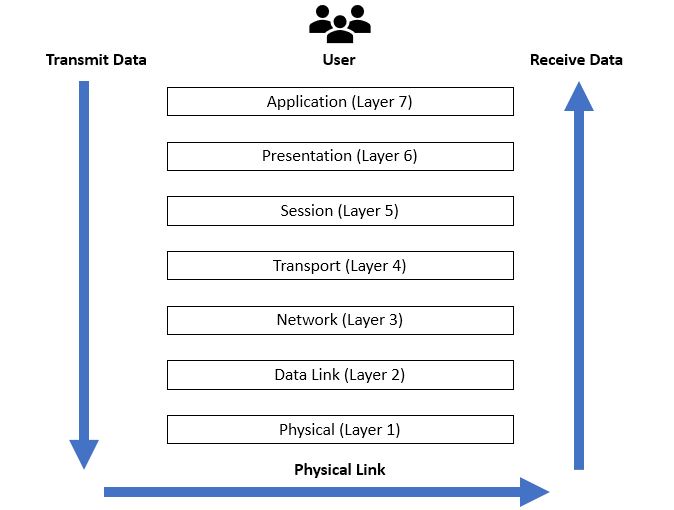 7 layers with arrows showing data flow. (Image: Ardika6879, CC BY-SA 4.0, via Wikimedia Commons)
B. Key Protocols for E-Commerce
HTTP/HTTPS:
- HTTP (Hypertext Transfer Protocol): Transfers web pages (unencrypted).
- HTTPS (HTTP Secure): Encrypts data using SSL/TLS (e.g.,
https://daraz.com.np). - Worked Example: When you buy a phone on Daraz, HTTPS ensures your credit card details aren’t intercepted.
TCP/IP:
- TCP (Transmission Control Protocol): Guarantees data arrives intact (used for emails, file transfers).
- IP (Internet Protocol): Routes data using IP addresses (e.g.,
192.168.1.1for your home router).
FTP/SFTP:
- FTP (File Transfer Protocol): Uploads/downloads files (e.g., Daraz uploading product images).
- SFTP (Secure FTP): Encrypted file transfers (e.g., Nepal Rastra Bank sharing audit reports).
SMTP/POP3:
- SMTP: Sends emails (e.g., Daraz’s order confirmations).
- POP3/IMAP: Receives emails (e.g., your Gmail for Daraz notifications).
3. E-Commerce Software Tools
A. Electronic Data Interchange (EDI)
- Definition: Standardized electronic exchange of business documents (invoices, orders, shipments) between companies.
- How It Works:
- Supplier (e.g., Daraz’s vendor) sends an order via EDI.
- Daraz’s system automatically updates inventory and triggers shipping.
- Receiver (e.g., Daraz warehouse) confirms receipt electronically.
- Example in Nepal:
- Daraz’s B2B portal uses EDI to sync orders from 10,000+ suppliers without manual paperwork.
- Nepal Customs uses EDI for import/export declarations (reducing delays).
B. Shopping Cart Software
- Features:
- Product catalog management.
- Inventory tracking.
- Payment gateway integration.
- Order processing.
- Popular Platforms:
- Magento (used by Daraz).
- Shopify (used by small Nepali sellers on Sanjhiko).
- WooCommerce (WordPress plugin for eSewa merchants).
- Worked Example:
- Step-by-Step Trace: Buying a laptop from Daraz:
- You add the laptop to the cart (Magento tracks stock).
- Proceed to checkout → Khalti/eSewa API processes payment.
- Daraz’s ERP system updates inventory and triggers shipping via Gati/Kantipur City.
- Step-by-Step Trace: Buying a laptop from Daraz:
C. Software Agents in E-Commerce
- Definition: Autonomous programs that perform tasks on behalf of users (e.g., price comparison, customer support).
- Types:
Agent Type Example in Nepal Function Shopping Agent PricePanda (compares Daraz/Sanjhiko) Finds best deals on electronics. Chatbot Ncell’s WhatsApp bot Resets SIM cards, checks bills. Recommendation Agent YouTube’s "Because you watched..." Suggests products on Daraz based on browsing. Monitoring Agent NTC’s network traffic analyzer Detects outages in broadband.
4. Physical vs. Software Infrastructure: A Comparison
| Aspect | Physical Infrastructure | Software Infrastructure |
|---|---|---|
| Definition | Hardware components (servers, cables, routers). | Programs and protocols (OS, databases, APIs). |
| Example in Nepal | NTC’s fiber backbone, Daraz’s data center. | eSewa’s payment gateway, Khalti’s app. |
| Failure Impact | Downtime (e.g., Nepal’s 2015 earthquake cut fiber links). | Security breaches (e.g., 2021 Daraz data leak). |
| Scalability | Limited by hardware (e.g., adding more servers). | Scales via cloud (e.g., AWS auto-scaling). |
| Maintenance | Physical repairs (e.g., fixing a broken cable). | Software updates (e.g., patching Magento). |
5. Partial vs. Pure E-Commerce: Models in Nepal
| Model | Definition | Nepal Example | Pros | Cons |
|---|---|---|---|---|
| Pure E-Commerce | Fully online (no physical store). | NEPSE (Nepal Stock Exchange) | No rent, global reach. | Trust issues, returns complex. |
| Partial E-Commerce | Blends online/offline (e.g., click-and-collect). | Daraz Pickup Points (Kathmandu stores). | Reduces shipping costs. | Limited to urban areas. |
| Brick-and-Mortar | Traditional physical store. | Mahalaxmi Shopping Center | Immediate gratification. | High overhead, limited hours. |
Worked Example:
- Daraz’s Hybrid Model:
- Pure: Buying a phone online → home delivery.
- Partial: Buying groceries online → pickup from Big Mart.
- Brick-and-Mortar: Daraz Outlet in Thapathali (physical store).
6. Environmental Factors Affecting E-Commerce in Nepal
| Factor | Impact on E-Commerce | Nepal-Specific Example |
|---|---|---|
| Internet Penetration | Low rural access limits growth. | NTC’s rural broadband reaches only 60% of Nepal. |
| Payment Infrastructure | Cash-heavy culture slows digital adoption. | eSewa/Khalti penetration is ~40% in Kathmandu. |
| Logistics | Poor road networks increase delivery costs. | Gati/Kantipur City charges extra for remote areas. |
| Government Policies | Taxes (VAT, customs) add to product costs. | 13% VAT on Daraz imports raises prices. |
| Cybersecurity Threats | Fraud and hacking deter users. | 2021 Daraz data breach exposed 1M users. |
7. Security Dimensions in E-Commerce
E-commerce security relies on three key dimensions (critical for eSewa, Khalti, and NEPSE):
Confidentiality:
- Goal: Protect sensitive data (credit cards, personal info).
- Tools: SSL/TLS, encryption (AES-256).
- Example: When you pay via eSewa, your card details are encrypted with TLS 1.3.
Integrity:
- Goal: Ensure data isn’t altered in transit.
- Tools: Digital signatures, checksums.
- Example: Nepal Rastra Bank verifies e-payment transactions with digital signatures.
Availability:
- Goal: Keep systems running (no downtime).
- Tools: Redundant servers, DDoS protection.
- Example: NTC’s backup generators prevent outages during loadshedding.
## In the Real World
eSewa’s Payment Gateway:
- Idea Used: HTTPS + SSL/TLS encryption and API integration with banks.
- How It Works: When you pay for a Daraz order via eSewa, the transaction uses TLS 1.2 to encrypt your card details. The eSewa API communicates with Nabil Bank’s servers to deduct funds and update your balance—all in <2 seconds.
Daraz’s Supplier EDI System:
- Idea Used: Electronic Data Interchange (EDI) for B2B automation.
- How It Works: A supplier in Lalitpur places an order for 500 smartphones on Daraz’s portal. The system automatically:
- Updates Daraz’s inventory.
- Sends a purchase order to the supplier’s ERP (e.g., SAP).
- Triggers a shipping notice to Gati once stock arrives in Kathmandu.
Pathao’s Ride-Hailing App:
- Idea Used: Real-time GPS tracking + TCP/IP protocols.
- How It Works: When you book a ride:
- Your phone sends a TCP request to Pathao’s servers via 4G.
- The app’s location agent (using Google Maps API) finds the nearest driver.
- The driver’s GPS coordinates are updated every 5 seconds via UDP packets (faster than TCP).
## Exam Tip
Diagrams Are Your Friends:
- Always draw:
- OSI/TCP/IP layer diagrams (label all 7/4 layers).
- EDI transaction flows (supplier → system → warehouse).
- Shopping cart workflows (user → cart → payment → order).
- Example Question: "Explain the physical infrastructure of the internet." → Draw the ISP → backbone → data center → CDN flow (like the Mermaid graph above).
- Always draw:
Compare and Contrast:
- Memorize tables for:
- OSI vs. TCP/IP layers.
- Partial vs. pure e-commerce (with Nepal examples).
- ADSL vs. fiber optics (speed, cost, use case).
- Example Question: "Differentiate between traditional and e-commerce." → Use a 2-column table (cost, reach, inventory, payment).
- Memorize tables for:
Real-World Applications:
- Link every concept to Nepal:
- SSL/TLS → eSewa/Khalti.
- EDI → Daraz suppliers.
- TCP/IP → NTC broadband.
- Example Question: "How does Daraz use software agents?" → Answer with price comparison bots + chatbots.
- Link every concept to Nepal:
Worked Examples:
- Practice tracing a transaction:
- "Explain how a Daraz order reaches your home."
- HTTP request from your phone.
- TCP/IP routes via NTC’s fiber.
- Magento cart processes payment via Khalti API.
- GPS tracking via Pathao’s logistics agent.
- "Explain how a Daraz order reaches your home."
- Calculate latency:
- "If a Daraz server is in Singapore (100ms ping), how long does it take to load a product page?"
- Answer:
200ms (round-trip time) + server processing (100ms total).
- Practice tracing a transaction:
Common Pitfalls:
- Don’t confuse:
- HTTP (unsecure) vs. HTTPS (secure).
- TCP (reliable) vs. UDP (fast).
- EDI (B2B) vs. APIs (general connectivity).
- Avoid vague answers:
- ❌ "The internet uses protocols."
- ✅ "E-commerce uses HTTPS (port 443) for secure transactions, while TCP (port 80) handles unencrypted HTTP requests."
- Don’t confuse:
## Quick Revision Checklist
Before the exam, verify you can:
- Draw the OSI 7-layer model and map it to TCP/IP.
- Explain how HTTPS secures a Daraz payment (SSL handshake).
- Describe EDI’s role in Daraz’s supply chain.
- Compare ADSL vs. fiber optics with Nepal examples.
- Trace a user’s click-to-payment flow on eSewa.
- List three software agents used in Nepali e-commerce.
Based on the TU BBM syllabus for E Commerce (IT204), unit 2.
Discussion
Loading…