Business strategyUnit 99 min read
Strategic Change & Culture: Forces, Models & Leadership
Unit 9 of Business Strategy explores how organizations adapt to internal/external pressures through strategic change, the role of corporate culture in shaping change readiness, and leadership’s pivotal role in driving transformation—using Nepali case studies (Nabil Bank, NTC) and global examples (Google’s Project Arist
TAKEAWAYS:
- Strategic change is triggered by disruptive forces (tech, regulation, competition) and follows Kotter’s 8-step model or Lewin’s 3-phase transition.
- Corporate culture acts as a double-edged sword: strong cultures (e.g., Himalayan Java’s teamwork) accelerate change, while rigid ones (e.g., NTC’s bureaucracy) resist it.
- Leadership styles (transformational vs. transactional) determine whether change is top-down (forced) or bottom-up (collaborative)—Nepal’s banks use both.
- Resistance to change stems from fear of job loss, lack of trust, or cultural misalignment (e.g., Daraz’s failed expansion in rural Nepal).
- Cultural web analysis (Johnson & Scholes) reveals visible artifacts (dress codes) vs. invisible assumptions (e.g., NTC’s "slow but stable" mindset).
- Change management tools like force-field analysis (Lewin) or ADKAR model (Prosci) help diagnose driving vs. restraining forces.
1. Why Organizations Must Change: The Case for Strategic Adaptation
Organizations don’t change because they want to—they change because they have to. Disruptive forces reshape industries overnight:
- Technological shifts: WhatsApp replaced SMS; eSewa disrupted traditional banking.
- Regulatory changes: Nepal’s Electric Vehicle Policy (2075) forced NTC to adapt its infrastructure.
- Market demands: Daraz’s shift from B2C to B2B after COVID-19 lockdowns.
- Competitive pressures: Nabil Bank’s digital transformation to compete with Fintech startups like iPay.
Caption: How a single app killed a $1B/year SMS industry in Nepal.
Worked Example: NTC’s Struggle with Digital Transformation
- Problem: NTC’s monopoly mindset (cultural inertia) delayed fiber-optic expansion, losing market share to Ncell’s 4G.
- Change trigger: Government’s Digital Nepal initiative (2018) forced NTC to modernize.
- Outcome: NTC’s Smart City Project (2022) now uses IoT sensors for traffic management—but employee resistance slowed rollout.
2. Models of Strategic Change: How to Navigate the Storm
Two dominant frameworks explain how change happens:
A. Lewin’s 3-Phase Model: Unfreeze-Change-Refreeze
flowchart LR
    A["Unfreeze: Break old habits"] -->|"Create urgency"| B["Change: Implement new behaviors"]
    B -->|"Reinforce success"| C["Refreeze: Stabilize new culture"]
C -->|"New equilibrium"| A- Unfreeze: Diagnose cultural gaps (e.g., Nabil Bank’s "paperwork-heavy" loans vs. digital lenders).
- Change: Pilot agile teams (e.g., Pathao’s "squads" for driver training).
- Refreeze: Embed change via incentives (e.g., NTC’s bonuses for employees adopting new tech).
B. Kotter’s 8-Step Model: The "Hardwiring" Approach
| Step | Action | Nepali Example |
|---|---|---|
| 1. Create urgency | Highlight crises (e.g., NEPSE’s 2020 crash) | Nabil Bank’s "Digital or Die" campaign |
| 2. Build coalition | Align leaders (CEO + CIO) | Himalayan Java’s CEO + IT team for ERP shift |
| 3. Form vision | Define "what success looks like" | Daraz’s "Rural Nepal by 2025" goal |
| 4. Communicate vision | Use storytelling (e.g., employee testimonials) | NTC’s "From Copper to Cloud" video series |
| 5. Empower action | Remove barriers (e.g., slow IT approvals) | Kathmandu University’s fast-track for digital tools |
| 6. Generate short wins | Quick victories (e.g., 20% loan processing speedup) | Nabil Bank’s "24-hour loan approval" pilot |
| 7. Consolidate gains | Anchor changes in culture | NTC’s "Innovation Week" annual event |
| 8. Institutionalize | Make change permanent via policies | Daraz’s "Agile Fridays" for R&D |
3. The Role of Corporate Culture in Change
Culture is the glue that holds change together—or glue that breaks it. Two types:
- Adaptive cultures (e.g., Google’s "Psychological Safety") thrive on change.
- Resistant cultures (e.g., NTC’s "We’ve always done it this way") stifle innovation.
Johnson & Scholes’ Cultural Web: Diagnosing Hidden Barriers
mindmap
  root((Corporate Culture))
    Rituals["Rituals & Routines"]
    Stories["Stories & Myths"]
    Symbols["Symbols & Language"]
    Power["Power Structures"]
    Control["Control Systems"]
Beliefs["Basic Assumptions"]- Example: At Himalayan Java, the "Open Door Policy" (symbol) and "Team Coffee Breaks" (ritual) reinforce collaboration.
- Contrast: At NTC, "Silent Approvals" (control system) and "Hierarchy Jargon" (language) slow decision-making.
Worked Example: Nabil Bank’s Cultural Shift
- Old culture: "Loans take 30 days" → Resistance to digital lending.
- Change: Introduced "Fast-Track Loan Officers" (new rituals) + "Customer-First" training (new stories).
- Result: 40% faster loan processing (2022 data).
4. Leadership’s Role: The Change Catalyst
Leadership style makes or breaks change. Two extremes:
| Leadership Style | How It Drives Change | Nepali Example |
|---|---|---|
| Transformational | Inspires via vision (e.g., "We’ll be the #1 fintech") | iPay’s CEO (digital payments) |
| Transactional | Uses rewards/punishments (e.g., bonuses for tech adoption) | NTC’s "Top Performer" awards |
| Laissez-Faire | Hands-off; risks chaos | Failed at Nabil Bank’s early digital push |
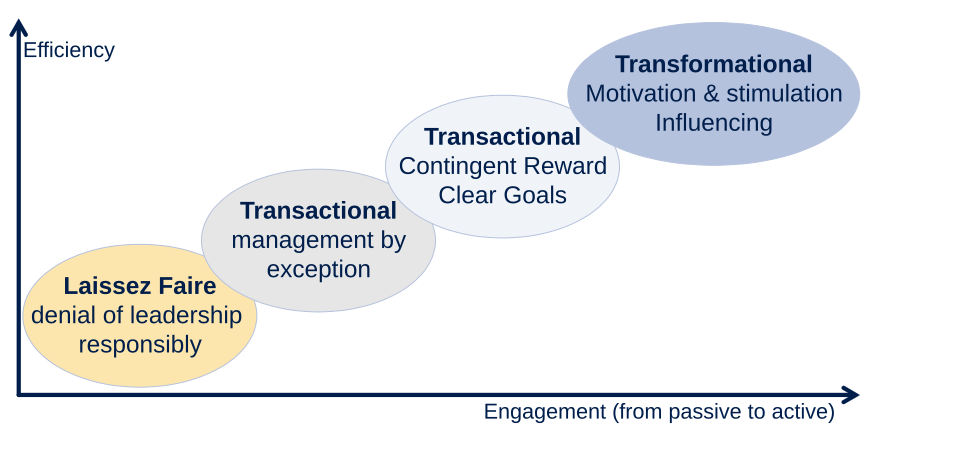 Matrix comparing impact on employee buy-in (Image: Hou710, CC BY-SA 4.0, via Wikimedia Commons)
Caption: Transactional works for quick fixes; transformational for long-term shifts.
Matrix comparing impact on employee buy-in (Image: Hou710, CC BY-SA 4.0, via Wikimedia Commons)
Caption: Transactional works for quick fixes; transformational for long-term shifts.
Key Leadership Actions for Change
- Communicate relentlessly (e.g., Daraz’s CEO updates during COVID).
- Lead by example (e.g., Nepal Rastra Bank’s Governor using digital banking).
- Manage resistance via ADKAR model (Awareness → Desire → Knowledge → Ability → Reinforcement).
5. Overcoming Resistance to Change
Common restraining forces and how to tackle them:
| Resistance Type | Cause | Solution | Nepali Case |
|---|---|---|---|
| Fear of job loss | Automation (e.g., ATMs replacing tellers) | Retraining programs | Nabil Bank’s "Digital Skills Academy" |
| Lack of trust | Top-down orders without consultation | Inclusive workshops | NTC’s "Employee Feedback Panels" |
| Cultural misfit | New values clash with old norms | Cultural integration | Himalayan Java’s "Values Day" |
| Short-term focus | Managers prioritize quarterly profits | Long-term incentives | Daraz’s "5-Year Growth Bonuses" |
6. Measuring Change Success: KPIs and Culture Metrics
Not all change is equal. Track:
- Quantitative: Loan processing time (Nabil Bank: 30 → 5 days), customer satisfaction (Daraz: 3.2 → 4.5/5).
- Qualitative: Employee engagement surveys (NTC: 40% → 65% positive responses after "Innovation Week").
Worked Example: Google’s Project Aristotle
- Goal: Find what makes teams effective.
- Discovery: Psychological safety > skills or experience.
- Application: Nepal’s Social Welfare Council now trains teams in open feedback.
In the Real World
eSewa’s Cultural Shift
- Idea: Agile teams and customer obsession (from "bureaucratic" to "startup-like").
- How: Cross-functional squads (e.g., "Payments Team" + "Marketing Team") collaborate daily.
- Result: 300% growth in digital transactions (2018–2023).
NTC’s Failed (Then Succeeded) Change
- First attempt (2010): Forced fiber-optic rollout → employee strikes (resistance to tech).
- Second attempt (2020): Pilot with "Tech Champions" → 70% adoption in 18 months.
Pathao’s Driver Training Program
- Idea: Behavioral change (safety > speed).
- How: Gamified app with badges for safe rides + peer mentoring.
- Result: 25% fewer accidents in 2022.
Exam Tip
Case Study Questions: Always use Kotter’s 8 steps or Lewin’s model to structure answers.
- Example: For NTC’s digital failure → "Lack of Step 1 (urgency) + Step 5 (empowerment)".
Culture Questions: Use Johnson & Scholes’ web to analyze visible vs. invisible elements.
- Example: "Why did Daraz struggle in rural Nepal?" → "Stories of ‘city-only’ success" (invisible) + "lack of local language support" (symbols).
Leadership: Link styles to change speed.
- Example: "Nabil Bank’s CEO used transformational leadership to push digital loans → faster than NTC’s transactional approach."
Resistance: Force-field analysis is your friend.
- Example: "Nepal’s banks resist Fintech because:
- Driving: Govt. pressure (Digital Nepal 2.0).
- Restraining: Fear of job loss (tellers), cultural inertia."
- Example: "Nepal’s banks resist Fintech because:
Avoid: Generic answers like "change is good." Always tie to a Nepali example (NTC, Nabil, Daraz).
Final Visual: "Strategic Change Toolkit"
classDiagram
    class ChangeModel {
        +Lewin's 3-Phase
        +Kotter's 8-Step
    }
    class CultureTool {
        +Johnson & Scholes Web
        +ADKAR Model
    }
    class LeadershipStyle {
        +Transformational
        +Transactional
    }
    ChangeModel --> CultureTool : "Diagnose barriers"
    CultureTool --> LeadershipStyle : "Align actions"
    LeadershipStyle --> ChangeModel : "Drive execution"
Caption: The interconnected tools for managing strategic change.Based on the TU BBM syllabus for Business strategy (MGT318), unit 9.
Discussion
Loading…