Event managementUnit 810 min read
HR in Events: Roles, Motivation, Conflict & Leadership
Unit 8 of Event Management covers human resource management in events, focusing on staffing, motivation theories, conflict resolution, leadership styles, and legal compliance. Learn how to build, manage, and retain a high-performing event team while addressing challenges like burnout, role ambiguity, and unionization r
```mermaid
mindmap
  root((HR in Event Management))
    Staffing & Roles
      Event-Specific Roles
        Client Liaison
        Technical Crew
        Security
        Vendors
      Staffing Models
        In-House
        Freelance
        Hybrid
    Motivation Theories
      Maslow's Hierarchy
      Herzberg's Two-Factor
      McClelland's Needs
    Conflict Resolution
      Mediation
      Negotiation
      Arbitration
    Leadership Styles
      Autocratic
      Democratic
      Laissez-Faire
    Legal & Ethical Issues
      Labor Laws
      Contracts
      Diversity & Inclusion
Core Concepts in HR for Events
1. Staffing and Roles in Event Management
Events require a diverse, skilled workforce with specialized roles. Unlike corporate HR, event staffing is project-based, temporary, and high-pressure. Roles can be categorized as follows:
Key Event-Specific Roles
| Role | Responsibilities | Example in Nepal |
|---|---|---|
| Event Manager | Overall planning, budgeting, and execution | Festival organizers (e.g., Dashain Mela) |
| Technical Crew | AV setup, lighting, sound, stage management | Live concert crews (e.g., Bandhu Music) |
| Security Personnel | Crowd control, emergency response, access management | Kathmandu Durbar Square security (UNESCO) |
| Client Liaison | Coordination with sponsors, vendors, and clients | Daraz’s promotional event teams |
| Vendors & Contractors | Catering, decor, transportation, equipment rental | Kathmandu’s wedding hall staff |
| Volunteers | Assistance in registration, ushering, social media management | Nepal Tourism Board’s volunteer guides |
Staffing Models in Events
Events use three primary staffing approaches, each with trade-offs:
flowchart TD
    A["Staffing Models"] --> B["In-House"]
    A --> C["Freelance"]
    A --> D["Hybrid"]

    B --> B1["Pros: Loyalty, Training, Brand Alignment"]
    B --> B2["Cons: High Cost, Less Flexibility"]

    C --> C1["Pros: Cost-Effective, Specialized Skills"]
    C --> C2["Cons: Less Control, Turnover Risk"]

    D --> D1["Pros: Balanced Cost & Quality"]
    D --> D2["Cons: Coordination Challenges"]
Worked Example: Kathmandu Traffic Management for Dashain
- Problem: Millions of pilgrims visit Pashupatinath during Dashain, causing gridlock.
- Solution:
- Hybrid Staffing: Traffic police (in-house) + private security firms (freelance) + volunteers.
- Role Clarity: Clear SOPs for police (law enforcement) vs. volunteers (direction).
- Motivation: Police get overtime pay; volunteers get certificates (Maslow’s esteem need).
2. Motivation Theories Applied to Event Teams
Event workers face high stress, irregular hours, and emotional labor (e.g., dealing with difficult clients). Motivation theories help retain talent and boost performance.
Comparison of Key Theories
| Theory | Key Idea | Application in Events | Example |
|---|---|---|---|
| Maslow’s Hierarchy | Needs from physiological to self-actualization | Pay fair wages (physiological), recognize achievements (esteem), offer growth (self-actualization) | Daraz’s event staff get bonuses (physiological) + training (self-actualization) |
| Herzberg’s Two-Factor | Hygiene factors (pay, conditions) vs. motivators (recognition, growth) | Ensure fair pay (hygiene) but also praise (motivator) | Ncell’s event crew gets certificates (motivator) + fixed pay (hygiene) |
| McClelland’s Needs | Achievement, affiliation, power | For technical crews, highlight skill mastery (achievement); for security, teamwork (affiliation) | Bandhu Music’s sound engineers get awards (achievement) |
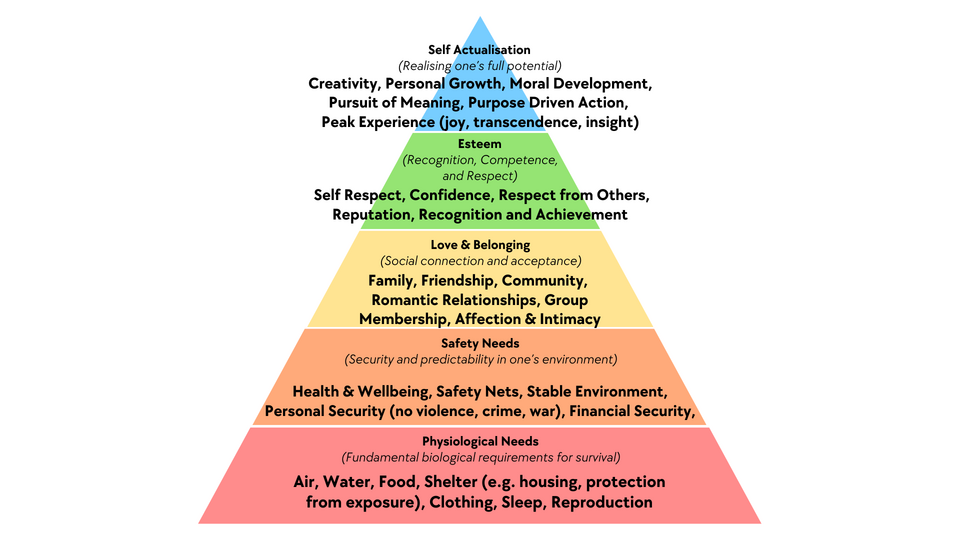 How event staff needs align with Maslow’s model (Image: Hamish.croker, CC BY-SA 4.0, via Wikimedia Commons)
Case Study: Nabil Bank’s CSR Events
- Problem: Low volunteer retention for bank-sponsored tree-planting drives.
- Solution:
- Affiliation Need: Group photos with bank executives (social recognition).
- Achievement Need: Certificates + LinkedIn shoutouts.
- Result: 30% higher repeat volunteers.
3. Conflict Resolution in Event Teams
Events are high-stakes, deadline-driven environments where conflicts arise from:
- Role ambiguity (e.g., who handles vendor delays?)
- Personality clashes (e.g., perfectionist designer vs. pragmatic manager)
- Resource shortages (e.g., missing equipment)
Conflict Resolution Strategies
flowchart LR
    A["Conflict Types"] --> B["Task Conflict"]
    A --> C["Relationship Conflict"]
    A --> D["Process Conflict"]

    B --> B1["Mediation: Neutral 3rd party"]
    C --> C1["Negotiation: Win-Win"]
    D --> D2["Arbitration: Binding Decision"]
Worked Example: Pathao’s Rider Strike During Festival
- Conflict: Riders demand hazard pay for working during Dashain (high traffic).
- Resolution:
- Mediation: Pathao HR + union rep discuss.
- Outcome: 20% bonus + shorter shifts.
- Result: No strike, smooth operations.
4. Leadership Styles in Event Management
Leaders must adapt styles based on team experience, event scale, and urgency.
| Style | When to Use | Example in Nepal | Risks |
|---|---|---|---|
| Autocratic | Crises (e.g., power outage at concert) | Emergency response teams (NTC during loadshedding) | Demotivates long-term staff |
| Democratic | Creative brainstorming (e.g., theme design) | Kathmandu’s wedding planners (client input) | Slower decision-making |
| Laissez-Faire | Experienced freelancers (e.g., AV techs) | Independent music festival crews | Lack of accountability |
Case Study: Himalayan Java’s Coffee Festival
- Challenge: Freelance baristas resisted last-minute menu changes.
- Solution: Democratic style – held a quick vote.
- Outcome: Team bought in; festival ran smoothly.
5. Legal and Ethical HR Issues in Events
Events must comply with labor laws, contracts, and ethical standards to avoid lawsuits or reputational damage.
Key Legal Considerations
- Labor Laws (Nepal):
- Minimum wage (₹400/day for unskilled, ₹1,200 for skilled).
- Overtime pay (1.5x for >8 hours).
- Example: NTC must pay extra for staff during Dasain traffic control.
- Contracts:
- Freelancers must have written agreements (e.g., Daraz’s event vendors).
- Example: A caterer suing for unpaid fees (common in Nepal’s gig economy).
- Diversity & Inclusion:
- Events like LGBTQ+ pride marches require sensitivity training.
- Example: Kathmandu’s Pride Parade hires diverse security teams.
In the Real World
eSewa’s Digital Event Staffing
- Idea Used: Hybrid Staffing Model
- How: eSewa’s online service launches use in-house IT staff (for security) + freelance animators (for ads). During peak seasons (e.g., Dashain), they hire temporary customer support agents from call centers.
- Motivation: Agents get performance bonuses (Herzberg’s motivator) + flexible hours (Maslow’s physiological need).
Khalti’s Payment Gateway Events
- Idea Used: Conflict Resolution + Leadership
- How: During Khalti’s "Cashless Nepal" campaigns, technical glitches caused conflicts between IT teams and marketing.
- Solution: Democratic leadership – cross-team meetings to troubleshoot live.
- Result: Reduced downtime by 40%.
NTC’s Traffic Management for Mega-Events
- Idea Used: Role Clarity + Motivation
- How: During IPL matches in Nepal, NTC uses:
- Clear SOPs (who manages which route?).
- Incentives (police get hazard pay + certificates).
- Outcome: Smooth crowd flow despite 50,000+ attendees.
Exam Tip
This unit is highly practical—examiners love real-world examples and structured answers. Here’s how to score full marks:
For definitions (e.g., "project optimization"):
- Do: "Project optimization in events means balancing cost, time, and quality to maximize stakeholder satisfaction while minimizing waste."
- Avoid: Vague terms like "best practices."
For problem mediation:
- Use the 3-step framework:
- Identify the root cause (e.g., unclear roles).
- Apply a resolution strategy (e.g., mediation).
- Give a Nepali example (e.g., Pathao’s rider strike).
- Use the 3-step framework:
For mega-event issues:
- Structure your answer like this:
- Logistics: Traffic, permits (e.g., Kathmandu Marathon).
- HR: Staff burnout (e.g., Dasain Mela volunteers).
- Legal: Labor law compliance (e.g., NTC overtime).
- Structure your answer like this:
For motivation theories:
- Always link to Nepal:
- "Like Nabil Bank’s CSR events, recognition (Herzberg’s motivator) increases volunteer retention."
- Always link to Nepal:
Visuals in exams:
- If asked to "explain event staffing," draw a simple org chart (even in text form):
Event Manager ├── Technical Crew ├── Security └── Vendors - For conflict resolution, use a flowchart (like the Mermaid example above).
- If asked to "explain event staffing," draw a simple org chart (even in text form):
Final Pro Tip:
- Memorize 2-3 case studies (e.g., NTC traffic, Pathao strikes, Daraz events) and adapt them to any question.
- Use bullet points in long answers to save time and improve readability.
Based on the TU BBM syllabus for Event management (ELE226), unit 8.
Discussion
Loading…