Project managementUnit 911 min read
BOOT Model, Challenges & Nepal’s Project Success Factors
Unit 9 of Project Management explores Nepal’s BOOT (Build-Own-Operate-Transfer) model in infrastructure projects (e.g., hydropower), analyzes environmental and structural challenges (political, economic, technical), and compares fast-track vs. traditional projects using real cases like Khimti-I and Melamchi. Covers sup
TAKEAWAYS:
- The BOOT model shifts project risks to private sectors (funding, operation) while transferring assets to the government after a set period—critical for Nepal’s hydropower and road projects.
- Nepal’s project delays stem from political instability, weak contract enforcement, and supply chain bottlenecks, unlike global best practices (e.g., Singapore’s PPPs).
- Fast-track projects (e.g., Melamchi Water Supply) use overlapping phases to cut timelines but require strong monitoring—a lesson from Nepal’s failed Koshi Barrage.
- Supply chain management in Nepal faces customs delays, poor logistics infrastructure, and vendor unreliability, unlike Daraz’s just-in-time inventory systems.
- Risk mitigation in Nepal’s projects often relies on government guarantees (e.g., tax holidays for hydropower), unlike global firms that use insurance and hedging.
- Project handover in Nepal requires legal clarity (e.g., BOOT agreements) and capacity building for public agencies—seen in the Lukla Airport upgrade.
1. The BOOT Model: How It Works in Nepal
The Build-Own-Operate-Transfer (BOOT) model is a public-private partnership (PPP) where a private entity:
- Builds the infrastructure (e.g., hydropower plant).
- Owns and operates it for a fixed period (e.g., 25–30 years).
- Transfers ownership to the government at the end.
Why Nepal Uses BOOT
Nepal lacks foreign exchange and technical expertise for large projects (e.g., hydropower, roads). BOOT brings:
- Private funding (reduces government debt).
- Operational efficiency (private firms optimize costs).
- Risk transfer (private sector bears construction/operational risks).
Real-World Example: Khimti-I Hydropower Plant
flowchart LR
    A["Government of Nepal"] -->|"Signs BOOT Agreement"| B["Khimti Hydropower Company (Private)"]
    B -->|"Builds Plant"| C["Khimti-I Dam (24 MW)"]
    C -->|"Operates for 25 years"| D["Generates Electricity"]
    D -->|"Sells to NEPAL ELECTRICITY AUTHORITY (NEA)"| E["Government"]
    E -->|"After 25 years"| F["Transfers Ownership to Government"]
Key Terms in the Agreement:
| Clause | Example (Khimti-I) | Risk to Private Sector |
|---|---|---|
| Concession Period | 25 years | Political instability may force early transfer. |
| Tariff Guarantee | Rs. 7.50/kWh (fixed for 25 years) | Inflation erodes profit margins. |
| Force Majeure | Earthquakes, wars | Delays increase costs. |
| Exit Strategy | Government buys back at fair market value | Valuation disputes. |
2. Challenges in Nepal’s Project Management
Nepal’s projects face unique hurdles compared to global benchmarks (e.g., Singapore’s PPPs). A comparison table:
| Challenge | Nepal’s Reality | Global Best Practice | Example |
|---|---|---|---|
| Political Instability | Frequent government changes halt projects. | Long-term contracts (e.g., UK’s PFI model). | Melamchi Water Supply delayed by political decisions. |
| Weak Contract Enforcement | Courts slow; corruption undermines clauses. | Independent dispute resolution (e.g., ICC). | Koshi Barrage abandoned due to legal battles. |
| Supply Chain Bottlenecks | Customs delays, poor roads, vendor defaults. | Just-in-time logistics (e.g., Daraz). | Lukla Airport materials stuck at border. |
| Technical Capacity Gaps | Lack of skilled labor for complex projects. | Training programs (e.g., Singapore’s SMEs). | Buddha Air Terminal delayed for retraining staff. |
| Funding Risks | High interest rates, currency fluctuations. | Sovereign guarantees (e.g., China’s BRI). | West Seti Hydropower faced forex losses. |
Case Study: Melamchi Water Supply Project
Problem: A fast-track BOOT project (target: 5 years) faced:
- 5-year delay (completed in 2021).
- Cost overrun (Rs. 50 billion → Rs. 110 billion).
- Supply chain issues (pipes stuck at Indian border).
Root Causes:
mindmap
  root((Melamchi Delays))
    Political
      Frequent government changes
      Lack of long-term vision
    Contractual
      Weak penalty clauses
      Corruption in tendering
    Logistical
      Customs clearance delays
      Poor road infrastructure
    Technical
      Underestimated geological challenges
      Lack of local expertise
3. Fast-Track vs. Traditional Projects
| Feature | Fast-Track Projects | Traditional Projects |
|---|---|---|
| Phases | Overlapping (design → construction → testing). | Sequential (design → approval → build). |
| Time | 30–50% faster. | 2–5 years (for infrastructure). |
| Risk | Higher (unforeseen issues during overlap). | Lower (structured phases). |
| Cost | Higher (parallel activities). | Lower (but delays add costs). |
| Example in Nepal | Melamchi Water Supply (failed fast-track). | Khimti-I (successful BOOT). |
Why Fast-Track Fails in Nepal
- Lack of Monitoring: No real-time progress tracking (unlike Daraz’s agile supply chain).
- Vendor Unreliability: Contractors delay due to payment disputes (e.g., Lukla Airport).
- Regulatory Hurdles: Environmental clearances take 1–2 years (vs. 3 months in Singapore).
Worked Example: Kathmandu Traffic Routes (Fast-Track vs. Reality)
- Goal: Reduce congestion by building underground metro (2025).
- Fast-Track Plan:
- Phase 1: Tunnel boring (2 years).
- Phase 2: Track laying (1 year).
- Phase 3: Testing (6 months).
- Reality:
- Phase 1 delayed due to land acquisition disputes.
- Phase 2 stalled for lack of foreign exchange.
- Result: Project now 5 years behind schedule.
4. Supply Chain Management in Nepal’s Projects
Nepal’s supply chain for BOOT projects suffers from:
- Poor Infrastructure: 75% of goods arrive via India/China (customs delays).
- Vendor Dependence: Over-reliance on Indian contractors (e.g., West Seti Hydropower).
- Payment Delays: Government payments to contractors take 6–12 months.
How Daraz Does It Better
| Daraz (E-Commerce) | Nepal’s BOOT Projects |
|---|---|
| Just-in-Time Inventory | Bulk ordering with 3–6 month delays. |
| Tech Tracking | Real-time GPS for shipments. |
| Local Warehouses | Reduces last-mile time. |
5. Project Completion and Handover: Nepal’s Gaps
A successful handover requires:
- Clear Ownership Transfer: BOOT agreements must define asset valuation.
- Operational Readiness: Public agencies (e.g., NEA for hydropower) must be trained.
- Maintenance Plans: Private sector often leaves incomplete manuals.
Case Study: Lukla Airport Upgrade (2023)
- BOOT Contractor: Chinese firm (built runway in 18 months).
- Handover Issues:
- No transfer of technical data (black-box systems).
- Nepal Army (operator) lacks pilots for new aircraft.
- Result: Airport underutilized post-handover.
6. Risk Management: Nepal vs. Global Standards
| Risk Type | Nepal’s Approach | Global Approach | Example |
|---|---|---|---|
| Political Risk | Government guarantees (e.g., tax holidays). | Political risk insurance (e.g., MIGA). | West Seti got tax breaks but faced protests. |
| Financial Risk | High-interest loans (e.g., 12% from banks). | Sovereign bonds (e.g., Singapore’s 2% rates). | Koshi Barrage abandoned due to cost. |
| Technical Risk | Local labor with low expertise. | Foreign consultants (e.g., AECOM). | Buddha Air Terminal needed retraining. |
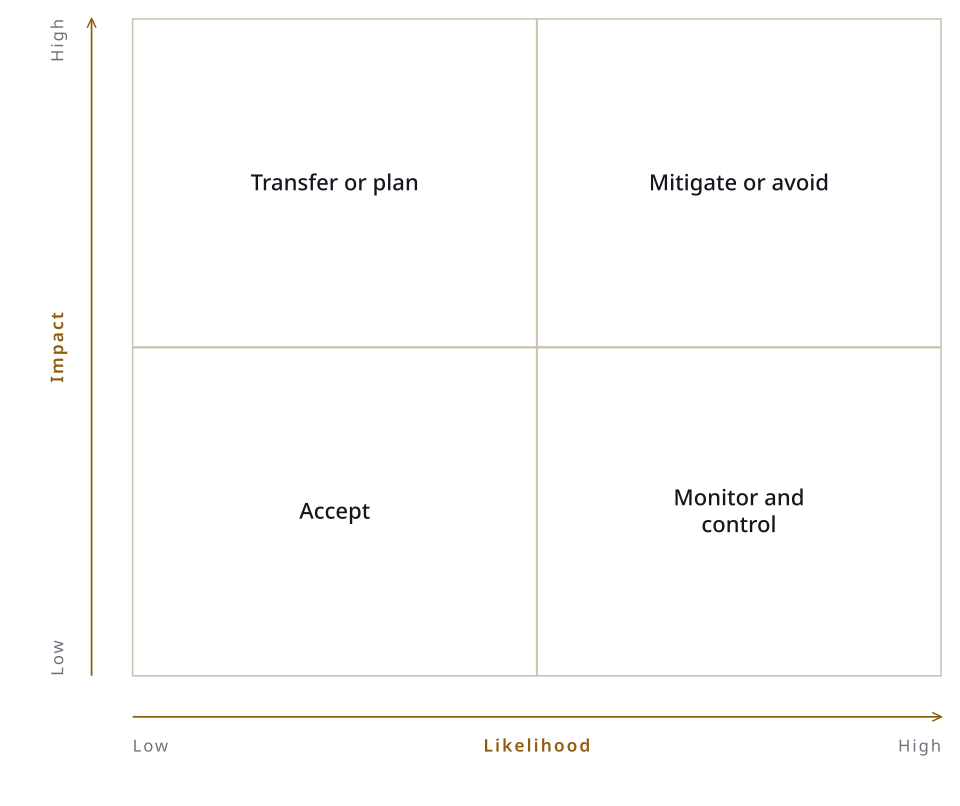 Probability vs. Impact (Nepal’s projects) (Image: Peter Gladdish, CC BY 4.0, via Wikimedia Commons)
Exam Tip: How to Score Full Marks
Link Theory to Nepal’s Cases:
- Always cite Khimti-I, Melamchi, or Lukla Airport when explaining BOOT/risk/supply chain.
- Example: "Like Daraz’s just-in-time model, Nepal’s BOOT projects require real-time supply chain tracking, but lack of digital infrastructure causes delays (e.g., Melamchi pipes stuck at border)."
Compare Nepal with Global Practices:
- Use Singapore’s PPPs or China’s BRI as benchmarks.
- Example: "Unlike Nepal’s government guarantees, Singapore uses independent dispute resolution (e.g., ICC) to enforce contracts, reducing delays."
Structure Answers for Case Studies:
- Problem → Root Cause → Solution → Nepal’s Gap
- Example for Melamchi delays:
- Problem: 5-year delay.
- Root Cause: Political instability + supply chain.
- Solution: Fast-track with digital monitoring.
- Nepal’s Gap: No real-time progress tracking (unlike Pathao’s delivery tracking).
Memorize Key Terms with Examples:
- BOOT: Khimti-I (25-year concession).
- Fast-Track: Melamchi (failed due to overlaps).
- Supply Chain Risk: Lukla Airport (customs delays).
- Handover Risk: Buddha Air Terminal (lack of training).
For Numerical Questions (e.g., "Why are projects late in Nepal?"):
- Use the 5 Whys Technique:
- Why are projects late? → Political instability.
- Why? → Frequent government changes.
- Why? → No long-term project continuity.
- Why? → Elections every 5 years.
- Why? → Weak institutional memory in public agencies.
- Use the 5 Whys Technique:
Final Visual Summary: Nepal’s Project Management Ecosystem
flowchart TD
    A["Government of Nepal"] -->|"Lacks Funds"| B["Private Sector (BOOT Partner)"]
    B -->|"Builds Project"| C["Infrastructure (Hydropower/Road)"]
    C -->|"Operates for X Years"| D["Generates Revenue"]
    D -->|"Sells to NEA/NTC"| E["Government"]
    E -->|"After X Years"| F["Transfers Ownership"]
    G["Challenges"] -->|"Political"| A
    G -->|"Contractual"| B
    G -->|"Logistical"| C
    G -->|"Technical"| D
    H["Global Benchmark"] -->|"Singapore/China"| E
    H -->|"PPP Best Practices"| F
Based on the TU BBM syllabus for Project management (EED217), unit 9.
Discussion
Loading…