Service operation managementUnit 79 min read
Game Theory & Decision Making: Models, Games & Strategies
Unit 7 of Service Operations Management explores how game theory and decision-making models (maximin, minimax, Laplace, Hurwitz, dominance) help managers optimize choices in competitive or uncertain environments—with real-world cases from Nepali tech firms and global giants.
TAKEAWAYS:
- Game theory models strategic interactions (e.g., price wars between Daraz and Sastodeal) using payoff matrices and optimal strategies.
- Decision criteria (maximin, minimax regret, Laplace, Hurwitz) help managers pick the best action under uncertainty (e.g., Ncell’s network expansion).
- Zero-sum games (where one player’s gain = another’s loss) are solved via dominance rules or mixed strategies (e.g., eSewa vs. Khalti in digital payments).
- Real-world applications: Game theory explains pricing (Nepal Oil Corporation’s fuel price wars), queuing (Pathao’s surge pricing), and negotiations (Nabil Bank’s loan terms).
- Exam focus: Solve payoff tables, reduce games to 2×2 form, and justify decisions using criteria—always show calculations.
- Key tools: Payoff matrices, saddle points, expected value, and dominance rules are non-negotiable for full marks.
1. What is Game Theory?
Game theory studies strategic decision-making where outcomes depend on interdependent choices of two or more players. It’s used in:
- Competitive markets (e.g., Daraz vs. Sastodeal on discounts).
- Negotiations (e.g., NTC vs. private telecoms on spectrum auctions).
- Resource allocation (e.g., Kathmandu traffic police optimizing routes).
Core Concepts
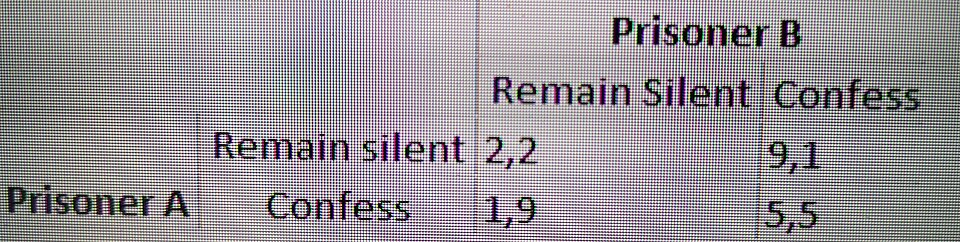 A classic example of non-zero-sum games where cooperation fails. (Image: S4485581, CC BY-SA 4.0, via Wikimedia Commons)
2. Types of Games
| Type | Example | Key Feature |
|---|---|---|
| Zero-Sum | eSewa vs. Khalti in digital payments | One’s gain = other’s loss (e.g., market share). |
| Non-Zero-Sum | Ncell & NTC collaborating on 5G | Both can benefit (e.g., shared infrastructure). |
| Cooperative | Chaudhary Group & Daraz partnerships | Players negotiate binding agreements. |
| Non-Cooperative | Price wars between fuel dealers | No communication; strategies are independent. |
Real-World Example:
- Nepal Oil Corporation (NOC) vs. Private Dealers:
- Game: Fuel price adjustments.
- Zero-Sum: If NOC cuts prices, private dealers lose sales (and vice versa).
- Outcome: NOC uses dominance strategies (e.g., bulk discounts to retain customers).
3. Solving Two-Person Zero-Sum Games
Step 1: Payoff Matrix
For a game with players A and B, the payoff table shows A’s gains (B’s losses):
| B1 | B2 | |
|---|---|---|
| A1 | 3 | -2 |
| A2 | 4 | -3 |
Step 2: Check for Saddle Points
- Saddle point: The minimum of the row maxima or the maximum of the column minima.
- If minimax = maximin, the game is strictly determinable (pure strategy solution exists).
Example: For the matrix above:
- Row maxima: max(3, -2) = 3, max(4, -3) = 4 → Minimax = 3.
- Column minima: min(3, 4) = 3, min(-2, -3) = -3 → Maximin = 3.
- Saddle point at (A1, B1) → Optimal pure strategy.
Step 3: Reduce to 2×2 by Dominance
Remove dominated strategies (always worse than another option).
Example: Original game:
| B1 | B2 | B3 | B4 | |
|---|---|---|---|---|
| A1 | 3 | 2 | 4 | 0 |
| A2 | 4 | 4 | 2 | 4 |
| A3 | 0 | 4 | 4 | 0 |
- A3 is dominated by A2 (A2 always ≥ A3).
- B3 is dominated by B2 (B2 always ≥ B3 for A1/A2). Reduced game: | | B1 | B2 |
|-------|--------|--------| | A1| 3 | 2 | | A2| 4 | 4 |
4. Decision-Making Under Uncertainty
When probabilities are unknown, use decision criteria:
| Criterion | Formula | When to Use | Example |
|---|---|---|---|
| Maximin | Choose max of the minimum payoffs | Pessimistic (worst-case scenario) | NTC planning for lowest possible demand. |
| Maximax | Choose max of the maximum payoffs | Optimistic (best-case scenario) | Startup launching a new product. |
| Minimax Regret | Minimize maximum opportunity loss | Risk-averse, avoid mistakes | Bank approving loans with default risks. |
| Laplace | Average of all payoffs | Neutral, no prior info | Daraz setting baseline delivery fees. |
| Hurwitz | Weighted avg (α=optimism, 1-α=pessimism) | Balanced view | Nabil Bank’s loan interest rates. |
Worked Example (Minimax Regret): Payoff table:
| S1 | S2 | S3 | |
|---|---|---|---|
| A | 4 | -2 | 7 |
| B | 0 | 6 | 3 |
| C | -5 | 9 | 2 |
- Regret Matrix:
- For A: max(4,0,-5)=4 → Regrets: 0, 6, -3
- For B: max(0,6,2)=6 → Regrets: 6, 0, 3
- For C: max(-5,9,7)=9 → Regrets: 14, 0, 7
- Max Regrets: [6, 3, 14] → Minimax Regret = S2.
5. Real-World Applications in Nepal
Case 1: eSewa vs. Khalti (Digital Payments)
- Game Type: Zero-sum (market share).
- Strategies:
- eSewa: Lower transaction fees, cashback.
- Khalti: Partnerships with merchants.
- Outcome: Mixed strategies (e.g., Khalti offers discounts during festivals to attract users).
Case 2: Pathao’s Surge Pricing
- Game Theory: Dynamic pricing during peak hours (e.g., Dashain).
- Model: Non-zero-sum (drivers and riders both benefit from efficient matching).
- Strategy: Increase fares when demand > supply (like Uber’s surge pricing).
Case 3: NTC’s Network Expansion
- Decision Criterion: Hurwitz (α=0.6 for optimism).
- Options:
- Expand in Kathmandu (high cost, high demand).
- Expand in rural areas (low cost, low demand).
- Calculation:
- Kathmandu: (0.6×10M + 0.4×(-2M)) = 4.4M profit.
- Rural: (0.6×3M + 0.4×1M) = 2.2M profit.
- Choice: Kathmandu (higher expected value).
6. Game Theory in Global Companies
| Company | Application | Game Theory Concept |
|---|---|---|
| Google Ads | Auction-based ad pricing | Sealed-bid auctions, Nash equilibrium |
| Amazon | Dynamic pricing (e.g., Kindle books) | Zero-sum with competitors |
| Tesla | Battery supply chain negotiations | Cooperative games with suppliers |
| McDonald’s | Franchise location decisions | Spatial competition models |
Exam Tip: How to Score Full Marks
For payoff matrices:
- Always label rows/columns clearly (Player A/B, Strategies 1/2).
- Show step-by-step dominance reduction (circle dominated strategies).
- For mixed strategies, solve using linear equations (e.g., ).
For decision criteria:
- Write the formula (e.g., Hurwitz: ).
- Calculate all options before choosing the best.
- Justify (e.g., “Minimax regret is chosen to avoid high opportunity loss”).
For case studies:
- Map the game type (zero-sum/non-zero-sum).
- Identify strategies and payoffs (even if hypothetical).
- Link to real data (e.g., “NTC’s revenue dropped 10% when private dealers undercut prices”).
Common Pitfalls:
- ❌ Forgetting to reduce the game to 2×2 before solving.
- ❌ Mislabeling rows/columns (Player A’s payoffs go first).
- ❌ Skipping the “fairness” check for strictly determinable games.
Practice Questions (Exam-Style)
Reduce and solve: Player A | B1 (2,4) | B2 (3,1) | B3 (1,5) Use dominance to find optimal strategies.
Decision criteria: For the payoff table below, find the best decision using: i) Laplace criterion ii) Hurwitz (α=0.3)
S1 S2 S3 A 5 2 8 B 3 7 4 Case Study: Nepal Telecom (NTC) is deciding whether to launch a new 5G plan in Pokhara or Chitwan. The payoffs (in millions) are:
- Pokhara: High demand (15), Low demand (5).
- Chitwan: High demand (8), Low demand (10).
- Probability of high demand: 60%. Which location should NTC choose using expected value?
Final Note: Game theory is not just math—it’s about real-world strategy. Whether it’s negotiating with suppliers (like Daraz) or optimizing routes (like Pathao), these tools help managers make data-driven decisions. Practice payoff matrices daily, and you’ll ace the exam!
Based on the TU BBM syllabus for Service operation management (ELE227), unit 7.
Discussion
Loading…