Financial Accounting and AnalysisUnit 414 min read
Journal & Ledger: Entries, Postings & Trial Balance
Unit 4 of Financial Accounting and Analysis covers the journal (book of original entry) and ledger (book of final entry), their formats, posting rules, and how they form the trial balance. Learn to record transactions, classify accounts, and reconcile entries using real-world examples from Nepali businesses.
TAKEAWAYS:
- The journal is the first book where transactions are recorded chronologically before being transferred to the ledger.
- Each journal entry must follow the double-entry rule: debit = credit, with at least two accounts affected.
- The ledger organizes accounts by type (assets, liabilities, equity, revenue, expenses) and shows their full history.
- Posting from journal to ledger involves transferring amounts, referencing entries, and balancing accounts.
- A trial balance is a summary of ledger balances to check arithmetic accuracy before preparing financial statements.
- Errors like omission, commission, principle, or reversal of entries can be detected through trial balance discrepancies.
1. Journal: The Book of Original Entry
The journal is the first book of entry where transactions are recorded in chronological order before being transferred to the ledger. It acts as a diary of business activities and helps in:
- Identifying errors early.
- Providing a complete record of transactions.
- Serving as a source document for ledger postings.
Journal Entry Format
Every journal entry must include:
- Date (of the transaction).
- Particulars (description of the transaction).
- Ledger Folio (L.F.) (reference to the ledger account where the entry is posted).
- Debit Amount (left side).
- Credit Amount (right side).
| Date       | Particulars                          | L.F. | Debit (Rs.) | Credit (Rs.) |
|------------|---------------------------------------|------|-------------|--------------|
| 2080-01-01 | Cash A/c Dr.                          |      | 1,000,000   |              |
|            | To Capital A/c (Business started)     |      |             | 1,000,000    |
| 2080-01-02 | Bank A/c Dr.                          |      | 300,000     |              |
|            | To Cash A/c (Deposit into bank)       |      |             | 300,000      |
Types of Journal Entries
- Simple Entry: Involves only two accounts (one debit, one credit).
- Example: Cash deposited into the bank.
- Compound Entry: Involves one debit and multiple credits or one credit and multiple debits.
- Example: Purchasing multiple items on credit.
- Transfer Entry: Moves an amount within the same class of accounts (e.g., cash to bank).
- Example: Withdrawing cash from the bank.
Rules for Journalizing Transactions
- Debit what comes in (assets, expenses) or increases (liabilities, equity).
- Credit what goes out (assets, expenses) or decreases (liabilities, equity).
- Double-Entry System: Every transaction affects at least two accounts.
2. Ledger: The Book of Final Entry
The ledger is the second book of entry where transactions are classified and summarized by account. It provides a complete history of each account and helps in:
- Preparing financial statements.
- Detecting errors through trial balance.
- Tracking account balances over time.
Ledger Account Format
Each ledger account has:
- Account Title (e.g., Cash A/c, Bank A/c, Capital A/c).
- Date (of the transaction).
- Particulars (description of the transaction).
- Journal Folio (J.F.) (reference to the journal entry).
- Debit (Dr.) and Credit (Cr.) columns.
- Balance (calculated after each entry).
| Date       | Particulars                          | J.F. | Debit (Rs.) | Credit (Rs.) | Balance (Rs.) |
|------------|---------------------------------------|------|-------------|--------------|---------------|
| 2080-01-01 | To Capital A/c                       | 1    | 1,000,000   |              | 1,000,000 Dr. |
| 2080-01-02 | By Bank A/c                           | 2    |             | 300,000      | 700,000 Dr.   |
Posting from Journal to Ledger
- Identify the accounts involved in the journal entry.
- Transfer the debit amount to the debit side of the ledger account.
- Transfer the credit amount to the credit side of the ledger account.
- Record the Journal Folio (J.F.) in the ledger.
- Calculate the balance after each entry.
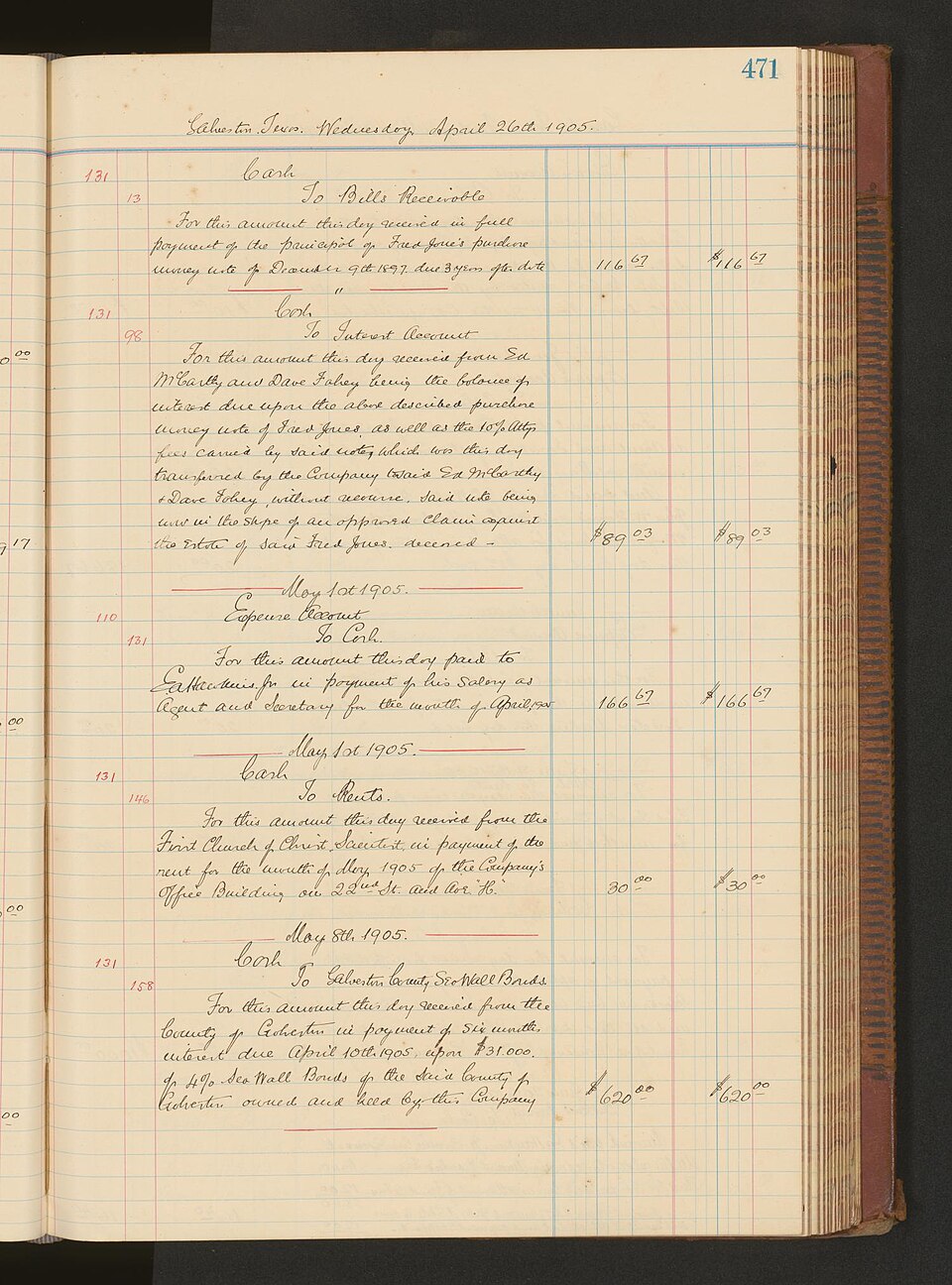 Ledger posting for a Kathmandu retail shop (Image: Galveston City Company, Galveston City Company, Public domain, via Wikimedia Commons)
3. Trial Balance: Checking Arithmetic Accuracy
A trial balance is a summary of all ledger accounts to ensure that:
- Debit totals = Credit totals.
- No arithmetic errors exist before preparing financial statements.
Trial Balance Format
| S.No. | Account Name          | Debit (Rs.) | Credit (Rs.) |
|-------|-----------------------|-------------|--------------|
| 1     | Cash A/c              | 700,000     |              |
| 2     | Bank A/c              |             | 300,000      |
| 3     | Capital A/c           |             | 1,000,000    |
| 4     | Rent A/c              | 52,000      |              |
| **Total** |                       | **752,000** | **1,300,000** |
Problem: Debit ≠ Credit → Error detected! (Note: In a real trial balance, totals must match. This is just an example to show the process.)
Common Errors Detected by Trial Balance
| Error Type | Cause | Solution |
|---|---|---|
| Omission | Transaction not recorded | Check all source documents. |
| Commission | Wrong account used | Verify account names. |
| Principle | Wrong class of account | Review debit/credit rules. |
| Reversal of Entry | Debit/Credit swapped | Recheck journal entries. |
| Compensating Error | Two errors cancel out | Review all entries carefully. |
4. The Accounting Cycle: Journal → Ledger → Trial Balance
flowchart TD
    A["Source Documents<br>(Invoices, Receipts)"] --> B["Journal<br>(Book of Original Entry)"]
    B --> C["Ledger<br>(Book of Final Entry)"]
    C --> D["Trial Balance<br>(Check Accuracy)"]
    D --> E["Financial Statements<br>(Income Statement, Balance Sheet)"]
    E --> F["Closing Entries<br>(Temporary Accounts)"]
    F --> G["Post-Closing Trial Balance<br>(Permanent Accounts)"]
    G -->|"Repeat"| A
In the Real World
eSewa (Nepal)
- Journal Entry Idea: Every time you pay a bill (e.g., electricity, phone) via eSewa, the system records a debit to "Expenses" and a credit to "Cash" in its journal. The ledger then updates the Cash Account and Electricity Expense Account to reflect the transaction.
- Ledger Posting: The bank (Nabil, Global IME) also posts this transaction to your account, reducing your balance (credit side of your Cash Account).
Khalti (Nepal)
- Journal Entry Idea: When you send money to a friend via Khalti, Khalti’s system debits your account (reducing your balance) and credits the recipient’s account (increasing theirs). This follows the double-entry rule strictly.
- Real Example: If you transfer Rs. 5,000 to a friend, Khalti’s journal entry looks like:
| Date       | Particulars                          | Debit (Rs.) | Credit (Rs.) |
|------------|---------------------------------------|-------------|--------------|
| 2080-01-10 | To [Friend’s Name] A/c              | 5,000       |              |
|            | By Your Khalti A/c                   |             | 5,000        |
Daraz (Nepal)
- Ledger Idea: When you place an order on Daraz, the system posts the order amount to your "Pending Payments" ledger account (debit side). Once paid, it transfers the amount to "Sales Revenue" (credit side) and deducts from "Cash/Bank" (debit side).
- Real Example: If you buy a phone worth Rs. 25,000 on Daraz:
- Journal Entry:
| Date | Particulars | Debit (Rs.) | Credit (Rs.) | |------------|---------------------------------------|-------------|--------------| | 2080-01-15 | To Daraz Sales Revenue A/c | | 25,000 | | | By Cash/Bank A/c | 25,000 | | - Ledger Posting: Daraz’s Cash Account is credited (increase in cash), and Sales Revenue Account is debited (increase in revenue).
- Journal Entry:
5. Worked Example: Journal and Ledger for a Nepali Business
Business Name: Kathmandu Retail Shop (KRS) Transactions for January 2080:
| Date | Transaction |
|---|---|
| 2080-01-01 | Started business with cash Rs. 500,000. |
| 2080-01-02 | Deposited Rs. 200,000 into Bank of Kathmandu. |
| 2080-01-03 | Purchased goods for Rs. 150,000 on credit from Nepal Trading Co. |
| 2080-01-04 | Sold goods for Rs. 80,000 cash. |
| 2080-01-05 | Paid rent for January Rs. 20,000 by cheque. |
| 2080-01-06 | Received Rs. 50,000 from Sagar Trading for goods sold on credit. |
Step 1: Journal Entries
| Date       | Particulars                          | L.F. | Debit (Rs.) | Credit (Rs.) |
|------------|---------------------------------------|------|-------------|--------------|
| 2080-01-01 | Cash A/c Dr.                          |      | 500,000     |              |
|            | To Capital A/c                       |      |             | 500,000      |
| 2080-01-02 | Bank A/c Dr.                          |      | 200,000     |              |
|            | To Cash A/c                           |      |             | 200,000      |
| 2080-01-03 | Purchases A/c Dr.                     |      | 150,000     |              |
|            | To Nepal Trading Co. A/c              |      |             | 150,000      |
| 2080-01-04 | Cash A/c Dr.                          |      | 80,000      |              |
|            | To Sales A/c                          |      |             | 80,000       |
| 2080-01-05 | Rent A/c Dr.                          |      | 20,000      |              |
|            | To Bank A/c                           |      |             | 20,000       |
| 2080-01-06 | Bank A/c Dr.                          |      | 50,000      |              |
|            | To Sagar Trading A/c                  |      |             | 50,000       |
Step 2: Ledger Postings
Cash Account:
| Date       | Particulars                          | J.F. | Debit (Rs.) | Credit (Rs.) | Balance (Rs.) |
|------------|---------------------------------------|------|-------------|--------------|---------------|
| 2080-01-01 | To Capital A/c                       | 1    | 500,000     |              | 500,000 Dr.   |
| 2080-01-02 | By Bank A/c                           | 2    |             | 200,000      | 300,000 Dr.   |
| 2080-01-04 | To Sales A/c                          | 4    | 80,000      |              | 380,000 Dr.   |
Bank Account:
| Date       | Particulars                          | J.F. | Debit (Rs.) | Credit (Rs.) | Balance (Rs.) |
|------------|---------------------------------------|------|-------------|--------------|---------------|
| 2080-01-02 | To Cash A/c                           | 2    | 200,000     |              | 200,000 Dr.   |
| 2080-01-05 | By Rent A/c                           | 5    |             | 20,000       | 180,000 Dr.   |
| 2080-01-06 | To Sagar Trading A/c                  | 6    | 50,000      |              | 230,000 Dr.   |
Step 3: Trial Balance
| S.No. | Account Name          | Debit (Rs.) | Credit (Rs.) |
|-------|-----------------------|-------------|--------------|
| 1     | Cash A/c              | 380,000     |              |
| 2     | Bank A/c              | 230,000     |              |
| 3     | Purchases A/c         | 150,000     |              |
| 4     | Rent A/c              | 20,000      |              |
| 5     | Sales A/c             |             | 80,000       |
| 6     | Nepal Trading Co. A/c |             | 150,000      |
| 7     | Sagar Trading A/c     |             | 50,000       |
| 8     | Capital A/c           |             | 500,000      |
| **Total** |                       | **780,000** | **780,000**  |
6. Comparison: Journal vs. Ledger
| Feature | Journal | Ledger |
|---|---|---|
| Purpose | Records transactions in chronological order. | Classifies and summarizes transactions by account. |
| Format | Single-column (Debit & Credit sides). | T-account format (Debit & Credit sides). |
| Posting | Transactions are first recorded here. | Entries are transferred from the journal. |
| Error Detection | Helps detect omissions and commissions. | Helps detect principle and reversal errors. |
| Example | Cash deposited into bank. | Cash Account showing all cash transactions. |
7. Advantages and Disadvantages of Journal and Ledger
Journal
✅ Advantages:
- Provides a chronological record of transactions.
- Helps in detecting errors early.
- Serves as a source document for ledger postings.
❌ Disadvantages:
- Does not show complete details of individual accounts.
- Time-consuming to locate specific transactions.
Ledger
✅ Advantages:
- Shows the complete history of each account.
- Helps in preparing financial statements.
- Easier to detect errors through trial balance.
❌ Disadvantages:
- Complex to maintain for large businesses.
- Posting errors can occur if not careful.
Exam Tip
Journal Entries:
- Always date transactions correctly (use Nepali dates if required).
- Describe particulars clearly (e.g., "To Capital A/c" instead of just "Capital").
- Balance debits and credits in every entry.
Ledger Postings:
- Reference the Journal Folio (J.F.) in the ledger.
- Calculate balances correctly after each entry.
- Use T-accounts for clarity in exams (even if not required, it helps visualize).
Trial Balance:
- Ensure Debit = Credit before submitting.
- List accounts in order: Assets → Liabilities → Equity → Revenue → Expenses.
- Highlight discrepancies if any (e.g., "Error: Debit exceeds Credit by Rs. X").
Common Mistakes to Avoid:
- Omitting entries (always check source documents).
- Reversing debit/credit (double-check rules).
- Incorrect account classification (e.g., treating revenue as an asset).
Real-World Application:
- Relate to businesses like eSewa, Khalti, or Daraz in exam answers.
- Use Nepali examples (e.g., a local shop’s transactions) to make answers relatable.
Final Note: Mastering journal and ledger is the foundation of accounting. Practice with real transactions (e.g., a friend’s small business) to understand how entries flow from journal to ledger. Always verify totals and cross-check postings to avoid errors. Good luck! 🚀
Based on the TU BBS syllabus for Financial Accounting and Analysis (MGT211), unit 4.
Discussion
Loading…