Principles of ManagementUnit 113 min read
Management Defined: Functions, Theories & OB in Nepalese Context
Unit 1 of Principles of Management covers core definitions of management (process, functions, levels), classical vs. behavioral theories, organizational behavior (OB) foundations, and how these apply to Nepali businesses like Nabil Bank or Daraz. Includes real-world examples, comparison tables, and exam-focused analysi
1. What is Management?
Definition & Nature
Management is the process of planning, organizing, leading, and controlling organizational resources (human, financial, physical, and information) to achieve goals efficiently and effectively.
mindmap
  root((Management))
    Functions
      Planning["Goal-setting & strategy"]
      Organizing["Structuring roles & resources"]
      Leading["Motivating & directing"]
      Controlling["Monitoring & correcting"]
    Levels
      Top["CEO, Board (Nabil Bank: Chairman)"]
      Middle["Managers (Branch Managers at NTC)"]
      Operational["Supervisors (Daraz delivery agents)"]
    Skills
      Technical["Job-specific (e.g., IT at eSewa)"]
      Human["Teamwork (Pathao drivers)"]
      Conceptual["Big-picture (Nepal Rastra Bank Governor)"]
Key Characteristics of Management (Exam Focus):
| Characteristic | Explanation | Nepali Example |
|---|---|---|
| Goal-Oriented | All activities align with organizational goals (e.g., NTC’s "24/7 service"). | |
| Dynamic | Adapts to changes (e.g., Daraz shifting to e-commerce during COVID-19). | |
| Multi-Dimensional | Involves people, tasks, and environment (e.g., NEPSE’s stock market regulations). | |
| Continuous Process | Ongoing cycle (plan → organize → lead → control → repeat). | |
| Group Activity | Requires teamwork (e.g., Kathmandu traffic police coordinating routes). | |
| Universal | Applies to all organizations (profit/non-profit, small/large). |
Nabil Bank’s hierarchy shows top-level (Chairman), middle (Zonal Managers), and operational (Branch Managers) levels.
Functions of Management (POLC Framework)
- Planning
- Setting objectives and deciding actions (e.g., NTC’s 5-year expansion plan).
- Types: Strategic (long-term), Tactical (medium-term), Operational (short-term).
- Example: Khalti’s plan to add 1M new users/year uses tactical planning.
Organizing
- Structuring resources (e.g., Daraz’s warehouse → delivery agent → customer chain).
- Tools: Departmentalization (function, product, geography), Delegation, Span of Control.
Leading (Directing)
- Motivating employees (e.g., Pathao’s driver incentives).
- Styles: Autocratic (NTC’s strict rules), Democratic (Himalayan Java’s team decisions), Laissez-Faire (startups).
Controlling
- Ensuring goals are met (e.g., Nepal Rastra Bank’s inflation targets).
- Steps: Setting standards → Measuring performance → Correcting deviations.
2. Management Theories: Classical vs. Behavioral
Classical Theory of Management
Assumptions:
- Workers are rational and lazy ("economic man").
- Focus on efficiency and structure.
Key Contributors & Ideas:
| Theory | Proponent | Key Idea | Nepali Application |
|---|---|---|---|
| Scientific Management | Frederick Taylor | Standardize work methods (e.g., NTC call center scripts). | Reduces errors in repetitive tasks. |
| Administrative Theory | Henri Fayol | 14 Principles (e.g., Unity of Command → Nabil Bank’s clear reporting lines). | Avoids confusion in hierarchies. |
| Bureaucratic Theory | Max Weber | Rules, hierarchy, impersonality (e.g., Nepal Police’s SOPs). | Ensures fairness but can slow decisions. |
Limitations of Classical Theory:
- Ignores human needs (e.g., motivation, job satisfaction).
- Rigid structures may stifle creativity (e.g., traditional banks vs. fintech like eSewa).
- Assumes workers are only motivated by money (not true for Nepali youth in startups).
Behavioral Theory of Management
Why It’s More Relevant Today:
- Focuses on human behavior and social systems.
- Recognizes motivation, leadership, and communication as critical.
Key Contributors:
Hawthorne Studies (Elton Mayo)
- Found that worker productivity increases with attention and group norms (e.g., Daraz’s team bonuses).
- Example: Khalti’s employee engagement programs boost morale.
Maslow’s Hierarchy of Needs
- Nepali Example: NTC’s "Employee of the Month" targets esteem needs.
- Herzberg’s Two-Factor Theory
- Hygiene Factors (salary, conditions) prevent dissatisfaction.
- Motivators (achievement, recognition) drive satisfaction.
- Example: Pathao’s "Top Driver" rewards use motivators.
Comparison Table: Classical vs. Behavioral
| Aspect | Classical Theory | Behavioral Theory |
|---|---|---|
| Focus | Tasks, efficiency, structure | People, motivation, communication |
| View of Workers | Rational, lazy, money-motivated | Social beings with complex needs |
| Leadership Style | Autocratic (top-down) | Democratic, participative |
| Example in Nepal | NTC’s rigid SOPs | Himalayan Java’s open-door policy |
| Strength | Clear roles, efficiency | Higher job satisfaction, innovation |
| Weakness | Ignores human factors | Can be less efficient in crises |
3. Organizational Behavior (OB): The Human Side
OB studies individual and group behavior in organizations. Key areas:
Attitudes & Job Satisfaction
- Example: Nepal Rastra Bank employees with high satisfaction → lower turnover.
Perception & Decision-Making
- Biases affect choices (e.g., NTC hiring based on nepotism vs. merit).
Workplace Diversity
- Nepal’s multicultural workforce (e.g., Daraz’s multilingual teams).
Stress & Burnout
- Example: Khalti’s 24/7 customer support teams need stress management.
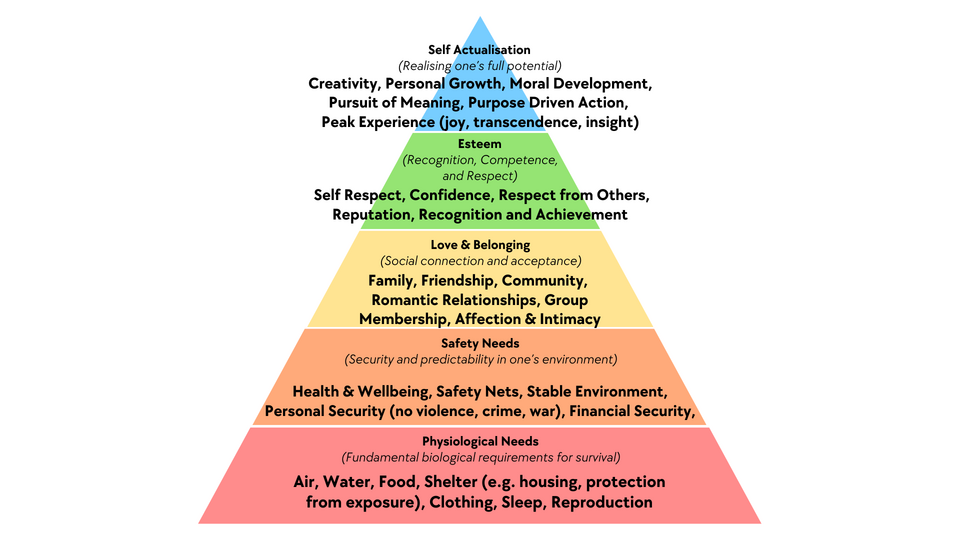 Maslow's Hierarchy of Needs pyramid (Image: Hamish.croker, CC BY-SA 4.0, via Wikimedia Commons)
Shows how Nabil Bank’s employee benefits (health insurance, career growth) address multiple levels.
Maslow's Hierarchy of Needs pyramid (Image: Hamish.croker, CC BY-SA 4.0, via Wikimedia Commons)
Shows how Nabil Bank’s employee benefits (health insurance, career growth) address multiple levels.
4. Management in Nepali Context
Existing Practices & Business Culture
| Aspect | Traditional Nepali Practices | Modern Adaptations |
|---|---|---|
| Leadership | Patriarchal (e.g., family-run businesses) | Professional managers (e.g., Nabil Bank’s CEO) |
| Decision-Making | Slow, consensus-based | Faster, data-driven (e.g., Daraz’s AI) |
| Communication | Hierarchical, formal | Flat structures (e.g., startups like Pathao) |
| Motivation | Seniority-based promotions | Performance-linked bonuses (e.g., NTC) |
| Conflict Resolution | Avoidance, face-saving | Structured grievance cells (e.g., banks) |
Challenges in Nepali Organizations:
- Bureaucracy: Slow approvals (e.g., NTC’s project delays).
- Lack of Training: Low productivity in SMEs.
- Political Interference: Affects public sector (e.g., NEPSE’s volatility).
Case Study: Daraz Nepal’s Management Approach
How Daraz Uses OB & Modern Management:
- Flat Structure: Reduces hierarchy (e.g., delivery agents report directly to zone managers).
- Motivation: Performance-based bonuses (behavioral theory).
- Technology: AI-driven logistics (classical efficiency + behavioral trust).
- Diversity: Hires from rural areas (e.g., Kathmandu → Pokhara hires).
Result: Faster deliveries, higher employee retention, and market leadership.
5. Worked Example: NTC’s Service Quality Management
Problem: Long customer wait times → dissatisfaction. Solution Using Management Principles:
- Planning: Set a goal of 80% calls answered in <30 seconds.
- Organizing: Hired 100 new agents and used IVR systems (classical structure).
- Leading: Trained agents on customer service skills (behavioral approach).
- Controlling: Monitored call logs and adjusted staffing (e.g., peak hours = more agents).
Outcome: Reduced complaints by 40% in 6 months.
In the Real World
eSewa (Digital Payments)
- Idea Used: Behavioral Theory (Motivation & Trust)
- How: eSewa rewards loyal users with cashback (Maslow’s esteem need) and ensures secure transactions (safety need). Their referral program leverages social motivation (Herzberg’s motivators).
Pathao (Ride-Hailing)
- Idea Used: Classical (Efficiency) + Behavioral (Motivation)
- How:
- Classical: Optimized driver routes (scientific management) to reduce wait times.
- Behavioral: Rating system + bonuses (Herzberg’s motivators) keep drivers engaged.
Nabil Bank (Financial Services)
- Idea Used: Organizational Structure & OB
- How:
- Flat Structure: Branch managers have autonomy (reduces bureaucracy).
- OB: Employee wellness programs (yoga, mental health days) address Maslow’s safety and social needs.
Exam Tip
Definitions Matter:
- Memorize key terms like:
- Management = "Process of achieving goals through people."
- OB = "Study of human behavior in organizations."
- Example Answer:
"Management is a dynamic, goal-oriented process involving planning, organizing, leading, and controlling resources to achieve organizational objectives efficiently."
- Memorize key terms like:
Theories Require Comparison:
- Always contrast classical vs. behavioral in answers.
- Example:
"While Taylor’s scientific management focuses on task efficiency (e.g., NTC’s call scripts), Mayo’s Hawthorne studies emphasize human factors like teamwork (e.g., Daraz’s delivery teams). Behavioral theory is more relevant today because it addresses motivation and job satisfaction, which classical theory ignores."
Use Nepali Examples:
- Examiners love real-world links. Always tie answers to:
- NTC (bureaucracy, customer service).
- Daraz/Khalti (technology + OB).
- Banks (Nabil, Standard Chartered) (structure, motivation).
- NEPSE (decision-making, globalization).
- Examiners love real-world links. Always tie answers to:
Diagrams = Extra Marks:
- Draw mindmaps for functions of management, Maslow’s hierarchy, or Nepali organizational structures in exams.
- Example: For planning, show a flowchart:
Common Pitfalls to Avoid:
- ❌ Vague answers: Instead of "Management is important," say "Management ensures NTC’s goals are met through structured planning and motivated employees."
- ❌ Ignoring limitations: Always mention one weakness (e.g., "Classical theory ignores job satisfaction, which leads to high turnover in Nepali SMEs.").
- ❌ Overcomplicating: Stick to POLC framework for functions and classical vs. behavioral for theories.
Final Checklist for Full Marks: ✅ Define the concept clearly. ✅ Use Nepali examples (NTC, Daraz, banks). ✅ Compare theories with a table or flowchart. ✅ Link to real-world applications (eSewa, Pathao). ✅ Include one diagram (mindmap, hierarchy, or process flowchart). ✅ End with exam-relevant insights (e.g., "This shows how behavioral theory improves employee retention at Khalti.").
Based on the TU BBS syllabus for Principles of Management (MGT213), unit 1.
Discussion
Loading…