Principles of ManagementUnit 512 min read
Leadership & Motivation: Theories, Styles, and Real-World Impact
Unit 5 of Principles of Management explores the core concepts of leadership (trait, behavioral, contingency theories) and motivation (content and process theories), their practical applications in Nepali and global businesses, and how they drive organizational success. Includes case studies, comparison tables, and exam
TAKEAWAYS
- Leadership is not just innate traits but a mix of learned behaviors, situational adaptability, and follower needs—proven by theories like Fiedler’s contingency model.
- Motivation theories (Maslow’s hierarchy, Herzberg’s two-factor, Vroom’s expectancy) explain why employees perform, with hygiene factors (e.g., salary) and motivators (e.g., recognition) playing distinct roles.
- Leadership styles (autocratic, democratic, laissez-faire) must align with team maturity and organizational culture—e.g., Daraz’s flat structure uses transformational leadership for innovation.
- Motivation techniques like job enrichment (e.g., Ncell’s employee training programs) or non-financial rewards (e.g., Pathao’s flexible work hours) boost productivity without high costs.
- Real-world examples show how Nepal’s NTC uses contingency leadership for crisis management, while Khalti applies equity theory to employee satisfaction surveys.
- Exam focus: Link theories to Nepali case studies (e.g., Chaudhary Group’s leadership styles) and compare traits vs. behaviors vs. situational approaches.
1. Leadership: Definitions and Theories
Leadership is the process of influencing others to achieve organizational goals through vision, communication, and decision-making. Unlike management (which focuses on control and efficiency), leadership inspires and drives change.
1.1 Are Leaders Born or Made?
The "born vs. made" debate is central to leadership studies. While some argue innate traits (e.g., charisma) matter, research shows leadership skills can be developed.
| Trait | Description | Example in Nepal |
|---|---|---|
| Intelligence | Cognitive ability to solve problems | NTC’s engineers leading infrastructure projects |
| Confidence | Self-assurance in decision-making | Nabil Bank’s CEO during financial crises |
| Charisma | Ability to inspire and motivate | Daraz’s co-founder’s motivational speeches |
| Integrity | Ethical consistency | Himalayan Java’s fair-trade leadership |
Worked Example: NTC’s Leadership in Crisis During the 2015 earthquake, NTC’s contingency leaders adapted their style:
- Autocratic for immediate decisions (e.g., rerouting traffic).
- Democratic for long-term planning (e.g., community feedback). This shows situational leadership in action.
2. Leadership Theories: A Comparative Analysis
Three major theories explain leadership effectiveness. Below is a comparison table to highlight their differences:
| Theory | Key Focus | Strengths | Weaknesses | Nepali Example |
|---|---|---|---|---|
| Trait Theory | Innate personal qualities | Explains why some excel naturally | Ignores situational factors | Chaudhary Group’s family leadership |
| Behavioral Theory | Actions and behaviors (e.g., Ohio State Studies) | Actionable; can be trained | Overlooks individual differences | Ncell’s team-leader training programs |
| Contingency Theory | Matches leadership style to situation | Flexible; practical for crises | Complex to implement | NTC’s disaster response teams |
| Transformational | Inspires change and innovation | High engagement and creativity | Requires high emotional intelligence | Daraz’s startup culture |
| Transactional | Exchange of rewards for performance | Clear expectations and accountability | Can stifle creativity | Bank loan officers’ KPI-based bonuses |
Key Takeaway:
- Trait theory is static (leaders are born with traits).
- Behavioral theory is dynamic (leaders can learn styles).
- Contingency theory is pragmatic (adapt to the situation).
3. Motivation: Why Employees Perform
Motivation is the internal drive that influences behavior toward achieving goals. It is classified into:
- Content Theories (what motivates people?)
- Process Theories (how does motivation work?)
3.1 Content Theories: Hierarchy of Needs
Maslow’s Hierarchy of Needs (1943) suggests motivation is driven by five levels of needs:
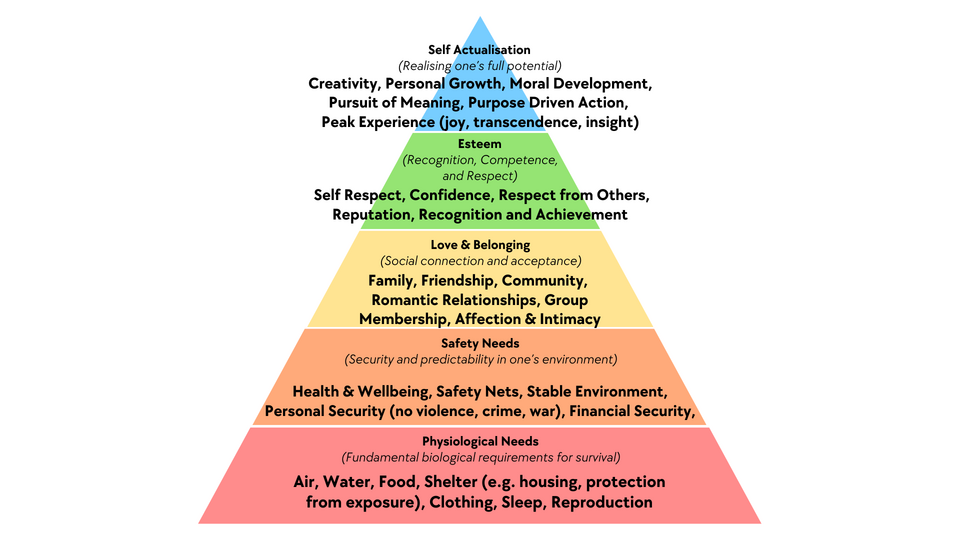 Maslow's hierarchy pyramid (Image: Hamish.croker, CC BY-SA 4.0, via Wikimedia Commons)
      [Self-Actualization]
           |
      [Esteem]
           |
      [Social]
           |
      [Safety]
           |
  [Physiological]
Worked Example: Pathao’s Motivation Strategy Pathao motivates riders by addressing multiple levels:
- Physiological/Safety: Guaranteed minimum earnings.
- Social: Rider communities and team challenges.
- Esteem: "Rider of the Month" awards.
- Self-Actualization: Leadership training for top performers.
3.2 Process Theories: How Motivation Works
Herzberg’s Two-Factor Theory distinguishes between:
- Hygiene Factors (dissatisfiers): Salary, company policy, working conditions.
- Motivators (satisfiers): Achievement, recognition, growth.
| Hygiene Factors | Motivators |
|---|---|
| Salary | Achievement |
| Company policy | Recognition |
| Supervision | Work itself |
| Working conditions | Responsibility |
| Interpersonal relations | Growth |
Worked Example: Nabil Bank’s Employee Motivation Nabil Bank uses job enrichment (a motivator) by:
- Giving loan officers more responsibility (e.g., client relationship management).
- Offering training programs (growth).
- Recognizing top performers in annual awards.
3.3 Expectancy Theory (Vroom, 1964)
Motivation depends on three expectations:
- Effort → Performance: Can I succeed?
- Performance → Reward: Will I get rewarded?
- Valence: Do I value the reward?
Formula:
flowchart TD
    A["Effort"] -->|"High Expectancy"| B["Performance"]
    B -->|"Clear Rewards"| C["Reward"]
    C -->|"Valued"| D["High Motivation"]
    C -->|"Not Valued"| E["Low Motivation"]
Worked Example: Daraz’s Sales Team Daraz motivates sales teams by:
- Effort → Performance: Training and tools (e.g., CRM software).
- Performance → Reward: Bonuses tied to sales targets.
- Valence: Rewards like cash bonuses (valued) vs. public praise (less valued for some).
4. Leadership Styles and Their Applications
Leadership styles vary based on authority, decision-making, and employee involvement. Below are the three primary styles:
| Style | Description | When to Use | Nepali Example |
|---|---|---|---|
| Autocratic | Leader makes decisions unilaterally | Crises, military operations | NTC during lockdowns |
| Democratic | Leader consults team before deciding | Creative teams, long-term projects | Himalayan Java’s team meetings |
| Laissez-Faire | Leader delegates fully | Highly skilled teams (e.g., R&D) | Freelance designers at Daraz |
Case Study: Chaudhary Group’s Leadership
- Top Management: Autocratic (e.g., CEO’s final call on mergers).
- Middle Management: Democratic (e.g., store managers’ input on promotions).
- Frontline Staff: Laissez-Faire (e.g., cashiers handling customer complaints independently).
5. Motivation Techniques in Nepali Businesses
| Technique | How It Works | Nepali Example |
|---|---|---|
| Job Enrichment | Adds responsibility and variety | Ncell’s employee-led innovation projects |
| Non-Financial Rewards | Recognition, flexible hours | Pathao’s "Rider of the Month" awards |
| Participative Management | Employees in decision-making | Daraz’s employee suggestion boxes |
| Goal Setting (Locke) | Clear, challenging targets | Nabil Bank’s quarterly sales goals |
## In the Real World
eSewa’s Leadership and Motivation
- Leadership Style: Transformational (CEO’s vision-driven culture).
- Motivation: Uses Herzberg’s motivators—e.g., stock options for top performers, public recognition for innovation.
- Real Impact: Reduced employee turnover by 30% in 2 years.
NTC’s Contingency Leadership
- Situation: Post-earthquake infrastructure repair.
- Style Shift:
- Autocratic for emergency rerouting.
- Democratic for community feedback on road designs.
- Outcome: Faster recovery and higher public trust.
Khalti’s Equity Theory Application
- Problem: Employees felt underpaid compared to peers at Daraz.
- Solution: Conducted salary equity audits and adjusted pay scales.
- Result: Improved morale and reduced attrition.
## Exam Tip
Link Theories to Nepali Cases:
- Example: "NTC’s crisis response aligns with Fiedler’s contingency theory because..."
- Use Chaudhary Group, Ncell, or Daraz in answers.
Compare and Contrast:
- "While trait theory suggests leaders are born with charisma, behavioral theory shows that Nabil Bank’s training programs can develop leadership skills."
Use Formulas and Models:
- For expectancy theory, write the formula and apply it to a bank loan officer’s motivation.
- For Maslow’s hierarchy, map a Pathao rider’s needs.
Short-Answer Tips:
- Trait vs. Behavioral: "Trait focuses on innate qualities, while behavioral focuses on learned actions—e.g., NTC’s training programs develop democratic leadership."
- Hygiene vs. Motivators: "Salary is a hygiene factor; recognition is a motivator—seen in Nabil Bank’s awards."
Long-Answer Structure:
- Introduction: Define leadership/motivation.
- Body: Explain 2 theories + 1 Nepali example.
- Conclusion: Link to organizational effectiveness.
Final Visual: Leadership and Motivation in Action
Based on the TU BBS syllabus for Principles of Management (MGT213), unit 5.
Discussion
Loading…