Cost and Management AccountingUnit 1213 min read
Pricing Decisions & Profit Planning: Methods, Analysis & Strategic Tools
Unit 12 of Cost and Management Accounting explores how businesses set prices to maximize profits while covering costs, using techniques like cost-plus pricing, break-even analysis, and target profit models. Learn real-world applications from Nepali firms like Daraz and Ncell, with fully worked examples in NPR.
TAKEAWAYS:
- Pricing decisions balance cost recovery, competition, and customer value—use cost-plus pricing for simplicity or value-based pricing for premium markets.
- Break-even analysis reveals the minimum sales volume needed to cover costs; target profit models extend this to desired profit levels.
- Profit planning integrates pricing with budgeting, variance analysis, and strategic goals (e.g., market share vs. profit maximization).
- Real-world tools: Nepali firms like Ncell use cost-volume-profit (CVP) analysis to set data plan prices, while Daraz applies price elasticity to adjust discounts.
- Common pitfalls: Ignoring fixed/variable cost distinctions, overestimating demand elasticity, or misapplying pricing strategies (e.g., cost-plus in competitive markets).
- Exam focus: Numerical problems (break-even, target profit), comparisons of pricing methods, and linking pricing to profit planning tools like flexible budgets.
1. Definitions and Core Concepts
Pricing decisions determine how much to charge for products/services to achieve financial and strategic goals. Profit planning is the process of setting pricing, sales targets, and cost structures to meet these goals.
Key Terms
| Term | Definition | Example (Nepali Context) |
|---|---|---|
| Cost-plus pricing | Price = Cost + Markup (e.g., 20% profit margin) | A Kathmandu biscuit shop adds 30% to cost. |
| Value-based pricing | Price = Perceived customer value (not just cost) | Ncell’s premium data plans priced higher. |
| Break-even point (BEP) | Sales volume where Total Revenue = Total Cost (no profit, no loss). | A Daraz seller needs to sell 500 units to cover costs. |
| Target profit pricing | Sets price to achieve a specific profit goal after covering costs. | A hotel in Pokhara prices rooms to earn Rs. 500K/month profit. |
| Price elasticity | % change in demand / % change in price (elastic = sensitive to price changes). | Khalti’s transaction fees drop when competitors lower theirs. |
2. Methods of Pricing Decisions
A. Cost-Based Pricing Methods
Used when competition is low or product differentiation is high. Two common types:
Cost-Plus Pricing
- Formula:
- Variants:
- Absorption costing: Includes all manufacturing costs (fixed + variable).
- Marginal costing: Uses only variable costs + markup.
- Example: A Kathmandu tea stall buys tea leaves for Rs. 100/kg, adds Rs. 50 for labor/overhead, and sells at Rs. 250/kg (150% markup).
flowchart TD
  A["Total Cost"] --> B["+ Markup (e.g., 30%)"]
  B --> C["= Selling Price"]
  C --> D["Customer Pays"]
Break-Even Pricing
- Goal: Set price to cover all costs (no profit, no loss).
- Formula:
- Example:
A Pokhara tailor has:
- Fixed costs (rent, salaries): Rs. 200,000/month
- Variable cost per suit: Rs. 1,500
- Wants to sell 200 suits/month. Break-even price per suit:
B. Demand-Based Pricing Methods
Used when demand is price-sensitive (e.g., competitive markets).
Value-Based Pricing
- Example: Ncell charges Rs. 1,000 for a premium data plan not because of cost, but because customers perceive it as worth it.
Dynamic Pricing
- Example: Pathao adjusts ride prices based on demand (surge pricing).
Penetration Pricing
- Example: Daraz offers deep discounts to enter new markets (e.g., rural Nepal).
3. Profit Planning Tools
Profit planning links pricing, sales volume, and costs to achieve financial goals.
A. Cost-Volume-Profit (CVP) Analysis
Analyzes how changes in sales volume affect profits.
Key Equations:
- Profit = (Selling Price per unit × Units Sold) – (Variable Cost per unit × Units Sold) – Fixed Costs
- Break-even units =
- Margin of Safety (MoS) = Actual Sales – Break-even Sales
Example: A Pokhara bakery sells cakes at Rs. 200 each. Variable cost per cake = Rs. 80. Fixed costs = Rs. 50,000/month.
- Break-even units:
- Target profit of Rs. 20,000:
B. Target Profit Analysis
Sets a desired profit and calculates required sales.
Formula: Where:
Example: A Kathmandu electronics shop wants Rs. 100,000 profit/month.
- Selling price per TV = Rs. 50,000
- Variable cost per TV = Rs. 30,000
- Fixed costs = Rs. 200,000
- CMR = (50,000 – 30,000)/50,000 = 40% = 0.4
- Required sales:
- Units to sell:
C. Profit-Volume (PV) Graph
Visualizes the relationship between sales volume, costs, and profit.
graph TD
  A["Sales Volume (Units)"] --> B["Total Revenue (TR)"]
  A --> C["Total Variable Cost (TVC)"]
  A --> D["Total Fixed Cost (TFC)"]
  B --> E["Profit/Loss = TR - TVC - TFC"]
Example:
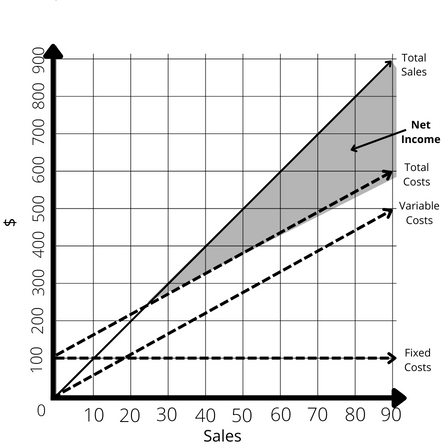 A PV graph for a Nepali mobile phone retailer showing break-even at 500 units. (Image: Slade74, CC0, via Wikimedia Commons)
4. Real-World Applications in Nepal
A. Ncell’s Data Plan Pricing
- Method: Value-based pricing + dynamic pricing.
- How:
- Premium plans (e.g., Rs. 1,500 for 100GB) priced based on customer willingness to pay.
- Off-peak discounts (e.g., 50% off at night) use demand elasticity.
B. Daraz’s Discount Strategy
- Method: Penetration pricing + cost-volume analysis.
- How:
- Deep discounts (e.g., 50% off on electronics) to increase sales volume and offset lower margins.
- Uses CVP analysis to ensure discounts don’t push them into losses.
C. Khalti’s Transaction Fees
- Method: Cost-plus pricing with price elasticity adjustments.
- How:
- Merchant fees: 2–3% of transaction value (covers Khalti’s costs + profit).
- Lower fees for high-volume sellers (e.g., 1.5% for Rs. 1M+ transactions) to retain customers.
D. NTC’s Broadband Pricing
- Method: Break-even pricing for rural areas.
- How:
- In low-income areas, NTC sets prices to cover costs (e.g., Rs. 500/month for 50Mbps) rather than maximize profit.
5. Worked Example: A Kathmandu Retail Shop
Scenario: A Thamel clothing store sells shirts with the following data:
- Selling price per shirt: Rs. 1,500
- Variable cost per shirt: Rs. 800 (fabric, labor)
- Fixed costs per month: Rs. 300,000 (rent, salaries, utilities)
- Desired profit: Rs. 100,000/month
Step 1: Calculate Break-Even Point (BEP)
Step 2: Calculate Target Sales for Desired Profit
Step 3: Margin of Safety (MoS)
If the store sells 600 shirts/month:
Step 4: Pricing Decision
- Option 1: Keep price at Rs. 1,500 and sell 543 shirts to hit target profit.
- Option 2: Lower price to Rs. 1,200 (check elasticity):
- New CMR = (1,200 – 800)/1,200 = 33.33%
- Required sales = (300,000 + 100,000)/0.3333 = Rs. 1.2M → 1,000 shirts.
- Risk: Lower profit per unit; need higher volume.
Recommendation:
- Stick with Rs. 1,500 if demand is elastic (customers won’t switch to competitors).
- Offer discounts on bulk purchases (e.g., 10% off for 5+ shirts) to boost volume without cutting price.
6. Comparison of Pricing Methods
| Method | When to Use | Advantages | Disadvantages | Example (Nepal) |
|---|---|---|---|---|
| Cost-plus | Low competition, stable demand | Simple, ensures cost recovery | Ignores customer value | Local biscuit shops |
| Value-based | Premium products, brand loyalty | Maximizes profit per customer | Hard to measure "value" | Ncell’s premium plans |
| Break-even | New business, uncertain demand | Guarantees no loss | May price out competitors | NTC’s rural broadband |
| Penetration | Entering competitive markets | Gains market share quickly | Low margins initially | Daraz’s discounts |
| Dynamic | High demand variability (e.g., events) | Optimizes revenue | Complex to implement | Pathao’s surge pricing |
7. Limitations of Pricing Decisions
- Ignoring competition: Cost-plus pricing may lead to higher prices than competitors.
- Overestimating demand: Assuming customers will buy at any price (e.g., Nepal’s low-income markets).
- Fixed vs. variable cost confusion: Mixing them up leads to wrong break-even points.
- Price elasticity misjudgment: Assuming demand is inelastic when it’s actually sensitive (e.g., Khalti’s fee hikes).
- Short-term focus: Chasing profits may hurt long-term brand value (e.g., Daraz’s deep discounts vs. quality perception).
8. Exam Tip: How to Score Full Marks
A. Numerical Problems (60% of marks)
Always show calculations step-by-step.
- Example: For break-even, write:
- Never skip units (e.g., "Rs." or "units").
Use tables for clarity:
Particulars Amount (Rs.) Fixed Costs 300,000 Variable Cost/unit 800 Selling Price/unit 1,500 Contribution/unit 700 BEP (units) 429 Interpret results:
- "The store must sell 429 shirts to break even. To earn Rs. 100,000 profit, it needs 543 shirts."
B. Short Answer Questions (20% of marks)
Define key terms precisely:
- ❌ "Break-even is where profit is zero."
- ✅ "Break-even point is the sales volume where total revenue equals total cost, resulting in zero profit or loss."
Link to real-world examples:
- "Like Ncell, which uses value-based pricing for premium plans, this company should consider customer perceived value rather than just costs."
C. Essay-Type Questions (20% of marks)
Structure your answer:
- Introduction: Define pricing decisions and profit planning.
- Body:
- Discuss 2–3 pricing methods with examples.
- Explain how profit planning tools (CVP, target profit) help.
- Conclusion: Summarize key takeaways and real-world applications.
Use diagrams:
- Draw a PV graph or CVP table to illustrate break-even.
9. Common Mistakes to Avoid
- Mixing fixed and variable costs: Always separate them in calculations.
- Ignoring taxes or discounts: Adjust selling price for VAT (13%) if required.
- Assuming linear demand: Real-world demand may drop sharply at higher prices.
- Overlooking strategic goals: Pricing should align with market share vs. profit maximization.
10. Quick Revision Checklist
Before the exam, ensure you can: ✅ Calculate break-even point and target profit sales. ✅ Differentiate cost-plus vs. value-based pricing. ✅ Explain how CVP analysis helps in decision-making. ✅ Give 2 Nepali examples of pricing strategies (e.g., Ncell, Daraz). ✅ Draw a PV graph and label BEP, profit area, and loss area.
Based on the TU BBS syllabus for Cost and Management Accounting (MGT212), unit 12.
Discussion
Loading…