Taxation In NepalUnit 611 min read
Business Income & Accounting: Concepts, Methods & Tax Links
Unit 6 of Taxation In Nepal covers the core accounting principles that determine business income for tax purposes, including accrual vs. cash basis, accounting cycles, ledger entries, and how these connect to Nepal’s Income Tax Act 2058. Learn through real-world examples (e.g., Daraz’s inventory accounting) and fully w
TAKEAWAYS:
- Business income for tax purposes is calculated using accrual accounting (not cash basis) unless exempt, per Section 2(27) of the Income Tax Act 2058.
- The accounting cycle (journal → ledger → trial balance → financial statements) directly impacts taxable income calculations.
- Depreciation (WDV method) reduces taxable income, but must follow Block A–E rates set by the Inland Revenue Department.
- Allowable deductions (e.g., business expenses, depreciation) must be wholly and exclusively related to income generation (Section 18).
- Real-world tie: Daraz’s "sold but not yet delivered" orders are recorded as revenue under accrual accounting, affecting taxable income before cash is received.
- Exam focus: Questions often mix accounting entries (Dr/Cr) with tax adjustments (e.g., disallowing personal expenses).
1. Definitions: Business Income and Accounting Concepts
Business income (Section 2(27) of Income Tax Act 2058) is the profit or gain derived from any business, trade, profession, or vocation, calculated using accrual accounting unless the taxpayer is a small trader (cash basis allowed under Section 10(1)(a)).
Key Accounting Concepts for Taxation
| Concept | Definition | Tax Relevance |
|---|---|---|
| Accrual Basis | Revenue recognized when earned; expenses when incurred, not when cash moves. | Default for businesses (Section 18). Unrecorded revenue/expenses are taxed/disallowed. |
| Cash Basis | Revenue/expenses recorded when cash is received/paid. | Allowed only for small traders (annual turnover < Rs. 1.5 million). |
| Matching Principle | Expenses matched to revenue they generate in the same period. | Ensures taxable income reflects economic reality, not cash flow. |
| Going Concern | Assumes business will continue indefinitely. | Affects depreciation and asset valuation for tax purposes. |
| Consistency | Same accounting methods used year-over-year. | Changes require IRD approval; arbitrary switches can trigger audits. |
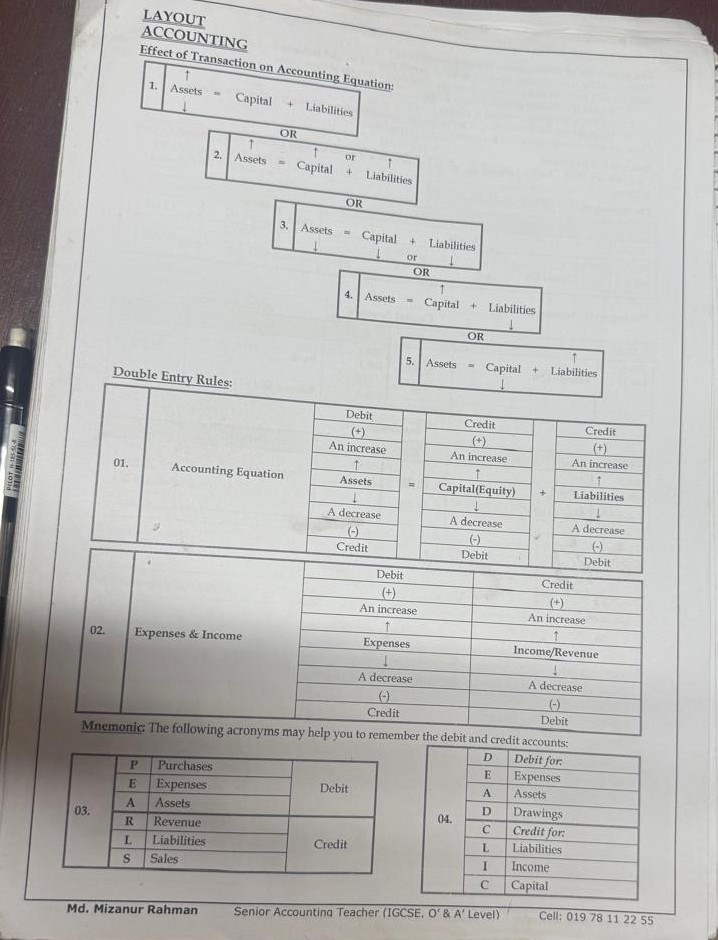 Assets = Liabilities + Owner’s Equity (with Dr/Cr arrows) (Image: Forex Awards, CC0, via Wikimedia Commons)
2. The Accounting Cycle and Tax Implications
The accounting cycle is the process of recording transactions, summarizing them, and preparing financial statements. For tax purposes, every step affects taxable income.
Step-by-Step Cycle with Tax Links
flowchart TD
    A["1. Transaction Occurs\n(e.g., Sale on Credit)"] --> B["2. Journal Entry\n(Dr A/c, Cr A/c)"]
    B --> C["3. Ledger Posting\n(T-accounts updated)"]
    C --> D["4. Trial Balance\n(Debits = Credits?)"]
    D --> E["5. Adjusting Entries\n(e.g., Depreciation, Prepaid Expenses)"]
    E --> F["6. Adjusted Trial Balance"]
    F --> G["7. Financial Statements\n(Income Statement → Taxable Income)"]
    G --> H["8. Tax Adjustments\n(Disallowed items per Section 18)"]
    H --> I["9. Tax Return Filing\n(Form 2/2A for businesses)"]
How This Affects Taxable Income
- Unrecorded Revenue: If a business (e.g., a Kathmandu electronics shop) sells goods on credit but doesn’t record the sale, the IRD will add it to taxable income under Section 18(1)(a).
- Prepaid Expenses: Rent paid in advance is not deductible immediately (must be spread over the period covered).
- Accrued Expenses: Salaries owed but not yet paid are deductible in the current year (matching principle).
3. Journal Entries and Ledger Postings: Visual Guide
Every business transaction is first recorded in a journal (chronological order) and then posted to ledger accounts (T-accounts).
Example: Sale on Credit (Nepali Business Context)
Scenario: Shree Electronics (Kathmandu) sells a laptop for Rs. 50,000 on 10th Bhadra 2079, terms: "Cash on Delivery."
| Journal Entry (Date: 10th Bhadra 2079) |
|---|
| Particulars |
| Sales A/c |
| To Debtors A/c (Customer Name) |
| (Sale on credit recorded) |
Ledger Posting (T-Accounts):
- Tax Impact: Revenue is taxable in the year of sale, even if cash is received later (accrual basis).
4. Accrual vs. Cash Basis: Comparison Table
| Feature | Accrual Basis | Cash Basis | Nepal Tax Rule |
|---|---|---|---|
| Revenue Recognition | When earned (invoice issued). | When cash is received. | Default for businesses (Section 18). |
| Expense Recognition | When incurred (e.g., utility bill). | When cash is paid. | Disallowed if mismatched (Section 18(2)). |
| Inventory Valuation | Cost of goods sold (COGS) deducted. | Not applicable. | Mandatory for traders (Section 20). |
| Example | Daraz records revenue when order is shipped. | A small tea stall records sales only when cash is paid. | Small traders (< Rs. 1.5M turnover) can use cash basis. |
| Tax Treatment | More accurate for taxable income. | Understates income if revenue is high. | IRD may reclassify if cash basis distorts profits. |
5. Worked Example: Calculating Taxable Business Income
Scenario: Kathmandu Books Pvt. Ltd. (a book retailer) provides the following for the income year 2079/80:
- Sales (all on credit): Rs. 12,000,000
- Purchases: Rs. 7,000,000
- Opening Inventory (1st Chaitra 2079): Rs. 1,500,000
- Closing Inventory (30th Chaitra 2080): Rs. 2,000,000
- Other Expenses:
- Rent (prepaid for 6 months): Rs. 300,000
- Salaries (accrued but unpaid): Rs. 400,000
- Depreciation (Block C, rate 15%): Rs. 200,000
- Personal car expenses (mixed use): Rs. 150,000
Step 1: Calculate Gross Profit (Accrual Basis)
Gross Profit = Sales - COGS
COGS = Opening Inventory + Purchases - Closing Inventory
     = 1,500,000 + 7,000,000 - 2,000,000
     = Rs. 6,500,000
Gross Profit = 12,000,000 - 6,500,000 = Rs. 5,500,000
Step 2: Adjust for Non-Deductible Items
| Expense | Amount (Rs.) | Tax Treatment | Deductible (Rs.) |
|---|---|---|---|
| Rent (prepaid) | 300,000 | Only deductible for 5 months (current year). | 125,000 |
| Salaries (accrued) | 400,000 | Fully deductible (incurred). | 400,000 |
| Depreciation (Block C) | 200,000 | Fully deductible (WDV method). | 200,000 |
| Personal Car Expenses | 150,000 | Not deductible (mixed use, Section 18(2)(g)). | 0 |
Step 3: Calculate Taxable Income
Taxable Income = Gross Profit - Deductible Expenses
               = 5,500,000 - (125,000 + 400,000 + 200,000)
               = Rs. 4,775,000
Step 4: Apply Tax Rate (Corporate: 25%)
Tax Payable = 4,775,000 × 25% = Rs. 1,193,750
6. Real-World Applications
Example 1: Daraz’s Inventory Accounting
- Concept: Accrual Basis + COGS Matching
- How it works: Daraz records revenue when an order is shipped (not when cash is received). The cost of goods sold (COGS) is deducted in the same period, ensuring taxable income reflects actual profitability, not just cash flow.
- Tax Link: If Daraz used cash basis, it could underreport income in years with high sales but delayed payments.
Example 2: Ncell’s Depreciation for Tax
- Concept: Written Down Value (WDV) Method
- How it works: Ncell’s telecom towers (Block C assets) are depreciated at 15% per year under the WDV method. This reduces taxable income annually, spreading the cost over the asset’s useful life.
- Tax Calculation:
- Year 1: Opening WDV = Rs. 5,000,000
- Depreciation: 5,000,000 × 15% = Rs. 750,000 (deductible).
- Closing WDV: 5,000,000 - 750,000 = Rs. 4,250,000.
Example 3: Pathao’s Prepaid Expenses
- Concept: Matching Principle
- How it works: Pathao pays 6 months’ rent in advance (Rs. 300,000). For tax purposes, only the portion used in the current year (e.g., Rs. 100,000 for 2 months) is deductible. The rest is carried forward.
- Tax Impact: Prevents overstating deductions in the year of payment.
7. Common Pitfalls and IRD Adjustments
The Inland Revenue Department (IRD) often disallows expenses if they violate Section 18 of the Income Tax Act. Common issues:
| Issue | Example | IRD Adjustment |
|---|---|---|
| Personal Expenses Mixed | Owner’s personal car used for business. | Disallow entire expense (Section 18(2)(g)). |
| Unrecorded Revenue | Cash sales not invoiced. | Add to taxable income (Section 18(1)(a)). |
| Capital Expenditures | Repairs vs. improvements (e.g., roof fix). | Capitalize if improves asset life (Section 22). |
| Related-Party Transactions | Overpriced purchases from owner’s firm. | Adjust to arm’s length value (Transfer Pricing Rules). |
| Inventory Valuation Errors | Overstating closing stock. | Recalculate COGS (Section 20). |
8. Exam Tip: How to Score Full Marks
- Always use accrual basis unless the question specifies cash basis or a small trader.
- Show all steps in calculations:
- Gross Profit → Deductible Expenses → Taxable Income → Tax Payable.
- Label adjustments clearly:
- "Disallowed as per Section 18(2)(g)" or "Deductible under WDV method."
- Use real-world examples in explanations (e.g., Daraz, Ncell).
- For journal entries:
- Write dates, particulars, and Dr/Cr amounts.
- Link to tax impact (e.g., "This affects taxable income under Section 18").
- Memorize key sections:
- Section 18: Allowable deductions.
- Section 20: Inventory valuation.
- Section 22: Depreciation and WDV.
Past Exam Question Analysis: Question: "Given the trading account of a sole trader, calculate taxable income." Student Mistake: Forgetting to adjust for prepaid expenses or accrued income. Correct Approach:
- Start with gross profit from the trading account.
- Add accrued income (e.g., interest received but not yet accounted for).
- Subtract prepaid expenses (only deduct the current year’s portion).
- Disallow non-business expenses (e.g., personal travel).
Final Note: Business income taxation in Nepal relies heavily on accounting principles. Master the accrual method, WDV depreciation, and Section 18 deductions to avoid common pitfalls. Always tie accounting entries to tax rules—examiners love this connection!
Based on the TU BBS syllabus for Taxation In Nepal, unit 6.
Discussion
Loading…