Foundations Of Financial Institutions And MarketsUnit 313 min read
Commercial Banking & Risk Management: Core Functions, Risks & Controls
Unit 3 of Foundations Of Financial Institutions And Markets: explores how commercial banks operate as intermediaries, their core functions (deposit-taking, lending, payments), the four major risks (credit, market, liquidity, operational) and how banks manage them via tools like Basel III, diversification and stress tes
TAKEAWAYS:
- Commercial banks create money via fractional reserve banking and facilitate payments through clearinghouses like the Nepal Clearing House (NCH).
- Risk-weighted assets (RWA) determine capital requirements under Basel III, with loans (100%) and government securities (0%) having different weights.
- Credit risk is mitigated by collateral, loan-to-value ratios, and diversification, while liquidity risk is managed via liquidity coverage ratios (LCR) and stress tests.
- Market risk arises from interest rate fluctuations and is hedged using derivatives (e.g., swaps) or matching asset/liability maturities.
- Operational risk (e.g., fraud, cyberattacks) is controlled via internal audits, KYC policies, and technology like eSewa’s transaction monitoring.
- Nepal Rastra Bank (NRB) enforces reserve requirements (e.g., 4% for transaction deposits) and capital adequacy ratios (CAR ≥ 10%) to ensure bank stability.
1. Core Functions of Commercial Banks
Commercial banks are the backbone of Nepal’s financial system, linking savers (depositors) with borrowers (businesses, households). Their primary roles include:
1.1 Deposit-Taking and Lending
Banks accept deposits (savings, current, fixed) and lend them to earn interest. The fractional reserve system ensures banks don’t lend out 100% of deposits, maintaining liquidity.
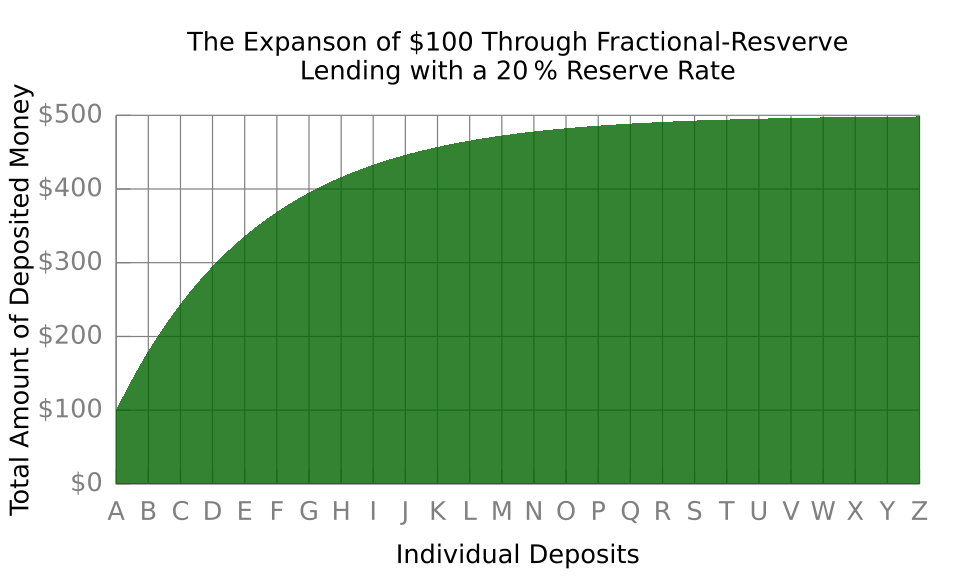 How banks create money by lending multiples of reserves (Image: Erik Streb, CC BY-SA 3.0, via Wikimedia Commons)
```mermaid
flowchart TD
    A["Depositor: Rs 100"] -->|deposits| B["Bank: Rs 100"]
    B -->|keeps 10% reserve| C["Reserve: Rs 10"]
    B -->|lends 90%| D["Borrower: Rs 90"]
    D -->|spends| E["New Depositor: Rs 90"]
    E -->|deposits| B
    B -->|lends 81%| F["Next Borrower: Rs 81"]
Key Idea: A single deposit of Rs 100 can generate Rs 1,000+ in loans via the money multiplier effect (1/reserve ratio). In Nepal, NRB sets reserve requirements (e.g., 4% for transaction deposits).
1.2 Payment Systems and Clearing
Banks facilitate transactions via:
- Cheques: Cleared through the Nepal Clearing House (NCH).
- Digital Payments: eSewa, Khalti, and Rupaiya (Ncell’s mobile wallet) use real-time gross settlement (RTGS).
- Bank Drafts: Guaranteed by issuing banks.
```mermaid
flowchart TD
    A["Bank A: Rs 50,000"] -->|"cheque"| B["NCH Clearing"]
    B -->|"settles"| C["Bank B: Rs 50,000"]
    B -->|"settles"| D["NRB: Net Settlement"]
    B -->|"RTGS"| E["eSewa/Khalti: Rs 10,000"]
    E -->|"settled"| F["Merchant: Rs 10,000"]
    G["Bank Draft: Rs 20,000"] -->|"guaranteed"| H["Issuing Bank: NRB"]
Nepal's payment systems: cheques, digital payments, and bank drafts Worked Example (NRB’s Role): If Bank A has a net debit of Rs 200 million in NCH, NRB adjusts its reserve account accordingly to maintain liquidity.
1.3 Investment and Trust Services
Banks invest in government securities (G-secs), corporate bonds, and mutual funds. They also act as trustees for pension funds (e.g., Nepal Insurance Corporation’s life insurance policies).
2. Risks in Commercial Banking
Banks face four major risks: credit, market, liquidity, and operational. Each is managed differently.
2.1 Credit Risk
Definition: Default by borrowers (e.g., a business failing to repay a loan). Sources:
- Loan defaults (e.g., Sirjana Finance’s past NPAs).
- Counterparty risk (e.g., a corporate borrower defaulting on a trade finance letter of credit).
Mitigation Strategies:
| Tool | How It Works | Example in Nepal |
|---|---|---|
| Collateral | Secures loans (e.g., property, inventory). | NRB’s mortgage-backed lending guidelines. |
| Loan-to-Value (LTV) | Limits loan amount to asset value (e.g., 70% for home loans). | Housing Development Bank’s LTV rules. |
| Diversification | Spreads risk across sectors (e.g., agriculture, SMEs). | NMB Bank’s portfolio diversification. |
| Stress Testing | Simulates economic shocks (e.g., 20% unemployment). | NRB’s capital stress tests for banks. |
Worked Example (Loan Portfolio): Suppose Global IME Bank has:
- Rs 500M in loans to SMEs (risk weight = 100%)
- Rs 300M in government securities (risk weight = 0%)
- Rs 200M in corporate bonds (risk weight = 50%)
Risk-Weighted Assets (RWA) = (500 × 100% + 300 × 0% + 200 × 50%) = Rs 650M.
2.2 Market Risk
Definition: Losses from interest rate changes or currency fluctuations. Sources:
- Interest rate risk: Fixed-rate loans vs. floating-rate deposits.
- Foreign exchange risk: Banks with USD/Rs exposures (e.g., Nepal Rastra Bank’s forex reserves).
Mitigation Tools:
| Tool | Example |
|---|---|
| Interest Rate Swaps | Locks in rates (e.g., Global IME Bank swaps floating to fixed loans). |
| Asset-Liability Matching | Aligns loan maturities with deposit terms. |
| Hedging with Derivatives | Uses futures or options to offset FX risk. |
```figure
{"type":"t-account","title":"Interest Rate Swap Example","dr":[["To Counterparty: Fixed Rate Payments","Rs 5,000/year"],["To Floating Rate Loan Interest","Variable"]],"cr":[["By Counterparty: Floating Rate Payments","Variable"],["By Fixed Rate Deposit Interest","Rs 5,000/year"]],"caption":"How Global IME Bank hedges floating-rate loans using an interest rate swap"}
2.3 Liquidity Risk
Definition: Inability to meet short-term obligations (e.g., Sirjana Finance’s 2020 liquidity crisis). Sources:
- Deposit withdrawals (e.g., Kathmandu Bank’s 2015 run on deposits).
- Asset illiquidity (e.g., holding long-term loans when cash is needed).
Mitigation Tools:
| Tool | How It Works | NRB’s Role |
|---|---|---|
| Liquidity Coverage Ratio (LCR) | Holds high-quality liquid assets (HQLA) ≥ 100% of 30-day net cash outflow. | NRB monitors compliance. |
| NSFR (Net Stable Funding Ratio) | Ensures long-term funding matches assets. | NRB enforces minimum NSFR of 100%. |
| Repurchase Agreements (Repos) | Borrows cash from NRB (e.g., Sirjana Finance’s Rs 20M repo in 2020). | NRB lends under Liquidity Support Facility. |
Worked Example (LCR Calculation): Suppose NMB Bank has:
- HQLA (cash, G-secs): Rs 150M
- 30-day net cash outflow: Rs 120M
LCR = (150 / 120) × 100 = 125% (complies with NRB’s 100% requirement).
2.4 Operational Risk
Definition: Losses from fraud, cyberattacks, or human error. Sources:
- Cybercrime: eSewa’s 2021 phishing scams.
- Regulatory violations: Global IME Bank’s 2022 fine for KYC lapses.
Mitigation Tools:
| Tool | Example |
|---|---|
| KYC/AML Policies | Nepal Rastra Bank’s customer due diligence rules. |
| Internal Audits | NMB Bank’s quarterly fraud detection. |
| Technology | eSewa’s AI-based transaction monitoring. |
3. Risk Management Frameworks
Banks use Basel III and NRB’s guidelines to manage risks.
3.1 Basel III: Capital Adequacy
Key Ratios:
Capital Adequacy Ratio (CAR) ≥ 10%:
- Tier 1 Capital (core capital: paid-up capital, retained earnings) ≥ 6%.
- Tier 2 Capital (subordinated debt, revaluation reserves) adds to CAR.
Example (ABC Bank Ltd.):
Item Amount (Rs M) Risk Weight RWA Contribution Paid-up Capital 2,400 0% 0 General Reserve 400 0% 0 Loans (SMEs) 1,500 100% 1,500 Government Securities 300 0% 0 Total RWA 1,500 CAR = (Tier 1 Capital / RWA) × 100 = (2,400 / 1,500) × 100 = 160% (complies). Leverage Ratio ≥ 5%:
- Total capital / total assets ≥ 5%.
3.2 Stress Testing
Banks simulate economic downturns (e.g., 10% unemployment, 20% GDP contraction) to assess resilience.
```mermaid
flowchart TD
    A["Baseline Scenario"] --> B["Stress Scenario: 20% GDP Drop"]
    B --> C["Simulate Loan Defaults: +15% NPA"]
    C --> D["Check Capital Buffer: CAR ≥ 8%?"]
    D -->|Yes| E["Passes"]
    D -->|No| F["Raise Capital or Reduce Risk"]
4. Nepal-Specific Context
4.1 NRB’s Role in Risk Management
- Reserve Requirements: 4% for transaction deposits (reduced from 6% in 2020).
- Liquidity Support: Repos (e.g., Rs 20M to Sirjana Finance in 2020).
- Capital Controls: Limits on foreign currency loans.
4.2 Case Study: Global IME Bank’s Risk Management
| Risk | Issue | Solution |
|---|---|---|
| Credit Risk | High NPA in SME loans (2019) | Introduced collateral requirements. |
| Liquidity Risk | Deposit outflow in 2020 | Increased HQLA holdings to 130% LCR. |
| Operational Risk | Fraud in digital banking | Implemented biometric authentication. |
## In the Real World
eSewa’s Fraud Prevention (Operational Risk)
- Idea: Uses machine learning to flag suspicious transactions (e.g., multiple small transfers in a row).
- How: Analyzes velocity of transactions and user behavior patterns to detect fraud in real time.
- Example: Blocked Rs 50M in fraudulent transactions in 2022.
NMB Bank’s Loan Portfolio Diversification (Credit Risk)
- Idea: Allocates loans across agriculture (30%), SMEs (40%), real estate (20%) to avoid sector-specific shocks.
- How: Limits single-borrower exposure to 10% of capital.
- Example: During the COVID-19 lockdown, agriculture loans (subsidized by NRB) kept NMB’s NPA ratio below 2%.
NRB’s Liquidity Support via Repos (Liquidity Risk)
- Idea: Acts as a lender of last resort by lending cash against collateral (e.g., government securities).
- How: Sirjana Finance borrowed Rs 20M in 2020 under a 7-day repo to meet reserve requirements.
- Worked Example:
- Repo Rate: 5%
- Amount Borrowed: Rs 20M
- Cost: Rs 20M × 5% × (7/365) = Rs 194 (daily interest).
## Exam Tip
Risk-Weighted Assets (RWA) Calculation:
- Always multiply each asset class by its risk weight and sum them.
- Formula: RWA = Σ (Asset × Risk Weight).
- Common Weights:
- Loans to SMEs: 100%
- Government securities: 0%
- Corporate bonds: 50–100%
Basel III Ratios:
- CAR = (Tier 1 Capital / RWA) × 100 ≥ 10%.
- Leverage Ratio = (Total Capital / Total Assets) × 100 ≥ 5%.
NRB’s Tools:
- Reserve Requirements: 4% for transaction deposits (adjusts via monetary policy).
- Liquidity Support: Repos, Discount Window Facility.
Risk Management Strategies:
- Credit Risk: Collateral, LTV ratios, stress testing.
- Liquidity Risk: LCR, NSFR, HQLA.
- Market Risk: Swaps, asset-liability matching.
- Operational Risk: KYC, internal audits, tech (e.g., eSewa’s AI).
Nepal-Specific Focus:
- Always tie answers to NRB’s policies (e.g., Basel III adoption in 2019, LCR implementation in 2020).
- Use real banks (NMB, Global IME, NMB) in examples.
Numerical Problems:
- For T-bill pricing, use:
- Example: 90-day T-bill, face value Rs 1M, discount rate 8%:
- For T-bill pricing, use:
Final Note: Always label your tables (e.g., "Risk-Weighted Assets Calculation for X Bank") and show workings for numerical problems. NRB’s policies are high-weight topics—expect 2–3 questions on them.
Based on the TU BBS syllabus for Foundations Of Financial Institutions And Markets (FIN255), unit 3.
Discussion
Loading…