Foundations Of Financial Institutions And MarketsUnit 137 min read
Financial Markets & Instruments: Roles, Instruments & Risks
Unit 13 of Foundations Of Financial Institutions And Markets explains how financial markets facilitate transactions, the types of financial instruments (debt, equity, derivatives), and the risks they manage—with real-world examples from Nepal’s NEPSE, Daraz, and banks.
TAKEAWAYS:
- Financial markets connect borrowers and lenders, enabling efficient allocation of capital.
- Primary markets issue new securities (e.g., IPOs), while secondary markets trade existing ones (e.g., NEPSE).
- Financial instruments include bonds (debt), stocks (equity), and derivatives (options/futures) to hedge or speculate.
- Market participants (brokers, dealers, investors) play distinct roles, but inefficiencies (e.g., low liquidity in Nepal) persist.
- Risk management tools like diversification and hedging mitigate market, credit, and liquidity risks.
- Regulation (e.g., SEBON in Nepal) ensures transparency but can stifle innovation.
1. Introduction to Financial Markets
Financial markets are platforms where buyers and sellers trade financial assets. They classify into primary (new issues) and secondary (existing trades) markets, with money markets (short-term) and capital markets (long-term) as subcategories.
Primary vs. Secondary Markets
flowchart TD
    A["Financial Markets"] --> B["Primary Market"]
    A --> C["Secondary Market"]
    B --> D["New securities issued (IPOs, bonds)"]
    C --> E["Existing securities traded (NEPSE, stock exchanges)"]
    D --> F["Issuer (company) <--> Investor"]
    E --> G["Buyer <--> Seller (no issuer involved)"]
Example in Nepal:
- Primary: NEPSE lists new companies (e.g., Daraz Nepal’s IPO in 2021 raised ₹1.5 billion).
- Secondary: Investors trade Daraz shares on NEPSE after listing.
2. Key Participants in Financial Markets
| Participant | Role | Example in Nepal |
|---|---|---|
| Investors | Provide capital (individuals, institutions) | Retirement funds buying NEPSE stocks |
| Issuers | Companies/banks raising funds (e.g., bonds, equity) | Ncell issuing corporate bonds |
| Brokers | Facilitate trades (charge commissions) | Khalti’s digital brokerage service |
| Dealers | Buy/sell for their own accounts (market makers) | NMB trading government securities |
| Regulators | Oversee markets (e.g., SEBON, Nepal Rastra Bank) | SEBON banning short-selling in 2020 |
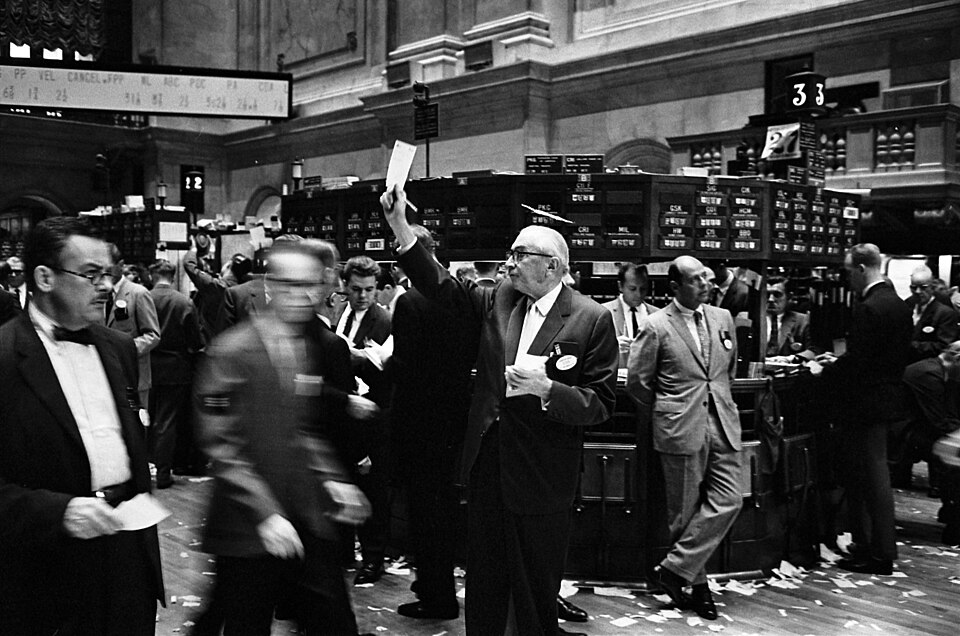 Traders at NEPSE’s Kathmandu office execute orders for listed firms like Siddhartha Hospital. (Image: Thomas J. O'Halloran, Public domain, via Wikimedia Commons)
3. Financial Instruments
Financial instruments are contracts representing financial value. They fall into three categories:
(A) Debt Instruments
Bonds: Fixed-income securities (e.g., government bonds, corporate bonds).
- Example: Nepal’s 10-year sovereign bond yields ~8% (2023).
- Key Terms:
- Par Value: ₹1,000 (face value).
- Coupon Rate: Annual interest (e.g., 7% of ₹1,000 = ₹70).
- Maturity: 5–30 years.
- Call Option: Issuer can redeem early (e.g., Ncell called its bonds in 2022).
Worked Example: A bond pays ₹75 yearly coupon, matures in 5 years, and trades at ₹950. Calculate yield to maturity (YTM). Where:
- (coupon),
- (face value),
- (price),
- (years).
(B) Equity Instruments
- Stocks: Ownership claims (e.g., NEPSE-listed Nepal Bank).
- Types:
- Common Stock: Voting rights, residual claims.
- Preferred Stock: Fixed dividends, no voting.
- Types:
(C) Derivative Instruments
- Options/Futures: Derive value from underlying assets (e.g., NEPSE S&P 500 index futures).
- Purpose: Hedging (e.g., farmers using futures to lock wheat prices) or speculation.
4. Money vs. Capital Markets
| Feature | Money Market | Capital Market |
|---|---|---|
| Maturity | <1 year | ≥1 year |
| Instruments | T-bills, commercial paper, repo | Bonds, stocks, derivatives |
| Risk | Low | Higher |
| Participants | Banks, NBFCs, governments | Corporations, institutional investors |
| Example (Nepal) | NRB’s 91-day T-bills (yield ~6%) | NEPSE-listed Ncell bonds |
5. Risks in Financial Markets
Financial institutions face market risk, credit risk, liquidity risk, and operational risk.
(A) Market Risk
- Price fluctuations (e.g., NEPSE index dropping 10% in 2022 due to global recession).
- Mitigation: Diversification, hedging with futures.
(B) Credit Risk
- Borrower defaults (e.g., Ncell’s debt restructuring in 2021).
- Tools:
- Credit Ratings (e.g., Moody’s, S&P; Nepal uses SEBON).
- Collateral (e.g., mortgages for home loans).
(C) Liquidity Risk
- Inability to sell assets quickly (e.g., illiquid NEPSE stocks like Sagarmatha Bank).
- Solution: Hold liquid assets (cash, T-bills).
6. Role of Financial Instruments in Real World
(A) eSewa’s Digital Payments
- Instrument Used: Electronic Funds Transfer (EFT) (a money market instrument).
- How: eSewa processes ₹50 billion+ monthly via real-time clearing systems (like RTGS in Nepal).
(B) Daraz’s Supply Chain Financing
- Instrument Used: Commercial Paper (short-term debt).
- How: Daraz issues ₹100 million CP to suppliers to delay payments, improving cash flow.
(C) NEPSE’s Index Futures
- Instrument Used: Index Futures (derivative).
- How: Investors hedge against NEPSE volatility by trading NEPSE S&P 500 futures.
7. Regulation and Market Efficiency
- Nepal: SEBON (Securities Exchange Board of Nepal) regulates NEPSE.
- Issues:
- Low liquidity (only 10% of NEPSE-listed firms trade daily).
- Lack of derivatives trading (unlike global markets).
- Global Comparison:
Market Liquidity Derivatives Regulator NEPSE Low Limited SEBON NYSE High Extensive SEC London Stock Ex. High Extensive FCA
8. Exam Tip: How to Score Full Marks
Define Terms Clearly:
- For bonds: Always mention par value, coupon, and maturity.
- For markets: Distinguish primary (new issues) vs. secondary (trading).
Use Real Examples:
- Link NEPSE to capital markets, eSewa to money markets.
- Cite Ncell’s bond call for debt instruments.
Compare Tables:
- For risks, list credit vs. market risk with Nepal-specific examples.
Worked Examples:
- Solve YTM or present value problems step-by-step (show formulas).
Critique Nepal’s Market:
- Mention low liquidity, lack of derivatives, or SEBON’s role in 2–3 lines.
Based on the TU BBS syllabus for Foundations Of Financial Institutions And Markets (FIN255), unit 13.
Discussion
Loading…