Mathematics IUnit 89 min read
Vectors and 3‑D Geometry – definitions, operations, lines, planes & applications
Unit 8 of Mathematics I introduces vectors, scalar & vector products, equations of lines/planes, distances, angles, and uses these tools to solve 3‑D geometry problems typical of TU exams.
Key points
- A vector is a directed quantity represented by its components \((x, y, z)\) and magnitude \(|\mathbf{v}|\).
- Dot product gives the cosine of the angle between two vectors; cross product yields a vector perpendicular to both.
- The mixed (scalar triple) product \(\mathbf{a}\cdot(\mathbf{b}\times\mathbf{c})\) equals the volume of the parallelepiped formed by the three vectors.
- Equations of a line and a plane in space are expressed compactly using vector notation and a normal vector.
- Distances, projections and angles in 3‑D are computed directly from vector formulas, avoiding cumbersome coordinate geometry.
1. Vectors in Three‑Dimensional Space
A vector in is an ordered triple . It is visualised as an arrow from the origin to the point .
Magnitude (length)
Direction cosines are the cosines of the angles that makes with the positive , , axes:
Unit vector in the direction of :
2. Vector Operations
| Operation | Symbol | Formula | Result |
|---|---|---|---|
| Scalar (dot) product | Scalar | ||
| Vector (cross) product | Vector ⟂ both | ||
| Mixed (scalar triple) product | Determinant | Scalar (volume) |
2.1 Dot product and angle
2.2 Cross product and perpendicular vector
where is a unit vector normal to the plane containing (right‑hand rule).
2.3 Mixed product – volume of a parallelepiped
The absolute value equals the volume of the parallelepiped built on .
3. Lines and Planes in Space
3.1 Vector equation of a line
Through point with direction vector : or component form
3.2 Plane equation
A plane with normal vector passing through point :
If the normal is known, the scalar form is where .
3.3 Distance formulas
Point to plane :
Point to line (using vector projection): where is a point on the line, the external point, and the direction vector.
4. Worked Examples
Example 1 – Unit vector perpendicular to a plane
Problem: Find a unit vector normal to the plane through
.
Solution:
Form two direction vectors in the plane:
Compute the cross product :
Simplify: .
Magnitude .
Unit normal vector:
Result: .
Example 2 – Volume of a parallelepiped
Problem: Find the volume of the parallelepiped whose concurrent edges are represented by
.
Solution:
Compute the scalar triple product:
Evaluating the determinant:
Thus cubic units.
Example 3 – Angle between two vectors
Problem: Find the angle between and .
Solution:
5. Comparison of Dot and Cross Products
flowchart LR
    D["Dot product"] -->|"Result"| S["Scalar (gives magnitude of projection)"]
    C["Cross product"] -->|"Result"| V["Vector (perpendicular, gives area)"]
    D -->|"Uses"| A["Angle between vectors"]
C -->|"Uses"| B["Normal to a plane"]- Dot product is commutative (), useful for angles and work.
- Cross product is anti‑commutative (), gives a vector orthogonal to the original pair, used for torque, area, and normals.
6. Applications in the Real World
6.1 GPS Navigation (Google Maps, NTC)
The position of a GPS receiver is obtained by solving three‑dimensional vector equations derived from satellite–receiver distance vectors. Each satellite provides a line‑of‑sight vector; the intersection of three such lines yields the receiver’s coordinates.
6.2 Drone Delivery (Pathao, Daraz)
A delivery drone follows a flight path defined by a parametric vector line . Obstacles are modelled as planes; the drone’s autopilot computes the shortest distance from its current point to each obstacle plane using the point‑to‑plane formula, then adjusts its direction vector to avoid collisions.
6.3 3‑D Modelling in E‑Commerce (Daraz product visualiser)
When a product is displayed in 3‑D, the rotation of the model is performed by applying rotation matrices to the position vectors of its vertices. The normal vectors of each face, obtained via cross products, determine lighting and shading, giving a realistic view.
Worked real‑world tie‑in:
A Daraz order queue can be visualised as a vector of pending orders where each component represents orders in a regional warehouse. The dot product of with a priority vector yields a scalar “urgency score” that the system uses to allocate delivery resources.
7. Advantages & Limitations
| Aspect | Advantage | Limitation |
|---|---|---|
| Vector notation | Compact representation of 3‑D geometry; easy manipulation with algebraic rules. | Requires careful handling of component order; mistakes in sign lead to wrong normals. |
| Cross product | Directly yields a perpendicular vector, essential for plane equations and torque. | Defined only in ; no analogue in higher dimensions without exterior algebra. |
| Scalar triple product | Gives volume without constructing the solid; useful in physics (e.g., work done by three forces). | Sensitive to orientation; sign indicates handedness, which may be confusing. |
| Projection formulas | Simplify decomposition of forces, motion, and graphics transformations. | Projection onto a non‑unit vector requires extra division, increasing computational steps. |
8. Summary of Key Formulas
| Concept | Formula |
|---|---|
| Vector magnitude | |
| Unit vector | |
| Dot product | |
| Angle (dot) | |
| Cross product | |
| Area of parallelogram | |
| Volume of parallelepiped | |
| Line (vector) | |
| Plane (normal form) | |
| Distance point‑to‑plane | |
| Distance point‑to‑line |
9. Exam tip
TU exams frequently ask for “vector method” proofs. Memorise the determinant form of the scalar triple product and the right‑hand rule for cross products; they let you write the answer in a single line. When a question gives three points, always compute two side vectors first, then use the cross product to obtain the normal—this avoids algebraic errors in plane equations. For distance problems, plug the normal vector directly into the point‑to‑plane formula; it’s faster than projecting onto the line.
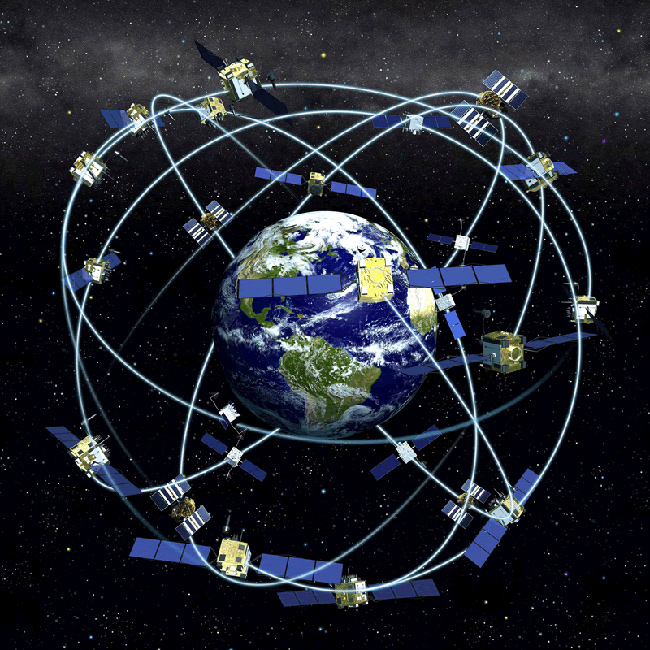 GPS satellites provide 3‑D position vectors for navigation (Image: U.S. Govt Source, Public domain, via Wikimedia Commons)
Based on the TU BCA syllabus for Mathematics I (CAMT104), unit 8.
Discussion
Loading…