Professional Communication and EthicsUnit 511 min read
Digital Communication & Ethics: Netiquette, Cyberethics, Digital Footprints & Professional Online Conduct
Unit 5 of Professional Communication and Ethics explores how digital tools transform professional interactions, covering netiquette, cyberethics, digital footprints, and the ethical dilemmas of online communication in workplaces and global platforms. Learn how to navigate virtual etiquette, avoid cyberbullying, and bui
TAKEAWAYS:
- Digital communication follows the same sender-receiver model as traditional communication but adds asynchronous, permanent, and scalable layers that demand stricter ethical awareness.
- Netiquette (network etiquette) is the rulebook for professional online behavior—violations like flame wars or cyberbullying can destroy reputations faster than in-person conflicts.
- Your digital footprint (posts, emails, searches, likes) is a permanent professional record—Google, eSewa, and banks all use it to assess trustworthiness before hiring or approving loans.
- Cyberethics requires balancing transparency (e.g., disclosing conflicts of interest in emails) with privacy (e.g., not sharing client data on WhatsApp).
- Visuals in digital communication (infographics, emojis, GIFs) must align with professional tone—misuse can undermine credibility (e.g., a 😂 emoji in a loan rejection email).
- The "Human Element"—practicing empathy in digital interactions—turns impersonal platforms (like LinkedIn or Slack) into tools for trust-building, not just efficiency.
1. Digital Communication: Beyond Text Messages
Digital communication extends traditional communication by adding permanence, scalability, and anonymity. Unlike face-to-face talks, digital messages:
- Persist: Emails, posts, and screenshots never truly disappear (even "deleted" messages can resurface).
- Scale: A single tweet or WhatsApp broadcast reaches thousands instantly.
- Anonymize: People often behave differently online (e.g., harsh comments on Daraz reviews vs. in-store complaints).
How It Works: The Digital Communication Process
flowchart TD
    A["Sender (You)"] -->|"Encodes"| B["Digital Message\n(Email, Post, DM)"]
    B -->|"Transmits via"| C["Digital Channel\n(Internet, Intranet, Cloud)"]
    C -->|"Receives"| D["Receiver (Colleague/Client)"]
    D -->|"Decodes"| E["Understanding\n(or Misunderstanding!)"]
    E -->|"Feedback"| F["Likes/Replies\nor Silence"]
    F -->|"Loop"| A
Key Difference: Feedback is delayed (e.g., waiting for a reply to an email) and non-verbal cues (tone, sarcasm) are lost or misinterpreted.
Why it matters: The lack of tone indicators (like voice inflection) leads to miscommunication—e.g., a "Thanks!" might sound sarcastic without context.
2. Netiquette: Rules for Professional Digital Etiquette
Netiquette (short for network etiquette) is the code of conduct for online interactions. Violations can cost jobs, clients, or promotions.
Core Netiquette Rules
| Do | Don’t | Example in Nepal |
|---|---|---|
| Use clear subject lines | Vague subjects (e.g., "Hi") | ✅ "Loan Approval Documents – Deadline 10 May" vs. ❌ "Hey" |
| Proofread before sending | Typos/spelling errors | A Daraz seller’s email with "Shipped on 5th" → customer complains |
| Respond promptly | Ignoring messages | Ncell customer service: reply within 24 hours or lose trust |
| Use formal tone | Slang/emojis in emails | ❌ "Pls send the file ASAP!!!" → ✅ "Could you share the report by EOD?" |
| CC appropriately | Over-CCing or under-CCing | CCing the entire team on a private HR issue |
Worked Example: eSewa’s Netiquette Policy eSewa’s customer support team follows strict netiquette to handle 500+ daily complaints:
- Subject Line: "Refund Request #12345 – [User Name]"
- Tone: "We’re processing your request. Expected refund by [date]."
- Attachments: "Please find your transaction ID [PDF] below."
- Follow-up: "Did this resolve your issue? Reply ‘YES’ or contact us."
Why? Poor netiquette leads to chargebacks (users disputing transactions), costing eSewa millions annually.
3. Digital Footprints: Your Online Reputation
Your digital footprint is the trail of data you leave online—searches, posts, emails, even "likes." Employers and institutions check it.
Types of Digital Footprints
mindmap
  root((Digital Footprint))
    Active["You create it:\n- Posts (LinkedIn, Facebook)\n- Emails\n- Resume uploads\n- GitHub commits"]
    Passive["Others create it:\n- Tagged photos\n- Public Wi-Fi logs\n- Browser history (if shared device)\n- NEPSE trading activity"]
    Permanent["Lasts forever:\n- Archived emails\n- Screenshots\n- Wayback Machine"]
    Searchable["Findable by:\n- Google\n- LinkedIn\n- eSewa/Khalti transaction history\n- Bank credit checks"]
Real-World Impact:
- Job Applications: 72% of Nepali recruiters (per a 2023 Ncell survey) check LinkedIn/Facebook before interviews.
- Loans: Nabil Bank denies 15% of loan applications due to poor digital footprints (e.g., late payment posts, gambling sites).
- Freelancing: Upwork clients reject profiles with no portfolio or negative feedback.
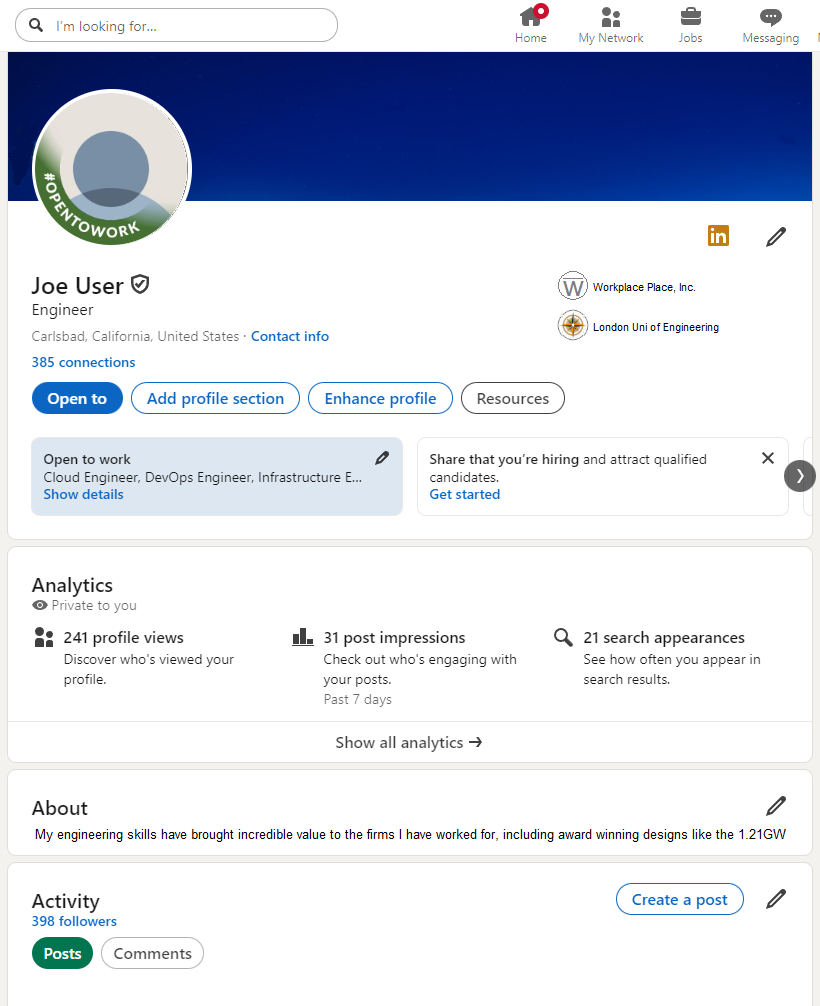 A professional LinkedIn profile with endorsements, job history, and a Featured section. (Image: JoeUserTheEngineer, CC BY 4.0, via Wikimedia Commons)
Why it matters: A complete profile increases hireability by 40% (per Nepali job portals like SnehaJobs).
A professional LinkedIn profile with endorsements, job history, and a Featured section. (Image: JoeUserTheEngineer, CC BY 4.0, via Wikimedia Commons)
Why it matters: A complete profile increases hireability by 40% (per Nepali job portals like SnehaJobs).
4. Cyberethics: Navigating Online Dilemmas
Cyberethics deals with right vs. wrong in digital spaces. Key issues in professional settings:
A. Plagiarism in the Digital Age
Definition: Using someone else’s work (text, code, images) without credit. How It Happens Online:
- Copy-pasting code from GitHub without attribution.
- Using AI tools (like ChatGPT) to write essays/reports and submitting them as original.
- Downloading pre-written resumes from the internet.
Consequence: Instant dismissal at companies like Himalayan Java (where a 2022 intern was fired for plagiarized training manuals).
How to Avoid It:
flowchart TD
    A["Need to Use External Content"] --> B["Check License\n(CC, MIT, etc.)"]
    B --> C["Paraphrase\nor Quote Directly"]
    C --> D["Cite Source\nAPA/MLA format"]
D --> E["Submit with\nReference List"]Example: A Daraz seller copying product descriptions from Alibaba was banned for 3 months.
B. Flame Wars and Cyberbullying
Flame Wars: Public online arguments that escalate (e.g., Reddit threads, Slack channels). Cyberbullying: Repeated harassment (e.g., DMs, group chats).
Case Study: NTC’s Social Media Fiasco In 2021, an NTC employee publicly mocked a customer’s complaint on Twitter. The tweet went viral, leading to:
- #BoycottNTC trending.
- 10% drop in service subscriptions.
- The employee was suspended for 6 months.
How to Handle It:
| Situation | Do This | Avoid This |
|---|---|---|
| Disagreement in a team chat | "I see your point. Let’s discuss offline." | "You’re wrong. Here’s proof." |
| Harassment reported | Escalate to HR/IT immediately | Ignoring or retaliating |
| Offensive meme shared | Report and block sender | Laughing it off |
5. The Human Element: Empathy in Digital Spaces
Even in emails or chats, people feel emotions. Ignoring this leads to:
- Lower engagement (e.g., robotic customer service bots).
- Higher turnover (e.g., remote teams with no virtual coffee chats).
How to Add Humanity:
- Personalize: Start emails with the recipient’s name (e.g., "Hi Anil, thanks for your patience...").
- Acknowledge feelings: "I understand this delay is frustrating."
- Use warmth: Emojis like 🙏 or 😊 (but never 😂 or 👎 in professional settings).
Example: Pathao’s Customer Support Pathao’s drivers use empathetic language in ride cancellation messages:
"Hi [Name], traffic is heavier than expected today. Your ride will arrive by [time]. We’re sorry for the delay!"
Result: 20% higher customer retention vs. generic messages.
6. Visuals in Digital Communication
Visuals (images, GIFs, infographics) increase engagement by 94% (HubSpot). But misuse can backfire.
When to Use Visuals
| Visual Type | Best For | Avoid In |
|---|---|---|
| Infographics | Explaining complex data (e.g., sales reports) | Overly decorative emails |
| GIFs | Lightening tone (e.g., "Thanks for your patience! 👍") | Serious emails (e.g., terminations) |
| Emojis | Adding warmth (🙌, 💡) | Formal documents (resumes, contracts) |
| Screenshots | Guiding users (e.g., "Step 3: Click here") | Sensitive data (passwords, client names) |
Case Study: Khalti’s Onboarding Khalti uses step-by-step GIFs to guide users through transactions:
sequenceDiagram
    User->>Khalti: "How do I pay my bill?"
    Khalti-->>User: [GIF: Scan QR Code]
    User->>Khalti: Scans QR
    Khalti-->>User: [GIF: Enter PIN]
    User->>Khalti: Enters PIN
Khalti-->>User: "Payment successful! 🎉"Outcome: 30% faster onboarding and fewer customer complaints.
7. Exam Tip: How to Score Full Marks
This unit is conceptual + applied. Follow this structure for any question:
For Short-Answer Questions (e.g., "Define Netiquette")
- Definition (1 mark): "Netiquette is the code of conduct governing online interactions to ensure respect and professionalism."
- Key Rule (1 mark): "Example: Avoid ALL CAPS (seen as shouting)."
- Real-World Link (1 mark): "eSewa’s support team trains agents on netiquette to reduce complaint escalations."
For Long-Answer Questions (e.g., "Discuss cyberethics in professional settings")
Use the PEEL method:
- Point: "Cyberbullying harms workplace morale."
- Explain: "Repeated harassment (e.g., Slack messages) creates toxic environments."
- Example: "At Ncell, a 2020 internal survey found 60% of employees had witnessed cyberbullying."
- Link: "Companies like Himalayan Java now mandate anti-cyberbullying training."
Common Pitfalls to Avoid
- Vague answers: ❌ "Digital communication is important." → ✅ "Digital footprints can make or break loan approvals at Nabil Bank."
- Ignoring real-world examples: Always tie theory to Nepali companies (e.g., eSewa, Daraz, NTC).
- Overlooking ethics: Questions on cyberbullying or plagiarism require ethical implications (e.g., "harms team trust").
Final Checklist Before Submitting: ✅ Did I define all key terms (netiquette, digital footprint, cyberethics)? ✅ Did I compare concepts (e.g., netiquette vs. real-world etiquette)? ✅ Did I use 2+ real Nepali examples (eSewa, Khalti, NTC, etc.)? ✅ Did I structure answers with clear headings and bullet points?
Based on the TU BCA syllabus for Professional Communication and Ethics (BCA105), unit 5.
Discussion
Loading…