Principle of ManagementUnit 820 min read
Environmental Analysis & Management Challenges: Tools, Trends & Case Studies
Unit 8 of Principle of Management explores how organizations analyze their external/internal environments (PESTEL, SWOT, Porter’s 5 Forces) to anticipate challenges like digital disruption, sustainability demands, and workforce shifts—with Nepali/global case studies (e.g., Ncell’s 5G rollout, Daraz’s supply chain crise
TAKEAWAYS:
- PESTEL breaks down macro-environmental factors (Political, Economic, Social, Technological, Environmental, Legal) into actionable insights for strategy.
- SWOT pairs internal strengths/weaknesses with external opportunities/threats—critical for startups like Pathao navigating ride-hailing regulations.
- Porter’s 5 Forces reveals industry competitiveness: NEPSE’s low threat of substitutes vs. Daraz’s high supplier bargaining power.
- Emerging challenges (AI ethics, climate risks, remote work) force managers to pivot—e.g., NTC’s fiber-optic expansion amid cybersecurity threats.
- Environmental scanning (continuous monitoring) turns threats into opportunities: Himalayan Java’s shift to organic coffee amid global sustainability trends.
- Case studies (e.g., Nabil Bank’s digital transformation) show how theory applies to real-world crises like COVID-19 or inflation.
1. Environmental Analysis: The Foundation of Strategic Decisions
Environmental analysis is the systematic process of identifying, evaluating, and interpreting external and internal factors that impact an organization’s performance. It acts as the compass for managers, helping them navigate uncertainties and align resources with opportunities.
Why It Matters
- Proactive vs. Reactive: Organizations that analyze their environment anticipate changes (e.g., Khalti preparing for CBDC regulations) rather than reacting to crises (e.g., NTC’s slow 5G adoption).
- Resource Allocation: Helps prioritize investments—e.g., Daraz focusing on logistics during monsoon season.
- Risk Mitigation: Identifies vulnerabilities—e.g., Nepal Rastra Bank monitoring inflation trends to adjust interest rates.
Types of Environments
| Environment | Scope | Key Factors | Example in Nepal |
|---|---|---|---|
| Macro (External) | Broad, uncontrollable | Political, Economic, Social, Technological, Environmental, Legal (PESTEL) | Political instability → NEPSE volatility |
| Micro (Internal) | Organization-specific | Strengths, Weaknesses, Opportunities, Threats (SWOT) | Pathao’s strong app UX vs. high driver costs |
| Industry | Competitive landscape | Porter’s 5 Forces (Rivalry, Suppliers, Buyers, Substitutes, New Entrants) | Ncell vs. NTC: Threat of new telecom players |
2. Tools for Environmental Analysis
A. PESTEL Analysis: Decoding the Macro-Environment
PESTEL is a framework to analyze external macro-factors that influence an organization’s strategy. It stands for:
- Political
- Economic
- Social
- Technological
- Environmental
- Legal
How It Works: A Case Study of Ncell
Let’s apply PESTEL to Ncell, Nepal’s largest telecom provider, as it plans its 5G rollout:
| Factor | Analysis for Ncell | Impact on Strategy |
|---|---|---|
| Political | Government’s push for digital Nepal, but slow bureaucracy in spectrum allocation. | Lobby for faster approvals; partner with local govts for tower installations. |
| Economic | High smartphone penetration (~80%) but low disposable income. | Offer affordable 5G plans; target rural areas with bundled services. |
| Social | Youth (18-35) drive tech adoption; rural areas lag. | Aggressive marketing in Kathmandu/Pokhara; digital literacy programs in villages. |
| Technological | 4G coverage at ~60%; 5G requires new infrastructure. | Invest in fiber backhaul; collaborate with Huawei for network upgrades. |
| Environmental | Earthquake risks damage infrastructure; climate change affects outdoor equipment. | Use earthquake-resistant towers; design for monsoon resilience. |
| Legal | Data privacy laws (PDPA 2018) restrict user data collection. | Transparent data policies; invest in cybersecurity to build trust. |
Worked Example: Daraz’s PESTEL During COVID-19 During the pandemic, Daraz (Alibaba’s Nepal arm) faced:
- Political: Lockdowns disrupted supply chains.
- Economic: Consumer spending dropped by 30%.
- Social: Shift to online shopping (opportunity).
- Technological: Demand for contactless delivery surged.
- Environmental: Waste from single-use packaging increased.
- Legal: E-commerce tax exemptions were extended. Action: Daraz launched "Daraz Mart" (essentials delivery) and partnered with Khalti for cash-on-delivery alternatives.
B. SWOT Analysis: Internal vs. External Forces
SWOT combines internal (Strengths, Weaknesses) and external (Opportunities, Threats) factors to create a strategic roadmap.
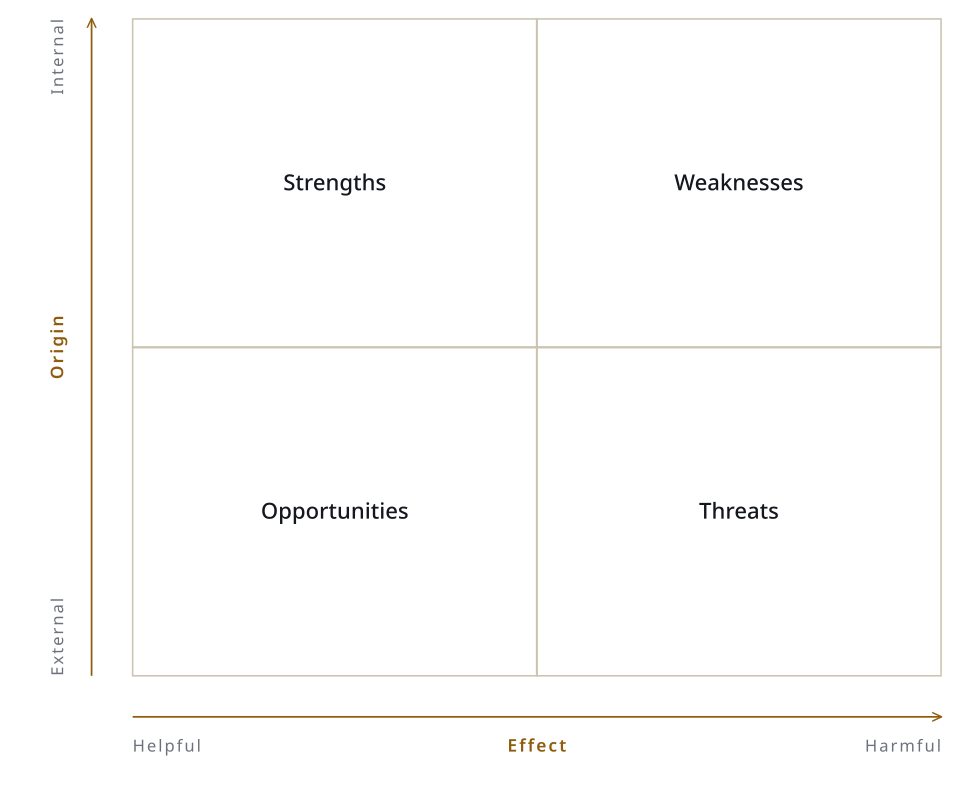 A 2x2 grid with Strengths (top-left), Weaknesses (top-right), Opportunities (bottom-left), Threats (bottom-right). (Image: Peter Gladdish, CC BY 4.0, via Wikimedia Commons)
How to Conduct a SWOT Analysis
- List Strengths: Unique advantages (e.g., Nabil Bank’s strong digital banking platform).
- List Weaknesses: Internal limitations (e.g., NTC’s slow customer service).
- List Opportunities: External trends to exploit (e.g., eSewa’s fintech boom).
- List Threats: External risks (e.g., Daraz’s competition from local e-commerce sites).
Worked Example: Himalayan Java’s SWOT
| Category | Factors |
|---|---|
| Strengths | Organic certification, direct farmer partnerships, strong brand in Europe. |
| Weaknesses | High production costs, limited processing infrastructure. |
| Opportunities | Global demand for sustainable coffee, potential for vertical integration (roasting in Nepal). |
| Threats | Climate change (affects yield), competition from Vietnamese coffee. |
Strategic Actions:
- SO Strategy: Leverage organic certification to enter Starbucks’ sustainable supply chain.
- WO Strategy: Partner with Nepal Investment Bank for low-interest loans to expand processing.
- OT Strategy: Capitalize on EU subsidies for organic farmers.
- WT Strategy: Diversify crops (e.g., macadamia) to hedge against coffee price volatility.
C. Porter’s 5 Forces: Understanding Industry Competition
Developed by Michael Porter, this model assesses industry attractiveness by analyzing:
- Threat of New Entrants (Barriers to entry).
- Bargaining Power of Suppliers.
- Bargaining Power of Buyers.
- Threat of Substitutes.
- Rivalry Among Existing Competitors.
Worked Example: Nepal’s Telecom Industry (Ncell vs. NTC)
| Force | Analysis for Ncell/NTC | Impact |
|---|---|---|
| New Entrants | High capital costs for spectrum licenses; government limits foreign ownership. | Low threat (but Smart Telecom entered in 2022). |
| Suppliers | Few global vendors (Huawei, Ericsson); high switching costs. | High bargaining power → Ncell/NTC locked into long-term contracts. |
| Buyers | Consumers have low switching costs (prepaid plans). | High bargaining power → Price wars (e.g., "Happy Hours" promotions). |
| Substitutes | Limited (VoIP like WhatsApp calls, but data costs are high). | Low threat. |
| Rivalry | Intense price competition; Ncell (40% market share) vs. NTC (35%). | High rivalry → Aggressive marketing (e.g., free data offers). |
Strategic Insight:
- Ncell focuses on premium services (5G, IoT) to reduce price sensitivity.
- NTC targets rural areas where Ncell’s coverage is weak.
3. Emerging Challenges in Management
Modern managers face disruptive challenges that require agile strategies:
A. Technological Disruption
AI and Automation: Khalti uses AI for fraud detection; Daraz automates warehouse sorting.
Cybersecurity Threats: Nepal Rastra Bank faced ransomware attacks in 2022.
Digital Divide: NTC struggles with last-mile connectivity in remote areas.
Customer["User"] --> Chatbot["AI Chatbot"] --> Database["Order History"] Chatbot --> HumanAgent["Support Agent"] (if escalated) HumanAgent --> CRM["Customer Database"]**
B. Sustainability and ESG Pressures
- Environmental: Himalayan Java faces pressure to reduce water usage in processing.
- Social: Pathao must ensure driver welfare amid gig economy regulations.
- Governance: NEPSE’s transparency is scrutinized post-2023 market crash.
C. Workforce and Remote Work Trends
- Hybrid Work Models: Nabil Bank allows 3 days/week remote work.
- Skill Gaps: IT firms struggle to find cybersecurity talent.
- Employee Well-being: Daraz introduced mental health support during pandemic.
D. Economic and Political Instability
- Inflation: Nepal’s 8% inflation (2023) increased operational costs for eSewa.
- Regulatory Changes: PDPA 2018 forced Khalti to overhaul data policies.
4. Environmental Scanning: The Continuous Process
Environmental scanning is not a one-time task but an ongoing cycle of monitoring, evaluating, and adapting. It involves:
- Data Collection: Gather info from reports, surveys, social media, and competitors.
- Analysis: Use tools like PESTEL/SWOT to interpret data.
- Forecasting: Predict trends (e.g., NTC forecasting 5G adoption growth).
- Decision-Making: Adjust strategies (e.g., Daraz shifting to local suppliers post-COVID).
- Implementation: Execute changes (e.g., Nabil Bank launching fintech partnerships).
- Feedback Loop: Monitor results and repeat.
flowchart TD
    A["Start"] --> B["Data Collection\n(Sources: Reports, Social Media, Competitors)"]
    B --> C["Analysis\n(PESTEL, SWOT, Porter’s 5 Forces)"]
    C --> D["Forecasting\n(Trend Projection)"]
    D --> E["Decision-Making\n(Strategic Adjustments)"]
    E --> F["Implementation\n(Policies, Products, Processes)"]
    F --> G["Monitor & Evaluate\n(KPIs, Feedback)"]
    G -->|"Loop"| B
5. Case Study: Nabil Bank’s Digital Transformation
Background: Nepal’s oldest bank (1989) faced challenges from fintech startups (eSewa, Khalti) and low digital adoption.
Environmental Analysis
| Tool | Findings |
|---|---|
| PESTEL | Technological: Low digital banking penetration (30%). Legal: PDPA 2018 required data security upgrades. |
| SWOT | Strengths: Strong brand trust. Weaknesses: Outdated core banking system. Opportunities: Govt. push for digital payments. Threats: Cyberattacks. |
| Porter’s 5F | Rivalry: High (competing with NMB, Global IME). Substitutes: Low (fintech still niche). |
Strategic Response
- Partnerships: Collaborated with Khalti for UPI integration.
- Tech Upgrade: Invested $5M in a new core banking system (2022).
- Customer-Centric: Launched "Nabil eBanking" with biometric login.
- Risk Mitigation: Hired 100 cybersecurity experts.
Outcome
- Digital customers grew by 120% in 2 years.
- Reduced fraud by 40% via AI monitoring.
- Market share stabilized despite fintech competition.
6. Common Challenges in Environmental Analysis
| Challenge | Cause | Solution |
|---|---|---|
| Information Overload | Too much data from multiple sources. | Use AI tools (e.g., Google Trends, Tableau) for filtering. |
| Bias in Interpretation | Managers may ignore unfavorable data. | Cross-functional teams for objective analysis. |
| Rapid Change | Tech/social trends evolve quickly (e.g., TikTok disrupting marketing). | Agile scanning: Monthly reviews instead of annual. |
| Resource Constraints | Small businesses lack budgets for analysis. | Low-cost tools: Free PESTEL templates, government reports (e.g., NPC). |
| Global vs. Local Focus | Multinationals (e.g., Daraz) must balance global trends with local needs. | Hybrid approach: Global PESTEL + local SWOT. |
## In the Real World
eSewa’s Fraud Detection (AI + Environmental Scanning)
- Idea Used: Technological (PESTEL) + Risk Analysis (SWOT)
- How: eSewa uses machine learning to flag fraudulent transactions in real-time. Their environmental scan identified:
- Opportunity: Govt. push for digital payments.
- Threat: Rising cybercrime (e.g., 2021 hack costing $500K).
- Action: Partnered with Mastercard for secure transactions and hired ethical hackers to test vulnerabilities.
Daraz’s Supply Chain Crisis (Porter’s 5 Forces + SWOT)
- Idea Used: Supplier Power (Porter’s 5F) + Weaknesses (SWOT)
- How: During COVID-19, 80% of Daraz’s suppliers were in China, causing delays.
- Analysis:
- Threat: Supplier dependency → High bargaining power.
- Weakness: Lack of local suppliers.
- Action: Shifted 30% of sourcing to Nepal/India (e.g., Himalayan Drugs for medicines).
NTC’s 5G Delay (PESTEL + Political Risks)
- Idea Used: Political (PESTEL) + Threats (SWOT)
- How: NTC’s 5G rollout was delayed by 2 years due to:
- Political: Spectrum allocation disputes.
- Legal: Data localization laws.
- Result: Lost $100M in potential revenue to Ncell’s faster 5G launch.
## Exam Tip: How to Score Full Marks
- Define Clearly: Start with precise definitions (e.g., "Environmental analysis is a systematic process of scanning both internal and external environments to identify opportunities and threats").
- Use Frameworks: Always apply PESTEL/SWOT/Porter’s 5F—examiners love structured answers.
- Example: For "Challenges in tech-based orgs", use:
- PESTEL: Technological (AI disruption) + Legal (data privacy laws).
- SWOT: Weakness (high R&D costs) + Threat (cybersecurity risks).
- Example: For "Challenges in tech-based orgs", use:
- Nepali Examples: Link theory to local companies (e.g., Ncell’s 5G, Daraz’s logistics).
- Diagrams: Draw 1-2 diagrams per answer (e.g., SWOT matrix, Porter’s 5 Forces).
- Case Studies: Mention real scenarios (e.g., "Like Nabil Bank, managers must balance digital transformation with cybersecurity risks").
- Avoid Vague Statements: ❌ "Managers should adapt." ✅ "Like Pathao, managers must use agile workforce policies to handle driver shortages during peak seasons."
## Practice Questions (Exam-Style)
Short Answer (5 marks) "Explain how PESTEL analysis helps a startup like Pathao in Nepal." Structure:
- Define PESTEL.
- Apply to Pathao:
- Political: Traffic regulations (e.g., electric vehicle mandates).
- Economic: Rising fuel costs → Higher driver payouts.
- Social: Youth preference for app-based rides.
- Technological: Need for real-time GPS tracking.
- Environmental: Govt. incentives for EV adoption.
- Legal: Data privacy laws for rider/driver data.
- Conclusion: Helps Pathao anticipate risks (e.g., fuel price hikes) and seize opportunities (e.g., EV partnerships).
Long Answer (10 marks) "A newly established e-commerce company in Nepal is facing intense competition from Daraz. Using Porter’s 5 Forces and SWOT, analyze the challenges and suggest strategies." Structure:
- Introduction: Briefly define Porter’s 5F and SWOT.
- Porter’s 5 Forces Analysis (Table format):
Force Analysis New Entrants High (low capital barriers, but Daraz’s brand dominance). Supplier Power Moderate (many small vendors, but Daraz has long-term contracts). Buyer Power High (price-sensitive consumers). Substitutes Low (limited offline alternatives). Rivalry Intense (Daraz has 70% market share). - SWOT Analysis (Table format):
Category Factors Strengths Niche products (e.g., handmade crafts), strong social media presence. Weaknesses Limited logistics network, high customer acquisition cost. Opportunities Govt. push for local e-commerce, untapped rural markets. Threats Daraz’s aggressive pricing, cybersecurity risks. - Strategies:
- Differentiation: Focus on local artisans (e.g., Thamel’s handicrafts).
- Partnerships: Collaborate with NTC for last-mile delivery.
- Digital Marketing: Leverage YouTube/TikTok for viral campaigns.
- Conclusion: Emphasize agility and niche targeting to compete with Daraz.
## Key Formulas and Checklists
| Tool | Quick Checklist |
|---|---|
| PESTEL | 1. Political stability? 2. Economic growth rate? 3. Social trends? 4. Tech advancements? 5. Environmental regulations? 6. Legal changes? |
| SWOT | 1. What do we do better than competitors? (Strengths) 2. What do we lack? (Weaknesses) 3. What external trends help us? (Opportunities) 4. What external threats exist? |
| Porter’s 5F | 1. How easy is it for new firms to enter? 2. Do suppliers have leverage? 3. Do buyers dictate terms? 4. Are substitutes available? 5. How fierce is competition? |
## Summary Mindmap
mindmap
  root((Environmental Analysis))
    Definition
      "Systematic scanning of internal/external factors"
    Tools
      PESTEL
        Political
        Economic
        Social
        Technological
        Environmental
        Legal
      SWOT
        Strengths
        Weaknesses
        Opportunities
        Threats
      Porter's 5 Forces
        New Entrants
        Suppliers
        Buyers
        Substitutes
        Rivalry
    Challenges
      Tech Disruption
      Sustainability
      Workforce Shifts
      Economic Instability
    Case Studies
      Ncell 5G
      Daraz Supply Chain
      Nabil Bank Digital
    Exam Tips
      Use frameworks
      Local examples
      Diagrams
Based on the TU BCA syllabus for Principle of Management (BCA156), unit 8.
Discussion
Loading…