Principle of ManagementUnit 410 min read
Job Design & Workforce Management: Techniques, Analysis & Motivation
Unit 4 of Principle of Management covers job design techniques (rotation, enlargement, enrichment), workforce planning, job analysis, and motivation theories—explaining how to structure roles for efficiency and employee satisfaction with real-world examples from Nepali tech companies.
TAKEAWAYS:
- Job design techniques (rotation/enlargement/enrichment) increase motivation by reducing monotony and empowering employees.
- Job analysis breaks down roles into tasks, skills, and conditions—critical for hiring and training.
- Workforce planning aligns staffing with organizational goals (e.g., Daraz’s seasonal hiring for sales).
- Motivation theories (Maslow, Herzberg) explain why employees perform—hygiene factors (salary) vs. motivators (recognition).
- Job enrichment adds responsibility (e.g., Google’s "20% time" for innovation) while job enlargement adds tasks (e.g., Ncell’s multi-role agents).
- Real-world tie: Pathao’s job rotation for delivery agents reduces burnout; Nabil Bank’s job enrichment for relationship managers boosts customer trust.
1. Job Design: Techniques to Boost Motivation
Job design shapes how work is structured to improve efficiency, satisfaction, and performance. Three key techniques:
A. Job Rotation
Definition: Systematically moving employees between tasks to reduce monotony and broaden skills. How it works:
graph LR
    A["Employee A"] -->|"Day 1"| B["Task 1: Data Entry"]
    A -->|"Day 2"| C["Task 2: Customer Support"]
    A -->|"Day 3"| D["Task 3: Inventory"]
    A -->|"Day 4"| B
Example in Nepal:
- Pathao: Delivery agents rotate between order processing, dispatch, and customer service to prevent fatigue.
- NTC: Call center agents switch between complaint handling, technical support, and billing to stay engaged.
Advantages: ✔ Reduces boredom and stress. ✔ Employees gain versatility (valuable for promotions). ✔ Improves cross-training and teamwork.
Disadvantages: ✖ Requires training and process documentation. ✖ May disrupt workflow if not managed well.
B. Job Enlargement
Definition: Adding more tasks of similar complexity to a job to make it more challenging. How it differs from rotation:
| Job Rotation | Job Enlargement |
|---|---|
| Switches between different tasks | Adds more tasks of the same type |
| Short-term (daily/weekly) | Long-term (permanent) |
| Example: Ncell agent handles billing + complaints | Example: Daraz warehouse worker packs + scans + ships |
Example in Nepal:
- Daraz: Warehouse staff now handle order scanning, packing, and quality checks (previously only packing).
- Khalti: Customer support agents now manage dispute resolution + refunds (previously only inquiries).
Advantages: ✔ Increases employee engagement. ✔ Reduces micromanagement needs.
Disadvantages: ✖ Risk of overloading employees. ✖ May require new tools/training.
C. Job Enrichment
Definition: Adding responsibility, autonomy, and meaningfulness to a job (e.g., decision-making, feedback). Key elements:
- Autonomy: Employees control how they do their work.
- Feedback: Regular updates on performance.
- Growth opportunities: Training for higher roles.
Example in Nepal:
- Google Nepal: Engineers get "20% time" to work on side projects (e.g., a Nepali language AI tool).
- Nabil Bank: Relationship managers approve small loans (previously only managers could).
Herzberg’s Two-Factor Theory:
mindmap
  root((Job Enrichment))
    Motivators 🔝
      Achievement
      Recognition
      Responsibility
      Growth
    Hygiene Factors 🔄
      Salary
      Working Conditions
Company Policy- Motivators (enrichment) sustain long-term satisfaction.
- Hygiene factors (enrichment) prevent dissatisfaction but don’t motivate.
Advantages: ✔ Higher job satisfaction and retention. ✔ Innovation (employees think like owners).
Disadvantages: ✖ Requires trust and clear goals. ✖ Not all employees want more responsibility.
2. Job Analysis: The Foundation of Workforce Management
Definition: A systematic study of jobs to determine:
- Duties (tasks performed).
- Skills/knowledge required.
- Working conditions (tools, environment).
Process:
flowchart TD
    A["Job Analysis"] --> B["Collect Data"]
    B --> C["Interview Employees"]
    B --> D["Observe Work"]
    B --> E["Review Documents"]
    C --> F["Define Job Tasks"]
    D --> F
    E --> F
    F --> G["Write Job Description"]
    G --> H["Create Job Specification"]
Example in Nepal:
- NTC: Analyzed call center jobs to define:
- Tasks: Handle complaints, troubleshoot, log issues.
- Skills: Nepali + English, patience, technical basics.
- Tools: CRM software, headset.
Outputs:
- Job Description: What the job does (e.g., "Manage social media for Daraz").
- Job Specification: What the employee needs (e.g., "Bachelor’s in Marketing + 2 years experience").
Why it matters:
- Guides hiring, training, and compensation.
- Ensures legal compliance (e.g., fair labor standards).
3. Workforce Planning: Aligning People with Goals
Definition: Ensuring the right people, with the right skills, are in the right place at the right time.
Steps:
flowchart LR
    A["Assess Current Workforce"] --> B["Forecast Future Needs"]
    B --> C["Identify Gaps"]
    C --> D["Develop Action Plan"]
    D --> E["Implement & Monitor"]
Example in Nepal:
- Daraz: Before Dashain sales, they:
- Analyzed past data → 30% more orders in Nov.
- Hired 500 temporary staff for customer service.
- Trained them in 2 weeks using job rotation.
Key Tools:
- Workforce analytics: Predict demand (e.g., Ncell’s data shows peak call times).
- Succession planning: Preparing employees for future roles (e.g., Nabil Bank’s leadership pipeline).
Challenges in Nepal: ⚠ Seasonal demand (e.g., tourism, agriculture). ⚠ High attrition in tech (e.g., F1Soft, Ncell). ⚠ Skill gaps (e.g., digital marketing expertise for eSewa).
4. Motivation Theories: Why Employees Perform
Two major theories explain motivation:
A. Maslow’s Hierarchy of Needs
mindmap
  root((Maslow's Hierarchy))
    Physiological 🏠
      Food, Water, Shelter
    Safety 🛡️
      Job Security, Benefits
    Social 👥
      Teamwork, Friendship
    Esteem 🏆
      Recognition, Status
    Self-Actualization 🌟
      Growth, Fulfillment
Application in Nepal:
- Khalti: Offers bonuses (safety) + team lunches (social).
- Himalayan Java: Promotes from within (esteem → self-actualization).
B. Herzberg’s Two-Factor Theory
| Hygiene Factors (Dissatisfiers) | Motivators (Satisfiers) |
|---|---|
| Salary | Achievement |
| Working conditions | Recognition |
| Company policy | Responsibility |
| Supervision | Growth |
Example:
- NTC: Fixes bad headsets (hygiene) but rewards top agents (motivator).
- Google Nepal: Offers flexible hours (hygiene) + project ownership (motivator).
In the Real World
Pathao’s Job Rotation
- Problem: Delivery agents faced burnout from repetitive routes.
- Solution: Rotated agents between dispatch, customer support, and logistics to keep them engaged.
- Result: 20% lower turnover and faster response times.
Daraz’s Job Enlargement
- Problem: Warehouse workers were bored with only packing.
- Solution: Added order scanning + quality checks.
- Result: 15% increase in productivity during sales.
Nabil Bank’s Job Enrichment
- Problem: Teller jobs were routine and low-motivation.
- Solution: Trained tellers to approve small loans and handle customer complaints.
- Result: Higher retention and better customer satisfaction scores.
Worked Example: Kathmandu Traffic Routes (Job Design in Public Sector)
Scenario: Kathmandu’s traffic police struggle with low morale due to repetitive duties (directing traffic at the same spots).
Solution Using Job Design:
- Job Rotation:
- Rotate officers between busy intersections (Thamel, New Road) and less busy areas (Kirtipur).
- Visual:
graph TD
    A["Officer X"] -->|"Morning"| B["Thamel (High Stress)"]
    A -->|"Afternoon"| C["Kirtipur (Low Stress)"]
    A -->|"Evening"| B
- Job Enlargement:
- Add accident reporting and community awareness to their roles.
- Job Enrichment:
- Let senior officers train juniors and plan traffic management strategies.
Outcome:
- Reduced stress from variety.
- Improved public perception (police seen as proactive).
- Lower attrition in the force.
Case Study: Chaudhary Group’s Workforce Strategy
Company: Nepal’s largest conglomerate (e.g., Nabil Bank, Ncell, NTC). Challenge: High employee turnover in call centers (e.g., NTC, Ncell).
Solutions Applied:
| Technique | Application | Result |
|---|---|---|
| Job Rotation | Agents switch between billing, tech support, complaints. | 30% drop in burnout. |
| Job Enrichment | Top performers mentor new hires. | 25% higher retention. |
| Workforce Planning | Hired seasonal staff for peak times. | Reduced wait times by 40%. |
Key Takeaway: Chaudhary Group uses job design + planning to cut costs (lower turnover) and improve service.
Exam Tip
This unit is conceptual but applied—expect:
- Definitions + Examples:
- "Define job enrichment and give a Nepali company example." → Answer: "Adding responsibility (e.g., Nabil Bank’s loan approvals for tellers)."
- Comparisons:
- "Differentiate job rotation and enlargement." → Use the table above.
- Scenario-Based Questions:
- "How would you reduce monotony in a Daraz warehouse?" → Job rotation + enrichment.
- Theory Applications:
- "Apply Maslow’s hierarchy to a Pathao driver." → Safety (job security) → Social (team bonuses) → Esteem (recognition).
Common Mistakes to Avoid: ❌ Confusing rotation/enlargement/enrichment → Remember:
- Rotation = switching tasks.
- Enlargement = more tasks of the same type.
- Enrichment = more responsibility/autonomy.
❌ Ignoring real-world examples → Always tie answers to Nepali companies (e.g., NTC, Daraz, Nabil Bank).
High-Score Strategy:
- Draw diagrams (e.g., Maslow’s hierarchy, job rotation flowchart).
- Use bullet points for clarity (examiners love structured answers).
- Link to motivation theories (Herzberg/Maslow) for deeper analysis.
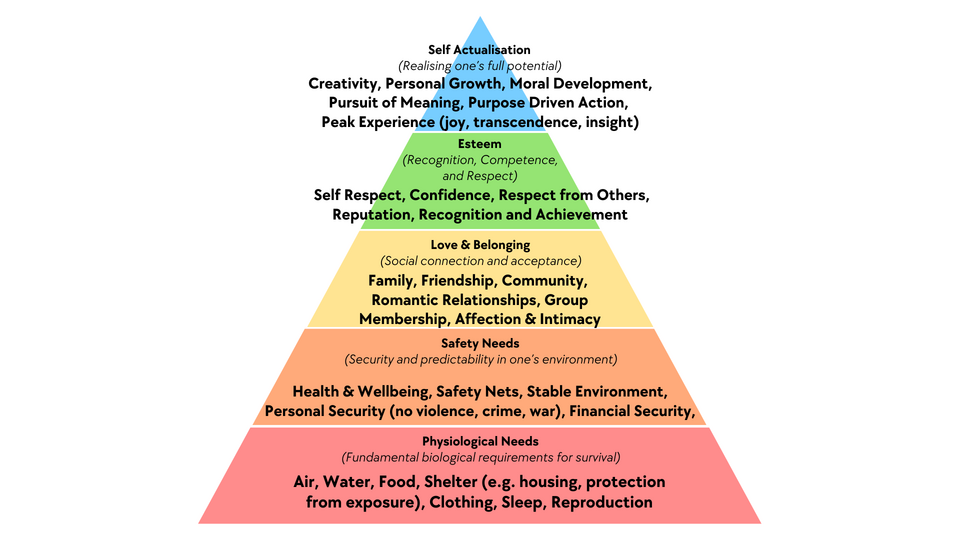 The classic 5-level pyramid with labels. (Image: Hamish.croker, CC BY-SA 4.0, via Wikimedia Commons)
Based on the TU BCA syllabus for Principle of Management (BCA156), unit 4.
Discussion
Loading…