Data Structures And AlgorithmsUnit 421 min read
Stacks & Queues: ADTs, Operations, Applications & Real-World Use
Unit 4 of Data Structures And Algorithms covers stacks and queues as Abstract Data Types (ADTs), their operations (push/pop/enqueue/dequeue), implementations (arrays/linked lists), applications (expression evaluation, scheduling), and real-world parallels in apps like eSewa, Pathao, and Ncell. Includes algorithm traces
TAKEAWAYS:
- Stacks follow LIFO (Last-In-First-Out) and are used for undo operations, expression evaluation, and recursion.
- Queues follow FIFO (First-In-First-Out) and model real-world waiting systems like order processing (Daraz) or traffic queues.
- Circular queues and priority queues optimize memory and scheduling for specific use cases.
- Postfix evaluation and infix-to-postfix conversion rely on stack operations and operator precedence.
- Linked-list implementations of stacks/queues avoid resizing overhead but use extra memory for pointers.
- Time complexity of stack/queue operations is O(1) for push/pop/enqueue/dequeue (amortized for dynamic arrays).
Core Concepts: Stacks and Queues as ADTs
What is an Abstract Data Type (ADT)?
An ADT defines a data structure’s behavior (operations) without specifying its implementation (how it’s stored). For example:
- A stack ADT specifies
push()andpop()but doesn’t say whether it uses an array or linked list. - A queue ADT specifies
enqueue()anddequeue()but hides the underlying data structure.
Why ADTs matter in exams:
- Questions often ask: "Why is a stack considered an ADT?" → Answer: Because it hides implementation details and exposes only essential operations.
- Visual analogy:
Stacks: LIFO Operations and Applications
Definition and Operations
A stack is a linear data structure that follows Last-In-First-Out (LIFO). Key operations:
| Operation | Description | Time Complexity |
|---|---|---|
push(x) |
Adds x to the top of the stack. |
O(1) |
pop() |
Removes and returns the top item. | O(1) |
peek() |
Returns the top item without removal. | O(1) |
isEmpty() |
Checks if the stack is empty. | O(1) |
Visualization: Stack Operations

- Push: Adds to the top.
- Pop: Removes from the top.
- Peek: Looks at the top without removing.
Implementations: Arrays vs. Linked Lists
1. Array Implementation
- Pros: Fast access, cache-friendly.
- Cons: Fixed size (unless dynamic resizing is used),
push()may require shifting elements. - Example (C++):
Trace for#include <iostream> using namespace std; const int MAX = 100; int stack[MAX]; int top = -1; // Stack is empty initially void push(int x) { if (top == MAX - 1) cout << "Stack Overflow!" << endl; else stack[++top] = x; } int pop() { if (top == -1) { cout << "Stack Underflow!" << endl; return -1; } return stack[top--]; }push(5),push(3),pop():Step topStack (array indices) Init -1 [ , , , ... ] Push 5 0 [5, , , ... ] Push 3 1 [5, 3, , ... ] Pop 0 [5, , , ... ] (returns 3)
2. Linked List Implementation
- Pros: Dynamic size, no resizing overhead.
- Cons: Extra memory for pointers.
- Example (C++):
Visualization: Linked List Stack Afterstruct Node { int data; Node* next; }; Node* top = NULL; void push(int x) { Node* newNode = new Node(); newNode->data = x; newNode->next = top; top = newNode; } int pop() { if (top == NULL) { cout << "Stack Underflow!" << endl; return -1; } Node* temp = top; int val = temp->data; top = top->next; delete temp; return val; }push(5),push(3)
Applications of Stacks
| Application | Example (Nepal/Global) | How Stack is Used |
|---|---|---|
| Undo/Redo Operations | MS Word, Google Docs | Stack stores actions; pop() undoes last. |
| Expression Evaluation | eSewa’s transaction validation | Postfix evaluation uses stack (see below). |
| Function Call Stack | Recursion in programs | Call stack tracks function calls. |
| Browser History | Back/Forward buttons in Chrome | Stack of visited pages. |
| Syntax Parsing | Compilers (e.g., C++/Java parsers) | Checks balanced parentheses/brackets. |
In the Real World
eSewa’s Transaction Processing
- When you pay a bill via eSewa, the app uses a stack to validate the transaction steps:
- Each step (e.g., "check balance," "deduct amount," "send confirmation") is pushed onto a stack.
- If any step fails (e.g., insufficient balance), the stack is popped to revert previous steps (undo).
- Worked Example: If you try to pay ₹500 but only have ₹300, eSewa’s stack rolls back all actions after detecting the error.
- When you pay a bill via eSewa, the app uses a stack to validate the transaction steps:
Pathao’s Ride Order Queue
- Pathao uses a priority queue (a variant of queue) to assign drivers to rides:
- Nearest available driver is dequeued first (FIFO-like but prioritized by distance).
- If no driver is free, new orders wait in the queue until a driver becomes available.
- Visualization: Pathao’s Driver Assignment Queue
- Pathao uses a priority queue (a variant of queue) to assign drivers to rides:
Ncell’s Call Waiting System
- When you’re on a call and another call comes in, Ncell uses a stack to handle the second call:
- The new call is "pushed" into a waiting stack.
- If you end the first call, the most recent (top of stack) call is "popped" and connected immediately.
- Trace:
- You’re on Call A → Call B comes in → stack = [A, B].
- You end Call A → pop() connects Call B.
- When you’re on a call and another call comes in, Ncell uses a stack to handle the second call:
Postfix Evaluation and Infix-to-Postfix Conversion
Why Postfix?
- Postfix notation (e.g.,
3 4 +) eliminates parentheses and operator precedence issues. - Used in calculators (e.g., HP calculators) and compilers.
Algorithm: Infix to Postfix (Shunting-Yard)
Steps:
- Initialize an empty stack for operators and an empty list for output.
- For each token in infix expression:
- If operand → add to output.
- If operator:
- While stack top has higher or equal precedence → pop to output.
- Push current operator to stack.
- If
(→ push to stack. - If
)→ pop from stack to output until(is encountered.
- Pop all remaining operators from stack to output.
Precedence Rules:
| Operator | Precedence |
|---|---|
^ |
4 |
*, / |
3 |
+, - |
2 |
( |
1 |
Example: Convert (A + B) * C - D to Postfix
Code Implementation (C++):
#include <stack>
#include <string>
#include <unordered_map>

int precedence(char op) {
    static unordered_map<char, int> prec = {{'+', 2}, {'-', 2}, {'*', 3}, {'/', 3}, {'^', 4}};
    return prec[op];
}

string infixToPostfix(string infix) {
    stack<char> opStack;
    string postfix;
    for (char c : infix) {
        if (isalnum(c)) postfix += c;
        else if (c == '(') opStack.push(c);
        else if (c == ')') {
            while (!opStack.empty() && opStack.top() != '(') {
                postfix += opStack.top();
                opStack.pop();
            }
            opStack.pop(); // Remove '('
        } else { // Operator
            while (!opStack.empty() && precedence(opStack.top()) >= precedence(c)) {
                postfix += opStack.top();
                opStack.pop();
            }
            opStack.push(c);
        }
    }
    while (!opStack.empty()) {
        postfix += opStack.top();
        opStack.pop();
    }
    return postfix;
}
Trace for (A + B) * C - D:
| Step | Token | Stack | Output |
|---|---|---|---|
| 1 | ( | [(] | |
| 2 | A | [(] | A |
| 3 | + | [(, +] | A |
| 4 | B | [(, +] | A B |
| 5 | ) | [] | A B + |
| 6 | * | [*] | A B + |
| 7 | C | [*] | A B + C |
| 8 | - | [-, *] | A B + C * |
| 9 | D | [] | A B + C * D - |
Evaluating Postfix Expressions
Algorithm:
- Initialize an empty stack.
- For each token in postfix expression:
- If operand → push to stack.
- If operator → pop top 2 operands, apply operator, push result.
- Final result is the only item left in the stack.
Example: Evaluate 3 4 + 2 *
Code Implementation (C++):
#include <stack>
#include <string>
#include <cctype>

int evaluatePostfix(string postfix) {
    stack<int> valStack;
    for (char c : postfix) {
        if (isdigit(c)) valStack.push(c - '0');
        else {
            int b = valStack.top(); valStack.pop();
            int a = valStack.top(); valStack.pop();
            switch (c) {
                case '+': valStack.push(a + b); break;
                case '-': valStack.push(a - b); break;
                case '*': valStack.push(a * b); break;
                case '/': valStack.push(a / b); break;
            }
        }
    }
    return valStack.top();
}
Trace for 4 5 + 7 3 - 2 + * (Exam Question):
| Step | Token | Stack | Operation |
|---|---|---|---|
| 1 | 4 | [4] | Push 4 |
| 2 | 5 | [4, 5] | Push 5 |
| 3 | + | [9] | 4 + 5 = 9 |
| 4 | 7 | [9, 7] | Push 7 |
| 5 | 3 | [9, 7, 3] | Push 3 |
| 6 | - | [9, 4] | 7 - 3 = 4 |
| 7 | 2 | [9, 4, 2] | Push 2 |
| 8 | + | [9, 6] | 4 + 2 = 6 |
| 9 | * | [54] | 9 * 6 = 54 |
| Result | 54 |
Queues: FIFO Operations and Variants
Definition and Operations
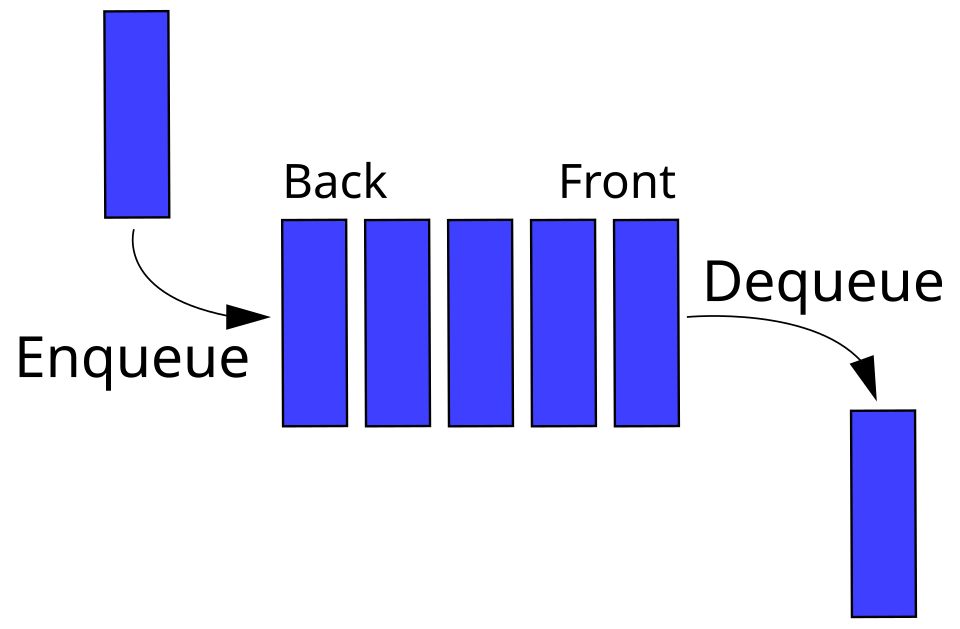
A queue follows First-In-First-Out (FIFO). Key operations:
| Operation | Description | Time Complexity |
|---|---|---|
enqueue(x) |
Adds x to the rear of the queue. |
O(1) |
dequeue() |
Removes and returns the front item. | O(1) |
peek() |
Returns the front item without removal. | O(1) |
isEmpty() |
Checks if the queue is empty. | O(1) |
Visualization: Queue Operations
Implementations: Arrays vs. Linked Lists
1. Array Implementation
- Problem: Fixed size → circular queue is used to reuse space.
- Example (Circular Queue):
Trace for#include <iostream> using namespace std; const int MAX = 5; int queue[MAX]; int front = -1, rear = -1; void enqueue(int x) { if ((rear + 1) % MAX == front) cout << "Queue Overflow!" << endl; else { if (front == -1) front = 0; rear = (rear + 1) % MAX; queue[rear] = x; } } int dequeue() { if (front == -1) { cout << "Queue Underflow!" << endl; return -1; } int val = queue[front]; if (front == rear) front = rear = -1; // Queue becomes empty else front = (front + 1) % MAX; return val; }enqueue(1),enqueue(2),dequeue():Step frontrearQueue (indices) Init -1 -1 [ , , , , ] Enqueue 1 0 0 [1, , , , ] Enqueue 2 0 1 [1, 2, , , ] Dequeue 1 1 [ , 2, , , ] (returns 1)
2. Linked List Implementation
- Pros: Dynamic size, no circular logic needed.
- Example (C++):
Visualization: Linked List Queue Afterstruct Node { int data; Node* next; }; Node* front = NULL, *rear = NULL; void enqueue(int x) { Node* newNode = new Node(); newNode->data = x; newNode->next = NULL; if (rear == NULL) front = rear = newNode; else { rear->next = newNode; rear = newNode; } } int dequeue() { if (front == NULL) { cout << "Queue Underflow!" << endl; return -1; } Node* temp = front; int val = temp->data; front = front->next; if (front == NULL) rear = NULL; delete temp; return val; }enqueue(1),enqueue(2)
Queue Variants
| Variant | Description | Use Case |
|---|---|---|
| Circular Queue | Reuses empty spaces in a fixed-size array. | CPU scheduling, traffic signals. |
| Priority Queue | Elements are dequeued based on priority (not FIFO). | Operating systems, Pathao rides. |
| Double-Ended Queue (Deque) | Supports insertion/deletion at both ends. | Palindrome checking, undo/redo. |
Example: Priority Queue (Ncell Call Handling)
- Calls are dequeued based on priority (e.g., VIP customers first).
- Visualization:
Applications of Queues
| Application | Example (Nepal/Global) | How Queue is Used |
|---|---|---|
| CPU Scheduling | Operating systems (Linux, Windows) | Ready queue for processes. |
| Order Processing | Daraz, Amazon | FIFO for customer orders. |
| Traffic Management | Kathmandu traffic signals | Circular queue for vehicles at junctions. |
| Printer Spooling | University lab printers | Queue of print jobs. |
| BFS (Breadth-First Search) | Pathfinding in maps (Google Maps) | Queue stores nodes to explore. |
In the Real World (Queues)
Daraz’s Order Processing
- When you place an order on Daraz, it enters a queue in the system:
- Orders are processed FIFO (first order placed = first shipped).
- If a seller is busy, your order waits in the queue until they pick it up.
- Worked Example: If you order at 10:00 AM and the seller processes 2 orders before yours, your order ships at ~10:15 AM.
- When you place an order on Daraz, it enters a queue in the system:
NTC’s Bus Route Scheduling
- NTC buses follow a circular queue schedule:
- Buses depart from the terminal in a fixed cycle (e.g., Bus 1 → Bus 2 → Bus 3 → repeat).
- Passengers waiting at a stop see buses arrive in a predictable FIFO order.
- Visualization: NTC Bus Circular Queue
flowchart TD
  A["Terminal"] --> B["Bus 1\n10:00 AM"]
  B --> C["Bus 2\n10:15 AM"]
  C --> D["Bus 3\n10:30 AM"]
  D --> A
- NTC buses follow a circular queue schedule:
Khalti’s Transaction Queue
- When you send money via Khalti, the transaction is added to a priority queue:
- High-priority transactions (e.g., emergency payments) are processed first.
- Normal transactions wait in the queue until their turn.
- Trace:
- You send ₹500 (priority: medium) → Queue: [Emergency ₹1000, Your ₹500].
- Emergency transaction is dequeued first → Your ₹500 is processed next.
- When you send money via Khalti, the transaction is added to a priority queue:
Stack vs. Queue: Comparison Table
| Feature | Stack (LIFO) | Queue (FIFO) |
|---|---|---|
| Order | Last-In-First-Out | First-In-First-Out |
| Operations | push(), pop(), peek() |
enqueue(), dequeue(), peek() |
| Analogy | Stack of plates (topmost is used first) | Line at a ticket counter |
| Use Cases | Undo/redo, expression evaluation | Scheduling, order processing |
| Implementation | Array/linked list | Array (circular)/linked list |
| Time Complexity | O(1) for all operations | O(1) for all operations |
Exam Tip: How to Score Full Marks
Define ADTs Clearly
- For stack/queue questions, always start with:
"A stack is an ADT that follows LIFO principle and supports
push(),pop(),peek(), andisEmpty()operations. It hides the implementation details (e.g., array vs. linked list)."
- For stack/queue questions, always start with:
Trace Algorithms Step-by-Step
- For infix-to-postfix or postfix evaluation, show the stack/queue state after each operation in a table (like above). Examiners love this!
- Example answer snippet:
"After processing token
B, the stack contains[+]and output isA B. The next token is), so we pop+to output, resulting inA B +."
Link to Real-World Examples
- Questions often ask for applications. Always give 2 examples (one local, one global) with clear explanations.
- Example:
"Stacks are used in eSewa for transaction validation (undo on failure) and in Pathao for ride assignment (priority queue)."
Code + Trace = High Marks
- If asked to write an algorithm (e.g.,
push()orenqueue()), provide:- Pseudocode (or C++/Java code).
- Trace table (show variables like
top,front,rear).
- Example trace header: | Step | Operation | Stack/Queue State | Output/Result |
- If asked to write an algorithm (e.g.,
Avoid Common Mistakes
- ❌ "Stack uses FIFO." → ✅ "Stack uses LIFO."
- ❌ Forgetting to handle
(and)in infix-to-postfix. - ❌ Not updating
front/rearcorrectly in circular queues.
For Postfix Evaluation
- Always show the stack contents after each operation and highlight the final result.
- Example answer:
*"The postfix expression
3 4 + 2 *evaluates to 14. The stack operations are:- Push 3 → [3]
- Push 4 → [3, 4]
- Pop 4, 3 → 3 + 4 = 7 → [7]
- Push 2 → [7, 2]
- Pop 2, 7 → 7 * 2 = 14 → [14] Final result: 14."*
Practice Questions (Exam-Style)
Define stack as an ADT and list four applications of stacks in real-world systems.
Answer: A stack is an ADT with LIFO order supporting
push(),pop(),peek(), andisEmpty(). Applications:- Undo operations (MS Word).
- Expression evaluation (eSewa transaction validation).
- Function call stack (recursion in programs).
- Browser history (back/forward buttons).
Convert the infix expression
A + B * (C - D) / Eto postfix and show the stack status after each step.Answer: Postfix =
A B C D - * E / +Stack Trace:Token Stack Output A [] A + [+] A B [+] A B * [+, *] A B ( [+, *, (] A B C [+, *, (] A B C - [+, *, (, -] A B C D [+, *, (, -] A B C D ) [+, *] A B C D - / [+, *, /] A B C D - * E [+, *, /] A B C D - * E End [+, *] A B C D - * E / [] A B C D - * E / + Evaluate the postfix expression
5 1 2 + 4 * + 3 -using a stack.Answer: 14 Trace:
Token Stack Operation 5 [5] Push 5 1 [5, 1] Push 1 2 [5, 1, 2] Push 2 + [5, 3] 1 + 2 = 3 4 [5, 3, 4] Push 4 * [5, 12] 3 * 4 = 12 + [17] 5 + 12 = 17 3 [17, 3] Push 3 - [14] 17 - 3 = 14 Differentiate between stack and queue with examples from Nepalese systems.
Answer:
Feature Stack (LIFO) Queue (FIFO) Example eSewa transactions (undo on failure) Daraz orders (first-order-first-ship) Analogy Last bill paid is the first to undo. First order placed is the first to ship. Use Case Reversible actions. Sequential processing.
Based on the TU BCA syllabus for Data Structures And Algorithms (CACS201), unit 4.
Discussion
Loading…