Cloud ComputingUnit 1014 min read
SOA, Cloud Integration & APIs: How Services Talk in the Cloud
Unit 10 of Cloud Computing explores Service-Oriented Architecture (SOA) principles, how cloud services integrate via APIs, REST/SOAP protocols, and real-world implementations like eSewa’s payment flows or Ncell’s billing systems. Learn message exchanges, ESBs, and cloud-native integration patterns with visual traces of
TAKEAWAYS:
- SOA breaks applications into loosely coupled services that communicate via standardized protocols (SOAP/REST), enabling reuse and scalability in the cloud.
- Cloud integration uses APIs, ESBs (Enterprise Service Buses), and message brokers to connect disparate services (e.g., Daraz’s inventory → payment → shipping workflows).
- REST APIs dominate cloud integration due to statelessness, HTTP methods (GET/POST/PUT/DELETE), and JSON/XML payloads, while SOAP adds WS-* standards for transactions.
- Service orchestration (BPEL) and choreography (event-driven) handle complex workflows like NTC’s traffic fine processing or Khalti’s multi-bank transfers.
- Security in SOA/cloud integration relies on OAuth 2.0, JWT tokens, API gateways (Kong, Apigee), and TLS 1.3 for end-to-end encryption.
- Real-world examples show how eSewa’s payment API uses OAuth 2.0 for bank authentication, while Pathao’s driver dispatch relies on REST APIs for real-time location updates.
1. What is Service-Oriented Architecture (SOA)?
SOA is a design paradigm where applications are built as independent, reusable services that communicate over a network using standardized protocols. Unlike monolithic apps, SOA services:
- Are loosely coupled (changes in one service don’t break others).
- Have well-defined interfaces (contracts via WSDL or OpenAPI specs).
- Are discoverable (registered in a service registry like Eureka or Consul).
- Are stateless (or use sessions sparingly).
Why SOA for Cloud?
Cloud computing thrives on scalability, elasticity, and multi-tenancy. SOA enables:
- Microservices architecture: Each service (e.g., user auth, payment, inventory) can scale independently.
- Vendor-agnostic integration: Services from AWS (S3), Google Cloud (Firestore), and Azure (Cosmos DB) can interoperate.
- Cost efficiency: Pay-per-use for services (e.g., AWS Lambda for event-driven workflows).
2. Core SOA Concepts
A. Service Contracts
Services expose interfaces defined via:
- WSDL (Web Services Description Language): XML-based for SOAP services.
- OpenAPI/Swagger: JSON/YAML for REST APIs (e.g., Daraz’s order API).
Example Contract (REST API for Ncell Recharge):
{
  "paths": {
    "/recharge": {
      "post": {
        "summary": "Initiate mobile recharge",
        "requestBody": {
          "content": {
            "application/json": {
              "schema": {
                "type": "object",
                "properties": {
                  "phone": {"type": "string"},
                  "amount": {"type": "number"},
                  "operator": {"type": "string", "enum": ["Ncell", "NTC", "Smart"]}
                }
              }
            }
          }
        },
        "responses": {
          "200": {"description": "Recharge successful", "content": {"application/json": {"schema": {"type": "object", "properties": {"transactionId": {"type": "string"}}}}}}
        }
      }
    }
  }
}
B. Service Discovery
Services must find each other dynamically. Tools:
- Service Registries: Eureka (Netflix), Consul (HashiCorp).
- DNS-based discovery: AWS Route 53, Google Cloud DNS.
- API Gateways: Kong, Apigee (route requests to the right service).
Example: When you use Khalti to pay on Daraz, the API gateway routes your request to:
- User Auth Service (verifies your Khalti account).
- Payment Service (deducts funds).
- Order Service (updates Daraz’s inventory).
- Notification Service (sends SMS/email).
sequenceDiagram
    participant User
    participant API_Gateway
    participant Auth_Service
    participant Payment_Service
    participant Order_Service
    participant Notification_Service

    User->>API_Gateway: POST /pay (Khalti token, order ID)
    API_Gateway->>Auth_Service: Validate Khalti token
    Auth_Service-->>API_Gateway: 200 (User verified)
    API_Gateway->>Payment_Service: Deduct Rs. 500
    Payment_Service-->>API_Gateway: 200 (Success)
    API_Gateway->>Order_Service: Update inventory
    Order_Service-->>API_Gateway: 200 (Order confirmed)
    API_Gateway->>Notification_Service: Send SMS
    Notification_Service-->>API_Gateway: 200 (Delivered)
    API_Gateway-->>User: 200 (Payment successful)
C. Service Orchestration vs. Choreography
| Orchestration | Choreography |
|---|---|
| Centralized control (e.g., BPEL). | Decentralized (event-driven). |
| Example: Bank loan approval workflow. | Example: Pathao driver dispatch. |
| Uses long-running transactions. | Uses message queues (Kafka, RabbitMQ). |
| Pros: Atomicity, rollback. | Pros: Scalable, resilient. |
Worked Example: NTC Traffic Fine Workflow (Orchestration)
- Camera Service detects violation → sends event to Kafka.
- Orchestration Engine (BPEL):
- Calls License Service to fetch vehicle owner.
- Calls Payment Service to generate fine.
- Calls Notification Service to send SMS.
- Database updates fine records.
stateDiagram-v2
    [*] --> Fine_Detected: Camera captures violation
    Fine_Detected --> License_Lookup: Query license DB
    License_Lookup --> Payment_Generated: Create fine record
    Payment_Generated --> Notification_Sent: SMS to owner
    Notification_Sent --> [*]
3. Cloud Integration Mechanisms
A. APIs: The Glue of Cloud Services
| Protocol | Use Case | Example in Nepal |
|---|---|---|
| REST | Stateless, HTTP-based (JSON/XML). | eSewa’s payment API. |
| SOAP | WS-* standards (transactions, security). | Ncell’s legacy billing system. |
| GraphQL | Flexible queries (e.g., fetch user + orders in one call). | Daraz’s merchant dashboard. |
| gRPC | High-performance (binary protobuf). | Internal NTC traffic data processing. |
REST API Design Rules (for Exams):
- Resources: Nouns (
/users,/orders). - HTTP Methods:
GET /users/123→ Fetch user.POST /orders→ Create order.PUT /users/123→ Update user.DELETE /users/123→ Delete user.
- Status Codes:
200 OK,201 Created,404 Not Found,500 Server Error.
- Headers:
Authorization: Bearer <JWT>.Content-Type: application/json.
B. Enterprise Service Bus (ESB)
An ESB is a middleware that routes messages between services. Features:
- Protocol translation: Converts SOAP → REST.
- Message transformation: XML ↔ JSON.
- Routing: Directs messages based on rules (e.g., "If payment fails, retry 3 times").
- Security: Enforces OAuth, JWT validation.
Example: Nepal Rastra Bank’s ESB connects:
- Banking APIs (NMB, Global IME).
- Khalti/eSewa gateways.
- Government databases (for KYC checks).
graph LR
    A["Banking API"] -->|"SOAP"| B["ESB"]
    B -->|"Translate to REST"| C["Khalti Gateway"]
    B -->|"Validate OAuth"| D["Government KYC DB"]
    C -->|"JSON"| E["Merchant App"]
C. Message Brokers (Event-Driven Integration)
Tools: RabbitMQ, Kafka, AWS SQS/SNS. Use cases:
- Asynchronous processing: Pathao’s driver dispatch (no need to wait for GPS updates).
- Decoupling: NEPSE’s stock price updates (publishers don’t need to know subscribers).
Example: Pathao’s Order Flow
- User places order →
POST /orders(REST API). - Order Service publishes
OrderCreatedevent to Kafka. - Driver Service subscribes → picks nearest driver.
- Notification Service subscribes → sends SMS to user/driver.
sequenceDiagram
    participant User
    participant Order_API
    participant Kafka
    participant Driver_Service
    participant Notification_Service

    User->>Order_API: POST /orders (Pickup: Thapathali)
    Order_API->>Kafka: Publish OrderCreated (OrderID: 123)
    Kafka->>Driver_Service: Consume OrderCreated
    Driver_Service->>Kafka: Publish DriverAssigned (DriverID: 456)
    Kafka->>Notification_Service: Consume DriverAssigned
    Notification_Service->>User: SMS "Driver assigned"
4. Security in SOA/Cloud Integration
A. API Security
| Threat | Mitigation | Example |
|---|---|---|
| Unauthorized access | OAuth 2.0, JWT tokens. | eSewa uses OAuth 2.0 for bank auth. |
| Data leakage | API gateways (rate limiting, IP whitelisting). | Kong limits Daraz API calls to 1000/sec. |
| Man-in-the-middle | TLS 1.3, mutual TLS (mTLS). | Khalti uses TLS for payment data. |
| Injection attacks | Input validation, parameterized queries. | NTC’s fine system sanitizes license numbers. |
B. OAuth 2.0 Flow (for Exams)
- User requests access to a resource (e.g., Khalti balance).
- Authorization Server (Khalti) redirects to login.
- User logs in → gets authorization code.
- Client (your app) exchanges code for access token.
- Client uses token to call
/balanceAPI.
sequenceDiagram
    participant User
    participant Client_App
    participant Authorization_Server
    participant Resource_Server

    User->>Client_App: Request balance
    Client_App->>Authorization_Server: Redirect to /login
    User->>Authorization_Server: Login + Grant access
    Authorization_Server-->>Client_App: Authorization code
    Client_App->>Authorization_Server: Exchange code for token
    Authorization_Server-->>Client_App: Access token (JWT)
    Client_App->>Resource_Server: GET /balance (Authorization: Bearer <token>)
    Resource_Server-->>Client_App: 200 (Balance: Rs. 5000)
C. API Gateways
Tools: Kong, Apigee, AWS API Gateway. Functions:
- Authentication: Validate API keys/JWT.
- Rate limiting: Prevent abuse (e.g., 100 requests/min for Daraz).
- Routing: A/B testing, canary deployments.
- Logging: Track API usage (e.g., NTC monitors traffic fine APIs).
Example: eSewa’s API Gateway
- Validates OAuth tokens from banks.
- Routes requests to payment service or refund service.
- Logs all transactions for audit compliance.
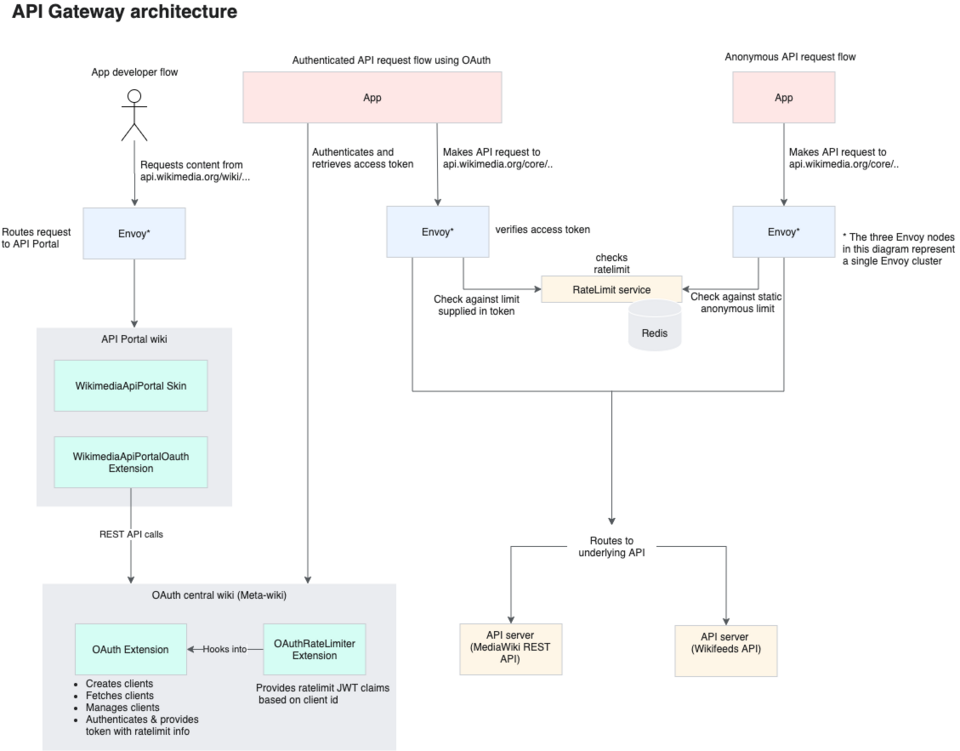 Example: Kong’s request flow (auth → rate limiting → routing → logging) (Image: APaskulin (WMF), CC BY-SA 4.0, via Wikimedia Commons)
5. Cloud-Native Integration Patterns
A. Serverless Integration (AWS Step Functions, Azure Logic Apps)
- Use case: Event-driven workflows (e.g., "When a new order arrives, check inventory → update warehouse → send notification").
- Example: Daraz’s order fulfillment:
- Event:
OrderCreated(trigger). - Step 1: Check inventory (Lambda).
- Step 2: If stock > 0 → update warehouse (SQS).
- Step 3: Send SMS (SNS).
- Event:
B. Hybrid Integration (On-Prem + Cloud)
- Scenario: NTC’s legacy traffic cameras (on-prem) + AWS cloud analytics.
- Solution:
- MQTT for real-time camera feeds.
- AWS IoT Core to process data.
- DynamoDB to store violation records.
graph TD
    A["Traffic Camera<br/>(On-Prem)"] -->|"MQTT"| B["AWS IoT Core"]
    B --> C["Lambda: Detect Violation"]
    C --> D["DynamoDB: Store Fine"]
    C --> E["SNS: Alert Police"]
6. Real-World Examples
Example 1: eSewa’s Payment Flow (SOA + OAuth 2.0)
- User selects "Pay bill" → eSewa app calls
/payments/initiate. - API Gateway validates JWT (from eSewa login).
- Payment Service calls Bank API (via OAuth 2.0).
- Bank returns
transactionId→ eSewa updates DB. - Notification Service sends SMS.
Why SOA?
- Bank Service can be updated independently.
- Notification Service can switch from SMS to WhatsApp without breaking payments.
Example 2: Pathao’s Driver Dispatch (Event-Driven)
- User requests ride →
POST /rides(REST API). - Ride Service publishes
RideRequestedto Kafka. - Driver Service subscribes → filters drivers within 500m.
- Driver accepts →
RideAssignedevent published. - User and Driver get real-time updates via WebSockets.
Why Cloud Integration?
- Scalability: Handles 1000s of rides/hour.
- Resilience: If one service fails (e.g., GPS), others continue.
Example 3: NTC’s Traffic Fine System (Orchestration)
- Camera detects violation → sends image to S3.
- Fine Orchestrator (BPEL):
- Calls License Service (DynamoDB) → fetches owner.
- Calls Payment Service → generates fine.
- Calls Notification Service → sends SMS.
- Database logs fine in Aurora PostgreSQL.
Challenges:
- Latency: License lookup must be fast (use ElastiCache Redis).
- Fraud: Validate license plate via OCR (AWS Textract).
7. Challenges of SOA/Cloud Integration
| Challenge | Solution | Nepal Example |
|---|---|---|
| Service discovery | Service registries (Eureka, Consul). | Ncell’s internal API catalog. |
| Latency | Edge computing, CDNs. | eSewa uses Cloudflare for low latency. |
| Security breaches | Zero-trust architecture, mTLS. | Khalti encrypts all payment data. |
| Vendor lock-in | Use open standards (REST, OAuth). | Daraz uses Kubernetes (not AWS-only). |
| Monitoring complexity | APM tools (New Relic, Datadog). | NTC uses Prometheus for traffic APIs. |
8. Exam Tip: How to Score Full Marks
Define SOA clearly:
"SOA is an architectural style where applications are composed of independent, reusable services that communicate via standardized protocols (SOAP/REST) and are discoverable via registries."
Compare REST vs. SOAP: Use a table (like above) and mention real-world use (e.g., REST for eSewa, SOAP for Ncell legacy).
Draw sequence diagrams: Examiners love message flows. Always label:
- Participants (User, API Gateway, Service A).
- Messages (e.g.,
POST /pay). - Responses (HTTP status codes).
Relate to Nepal:
- eSewa: OAuth 2.0 + API Gateway.
- Pathao: Event-driven (Kafka) + REST APIs.
- NTC: Orchestration (BPEL) + DynamoDB.
Security is key: Always mention:
- Authentication: OAuth 2.0/JWT.
- Encryption: TLS 1.3.
- API Gateways: Rate limiting, logging.
Worked examples:
- Calculate: If a REST API returns
429 Too Many Requests, how would you fix it? → "Use API gateway rate limiting or implement exponential backoff." - Trace: Draw a sequence diagram for Khalti’s payment flow (as above).
- Calculate: If a REST API returns
Based on the TU BCA syllabus for Cloud Computing (CACS402), unit 10.
Discussion
Loading…