Cyber Law And Professional EthicsUnit 16 min read
Introduction to Cyber Law and Professional Ethics: Foundations and Frameworks
Unit 1 of Cyber Law And Professional Ethics: provides a foundational overview of the legal frameworks governing cyberspace, the distinction between morality and professional ethics, and the critical role of corporate social responsibility in the modern IT industry.
Key points
- Cyber law encompasses the legal principles governing the digital environment, including electronic transactions, data privacy, and cybercrime.
- Ethics refers to a set of moral principles guiding behavior, whereas morals are personal beliefs about right and wrong.
- Professional ethics in IT ensure accountability, integrity, and the protection of user data in software development and business operations.
- Corporate Social Responsibility (CSR) is the commitment of businesses to operate ethically and contribute to economic development while improving the quality of life of the workforce.
- The Electronic Transactions Act (ETA) 2063 serves as the primary legislative framework for cyber law in Nepal.
Understanding Ethics and Morality
Ethics and morality are often used interchangeably, but they serve different functions in a professional context.
- Morals: These are personal, internal beliefs about what is right or wrong, often influenced by culture, religion, or upbringing. They are subjective and vary from person to person.
- Ethics: These are external, standardized codes of conduct adopted by groups, professions, or organizations. In the IT industry, ethics are codified in professional standards (e.g., ACM or IEEE Code of Ethics).
| Feature | Morals | Ethics |
|---|---|---|
| Origin | Internal/Personal | External/Social/Professional |
| Consistency | Highly subjective | Standardized for a group |
| Enforcement | Conscience/Social pressure | Professional bodies/Legal codes |
Cyber Law: Definition and Scope
Cyber law is the intersection of legal systems and digital technology. It regulates the use of computers, networks, and the internet. Its primary objectives are to provide legal recognition for electronic documents, ensure secure electronic transactions, and penalize cybercrimes.
The Electronic Transactions Act (ETA) 2063 (Nepal)
The ETA 2063 is the cornerstone of Nepal's cyber legal framework. Key provisions include:
- Legal Recognition: Electronic records and digital signatures are given the same legal status as paper-based documents.
- Cybercrime Provisions: It defines offenses such as unauthorized access, data theft, and the publication of illegal content.
- Regulatory Body: It establishes the role of the Controller of Certification Authorities (CCA) to oversee digital signatures.
flowchart TD
    A["Cyber Law Framework in Nepal"] --> B["Electronic Transactions Act 2063"]
    A --> C["Data Privacy Act 2075"]
    A --> D["Cyber Security Act 2075"]
    B --> E["Digital Signatures & Certificates"]
    B --> F["Cybercrime Provisions (Unauthorized Access, Fraud, etc.)"]
    B --> G["E-Governance & Digital Records"]
    C --> H["Personal Data Protection"]
    D --> I["Incident Response & Penalties"]
Business Ethics and Corporate Social Responsibility (CSR)
Business ethics involve applying moral principles to business situations. Organizations pursue good ethics to build trust with stakeholders, comply with laws, and enhance brand reputation.
Reasons to pursue CSR:
- Sustainability: Ensuring long-term viability by respecting environmental and social norms.
- Stakeholder Trust: Customers and investors prefer companies that demonstrate ethical responsibility.
- Risk Management: Ethical practices reduce the risk of legal litigation and public scandals.
Responding to Cyber Attacks
When an organization faces a cyber attack, a structured response is essential to minimize damage and ensure legal compliance.
flowchart LR
    A["Identification"] --> B["Containment"]
    B --> C["Eradication"]
    C --> D["Recovery"]
D --> E["Lessons Learned"]- Identification: Detecting the breach (e.g., unauthorized access to a server).
- Containment: Isolating the affected systems to prevent the spread of malware.
- Eradication: Removing the threat (e.g., deleting malicious code).
- Recovery: Restoring systems from clean backups.
- Lessons Learned: Documenting the incident for future security audits.
Digital Signatures
A digital signature is a mathematical scheme for verifying the authenticity of digital messages or documents. It ensures:
- Authentication: The sender is who they claim to be.
- Integrity: The document has not been altered since it was signed.
- Non-repudiation: The sender cannot deny having sent the message.
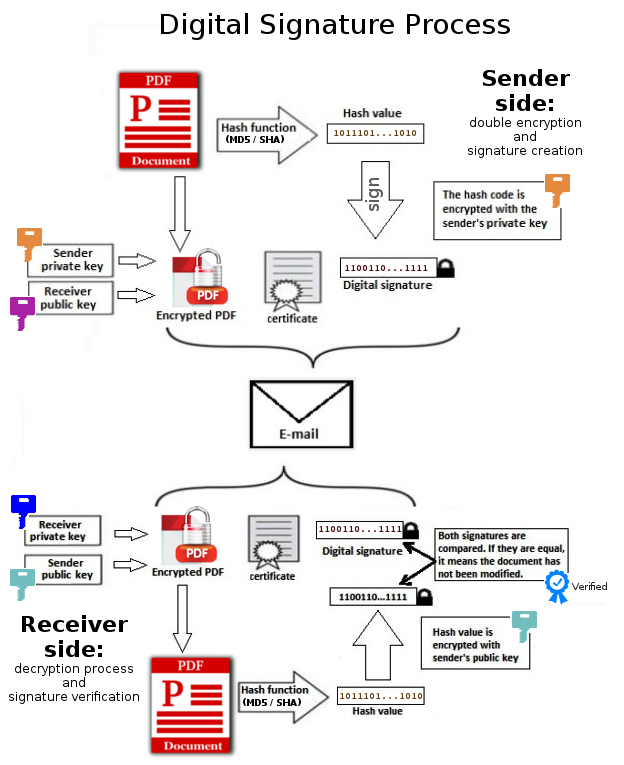 A visual representation of public/private key encryption in digital signing. (Image: Thiagocv, CC BY-SA 4.0, via Wikimedia Commons)
In the real world
- eSewa and Khalti: These Nepali fintech apps rely heavily on the Electronic Transactions Act 2063. They use digital signatures and encryption to ensure that every transaction is legally binding and secure, preventing unauthorized fund transfers.
- NEPSE (Nepal Stock Exchange): The online trading platform uses strict ethical and legal protocols to ensure fair market practices. If a broker engages in insider trading, they are violating both professional ethics and the legal provisions of the Securities Act, which is a subset of the broader cyber-legal environment.
- Daraz: When you place an order, the system generates an electronic receipt. This receipt is a legal record under the ETA 2063. If a dispute arises regarding a payment, this digital record serves as evidence in a court of law, demonstrating the practical application of cyber law in e-commerce.
Exam tip
When answering questions about the Electronic Transactions Act 2063, always mention its dual purpose: facilitating e-commerce (through digital signatures) and controlling cybercrime. For ethics questions, always distinguish between "personal morals" and "professional codes of conduct." If asked about cyber attacks, structure your answer using the five-step response cycle (Identification to Lessons Learned) to show a systematic, professional approach.
Based on the TU BCA syllabus for Cyber Law And Professional Ethics (CACS401), unit 1.
Discussion
Loading…