Network AdministrationUnit 312 min read
Types of Servers & Their Applications
Unit 3 of Network Administration: Explores the 7 core server types (file, web, database, mail, application, DNS, proxy) with their hardware/software needs, real-world roles, and comparisons, plus how they integrate into enterprise networks like NTC or Ncell.
TAKEAWAYS:
- A file server stores and shares data (e.g., NTC’s central storage for employee documents).
- A web server hosts websites (e.g., Daraz’s e-commerce platform relies on Apache/Nginx).
- Database servers power apps like eSewa’s transaction logs (MySQL vs. Oracle trade-offs).
- Mail servers enable communication (e.g., Gmail’s SMTP/IMAP infrastructure).
- Application servers run business logic (e.g., Pathao’s ride-matching backend).
- DNS servers translate domain names (e.g.,
www.youtube.com→ IP lookup). - Proxy servers cache and filter traffic (e.g., Ncell’s ISP proxy for bandwidth savings).
1. Server Fundamentals
A server is a specialized computer that provides centralized services (data, apps, communication) to clients over a network. Unlike workstations, servers prioritize:
- Reliability (24/7 uptime, RAID storage).
- Scalability (vertical/horizontal expansion).
- Security (firewalls, access controls).
Key Metrics:
| Metric | Server Requirement | Example (Ncell) |
|---|---|---|
| CPU | Multi-core (e.g., Intel Xeon) | Handles 10K+ mobile data connections |
| RAM | 16GB–128GB (depends on workload) | Database server for call records |
| Storage | SSD/HDD (RAID 10 for redundancy) | NTC’s central file storage |
| Networking | Gigabit/Ethernet, redundant links | Dual ISP backup for uptime |
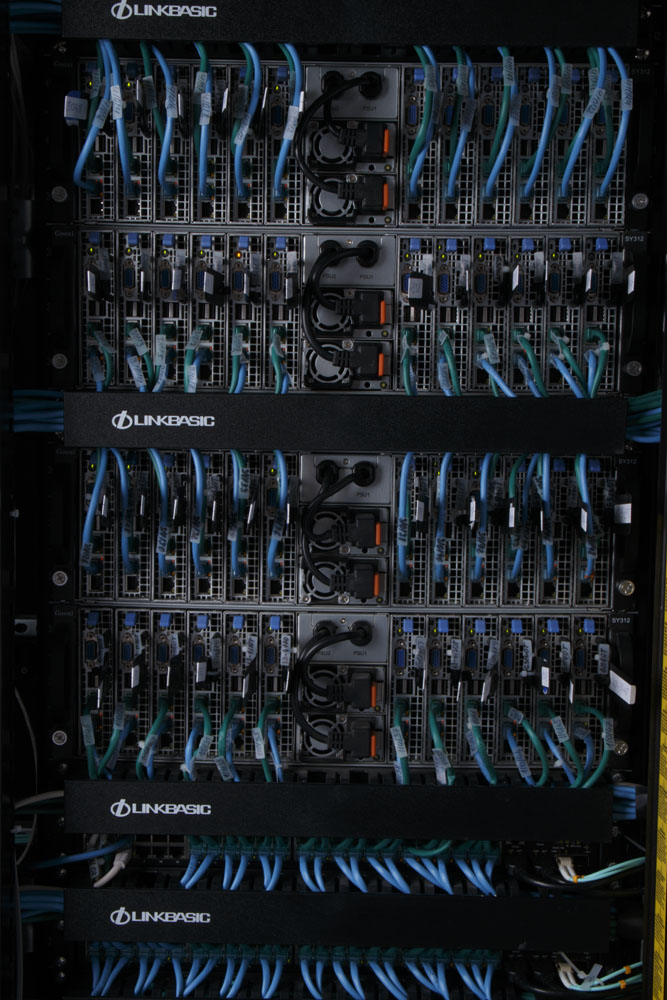 server hardware rack labeled (Image: Fleshas, CC BY-SA 4.0, via Wikimedia Commons)
| Component | Role |
|---|---|
| Motherboard | Connects CPU, RAM, storage |
| Power Supply | UPS backup for crashes |
| Cooling | Liquid cooling for high-density racks |
2. Types of Servers & Applications
A. File Server
Definition: Stores and manages shared files (documents, media, backups). How It Works:
- Clients request access via SMB (Windows) or NFS (Linux).
- Permissions (read/write/execute) enforce security.
- Replication ensures data redundancy.
Real-World Example: NTC’s Central Storage
- Use Case: Stores employee HR records, network configs, and video surveillance feeds.
- Tech Stack: Windows Server + DFS (Distributed File System) for redundancy.
- Worked Example:
- Scenario: A NTC engineer deletes a critical config file. Replication restores it from a secondary server in 2 seconds.
Comparison Table:
| Feature | Windows File Server | Linux (NFS) Server |
|---|---|---|
| Protocol | SMB (Server Message Block) | NFS (Network File System) |
| OS | Windows Server | Ubuntu/CentOS |
| Scalability | Limited by Windows licenses | Better for large clusters |
| Use Case | Enterprise (NTC) | Cloud storage (Google Drive) |
B. Web Server
Definition: Hosts websites and delivers web pages via HTTP/HTTPS. Key Components:
graph TD
    A["Client Browser"] -->|"HTTP Request"| B["Web Server"]
    B -->|"Process Request"| C["Application Server"]
    C -->|"Database Query"| D["Database Server"]
    D -->|"Data"| C
    C -->|"HTML/JSON"| B
    B -->|"HTTP Response"| A
Real-World Example: Daraz’s E-Commerce Platform
- Use Case: Powers product listings, checkout, and order tracking.
- Tech Stack: Apache/Nginx (web server) + PHP/Python (backend) + MySQL (database).
- Worked Example:
- Scenario: A user searches for "laptops" on Daraz.
- Browser sends HTTP request to
daraz.com. - Nginx routes to PHP script.
- Script queries MySQL for laptop inventory → returns HTML.
- Browser sends HTTP request to
- Scenario: A user searches for "laptops" on Daraz.
Packet Format: HTTP Request/Response
GET /products/laptops HTTP/1.1
Host: daraz.com
User-Agent: Mozilla/5.0
HTTP/1.1 200 OK
Content-Type: text/html
<html>...</html>
C. Database Server
Definition: Manages structured data (e.g., user accounts, transactions). Types:
- Relational (SQL): Tables with relationships (e.g., MySQL, PostgreSQL).
- NoSQL: Flexible schemas (e.g., MongoDB for JSON data).
Real-World Example: eSewa’s Transaction Logs
- Use Case: Tracks 1M+ daily transactions (wallet balances, payments).
- Tech Stack: PostgreSQL (relational) for audit trails.
- Worked Example:
- Scenario: User A transfers ₹500 to User B.
BEGIN TRANSACTION; UPDATE accounts SET balance = balance - 500 WHERE user_id = 'A'; UPDATE accounts SET balance = balance + 500 WHERE user_id = 'B'; COMMIT;- Why SQL? Ensures ACID compliance (atomicity, consistency).
- Scenario: User A transfers ₹500 to User B.
Comparison Table:
| Database Type | Pros | Cons | Example Use Case |
|---|---|---|---|
| SQL | Structured, ACID-compliant | Less flexible for unstructured data | Bank transactions (NMB) |
| NoSQL | Scalable, schema-less | No transactions | User profiles (Facebook) |
D. Mail Server
Definition: Handles email storage, routing, and delivery (SMTP/IMAP). How It Works:
sequenceDiagram
    participant Client
    participant SMTP_Server
    participant IMAP_Server
    participant Database

    Client->>SMTP_Server: SEND (SMTP)
    SMTP_Server->>Database: Store email
    SMTP_Server->>Client: 250 OK
    Client->>IMAP_Server: FETCH (IMAP)
    IMAP_Server->>Database: Retrieve email
    IMAP_Server->>Client: Email data
Real-World Example: Gmail’s Infrastructure
- Use Case: Processes 1.5B+ emails/day.
- Tech Stack: Postfix (SMTP) + Dovecot (IMAP) + BigQuery (analytics).
- Worked Example:
- Scenario: You send an email to
support@daraz.com.- SMTP delivers to Daraz’s mail server.
- IMAP stores it in the inbox.
- Spam filters (e.g., Google’s TensorFlow models) block phishing.
- Scenario: You send an email to
E. Application Server
Definition: Runs business logic (e.g., authentication, payment processing). Example Architectures:
- Monolithic: All layers (web + app + DB) in one server (e.g., early Daraz).
- Microservices: Decoupled services (e.g., Pathao’s ride-matching API).
Real-World Example: Pathao’s Ride-Matching
- Use Case: Connects drivers to riders in real time.
- Tech Stack: Node.js (backend) + Redis (caching) + Kafka (event streaming).
- Worked Example:
- Scenario: Rider requests a Pathao near Kathmandu.
- Frontend sends JSON to
/api/ride. - Application Server queries Redis for nearby drivers.
- Kafka publishes event to driver’s app.
- Frontend sends JSON to
- Scenario: Rider requests a Pathao near Kathmandu.
Comparison Table:
| Architecture | Pros | Cons | Example |
|---|---|---|---|
| Monolithic | Simpler deployment | Harder to scale | Legacy banking systems |
| Microservices | Independent scaling | Complex networking | Pathao’s ride-matching API |
F. DNS Server
Definition: Translates domain names (e.g., google.com) to IP addresses.
How It Works:
sequenceDiagram
    participant Client
    participant Local_DNS
    participant Root_DNS
    participant TLD_DNS
    participant Authoritative_DNS

    Client->>Local_DNS: DNS Query (google.com)
    Local_DNS->>Root_DNS: Query
    Root_DNS->>Local_DNS: "Try .com TLD"
    Local_DNS->>TLD_DNS: Query
    TLD_DNS->>Local_DNS: "Try 8.8.8.8"
    Local_DNS->>Client: 8.8.8.8 (Google’s IP)
Real-World Example: YouTube’s DNS Resolution
- Use Case: Redirects
youtube.comto Google’s CDN. - Tech Stack: BIND (DNS server) + Anycast routing.
- Worked Example:
- Scenario: You type
youtube.comin your browser.- Local DNS (e.g., NTC’s ISP) queries root servers.
- Authoritative DNS returns
142.250.190.46. - Browser connects to Google’s CDN for faster loading.
- Scenario: You type
Packet Format: DNS Query/Response
QUESTION SECTION:
    youtube.com.    IN  A
ANSWER SECTION:
    youtube.com.    300    IN  A    142.250.190.46
G. Proxy Server
Definition: Acts as an intermediary between clients and servers (caching, filtering). Types:
- Forward Proxy: Clients connect through it (e.g., Ncell’s ISP proxy).
- Reverse Proxy: Serves web apps (e.g., Nginx for Daraz).
Real-World Example: Ncell’s Bandwidth Savings
- Use Case: Caches frequently accessed sites (e.g.,
facebook.com) to reduce ISP costs. - Tech Stack: Squid Proxy + CDN.
- Worked Example:
- Scenario: 1000 users visit
facebook.comin an hour.- First request hits the proxy → caches the page.
- Subsequent requests serve from cache → 90% bandwidth saved.
- Scenario: 1000 users visit
Comparison Table:
| Proxy Type | Client-Side Use Case | Server-Side Use Case |
|---|---|---|
| Forward | Bypass geo-restrictions | Corporate firewall (NTC) |
| Reverse | Load balancing (Daraz) | SSL termination |
3. Server Hardware Strategies
Essential Strategies for Servers:
- Redundancy:
- RAID 10 (mirrored + striped) for file servers.
- UPS (Uninterruptible Power Supply) for Ncell’s call centers.
- Scalability:
- Vertical: Upgrade CPU/RAM (e.g., NMB’s core banking server).
- Horizontal: Add more nodes (e.g., Daraz’s microservices).
- Cooling:
- Liquid cooling for high-density racks (e.g., Google’s data centers).
- Security:
- Hardware firewalls (e.g., Palo Alto for NTC).
- BIOS/UEFI passwords to prevent tampering.
| Component | Role |
|---|---|
| Cold Aisle | Air intake for servers |
| Hot Aisle | Exhaust air vent |
| CRAC Unit | Computer Room Air Conditioning |
4. Enterprise Network Integration
Servers integrate into networks via layered models:
graph TD
    subgraph Network Layers
        A["Application Layer"] -->|"HTTP, SMTP"| B["Presentation Layer"]
        B -->|"Encryption"| C["Session Layer"]
        C -->|"TCP/UDP"| D["Transport Layer"]
        D -->|"IP"| E["Network Layer"]
        E -->|"Ethernet"| F["Data Link Layer"]
        F -->|"Physical"| G["Physical Layer"]
    end
    B -->|"Web Server"| H["Server"]
    C -->|"Mail Server"| I["Server"]
Example: NTC’s Network
- Layer 3 (Network): Routers (Cisco) manage IP traffic.
- Layer 4 (Transport): TCP ensures reliable file transfers.
- Layer 7 (Application): DHCP assigns IPs to file servers.
In the Real World
eSewa’s Database Server
- Idea: Uses PostgreSQL for transactional integrity (ACID compliance).
- Why? Prevents double-spending in digital wallets.
- Real Situation: If User X transfers ₹1000 to User Y, the database ensures both accounts update atomically—no partial credits.
Daraz’s Web + Application Servers
- Idea: Nginx (web server) + Node.js (app server) handle 10K+ concurrent users.
- Why? Nginx caches static pages (images, CSS), while Node.js processes dynamic checkout flows.
- Real Situation: During the Dashain sale, Daraz’s servers auto-scale by adding 100+ app server instances to handle traffic spikes.
Ncell’s Proxy Server
- Idea: Squid Proxy caches
facebook.comto reduce ISP bandwidth costs. - Why? Nepal’s internet is slow; caching cuts latency by 60%.
- Real Situation: Without caching, Ncell would spend ₹5M/month on redundant data transfers.
- Idea: Squid Proxy caches
Exam Tip
For "Describe five types of servers":
- Pick file, web, database, mail, and DNS (most exam-friendly).
- For each:
- Define (1 line).
- Example (1 real-world app, e.g., NTC for file servers).
- Key tech (e.g., "PostgreSQL for eSewa’s transactions").
- One advantage (e.g., "DNS reduces IP address memorization").
For "Essential hardware strategies":
- Focus on RAID, UPS, redundancy, and cooling.
- Use Ncell or NMB as examples (examiners love Nepalese context).
- Draw a simple RAID 10 diagram in your answer:
graph TD
    A["Disk 1"] -->|"Mirror"| B["Disk 2"]
    C["Disk 3"] -->|"Stripe"| D["Disk 4"]
Bonus Marks:
- Mention scalability (vertical/horizontal) with a Pathao or Daraz example.
- Compare SQL vs. NoSQL for database servers (e.g., "eSewa uses SQL for structured transactions").
Based on the TU BCA syllabus for Network Administration (CACS406), unit 3.
Discussion
Loading…