Knowledge EngineeringUnit 312 min read
Description Logics & Ontology Engineering: Structure, Rules & Real-World Use
Unit 3 of Knowledge Engineering explores how Description Logics (DL) formalize structured knowledge and how ontologies enable machines to understand and share it. Learn DL syntax, ontology layers (concepts/roles/axioms), OWL’s role, and real-world applications in eSewa, NEPSE, and medical systems—with visual traces of
TAKEAWAYS:
- Description Logics (DL) are a family of formal knowledge representation languages that combine concepts (classes), roles (properties), and axioms (rules) to define structured hierarchies (e.g.,
Animal ∧ ¬Bird → Fly). - Ontologies are explicit, shared conceptualizations of a domain (e.g., "eSewa’s ontology defines
User,Transaction,PaymentMethodwith constraints likeUser → has(PhoneNumber)). - OWL (Web Ontology Language) extends RDF with DL to enable machine-readable semantics (e.g.,
owl:equivalentClassfor synonyms likeNepaliCitizen ≡ CitizenOfNepal). - Ontology engineering follows METHONTOLOGY: specification → conceptualization → formalization → implementation → evaluation (visualized as a pipeline).
- Real-world impact: DL powers semantic search (e.g., NEPSE’s stock ontology), medical diagnosis (ICD-11 codes), and e-commerce (Daraz’s product hierarchies).
- Exam focus: Compare DL vs. predicate logic, trace ontology reasoning, and explain OWL’s role in the Semantic Web stack (RDF → RDFS → OWL).
1. What is Description Logic (DL)?
DL is a formal logic for structured knowledge representation, combining:
- Concepts (classes, e.g.,
Person,Employee). - Roles (properties, e.g.,
hasName,worksAt). - Axioms (rules, e.g.,
Employee → worksAt(Some Organization)).
Key Features
classDiagram
    class Concept {
        +Name: String
        +Definition: Axioms
    }
    class Role {
        +Name: String
        +Domain/Range: Concepts
    }
    class Axiom {
        +Type: Subsumption/Equivalence/Disjointness
        +Example: "Student → takes(Course)"
    }
    Concept "1" --> "0..*" Role : "has"
    Concept "1" --> "1..*" Axiom : "defines"
DL Syntax Examples
| Notation | Meaning | Example |
|---|---|---|
C ∩ D |
Intersection (AND) | Bird ∩ ¬Penguin |
C ∪ D |
Union (OR) | Employee ∪ Student |
¬C |
Negation (NOT) | ¬Fly (non-flying things) |
∃ r.C |
Existential ("has a") | ∃ hasChild.Person |
∀ r.C |
Universal ("all") | ∀ worksAt.Organization |
C ⊑ D |
Subsumption ("is-a") | Student ⊑ Person |
Worked Example: eSewa’s User Ontology
Scenario: eSewa defines users with constraints:
- All users have a phone number.
- Users can be verified or unverified.
- Verified users can send money; unverified cannot.
DL Representation:
User ⊑ ∀ hasPhoneNumber.String
VerifiedUser ⊑ User ∩ ∃ canSendMoney.Amount
UnverifiedUser ⊑ User ∩ ¬∃ canSendMoney.Amount
Visual Trace:
graph TD
    A["User"] --> B["hasPhoneNumber: String"]
    A --> C["VerifiedUser"]
    A --> D["UnverifiedUser"]
    C -->|"canSendMoney"| E["Amount"]
    D -->|"¬canSendMoney"| F["Amount"]
2. Ontologies: The Backbone of Shared Knowledge
An ontology is a machine-readable specification of:
- Concepts (classes),
- Roles (properties),
- Axioms (rules),
- Individuals (instances).
Ontology Layers
mindmap
  root((Ontology))
    Concepts
      Classes: e.g., `Person`, `Vehicle`
      Hierarchies: `is-a`, `part-of`
    Roles
      Object Properties: `hasOwner`, `locatedAt`
      Data Properties: `hasName: String`
    Axioms
      Subsumption: `Student ⊑ Person`
      Equivalence: `NepaliCitizen ≡ CitizenOfNepal`
      Disjointness: `Cat ⊑ ¬Dog`
    Individuals
      Instances: `John: Person`, `Kathmandu: City`
Ontology Engineering Methodology (METHONTOLOGY)
flowchart LR
    A["Specification"] --> B["Conceptualization"]
    B --> C["Formalization"]
    C --> D["Implementation"]
    D --> E["Evaluation"]
    E -->|"Feedback"| B
Real-World Ontologies
| Domain | Ontology Example | DL Snippet | Why It Matters |
|---|---|---|---|
| eSewa | User, Transaction, PaymentMethod | Transaction ⊑ ∃ involves(User ∩ Verified) |
Prevents fraud by enforcing verification. |
| NEPSE | Stock, Company, TradingRule | Stock ⊑ ∀ listedOn.Exchange |
Ensures only valid stocks are traded. |
| Medical (ICD-11) | Disease, Symptom, Treatment | Diabetes ⊑ ∃ causes(Symptom) |
Enables symptom-to-disease reasoning. |
| Daraz | Product, Category, Review | Electronics ⊑ Product ∩ ∃ hasPrice.Numeric |
Powers semantic search (e.g., "budget laptops"). |
3. OWL: The Web Ontology Language
OWL is the W3C standard for ontologies, built on RDF and DL. It supports:
- Class expressions (e.g.,
∃ hasAuthor.Author). - Property hierarchies (e.g.,
subPropertyOf). - Individual assertions (e.g.,
John: Person).
OWL vs. RDF vs. RDFS
| Feature | RDF | RDFS | OWL |
|---|---|---|---|
| Purpose | Data model (triples) | Lightweight schema | Full DL reasoning |
| Class Hierarchy | No | rdfs:subClassOf |
owl:equivalentClass, owl:disjointWith |
| Property Rules | No | rdfs:domain, rdfs:range |
owl:FunctionalProperty |
| Reasoning | None | Limited | Full DL inference |
| Example Use | Storing data (e.g., user profiles) | Defining basic types | eSewa’s transaction rules |
OWL Worked Example: Ncell’s Customer Ontology
Scenario: Ncell defines:
- Customers can be prepaid or postpaid.
- Postpaid customers must have a contract.
- Prepaid customers cannot exceed a data limit.
OWL Axioms:
@prefix : <http://example.org/ncell#> .
@prefix owl: <http://www.w3.org/2002/07/owl#> .
@prefix rdfs: <http://www.w3.org/2000/01/rdf-schema#> .

:Customer rdfs:subClassOf :Person .
:PrepaidCustomer rdfs:subClassOf :Customer ;
    owl:equivalentClass [ owl:intersectionOf (
        :Customer
        [ owl:onProperty :hasPlan ; owl:hasValue :PrepaidPlan ]
    ) ] ;
    owl:disjointWith :PostpaidCustomer .
:PostpaidCustomer rdfs:subClassOf :Customer ;
    owl:equivalentClass [ owl:intersectionOf (
        :Customer
        [ owl:onProperty :hasContract ; owl:hasValue :Contract ]
    ) ] .
:PrepaidPlan owl:equivalentClass [ owl:intersectionOf (
    :Plan
    [ owl:onProperty :hasDataLimit ; owl:hasValue [ owl:datatype xsd:float ; xsd:value "10" ] ]
) ] .
Visualization:
graph TD
    A["Customer"] --> B["PrepaidCustomer"]
    A --> C["PostpaidCustomer"]
    B -->|"hasPlan"| D["PrepaidPlan"]
    C -->|"hasContract"| E["Contract"]
    D -->|"hasDataLimit"| F["10GB"]
4. Ontology Reasoning: How Machines "Think" with DL
Ontology reasoners (e.g., HermiT, Pellet) infer implicit knowledge from axioms. Example:
Given:
Student ⊑ Person
∀ takes.Course
∃ hasGPA.Numeric
Query: Is Alice a Person if Alice: Student?
Trace:
Alice: Student(given).Student ⊑ Person(axiom) → Alice ⊑ Person (inferred).
Real-World Trace: NEPSE’s Trading Rules Scenario: NEPSE’s ontology enforces:
- Only listed companies can trade.
- Trading requires a valid broker.
Axioms:
Stock ⊑ ∀ listedOn.Exchange
Trade ⊑ ∃ involves(Broker ∩ Valid)
Query: Can CompanyX trade if it’s not listed?
Trace:
CompanyX: Stock(given).Stock ⊑ ∀ listedOn.Exchange→ IfCompanyXhas nolistedOn, it cannot trade.
5. Applications of DL and Ontologies
A. Semantic Web
- Linked Data: Ontologies enable machine-readable links between datasets (e.g., DBpedia connects Wikipedia to medical ontologies).
- Example: Google’s Knowledge Graph uses ontologies to answer questions like "What movies starred Tom Hanks in 2020?".
B. E-Commerce (Daraz, Amazon)
- Product Ontologies: Define
Product ⊑ ∃ hasCategory.Category ∩ ∃ hasPrice.Numeric. - Use Case: When you search "budget smartphones under Rs. 20,000", the system infers:
graph TD
    A["Search: 'budget smartphones <20k'"] --> B["hasCategory: Smartphone"]
    B --> C["hasPrice: Numeric"]
    C -->|"<20000"| D["Filtered Results"]
C. Healthcare (ICD-11, Hospital Systems)
- Diagnosis Ontologies: Link symptoms to diseases (e.g.,
Fever ∩ Cough ⊑ ∃ causes(Disease ∩ Flu)). - Example: A hospital system might flag:
graph TD
    A["Patient Symptoms"] --> B["Fever"]
    A --> C["Cough"]
    B -->|"∃ causes"| D["Disease: Flu"]
    C -->|"∃ causes"| D
D. Finance (Banks, NEPSE)
- Loan Eligibility: Ontologies define rules like:
LoanApplicant ⊑ Person ∩ ∃ hasCreditScore(Numeric ∩ ≥700) - Example: A bank’s system rejects an applicant if:
graph TD
    A["Applicant"] --> B["hasCreditScore: 650"]
    B -->|"<700"| C["Rejected"]
6. Challenges and Limitations
| Challenge | Example | Mitigation |
|---|---|---|
| Scalability | Large ontologies (e.g., SNOMED CT) | Use modular ontologies or OWL 2 DL. |
| Expressivity vs. Decidability | Undecidable fragments in DL | Stick to decidable profiles (e.g., EL++). |
| Maintenance | Evolving domains (e.g., medical terms) | Version control for ontologies. |
| Interoperability | Merging ontologies from different sources | Use alignment tools (e.g., Protégé). |
7. Exam Tip: How to Score Full Marks
Do’s:
- Compare DL vs. Predicate Logic:
- DL is structured (concepts/roles/axioms) vs. PL’s unstructured formulas.
- DL supports modular reasoning (e.g.,
Student ⊑ Personis reusable).
- Trace Ontology Reasoning:
- Show step-by-step inference (e.g., "Given
A ⊑ BandX: A, inferX: B").
- Show step-by-step inference (e.g., "Given
- Link to OWL/RDF:
- Always mention OWL’s role in the Semantic Web stack (RDF → RDFS → OWL).
- Use Real-World Examples:
- Tie answers to eSewa, NEPSE, or Daraz (e.g., "OWL enforces eSewa’s transaction rules").
Don’ts:
- Don’t confuse ontologies with databases:
- Ontologies are for semantic meaning; databases store data.
- Don’t ignore axioms:
- Always include rules (e.g.,
⊑,∃,∀) in answers.
- Always include rules (e.g.,
- Don’t skip visuals:
- Draw concept hierarchies or reasoning traces in exams.
Sample Exam Answer Structure
Question: "Explain the role of OWL in ontology engineering." Answer:
- Definition: OWL is a W3C standard for ontologies, built on RDF and DL.
- Key Features:
- Supports class expressions (e.g.,
∃ hasAuthor.Author). - Enables reasoning (e.g., inferring
Student ⊑ Person).
- Supports class expressions (e.g.,
- Real-World Use:
- eSewa: Defines
Transaction ⊑ ∃ involves(User ∩ Verified)to prevent fraud.
- eSewa: Defines
- Comparison:
Feature OWL RDFS Reasoning Full DL inference Limited Property Rules FunctionalProperty,InverseOfdomain,range - Diagram:
graph TD
    A["RDF"] --> B["RDFS"]
    B --> C["OWL"]
    C --> D["Semantic Web"]
8. Practice Questions (With Hints)
Convert to DL: "All professors are employees. Some professors teach computer science." Hint: Use
Professor ⊑ Employeeand∃ teaches.Course.Ontology Reasoning: Given:
Vehicle ⊑ ∀ hasEngine.Engine
Bike ⊑ Vehicle
Can you infer
Bike ⊑ ∀ hasEngine.Engine? Yes (subsumption).OWL vs. RDF: Which supports
owl:equivalentClass? OWL (RDF alone cannot).Real-World Trace: How does Daraz use ontologies for product search? Hint:
Product ⊑ ∃ hasCategory.Category ∩ ∃ hasPrice.Numericenables filtering.
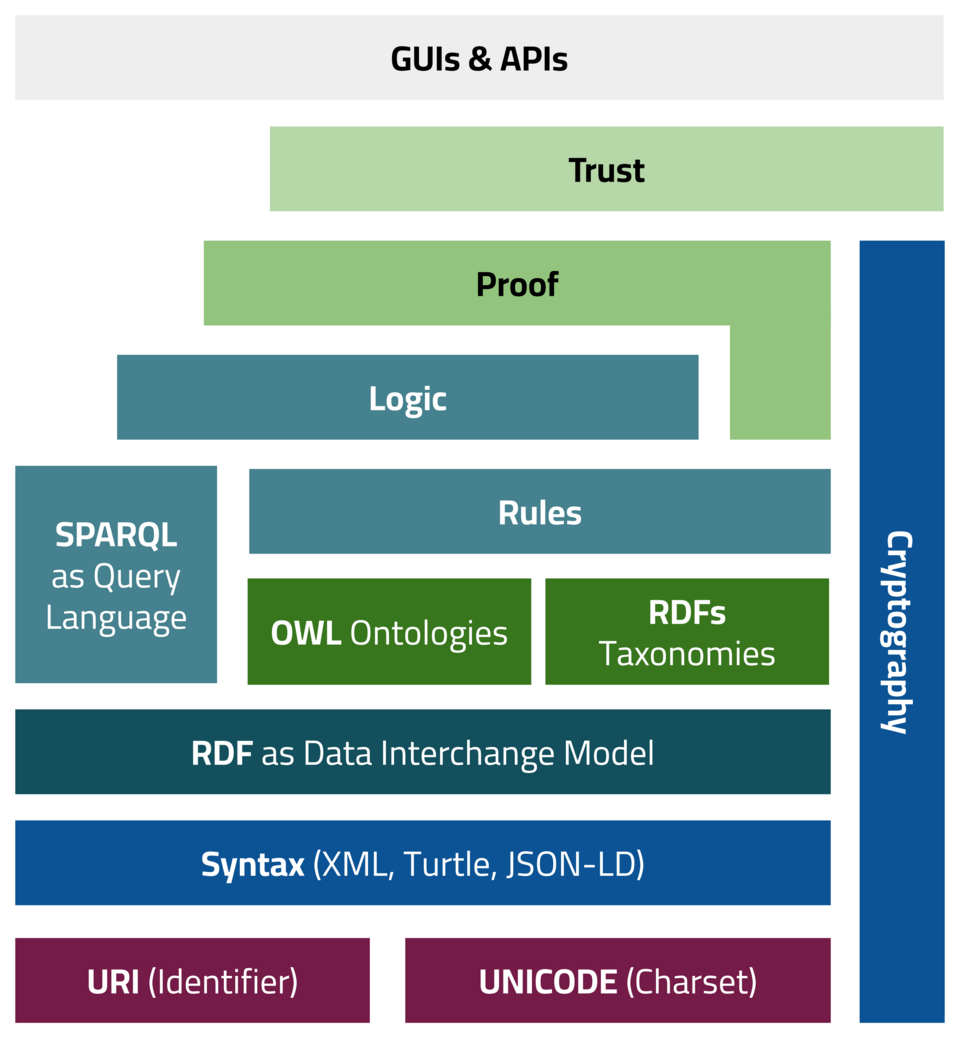 The stack: Unicode → XML → RDF → RDF Schema → OWL → Logic → Proof. (Image: Florian Thiery, CC BY-SA 4.0, via Wikimedia Commons)
Based on the TU BCA syllabus for Knowledge Engineering (CACS458), unit 3.
Discussion
Loading…