Foundation of Business ManagementUnit 113 min read
Business Management: Definitions, Goals, Environments & Functions
Unit 1 of Foundation of Business Management introduces core concepts like business definitions, objectives, environments (internal/external), and key functions (production, marketing, finance, HR), with real-world applications in Nepali and global firms.
TAKEAWAYS:
- Define business, its economic and managerial roles, and how it differs from non-profit organizations.
- Explain the four key business objectives (profit, growth, survival, customer satisfaction) and their trade-offs.
- Map the internal and external organizational environments (micro vs. macro) and their impact on decision-making.
- Compare primary (production, marketing) vs. secondary (finance, HR) business functions using a functional structure diagram.
- Analyze how Nepali businesses (eSewa, Nabil Bank) and global firms (Google, Toyota) apply these concepts in practice.
- Link business ethics and social responsibility to environmental sustainability (e.g., Daraz’s carbon-neutral delivery).
1. What is Business? Definitions and Roles
Business is an organized economic activity aimed at producing goods/services for profit or societal benefit. It involves exchange of value (money, goods, services) between buyers and sellers.
Key Definitions
| Definition | Source/Expert | Key Idea |
|---|---|---|
| "Business is an institution that produces goods/services for profit." | Peter Drucker (Management Guru) | Focuses on profit-driven economic activity. |
| "Business is any activity that seeks to provide goods/services to others while operating at a profit." | Philip Kotler (Marketing) | Emphasizes customer satisfaction + profit. |
| "Business is an organized effort of individuals to produce and sell, for a profit, the goods and services that satisfy human wants." | Stoner & Freeman | Highlights human needs, organization, and profit. |
Economic vs. Managerial Roles of Business
mindmap
root((Business Roles))
Economic
Production of Goods/Services
Wealth Creation
Employment Generation
Economic Growth
Managerial
Planning & Decision Making
Organizing Resources
Leading & Motivating Teams
Controlling Performance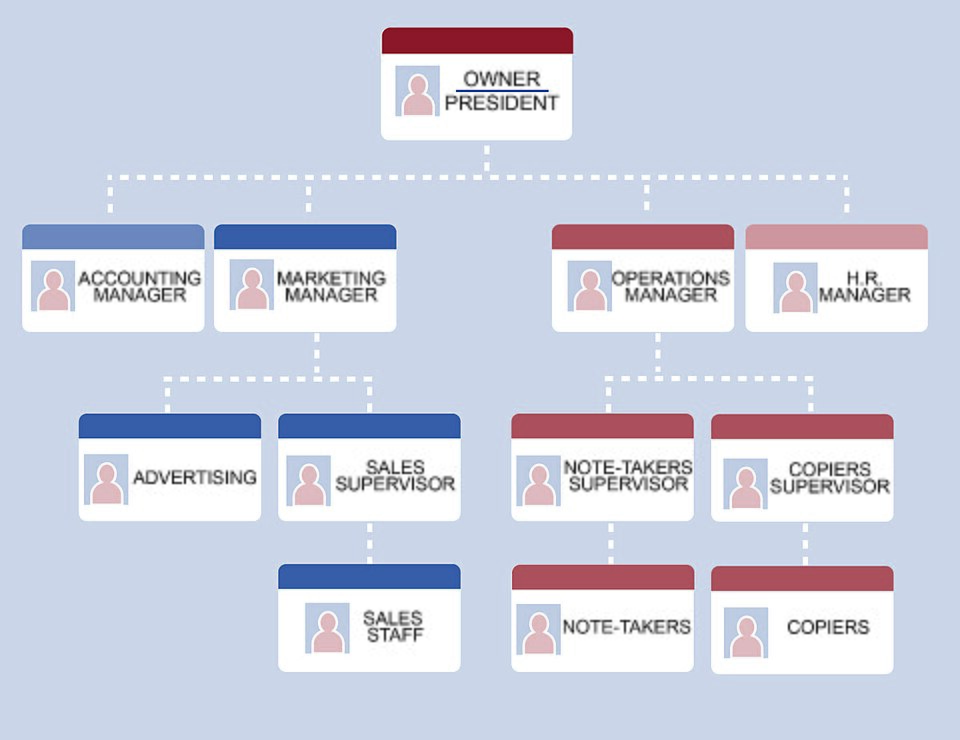 A simple hierarchical structure showing CEO → Managers → Employees (for visualizing managerial roles). (Image: Designed for Virginia Tech Libraries by Brian Craig http://b, CC BY 4.0, via Wikimedia Commons)
2. Objectives of Business
Businesses pursue multiple, often conflicting objectives. The primary goal is profit, but others like growth, survival, and social responsibility also matter.
Four Key Business Objectives
| Objective | Description | Example (Nepali Context) |
|---|---|---|
| Profit | Maximize earnings after expenses. | Nabil Bank aims for 15% ROA (Return on Assets) to attract investors. |
| Growth | Expand market share, sales, or assets. | Daraz acquired Foodmandu to grow its e-commerce ecosystem. |
| Survival | Stay operational in competitive/macroeconomic challenges. | Small tea shops in Kathmandu reduce costs during monsoon season to survive. |
| Customer Satisfaction | Deliver value to retain and attract customers. | eSewa offers 24/7 customer support to improve user experience. |
Trade-offs Example:
- Nepal Telecom (NTC) invests in fiber expansion (growth) but may reduce short-term profits due to high initial costs.
3. Business Environments: Internal vs. External
Businesses operate in dynamic environments that influence their strategies. These are classified into:
- Internal Environment (Controllable)
- External Environment (Uncontrollable)
A. Internal Environment
Includes factors within the organization’s control:
- Employees (skills, culture, motivation)
- Management (leadership style, decision-making)
- Resources (finance, technology, infrastructure)
- Organizational Structure (hierarchy, departments)
mindmap
  root((Internal Environment))
    Employees
      Skills & Training
      Motivation & Culture
    Management
      Leadership Style
      Decision-Making
    Resources
      Finance
      Technology
      Infrastructure
    Structure
      Hierarchy
      Departments
B. External Environment
Divided into micro (industry-specific) and macro (broad societal) environments:
| Micro Environment | Macro Environment |
|---|---|
| Suppliers (e.g., raw materials for Himalayan Java) | Political (e.g., Nepal’s FDI policies) |
| Customers (e.g., Daraz’s online shoppers) | Economic (e.g., inflation in 2023) |
| Competitors (e.g., Ncell vs. NTC) | Social (e.g., digital payment trends) |
| Marketing Intermediaries (e.g., Pathao’s delivery partners) | Technological (e.g., AI in banking) |
| Public (e.g., NGOs pressuring Chaudhary Group for sustainability) | Legal (e.g., Consumer Protection Act) |
| Trade Unions (e.g., labor strikes at garment factories) | Environmental (e.g., plastic ban in Kathmandu) |
Real-World Trace: How NTC Adapts to External Changes
- Macro (Economic): Rising telecom tariffs → NTC introduces prepaid bundles to attract customers.
- Micro (Competitors): Ncell’s 5G launch → NTC invests in fiber expansion to stay competitive.
- Social: Cashless Nepal initiative → NTC partners with eSewa/Khalti for digital payments.
4. Business Functions: Primary vs. Secondary
Businesses perform core and supporting functions to achieve objectives. These are often organized into departments.
A. Primary Functions (Directly Related to Production & Sales)
| Function | Role | Example (Nepali Firm) |
|---|---|---|
| Production | Creates goods/services using resources. | Himalayan Java roasts coffee beans. |
| Marketing | Promotes products to customers. | Daraz uses discounts + influencer marketing. |
| Sales | Converts marketing efforts into revenue. | Nabil Bank sells fixed deposits. |
B. Secondary Functions (Support Primary Activities)
| Function | Role | Example (Global Firm) |
|---|---|---|
| Finance | Manages funds, investments, and financial risks. | Google’s Alphabet structure for tax optimization. |
| Human Resources | Hires, trains, and retains employees. | Pathao offers driver incentives. |
| Accounting | Records financial transactions. | Nepal Rastra Bank (NRB) audits banks. |
| Research & Development (R&D) | Innovates products/processes. | Toyota invests in electric vehicles (EV). |
Visualizing Functional Structure (Mermaid)
flowchart TD
    CEO["CEO (Chaudhary Group)"]
    subgraph Primary Functions
        Production["Production\n(Himalayan Java)"]
        Marketing["Marketing\n(Daraz)"]
        Sales["Sales\n(Nabil Bank)"]
    end
    subgraph Secondary Functions
        Finance["Finance\n(Google Alphabet)"]
        HR["HR\n(Pathao)"]
        RnD["R&D\n(Toyota EV)"]
    end
    CEO --> Production
    CEO --> Marketing
    CEO --> Sales
    CEO --> Finance
    CEO --> HR
    CEO --> RnD
5. Business vs. Non-Profit Organizations
| Feature | Business (For-Profit) | Non-Profit (NGOs, Social Enterprises) |
|---|---|---|
| Primary Goal | Profit maximization | Social/environmental impact |
| Funding Source | Sales, investments, loans | Donations, grants, CSR funds |
| Reinvestment | Dividends to shareholders | Programs/services for beneficiaries |
| Example (Nepali) | Nabil Bank, Daraz | Green Tara Nepal (conservation), Pratham (education) |
| Tax Benefits | Pays taxes | Tax exemptions (under Social Welfare Act) |
Real-World Case: Chaudhary Group’s Social Responsibility
- Profit-Driven: Owns Daraz (e-commerce), Himalayan Java (F&B).
- Non-Profit Arm: Chaudhary Foundation funds education and healthcare in rural Nepal.
- Why? Balances shareholder returns with social responsibility.
6. Business Ethics and Social Responsibility
Businesses must balance profit with ethical practices and social responsibility.
A. Business Ethics
- Code of Conduct: Rules governing fair competition, transparency, and honesty.
- Example: Nepal Stock Exchange (NEPSE) prohibits insider trading.
B. Social Responsibility (CSR)
Businesses contribute to societal well-being beyond profit.
| Type of Responsibility | Example (Nepali Firm) | Global Example |
|---|---|---|
| Economic | NTC provides affordable internet to rural areas. | Google offers free Wi-Fi in public spaces. |
| Legal | Banks (Nabil, Global IME) comply with NRB regulations. | Toyota follows global emission standards. |
| Ethical | Himalayan Java uses fair-trade coffee. | Patagonia donates 1% of sales to environmental causes. |
| Philanthropic | Chaudhary Group builds schools in Sindhupalchowk. | Microsoft funds digital literacy programs. |
Exam Tip: Always relate ethics/CSR to real firms (e.g., "How does Daraz reduce its carbon footprint?").
In the Real World
eSewa (Digital Payments & Customer Satisfaction)
- Idea Used: Primary function (sales + marketing) via user-friendly app and partnerships with banks.
- How? eSewa monetizes transactions (profit) while ensuring seamless payments (customer satisfaction).
- Trade-off: High transaction fees (profit) vs. low charges for merchants (growth).
Nabil Bank (Financial Services & Social Responsibility)
- Idea Used: Secondary function (finance) + CSR (economic responsibility).
- How? Offers microfinance loans to women entrepreneurs (social impact) while maintaining 15% ROA (profit).
- Real Example: Nabil’s "Women Empowerment Loan" helps 50,000+ women start businesses.
Daraz (E-Commerce & Technological Adaptation)
- Idea Used: Primary (marketing + sales) + macro environment (technological).
- How? Uses AI for demand forecasting and drone deliveries (innovation) to compete with Amazon India.
- Challenge: Last-mile delivery costs (external environment) force partnerships with Pathao.
Exam Tip
- Definitions First: Always start with standard definitions (e.g., "Business is an organized economic activity...").
- Real-World Links: Examiners love Nepali examples (eSewa, NTC, Daraz). Always tie theory to practice.
- Example: "NTC’s expansion into fiber reflects growth objective and adaptation to technological macro-environment."
- Diagrams > Text: Draw mindmaps for environments, flowcharts for business functions, and tables for comparisons.
- Case Study Approach: For 10-mark questions, structure answers as:
- Introduction (define key terms).
- Analysis (apply concepts to the firm).
- Conclusion (link to broader business objectives).
- Common Pitfalls:
- ❌ Confusing internal vs. external environments (e.g., calling "employees" an external factor).
- ❌ Ignoring trade-offs (e.g., profit vs. ethics).
- ❌ Generic answers (always name a Nepali/global firm).
Sample Exam Question & Answer: Q: "Explain the internal and external environments of a business with reference to Nepal Telecom (NTC)." A:
- Internal:
- Employees: Skilled engineers for 5G rollout.
- Management: Flat structure for faster decisions.
- External:
- Micro: Competitors (Ncell) force price wars.
- Macro: Government policies (e.g., telecom license fees) increase costs.
- Impact: NTC’s fiber expansion is a response to technological macro-trends and competition (micro).
Final Visual Summary
mindmap
  root((Business Management Unit 1))
    Definitions
      Business = Economic Activity for Profit/Social Good
    Objectives
      Profit, Growth, Survival, Customer Satisfaction
    Environments
      Internal: Employees, Management, Resources
      External: Micro (Suppliers, Competitors) & Macro (Political, Economic)
    Functions
      Primary: Production, Marketing, Sales
      Secondary: Finance, HR, R&D
    Ethics & CSR
      Code of Conduct vs. Social Responsibility
    Real-World
      eSewa, NTC, Daraz, Nabil Bank
Based on the TU BIM syllabus for Foundation of Business Management (MGT231), unit 1.
Discussion
Loading…