Organizational Behavior and Human Resource ManagementUnit 108 min read
Rewards, Compensation & Motivation Systems
Unit 10 of Organizational Behavior and Human Resource Management explores the principles, types, and strategic design of employee rewards and compensation systems, linking them to motivation, equity, and organizational performance.
Core Concepts: Rewards vs. Compensation
Rewards and compensation are not the same—they serve different purposes in motivating employees.
1. Definitions
- Compensation: The total financial package an employee receives in exchange for work (salary, bonuses, benefits).
- Rewards: Non-financial or financial incentives given to recognize performance (praise, promotions, stock options).
2. Types of Compensation
| Type | Description | Example (Nepal) |
|---|---|---|
| Base Pay | Fixed salary for a job. | NTC employee’s monthly salary. |
| Variable Pay | Performance-based (bonuses, commissions). | Daraz delivery agent’s tip-based pay. |
| Benefits | Non-cash perks (health insurance, leave). | Nabil Bank’s provident fund. |
| Stock Options | Equity-based rewards (for long-term retention). | Chaudhary Group’s employee stock plans. |
How Compensation Systems Work
1. Job Evaluation & Pay Structure
- Job Evaluation: Assessing a job’s worth based on skills, responsibility, and market rates.
- Pay Grades: Grouping similar jobs into pay bands (e.g., Entry, Mid, Senior levels).
Example (Nepal):
- NTC Engineer (Grade 6) earns ₹120,000–₹180,000/month (fixed + allowances).
- Daraz Delivery Agent earns ₹15,000–₹30,000/month (base + tips).
2. Pay-for-Performance Models
- Merit Pay: Salary increases based on performance reviews.
- Profit Sharing: Employees get a % of company profits (e.g., Himalayan Java shares 5% of annual profit).
- Piece Rate: Pay per unit produced (e.g., garment factory workers in Kathmandu).
flowchart TD
  A["Performance Review"] --> B{"Meets Target?"}
  B -->|"Yes"| C["Merit Increase"]
  B -->|"No"| D["No Change"]
  C --> E["Updated Salary"]
  D --> F["Development Plan"]
In the Real World
Khalti & eSewa (Digital Payments)
- Idea Used: Variable Pay (Commissions + Bonuses)
- How? Agents earn ₹5–₹50 per transaction, motivating higher sales volume.
Nabil Bank (Employee Benefits)
- Idea Used: Non-Financial Rewards (Work-Life Balance)
- How? Offers flexible work hours and mental health support, reducing turnover.
Daraz (Gig Economy Pay)
- Idea Used: Piece Rate + Performance Bonuses
- How? Delivery agents get ₹10–₹50 extra per successful order, encouraging efficiency.
Motivation Theories & Rewards
| Theory | Link to Rewards | Nepali Example |
|---|---|---|
| Maslow’s Hierarchy | Rewards fulfill safety (salary), esteem (promotions), self-actualization (growth). | NTC promotions for senior engineers. |
| Herzberg’s Two-Factor | Hygiene factors (pay, benefits) prevent dissatisfaction; motivators (recognition, growth) drive performance. | Nabil Bank’s employee-of-the-month awards. |
| Equity Theory | Employees compare their input (effort) vs. output (rewards) to peers. | If a Pathao driver earns less than a KTM driver, morale drops. |
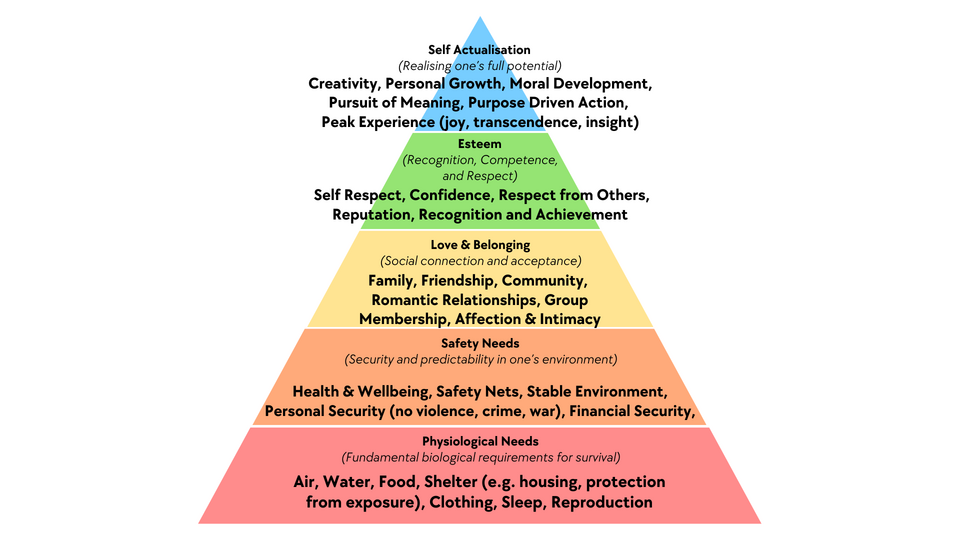 How rewards fit into self-actualization. (Image: Hamish.croker, CC BY-SA 4.0, via Wikimedia Commons)
Designing an Effective Compensation System
Key Principles
✅ Internal Equity: Fair pay within the company (e.g., a senior software engineer at Himalayan Java earns more than a junior). ✅ External Equity: Competitive pay vs. market rates (e.g., Google’s high salaries attract global talent). ✅ Legal Compliance: Follow Nepali labor laws (minimum wage, overtime pay). ✅ Flexibility: Allow bonuses, stock options, or remote work perks.
Common Mistakes
❌ One-Size-Fits-All: Giving the same raise to high and low performers. ❌ Ignoring Inflation: Not adjusting salaries for rising living costs (e.g., Kathmandu’s high rent). ❌ Over-Reliance on Bonuses: If bonuses are unpredictable, employees feel insecure.
Case Study: Chaudhary Group’s Compensation Strategy
Company: Chaudhary Group (Nepal’s largest business conglomerate). Challenge: High turnover in retail and logistics due to low motivation. Solution:
- Performance-Linked Bonuses: Sales staff get 10–20% of profits from their sales.
- Stock Options: Long-term employees get company shares.
- Training Rewards: Employees who complete certification courses get ₹50,000 bonuses.
Result: ✔ 30% drop in turnover in 2 years. ✔ Higher productivity in retail stores.
Exam Tip
How This Unit is Tested (TU/PU/NEB Pattern)
Definitions & Differences (5 marks)
- "Distinguish between compensation and rewards with examples."
- Answer Tip: Use Nepali companies (e.g., NTC vs. Daraz).
Worked Examples (10 marks)
- "Calculate the annual take-home pay of an NTC engineer earning ₹150,000/month with 10% PF and 5% tax."
- Answer Tip: Show step-by-step deduction (PF, tax, bonuses).
Theory Application (15 marks)
- "How does Herzberg’s Two-Factor Theory explain why Nabil Bank employees stay motivated despite high salaries?"
- Answer Tip: Link hygiene factors (salary) vs. motivators (recognition, growth).
Case Analysis (20 marks)
- "Analyze Daraz’s gig worker pay model—is it fair? Suggest improvements."
- Answer Tip: Discuss equity, motivation theories, and legal compliance.
Common Pitfalls in Exams
❌ Vague Examples: Don’t say "companies give bonuses"—name Khalti, Nabil Bank, or Daraz. ❌ Ignoring Nepali Context: Always relate to Nepali labor laws, inflation, or company cases. ❌ Overcomplicating: Stick to clear definitions + 2–3 bullet points per question.
Final Summary Table
| Aspect | Key Idea | Nepali Example |
|---|---|---|
| Base Pay | Fixed salary for a job. | NTC engineer: ₹120K–₹180K/month. |
| Variable Pay | Performance-based (bonuses, commissions). | Daraz agent: ₹15K + tips. |
| Benefits | Non-cash perks (health, leave). | Nabil Bank: Provident Fund + gym. |
| Motivation Link | Rewards fulfill Maslow’s needs (security, esteem). | Pathao driver’s bonus for 100+ rides. |
| Legal Compliance | Must follow Nepali labor laws (minimum wage, overtime). | Garment factory workers’ ₹18K/month minimum. |
Next Steps for Revision: ✔ Practice calculations (salary deductions, bonuses). ✔ Relate theories (Maslow, Herzberg) to Nepali companies. ✔ Memorize key laws (Labor Act 2017, PF rules).
Based on the TU BIM syllabus for Organizational Behavior and Human Resource Management (MGT241), unit 10.
Discussion
Loading…