Financial AccountingUnit 29 min read
Double-Entry System & Accounting Cycle: Rules, Journalizing & Trial Balance
Unit 2 of Financial Accounting explains the double-entry system, its rules, the accounting cycle (journal → ledger → trial balance), and how transactions are recorded. Learn with Nepali business examples, t-accounts, and real-world applications like eSewa’s transaction tracking or Daraz’s inventory accounting.
TAKEAWAYS:
- Every transaction affects at least two accounts (debit and credit) to maintain the accounting equation: Assets = Liabilities + Equity.
- The double-entry system ensures accuracy by recording both sides of a transaction (e.g., cash received debits Cash but credits Revenue).
- The accounting cycle follows a sequence: Journal → Ledger → Trial Balance → Financial Statements.
- Debit/Credit rules depend on account type: Assets/Liabilities/Expenses increase with debits; Equity/Revenue increase with credits.
- A trial balance checks mathematical accuracy but does not detect errors like omitted transactions or incorrect classifications.
- Real-world systems (e.g., Khalti’s payment processing, Nepal Rastra Bank’s loan accounting) rely on double-entry to track money flows transparently.
1. The Accounting Equation: The Foundation
The accounting equation is the backbone of financial accounting:
- Assets: Resources owned (Cash, Inventory, Equipment).
- Liabilities: Debts owed (Loans, Accounts Payable).
- Equity: Owner’s claim (Capital, Retained Earnings).
Why it matters: Every transaction must keep this equation balanced. For example:
- If you buy inventory on credit (Asset ↑, Liability ↑), the equation stays balanced.
- If you pay salaries (Asset ↓, Equity ↓), the equation adjusts.
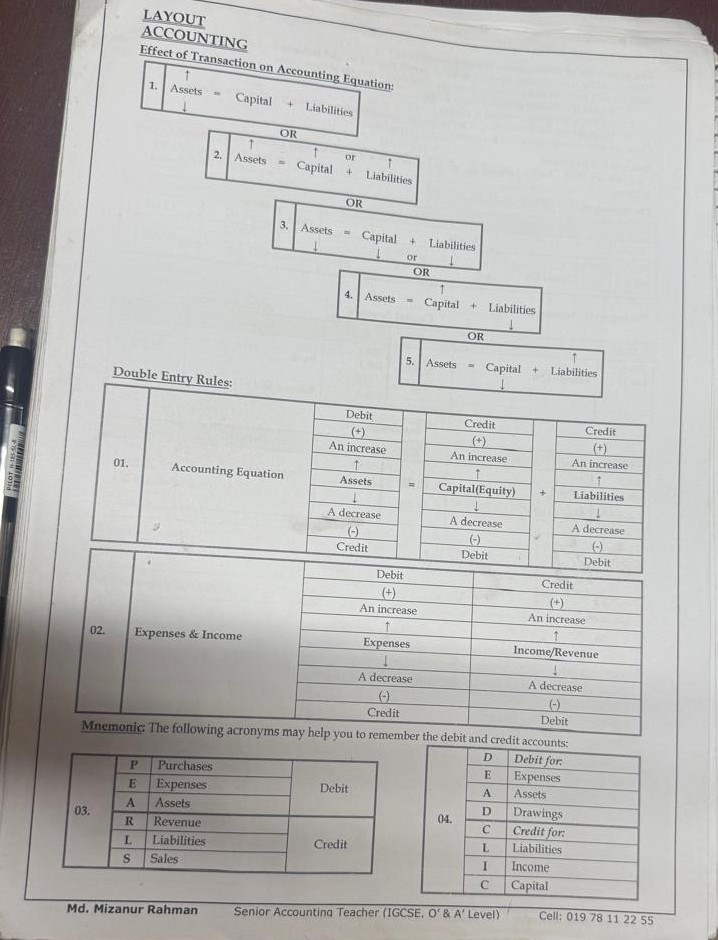 Visual representation of Assets = Liabilities + Equity with arrows showing transaction impacts (Image: Forex Awards, CC0, via Wikimedia Commons)
2. Double-Entry System: Rules and Logic
The double-entry system records two aspects of every transaction:
- Debit (Dr): Left side of an account.
- Credit (Cr): Right side of an account.
Key Rules:
| Account Type | Increase (Dr/Cr) | Decrease (Dr/Cr) |
|---|---|---|
| Assets | Debit (Dr) | Credit (Cr) |
| Liabilities | Credit (Cr) | Debit (Dr) |
| Equity (Capital) | Credit (Cr) | Debit (Dr) |
| Revenue | Credit (Cr) | Debit (Dr) |
| Expenses | Debit (Dr) | Credit (Cr) |
Example: A Kathmandu retail shop (ABC Mart) buys furniture worth NPR 50,000 on credit from a supplier.
- Furniture (Asset) ↑ Dr 50,000
- Accounts Payable (Liability) ↑ Cr 50,000
VISUAL: T-Account for Furniture Purchase Shows how both accounts are affected equally.
3. The Accounting Cycle: Step-by-Step
The cycle ensures transactions are recorded systematically:
Steps Explained:
- Journal Entry: Record transactions in the journal (chronological order).
- Ledger Posting: Transfer journal entries to individual ledger accounts (T-accounts).
- Trial Balance: Summarize ledger balances to check mathematical accuracy.
- Adjusting Entries: Correct for accruals/deferrals (e.g., unearned revenue).
- Financial Statements: Prepare Income Statement and Balance Sheet.
- Closing Entries: Reset temporary accounts (Revenue/Expenses) to zero.
4. Journalizing Transactions: Worked Example
Scenario: ABC Mart (Kathmandu) starts business with:
- Cash deposited: NPR 200,000
- Furniture bought: NPR 150,000 (on credit)
- Shop rent paid: NPR 30,000 (cash)
Journal Entries:
| Date | Particulars | Dr (NPR) | Cr (NPR) |
|---|---|---|---|
| 2024-01-01 | Cash A/c | 200,000 | |
| To Capital A/c | 200,000 | ||
| 2024-01-01 | Furniture A/c | 150,000 | |
| To Accounts Payable A/c | 150,000 | ||
| 2024-01-01 | Rent Expense A/c | 30,000 | |
| To Cash A/c | 30,000 |
VISUAL: Ledger Postings for ABC Mart
5. Trial Balance: Checking Accuracy
A trial balance lists all ledger accounts and their balances to verify:
Example for ABC Mart:
| Account | Dr (NPR) | Cr (NPR) |
|---|---|---|
| Cash | 170,000 | |
| Furniture | 150,000 | |
| Rent Expense | 30,000 | |
| Accounts Payable | 150,000 | |
| Capital | 200,000 | |
| Total | 350,000 | 350,000 |
Limitations:
- Does not detect:
- Omitted transactions.
- Incorrect account classifications (e.g., recording Rent as Asset).
- Compensating errors (e.g., overstating one account and understating another by the same amount).
6. Real-World Applications
a. eSewa (Nepal)
- Idea Used: Double-Entry for Transactions
- How:
When you pay NPR 500 for electricity via eSewa:
- eSewa’s Cash Account: Dr 500 (Cash received).
- NTC’s Accounts Receivable: Cr 500 (Payment recorded). The system ensures both parties’ records match.
b. Daraz (Nepal)
- Idea Used: Journalizing Sales & Inventory
- How:
When Daraz sells a product:
- Cash/Receivables (Asset): Dr (Income recorded).
- Sales Revenue (Equity): Cr (Revenue recognized).
- Inventory (Asset): Dr (Cost of goods sold).
c. Nepal Rastra Bank (NRB)
- Idea Used: Loan Accounting (Double-Entry)
- How:
When a bank gives a NPR 1,000,000 loan:
- Loan Asset (Bank’s Asset): Dr 1,000,000.
- Customer’s Liability (Loan Payable): Cr 1,000,000. Interest is later recorded as:
- Interest Revenue (Equity): Dr (Income).
- Interest Expense (Liability): Cr (Customer’s debt increases).
VISUAL: Bank Loan Transaction (NRB Example)
7. Common Errors and How to Avoid Them
| Error Type | Example | Solution |
|---|---|---|
| One-Sided Entry | Recording only Cash Dr 10,000 but forgetting the Cr (e.g., Revenue). | Always ask: "What two accounts are affected?" |
| Wrong Account Classification | Recording Rent Paid as Asset instead of Expense. | Use the chart of accounts to verify. |
| Transposition Error | Writing NPR 520 instead of NPR 502. | Double-check calculations. |
| Omission Error | Forgetting to record a NPR 5,000 sale. | Reconcile with source documents (invoices, receipts). |
8. Exam Tip: How to Score Full Marks
Show the Accounting Equation: Always start with Assets = Liabilities + Equity and explain how transactions affect it.
Use T-Accounts for Ledger Postings: Examiners love visual proofs. Draw T-accounts for every transaction.
Label Journal Entries Clearly:
- Use dates, account names, and narrations (e.g., "To record furniture purchase").
- Example:
Dr: Furniture A/c   50,000
Cr: Accounts Payable A/c   50,000
Explain the Trial Balance’s Purpose:
- It checks mathematical accuracy, not logical accuracy.
- Mention its limitations (e.g., doesn’t catch omitted transactions).
Relate to Real Businesses:
- If asked about bank reconciliation, compare with Ncell’s mobile top-up accounting.
- For depreciation, link to ABC Mart’s furniture wear-and-tear.
Practice Numerical Problems:
- Solve 10+ problems on journalizing, ledger postings, and trial balances.
- Use Nepali rupees (NPR) and Nepali business names (e.g., Thapathali Shopping Center).
Final Checklist for Exams: ✅ Debit/Credit rules applied correctly. ✅ Trial balance totals match. ✅ Real-world example included (e.g., eSewa, Daraz). ✅ Diagrams/T-accounts used for clarity. ✅ Errors and limitations discussed where relevant.
Based on the TU BIM syllabus for Financial Accounting (ACC201), unit 2.
Discussion
Loading…