Economics for BusinessUnit 19 min read
Business Economics: Definitions, Scope, Methods & Key Principles
Unit 1 of Economics for Business introduces the core concepts of business economics, including its definitions, scope, methods, and fundamental principles like scarcity, choice, and optimization, with real-world applications in Nepalese businesses and global firms.
What is Business Economics?
Business economics is the application of economic theory and quantitative methods to business management. It helps firms make profit-maximizing decisions by analyzing market behavior, cost structures, and resource allocation.
Key Definitions
- Economics: The study of how individuals and societies allocate scarce resources to satisfy unlimited wants.
- Business Economics: A microeconomic branch that focuses on individual firms, industries, and markets to optimize decisions.
- Scarcity: The fundamental economic problem where unlimited wants exceed limited resources.
- Choice: Deciding how to allocate scarce resources among competing uses.
mindmap
  root((Business Economics))
    Definition
    Scope
    Methods
    Principles
    Applications
Scope of Business Economics
Business economics covers three main areas:
| Area | Key Focus | Example in Nepal |
|---|---|---|
| Microeconomics | Individual firms, consumers, and markets | Daraz’s pricing strategy for e-commerce |
| Macroeconomics | Aggregate economic behavior (GDP, inflation, unemployment) | NTC’s tariff adjustments based on inflation |
| Managerial Economics | Decision-making tools for firms (cost, revenue, profit optimization) | Pathao’s dynamic pricing for ride-hailing |
 A basic market equilibrium curve showing how price and quantity interact. (Image: Dallas.Epperson, CC BY-SA 3.0, via Wikimedia Commons)
Methods of Business Economics
Business economics uses two main approaches:
Positive Economics (What is?)
- Objective, fact-based analysis (e.g., "Nepal’s GDP growth was 5% in 2023.")
- Used for forecasting and policy analysis.
Normative Economics (What ought to be?)
- Subjective, value-based judgments (e.g., "The government should reduce tariffs to boost exports.")
- Used for policy recommendations.
Comparison Table:
| Aspect | Positive Economics | Normative Economics |
|---|---|---|
| Nature | Descriptive | Prescriptive |
| Example | "Inflation in Nepal rose to 7%." | "The central bank should cut interest rates." |
| Use in Business | Helps predict market trends (e.g., Daraz’s sales during Dashain) | Guides strategic decisions (e.g., Ncell’s pricing policy) |
Key Principles of Business Economics
1. Scarcity and Choice
- Scarcity forces firms to make trade-offs (e.g., a factory choosing between labor or machinery).
- Opportunity Cost: The next best alternative foregone (e.g., if a farmer grows wheat instead of rice, the rice yield is the opportunity cost).
Real-World Example: NEPSE Stock Market
- Investors must choose between dividend stocks (stable returns) or growth stocks (higher risk).
- If you invest in Nepal Bank Ltd. (dividend stock), you forgo potential gains from Nabil Bank (growth stock).
2. Rational Behavior and Optimization
- Firms and consumers act rationally to maximize utility (consumers) or profit (businesses).
- Profit Maximization Rule: A firm produces where Marginal Cost (MC) = Marginal Revenue (MR).
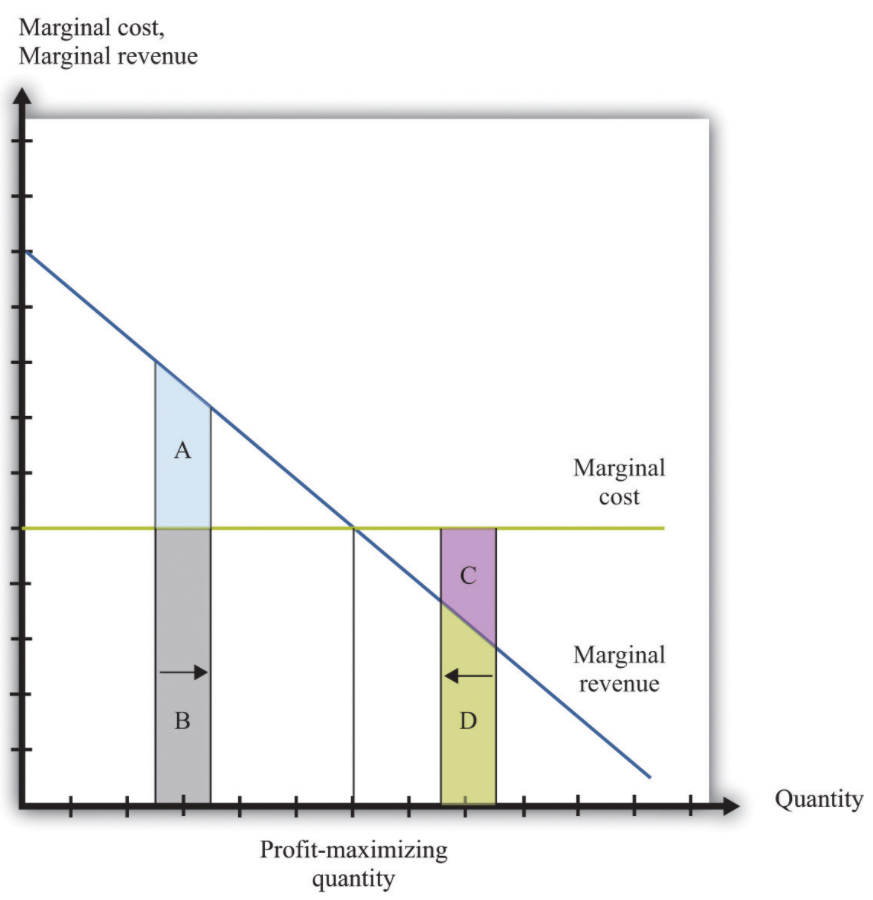 MC and MR curves intersecting at the optimal output level. (Image: 2012. Theory And Applications Of Microeconomics. [Place of p, CC BY-SA 4.0, via Wikimedia Commons)
3. Ceteris Paribus (All Else Equal)
- Economic models assume other factors remain constant to isolate relationships.
- Example: If we study how price affects demand, we assume income and tastes stay the same.
In the Real World
1. eSewa & Digital Payments (Transaction Costs & Efficiency)
- Idea Used: Reducing transaction costs (search, bargaining, enforcement).
- How?
- Before eSewa, paying bills required physical visits (high time cost).
- Now, payments are instant and low-cost (NPR 10-20 per transaction).
- Example: A student paying NTC bill online saves 30 minutes vs. visiting a counter.
2. Daraz & Dynamic Pricing (Supply & Demand Elasticity)
- Idea Used: Price elasticity of demand (how sensitive buyers are to price changes).
- How?
- During sales (e.g., Dashain), Daraz lowers prices to increase demand.
- For luxury items (e.g., iPhones), prices remain inelastic (buyers pay regardless of small price changes).
- Worked Example:
- If Daraz drops a laptop price from NPR 100,000 to NPR 80,000, demand may increase by 50% (elastic demand).
- But for brand-new iPhones, a NPR 5,000 price cut may only increase sales by 5% (inelastic).
3. NTC & Regulatory Pricing (Government Intervention)
- Idea Used: Price ceiling vs. price floor.
- How?
- NTC sets maximum tariffs (price ceiling) to prevent excessive profits from telecom companies.
- If NTC allows unregulated pricing, Ncell or SmartCell might raise prices too high, reducing affordability.
- Real Data (2023):
| Company       | Avg. Monthly Bill (NPR) | Price Control? |
|---------------|-------------------------|----------------|
| NTC           | 2,500 (capped)          | Yes            |
| Ncell         | 3,200 (market-driven)   | No             |
| SmartCell     | 2,800 (regulated)       | Yes            |
Exam Tip
How This Unit is Tested in TU Exams
Definitions (5-10 marks)
- Expect short-answer questions on:
- Difference between micro and macroeconomics.
- Meaning of scarcity, choice, and opportunity cost.
- Example Question:
"Define business economics and distinguish it from general economics."
- Expect short-answer questions on:
Applications (10-15 marks)
- Case-based questions on Nepalese firms (e.g., Daraz, NTC, banks).
- Example Question:
"How does eSewa reduce transaction costs? Explain with an example."
Diagrams (5-10 marks)
- Must-draw diagrams:
- Supply & Demand (with equilibrium).
- Profit maximization (MC=MR).
- Example Question:
"Draw a demand curve and show the effect of a price increase on quantity demanded."
- Must-draw diagrams:
Numerical Problems (5-10 marks)
- Opportunity cost calculations.
- Elasticity computations (price elasticity of demand).
- Example Question:
"If a 10% price increase leads to a 5% decrease in demand, calculate price elasticity."
Common Mistakes to Avoid
❌ Vague definitions (e.g., "Business economics is about money." → Wrong). ✅ Precise definitions (e.g., "Business economics applies economic principles to optimize firm decisions." → Correct).
❌ Ignoring real-world examples (exams love Nepalese cases like NTC, Daraz, banks). ✅ Always relate theory to local businesses.
❌ Forgetting ceteris paribus in explanations. ✅ Always state assumptions (e.g., "Assuming other factors remain constant...").
Final Worked Example: Kathmandu Traffic & Opportunity Cost
Scenario: The Kathmandu Metropolitan City (KMC) must decide between:
- Option 1: Building more roads (cost: NPR 5 billion).
- Option 2: Improving public transport (cost: NPR 4 billion).
Opportunity Cost Analysis:
- If KMC chooses roads, the public transport improvement is foregone.
- Benefit of Roads: Reduces travel time by 20% (saves NPR 2 billion/year in fuel costs).
- Benefit of Public Transport: Reduces congestion by 30% (saves NPR 3 billion/year in lost productivity).
- Decision: Since public transport saves more, KMC should prioritize it.
Exam Answer Structure:
- Define opportunity cost (1 mark).
- List both options (1 mark).
- Calculate benefits (2 marks).
- Recommend the better choice (1 mark).
Summary Table for Quick Revision
| Concept | Key Idea | Real-World Link |
|---|---|---|
| Scarcity | Unlimited wants vs. limited resources | NEPSE investors choosing stocks |
| Opportunity Cost | Next best alternative foregone | KMC choosing roads over transport |
| Rational Behavior | Firms maximize profit, consumers utility | Daraz’s dynamic pricing |
| Ceteris Paribus | "All else equal" assumption | Studying price effect on demand alone |
| Positive vs. Normative | Fact-based vs. value-based analysis | "Nepal’s inflation is 7%" vs. "Cut taxes" |
Final Note: Business economics is not just theory—it’s about real decisions that firms like Daraz, NTC, and banks make daily. Master the definitions, diagrams, and Nepalese examples, and you’ll score full marks in TU exams! 🚀
Based on the TU BIM syllabus for Economics for Business (ECO206), unit 1.
Discussion
Loading…